


Report Overview
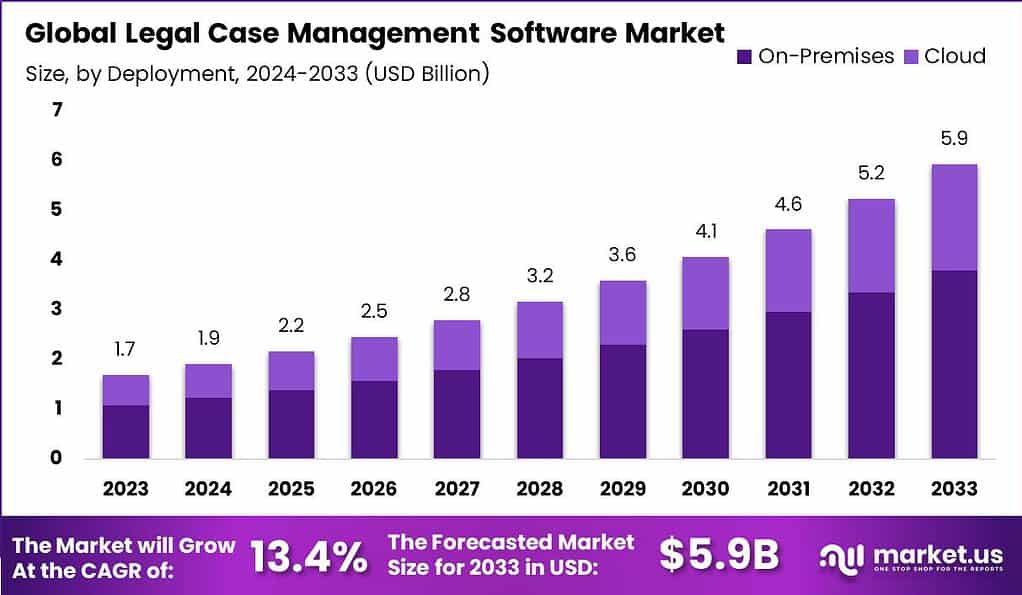
The global Legal Case Management Software Market is anticipated to be USD 5.9 billion by 2033. It is estimated to record a steady CAGR of 13.4% in the Forecast period 2023 to 2033. It is likely to total USD 1.9 billion in 2024.
Legal case management software refers to a specialized software solution designed to assist law firms and legal professionals in managing and streamlining their legal cases. It provides a centralized platform for organizing and tracking case-related information, documents, tasks, deadlines, and communication, facilitating efficient case management and collaboration within a legal practice.
The legal case management software market has seen significant growth in the last few years. The rising adoption of technology within the legal field and the demand for increased efficiency and productivity, as well as the increasing demand for central solution for managing cases have driven the growth of the market.
Note: Actual Numbers Might Vary In Final Report
The market provides a range different legal case management software options that range from standalone software programs and cloud-based solutions. Certain software providers provide customized solutions for the specific needs of different legal practice areas including litigation, corporate law family law, and intellectual property.
Key Takeaways
- Market Size and Growth: The Legal Case Management Software Market is forecasted to exhibit a strong 13.4% Compound Annual Growth Rate (CAGR), reaching a substantial size of USD 5.9 billion by 2033. This growth is significant, reflecting the increasing adoption of technology within the legal sector.
- Deployment Trends: In terms of deployment methods, the market showcases a notable shift towards cloud-based solutions, which secured a commanding position with a remarkable 64% share in 2023. Cloud solutions offer scalability, accessibility, and cost-efficiency, which are essential for legal firms seeking efficiency.
- End-User Dominance: Large enterprises dominate the Legal Case Management Software market, holding over 68% of the market share in 2023. Their demand for comprehensive and sophisticated case management solutions is driven by the complexities of handling a higher volume of legal cases.
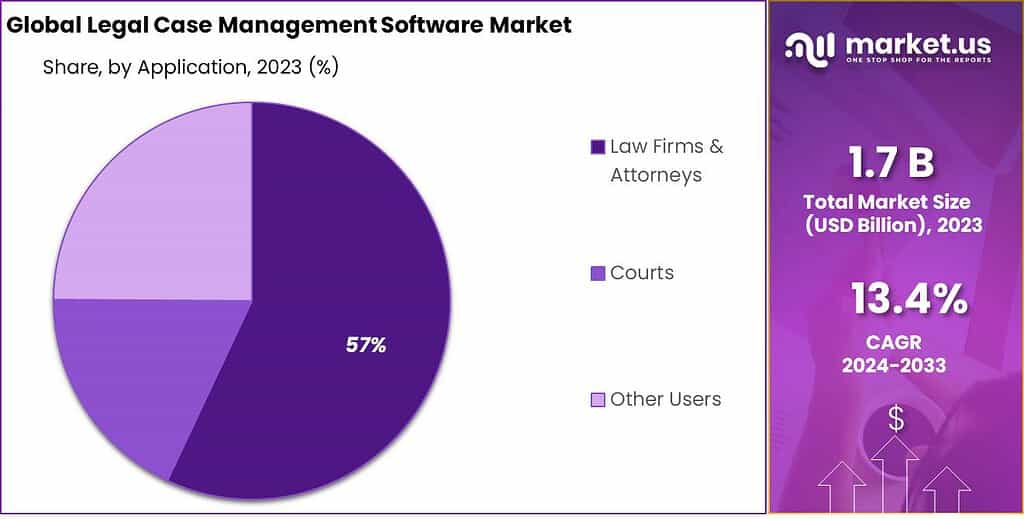
- Application Focus: The Law Firms & Attorneys segment emerged as the dominant force within the market, securing over 57% of the market share in 2023. These entities prioritize efficient case management solutions to handle diverse cases with unique requirements and deadlines.
- Driving Factors: Key factors driving the adoption of legal case management software include the ongoing digital transformation in the legal industry, the growing emphasis on data security and compliance, the rise of remote work trends, and increased litigation and complexity in the legal landscape.
- Challenges: Despite the benefits, the market faces challenges such as resistance to change among legal professionals, cost concerns, integration challenges with existing systems, and the need for data migration and staff training.
- Growth Opportunities: Opportunities for growth in the market include global expansion, integration of AI and machine learning capabilities, customization and specialization for niche markets, and partnerships and mergers with legal service providers.
- Key Market Trends: Market trends include the integration of AI-powered legal insights, mobile accessibility, blockchain for legal records, and ecosystem integration to create comprehensive legal tech solutions.
- Regional Dominance: North America emerged as the dominant player, with a market share of over 35% in 2023. This region’s developed legal industry, technological advancements, and emphasis on data security contributed to its leadership position.
- Key Players: Top key players in the legal case management software market include Clio, Odyssey, Smokeball, Firm Central, PracticePanther, MyCase, ProLaw, Zola Suite, Filevine, LexisNexis, Rocket Matter, and TrialWorks.
Deployment Analysis
In 2023, the Legal Case Management Software market exhibited a noteworthy dichotomy in terms of deployment methods, primarily categorized into On-Premises and Cloud-based solutions. A thorough market analysis reveals that the Cloud segment emerged as the dominant force, firmly securing a commanding position with a remarkable 64% share of the market.
The Cloud Segment’s supremacy in the Legal Case Management Software market can be attributed to a myriad of factors. Firstly, the inherent advantages of cloud-based deployments, such as scalability, accessibility, and cost-efficiency, have garnered substantial interest among legal firms and organizations. Cloud solutions offer the flexibility to scale resources as per requirements, thus eliminating the need for extensive on-site infrastructure and upfront capital investments. This attribute aligns with the cost-conscious approach adopted by many legal enterprises, propelling the Cloud Segment’s growth.
Furthermore, the ongoing trend towards digital transformation and remote work arrangements has boosted the adoption of cloud-based legal case management software. The accessibility of critical case data and documents from anywhere with an internet connection has become imperative in today’s legal landscape. Cloud deployments facilitate seamless collaboration among legal teams spread across different geographical locations, enhancing overall operational efficiency.
Another key driver behind the Cloud Segment’s dominance is the heightened focus on data security and compliance within the legal sector. Cloud service providers have made significant strides in bolstering their security measures, often surpassing the capabilities of individual on-premises solutions. This has instilled confidence in legal professionals, assuring them that sensitive client information is safeguarded with the utmost care.
In contrast, the On-Premises Segment, though still relevant, faced some headwinds in 2023. This deployment method, characterized by hosting legal case management software within an organization’s physical infrastructure, accounted for the remaining market share. Several legal entities, particularly those with stringent data security concerns and regulatory requirements, continue to opt for on-premises solutions. However, this segment’s market share has gradually eroded in the face of the Cloud Segment’s rapid ascent.
The On-Premises Segment has encountered challenges in terms of scalability and agility. Unlike cloud-based solutions, which can easily adapt to changing business needs, on-premises deployments often necessitate substantial investments in hardware and IT personnel to accommodate growth. This rigidity has deterred some legal firms from pursuing on-premises options, especially when compared to the more agile cloud-based alternatives.
End-User Analysis
In 2023, the Legal Case Management Software market exhibited a distinct segmentation in terms of end-users, primarily categorized into Small and Medium Enterprises (SMEs) and Large Enterprises. Notably, the Large Enterprise Segment emerged as the dominant force within this market, solidifying its position with a commanding share of over 68%.
The supremacy of the Large Enterprise Segment in the Legal Case Management Software market can be attributed to several key factors. Firstly, large enterprises often operate on a broader scale, handling a higher volume of legal cases and complexities compared to their SME counterparts. As a result, they have a heightened demand for comprehensive and sophisticated case management solutions.
These solutions need to cater to the intricacies of their legal processes, which typically involve multiple departments, diverse legal matters, and intricate compliance requirements. Consequently, large enterprises have been more inclined to invest in robust legal case management software to streamline their operations, enhance productivity, and ensure compliance with ever-evolving regulations.
Additionally, large enterprises often have more substantial financial resources at their disposal, enabling them to allocate budgets for cutting-edge legal technology solutions. This financial capability has empowered them to adopt feature-rich, customizable, and scalable legal case management software that aligns perfectly with their specific requirements.
Furthermore, the Large Enterprise Segment has been proactive in leveraging legal technology to gain a competitive edge in the industry. These enterprises understand the importance of data analytics, reporting capabilities, and automation features offered by advanced case management solutions. By harnessing these tools, large enterprises can make data-driven decisions, optimize their legal processes, and effectively manage complex litigation.
Conversely, while the Small and Medium Enterprise Segment remains significant, it faces unique challenges. SMEs often operate with more limited budgets and may not have the same scale or complexity of legal operations as large enterprises. As a result, they tend to prioritize cost-effective solutions over comprehensive features, leading some SMEs to opt for simpler and more budget-friendly legal case management software.
Application Analysis
In 2023, the Legal Case Management Software market displayed a distinctive segmentation based on applications, primarily categorized into Law Firms & Attorneys, Courts, and Other Users. Notably, the Law Firms & Attorneys Segment emerged as the dominant force within this market, securing a substantial share of over 57%.
The Law Firms & Attorneys Segment’s dominance can be attributed to several compelling factors. Firstly, law firms and individual attorneys operate in a highly dynamic and document-intensive environment. They handle a diverse range of cases, each with its unique set of requirements and deadlines. Therefore, the need for efficient case management solutions is paramount. legal case management software designed for the unique requirements of law firms and attorneys empowers them to optimize their processes, securely handle client information, and monitor crucial deadlines and documents.
Moreover, there is a growing acknowledgment within the legal profession of the significance of data-driven decision-making and the benefits of incorporating automation into everyday tasks. Advanced legal case management software offers features such as document automation, time tracking, and client communication management, which significantly enhance the operational efficiency of law firms and attorneys. This has been a driving force behind the segment’s dominance.
While the Law Firms & Attorneys Segment held a prominent position, the Courts and Other Users segments also play pivotal roles in the Legal Case Management Software market. Courts require specialized case management solutions to efficiently handle the vast volume of cases they process, manage court schedules, and ensure compliance with legal procedures. The Other Users category encompasses various entities, including corporate legal departments, government agencies, and non-profit organizations, each with their unique case management needs.
Note: Actual Numbers Might Vary In Final Report
Driving Factors
- Digital Transformation in Legal Industry: The legal sector is undergoing a digital transformation, with law firms and legal professionals increasingly adopting technology to enhance efficiency. Legal case management software plays a pivotal role in this transformation by streamlining workflows, automating tasks, and improving overall productivity.
- Data Security and Compliance: The growing emphasis on data security and compliance is driving the adoption of legal case management software. These solutions offer robust security features and help legal entities adhere to regulatory requirements, ensuring the protection of sensitive client information.
- Remote Work Trends: The rise of remote work arrangements has accelerated the demand for cloud-based legal case management software. Legal professionals need access to case data and documents from anywhere, and cloud solutions provide the flexibility and accessibility required in today’s remote work environment.
- Increased Litigation and Complexity: The legal landscape is becoming more litigious and complex, leading to a higher volume of cases and documents. Legal case management software simplifies case tracking, document management, and communication, making it indispensable for managing the growing caseload effectively.
Restraining Factors
- Resistance to Change: Some legal professionals and organizations may resist adopting new technology due to a preference for traditional methods or concerns about the learning curve. Overcoming this resistance can be a barrier to widespread adoption.
- Cost Concerns: While legal case management software offers long-term cost savings, the initial investment can be a deterrent for smaller law firms or organizations with limited budgets. Cost constraints may limit adoption among these entities.
- Integration Challenges: Integrating legal case management software with existing systems, such as CRM or accounting software, can be complex and time-consuming. Compatibility issues may hinder seamless integration.
- Data Migration and Training: Moving existing case data to new software and providing training for staff can be resource-intensive and disruptive. Organizations may be reluctant to undergo these processes, delaying adoption.
Growth Opportunities
- Global Expansion: Legal case management software providers have opportunities for global expansion as legal tech adoption grows worldwide. Expanding into new geographical markets can unlock significant growth potential.
- AI and Machine Learning Integration: Integrating artificial intelligence and machine learning capabilities into legal case management software can enhance predictive analytics, automate routine tasks, and improve decision-making, creating new avenues for growth.
- Customization and Specialization: Offering highly customizable and specialized solutions tailored to specific legal niches or practice areas can attract niche markets and cater to their unique needs.
- Partnerships and Mergers: Collaborating with legal service providers, law schools, or other industry players can open doors to new opportunities, such as co-branded solutions or expanded service offerings.
Challenges
- Security Concerns: While legal case management software enhances security, it also presents potential vulnerabilities. Data breaches and cybersecurity threats remain significant challenges, requiring continuous vigilance and investment.
- Regulatory Changes: Frequent changes in legal regulations and data protection laws can pose challenges for software providers, as they must ensure their solutions remain compliant, leading to ongoing development and adaptation.
- Competition: The legal tech market is highly competitive, with numerous software providers vying for market share. Staying ahead in a crowded field requires constant innovation and differentiation.
- User Adoption and Training: Convincing users to embrace new software and providing adequate training can be challenging. Resistance to change and the need for comprehensive training programs can slow down adoption.
Key Market Trends
- AI-Powered Legal Insights: Legal case management software is increasingly integrating AI-driven features like predictive analytics and contract analysis. These AI tools provide legal professionals with valuable insights, enabling data-driven decisions.
- Mobile Accessibility: Mobile-friendly versions of legal case management software are gaining prominence. Users can access case data and collaborate on the go, aligning with the trend of mobile work environments.
- Blockchain for Legal Records: Blockchain technology is being explored to enhance the security and immutability of legal records and documents within case management software, reducing the risk of tampering or data loss.
- Ecosystem Integration: Legal case management software is evolving to become part of larger legal tech ecosystems, connecting seamlessly with e-discovery, document management, and client communication tools for a comprehensive solution.
Key Market Segments
Deployment
- On-Premises
- Cloud
End-User
- Small and Medium Enterprise
- Large Enterprise
Application
- Law Firms & Attorneys
- Courts
- Other Users
Regional Analysis
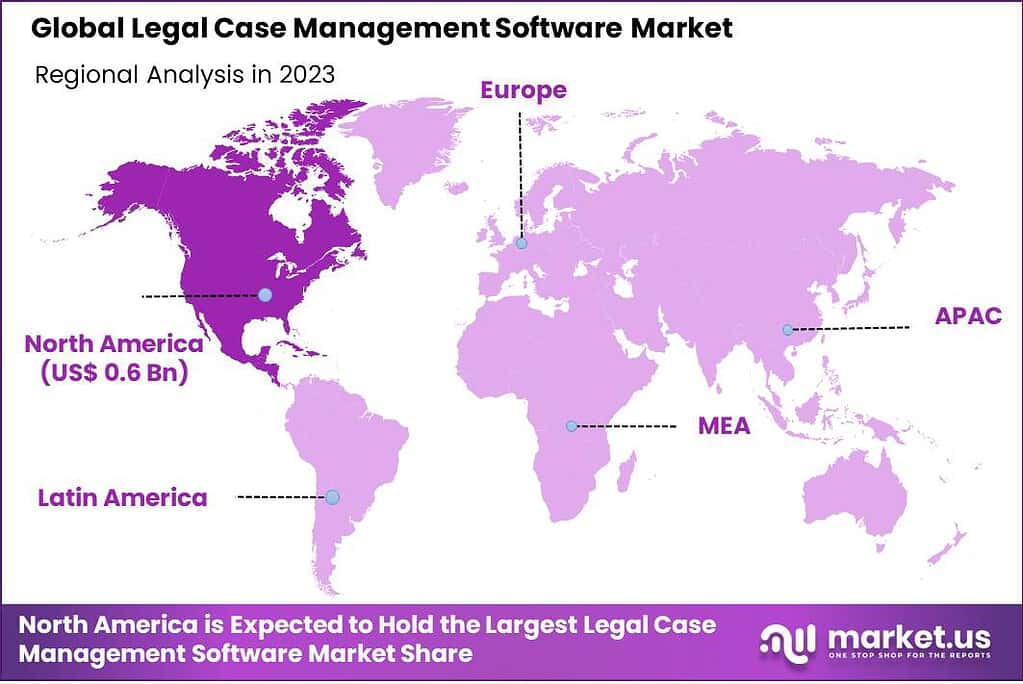
In 2023, the global Legal Case Management Software market exhibited a distinctive regional segmentation, with North America emerging as the dominant player, securing an impressive market share of over 35%. This regional dominance can be attributed to several key factors.
Firstly, North America boasts a highly developed legal industry characterized by a large number of law firms, corporate legal departments, and a robust judiciary system. The need for efficient case management solutions to handle the complexity and volume of legal proceedings has driven substantial adoption of legal case management software.
The demand for Legal Case Management Software in North America reached USD 0.6 billion in 2023, and there are optimistic projections for significant growth in the foreseeable future. Moreover, the region has been at the forefront of technological advancements and digital transformation, further accelerating the adoption of legal tech solutions. The emphasis on data security, compliance, and the need for seamless remote collaboration during the pandemic era played a pivotal role in the widespread adoption of these software solutions.
Furthermore, North America’s legal landscape is marked by a high degree of competition and a focus on innovation. Legal professionals and organizations in the region are keen to stay ahead in the legal tech race, leading to a strong appetite for cutting-edge legal case management software.
While North America led the way, other regions such as Europe, APAC, Latin America, and the Middle East and Africa also exhibited promising growth opportunities. Europe, with its diverse legal systems and increasing regulatory complexities, witnessed a steady adoption of legal case management software. APAC, on the other hand, showcased rapid growth driven by emerging economies and an increasing recognition of the importance of efficient legal processes.
Latin America, with its evolving legal landscape and emphasis on compliance, offered opportunities for software providers. Meanwhile, the Middle East and Africa, though a smaller market, displayed potential for growth as legal entities in these regions modernize their operations.
Note: Actual Numbers Might Vary In Final Report
Key Regions and Countries Covered in this Report:
- North America
- The US
- Canada
- Europe
- Germany
- France
- The UK
- Spain
- Italy
- Russia
- Netherland
- Rest of Europe
- APAC
- China
- Japan
- South Korea
- India
- New Zealand
- Singapore
- Thailand
- Vietnam
- Rest of Asia Pacific
- Latin America
- Brazil
- Mexico
- Rest of Latin America
- Middle East & Africa
- South Africa
- Saudi Arabia
- UAE
- Rest of MEA
Key Players Analysis
The legal case management software market is highly competitive and consists of several key players that provide comprehensive solutions for efficient case management within the legal industry. These companies offer a range of software products and services tailored to the needs of law firms, legal departments, and legal professionals.
Top Key Players
- Clio
- Odyssey
- Smokeball
- Firm Central
- PracticePanther
- MyCase
- ProLaw
- Zola Suite
- Filevine
- LexisNexis
- Rocket Matter
- TrialWorks
- Other Key Players
Recent Developments
- Clio Acquire Lawyaw: In February 2023, Clio acquired Lawyaw, a legal document automation and assembly platform, expanding its offerings.
- Smokeball unveils Smokeball Engage: In June 2023, Smokeball launched Smokeball Engage, a client portal designed to enhance client communication and engagement.
- Filevine introduces Filevine Marketplace: In September 2023, Filevine launched its Marketplace, offering integrations with various legal tech solutions.
- AbacusNext unveils AbacusNext Practice Management: In October 2023, AbacusNext unveiled AbacusNext Practice Management, a cloud-based solution specifically designed for smaller law firms.









