


Market Overview
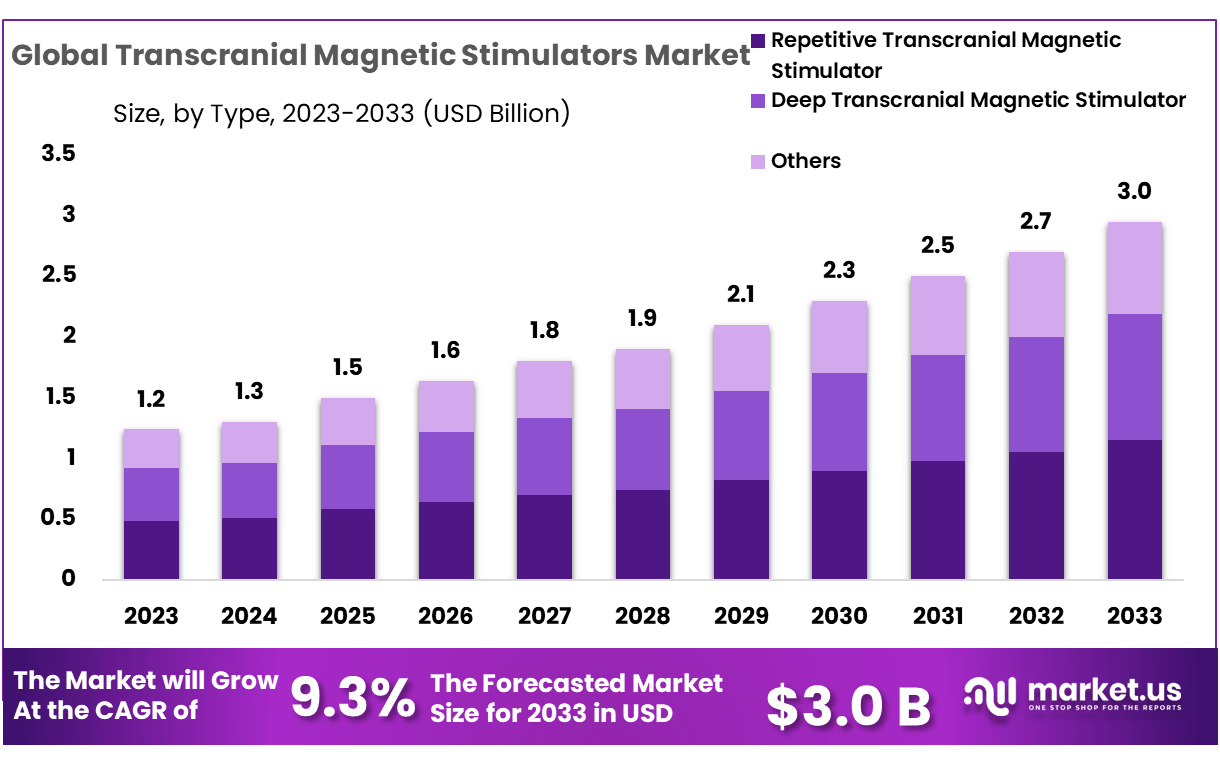
According to a recent report by Market.us, the Global Transcranial Magnetic Stimulators Market size is expected to be worth around USD 3.0 Billion by 2033 from USD 1.2 Billion in 2023, growing at a CAGR of 9.3% during the forecast period from 2024 to 2033.
The report on Transcranial Magnetic Stimulators Market offers an in-depth analysis of market trends, drivers, restraints, opportunities, etc. Along with qualitative information, this report includes the quantitative analysis of various segments in terms of market share, growth, opportunity analysis, market value, etc. for the forecast years. The global transcranial magnetic stimulators market is segmented on the basis of type, application, and geography.
What is a Transcranial Magnetic Stimulator (TMS)?
Transcranial magnetic stimulation (TMS), a medical device that stimulates the brain with magnetic fields, is called a transcranial magnet stimulator.TMS can be used to treat depression, chronic pain, and PTSD.TMS can also be used to treat cognitive disabilities as well as neurological disorders such as autism.
What are the benefits of TMS?
The Journal of ECT published a study in January 2015 that found that TMS can reduce symptoms of depression in people with treatment-resistant depression.For four weeks, Dr. Tomas Ruther from the University of Munster in Germany randomly gave TMS to 68 patients with treatment-resistant depression.Researchers found that TMS treatment had a significantly higher and more rapid effect on depression severity than placebo.Patients who had TMS treatment experienced a lower level of depression than patients who received a placebo.
Key Takeaways
- Market Size: Transcranial Magnetic Stimulators Market size is expected to be worth around USD 3.0 Billion by 2033 from USD 1.2 Billion in 2023.
- Market Growth: The market growing at a CAGR of 9.3% during the forecast period from 2024 to 2033.
- Type Analysis: In 2023, repetitive Transcranial Magnetic Stimulation (rTMS) led the market with 39.1% revenue share.
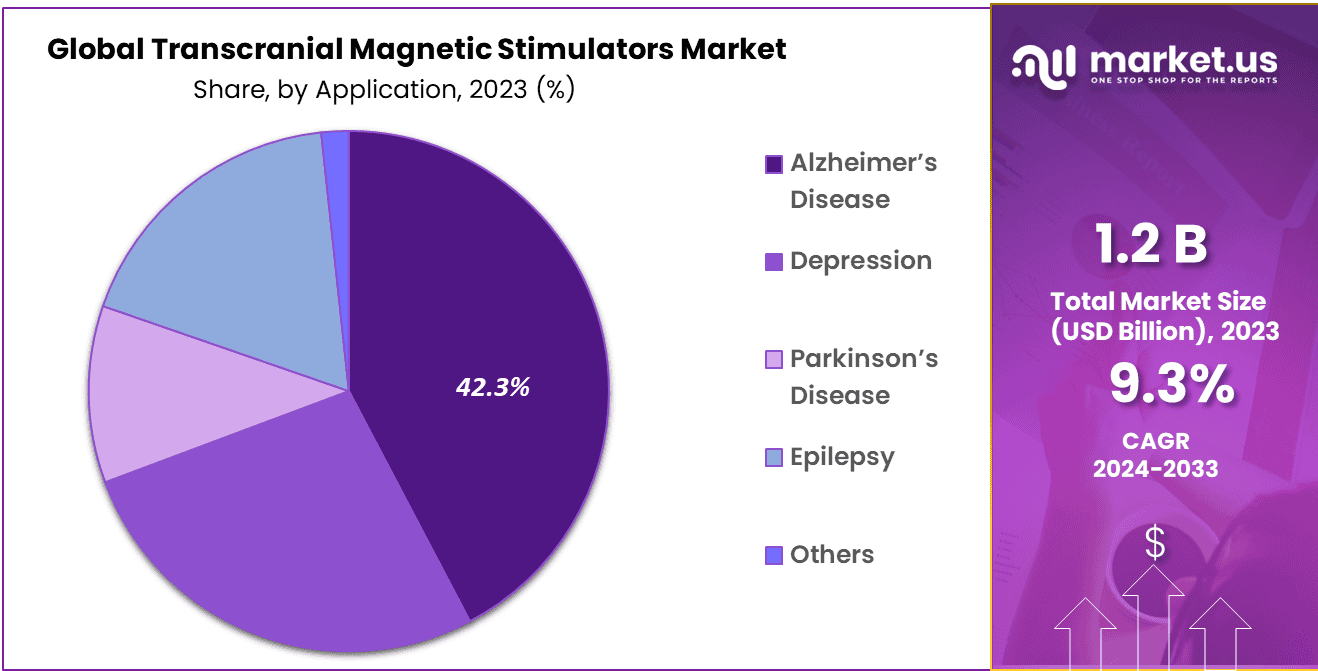
- Application Analysis: Alzheimer’s Disease emerged as a leader, taking control of 42.3% market share.
- Age Group Analysis: Adults segment were performers in 2023 market landscape, accounting for an impressive 58.5% share of total revenue share.
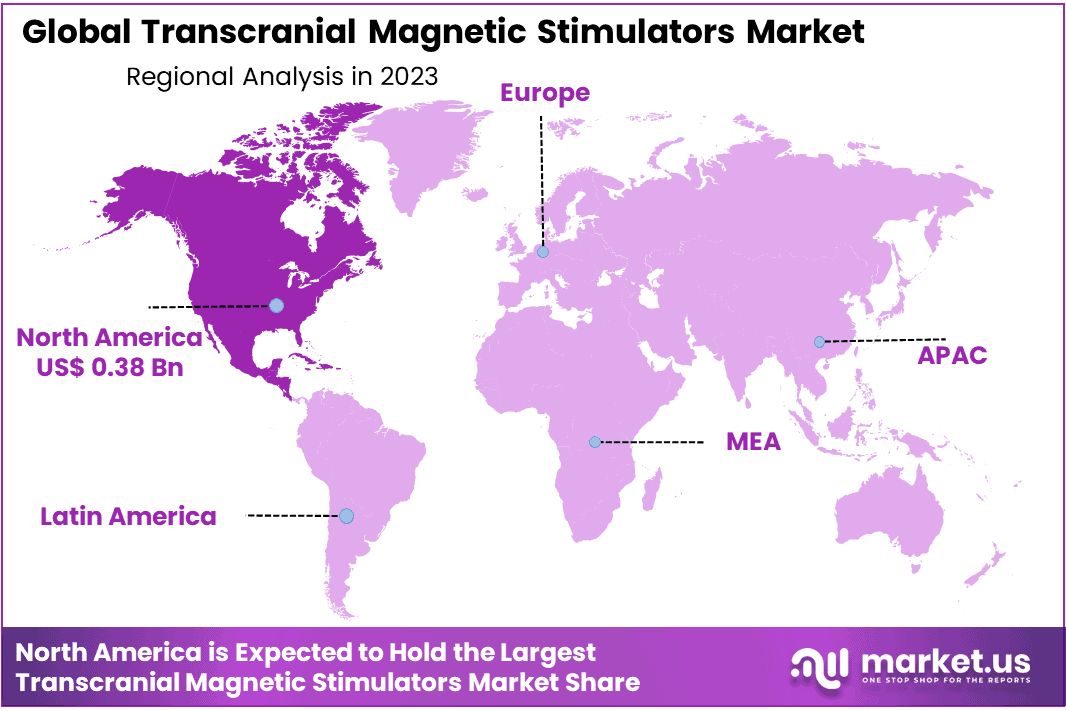
- Regional Analysis: North America had the highest revenue share at 32.1% and holding USD 0.38 Billion revenue in 2023.
- Technological advancements: Continuous advances in technology are increasing the effectiveness and precision that transcranial magnetic stimulation can provide providing promising results for both the therapeutic and diagnostic aspects.
- Psychiatric Treatments: There is an increase in the use the use of magnetic transcranial stimulation within the field of psychiatry, specifically for treating illnesses like major depressive disorder.
- The Neurorehabilitation Exploration Project: Scientists are looking into the possibility use of magnetic transcranial stimulation for rehabilitation of the brain, and are able to suggest broader applications that go beyond psychiatric disorders.
Type Analysis
In 2023, repetitive Transcranial Magnetic Stimulation (rTMS) led the market with 39.1% revenue share. This noninvasive brain stimulation technique employs electromagnetic induction through an insulated coil to stimulate specific areas of the brain that regulate mood regulation; its position over the scalp allows gentle magnetic pulses from its coil to reach into and penetrate the brain resembling those created by an MRI scanner; repeated application of these pulses leads to lasting changes in brain activity – hence its name!
Deep Transcranial Magnetic Stimulation (dTMS) is expected to experience the fastest compound annual growth rate at 9.8% over its forecast period, providing non-invasive, drug-free treatment for depression. Approved for use by FDA for treating patients who are resistant to current treatments, this therapy uses H1 coil for safe stimulation with minimal risks/side effects; standard sessions involve 20-minute sessions five times weekly over 4 to 6 weeks and easily fit into patients’ routine.
Application Analysis
Transcranial Magnetic Stimulators (TMS) market trends in 2023 saw a striking transformation: Alzheimer’s Disease emerged as a leader, taking control of 42.3% market share – this indicates widespread recognition that TMS offers hope as an approach for cognitive disorders like Alzheimer’s.
TMS has made significant strides toward combatting various neurological conditions beyond Alzheimer’s, with significant advances made against depression as a pervasive global issue and TMS providing noninvasive relief of symptoms and treatment alternatives to traditional medicines. Parkinson’s Disease – another complex neurodegenerative condition – has also seen considerable research conducted into its potential to mitigate motor symptoms while improving quality of life for its sufferers.
TMS therapy’s versatility in managing seizures and improving patient outcomes attests to its transformative potential in healthcare; as researchers discover more of what’s going on inside our heads, TMS remains at the forefront, offering hope to people struggling with neurological challenges of various sorts. TMS’ success across different neurological applications underscores its transformative influence; heralding a new era in search of effective, innovative treatments for complex brain disorders.
Age Group Analysis
Adults segment were performers in 2023 market landscape, accounting for an impressive 58.5% share of total revenue share. Epilepsy prevalence across developing nations has significantly heightened demand for cost-effective and efficient treatment solutions that emphasize long-term benefits – a surge in demand which will likely drive market expansion into the foreseeable future. According to the Centers for Disease Control and Prevention (CDC), 3 million adults in the US alone were living with active epilepsy as of 2021 and this anticipated segment growth can be linked with increased community awareness, legal framework support, proactive government initiatives among other things.
Politico-regulatory coverage presents major companies with ample opportunities for entry into these markets. A greater understanding of cutting-edge epilepsy treatments, along with healthcare infrastructure development, should further drive expansion in adults segment.
Children are expected to experience the fastest compound annual growth rate at 9.6% during this forecast period, driven by increasing neurological disorders, rising awareness around Transcranial Magnetic Stimulators (TMS) technology and improved healthcare infrastructure in emerging economies.
Market Segment
Type
- Deep Transcranial Magnetic Stimulator
- Repetitive Transcranial Magnetic Stimulator
- Others
Application
- Alzheimer’s Disease
- Depression
- Parkinson’s Disease
- Epilepsy
- Others
Age Group
- Adults
- Children
Drivers
Neurological Disorders: Rising Trends
One key driver behind the transcranial magnetic stimulators market is the rising prevalence of neurological conditions worldwide, such as depression, schizophrenia and Parkinson’s disease. TMS therapy could offer one promising noninvasive and effective solution, targeting specific regions of the brain that show promise in alleviating symptoms associated with various neurological illnesses.
Advances in Technology and Treatment Protocols
Technology advances have played an essential role in increasing the effectiveness of transcranial magnetic stimulation. Improved coil designs, advanced targeting algorithms and the incorporation of real-time imaging techniques have all played their parts to provide more targeted treatment protocols and personalized treatment protocols for individuals. As these technological enhancements continue, market for transcranial magnetic stimulators (TMSs) should experience substantial expansion with both clinicians and researchers taking full advantage of TMS for both diagnostic and therapeutic uses.
Trend
TMS Adoption Trend in Psychiatry Is on the Rise
Transcranial magnetic stimulators market trends highlight TMS’ growing acceptance as an effective noninvasive treatment option for major depressive disorder (MDD) and other psychiatric ailments, and as part of mainstream practices for managing depressive symptoms. TMS’ rise to recognition has been driven by mounting clinical evidence supporting its efficacy against MDD symptoms; evidence which validates TMS effectiveness against depressive symptoms was the driving factor.
Exploration of TMS for Neurorehabilitation: An Expansion into Practice.
Transcranial Magnetic Stimulation (TMS) has become an emerging trend in neurorehabilitation. Researchers and clinicians alike are exploring its use in aiding motor function recovery following neurological injuries like stroke. TMS’ noninvasive nature makes it an attractive approach for rehabilitation purposes; further studies will hopefully shed more light on its ability to promote neural plasticity while aiding rehabilitation outcomes.
Restraint
High Cost of TMS Devices
Transcranial Magnetic Stimulators Market faces one significant barrier due to high costs associated with TMS devices: their purchase cost and subsequent maintenance expenses can be prohibitively costly for healthcare facilities with limited financial resources – this represents a barrier that inhibits wider adoption of this technology, thus restricting patient accessibility.
Limit Reimbursement Policies
Another limiting factor for transcranial magnetic stimulation procedures is inadequate reimbursement policies for TMS procedures, despite evidence supporting its efficacy for treating certain neurological and psychiatric conditions. Reimbursement policies vary, with coverage limited in some regions; such restrictions hinder acceptance as standard care treatment thereby impacting market expansion.
Opportunities
Unexploitable Potential in Research and Development: Expanding Applications within R&D
Transcranial magnetic stimulation offers market growth potential through its growing applications in research and development settings. TMS is becoming an indispensable tool for studying brain function, mapping neural circuits, and uncovering mechanisms underlying neurological diseases and disorders. TMS opens new channels of collaboration between device makers and research institutions allowing them to tailor specialized TMS systems specifically tailored for research use cases.
Increase Awareness and Education
Transcranial magnetic stimulation presents an enormous market expansion potential through greater awareness and education of its benefits and safety to healthcare providers, patients, and the general public alike. Awareness campaigns targeting healthcare professionals, patients, and the general public could play a vital role in driving acceptance and adoption for TMS; collaborative initiatives with medical associations or strategic marketing campaigns all play key roles in disseminating information on TMS that ultimately leads to its integration into mainstream clinical practice.
Regional Analysis
North America had the highest revenue share at 32.1% and holding USD 0.38 Billion revenue in 2023, attributing its dominance to government investments supporting medical device research and development, key industry players’ presence, favorable reimbursement landscape and increasing chronic kidney diseases (CKD) prevalence rates that led to increasing home dialysis usage; all contributing to North America’s strong market position.
North America stands out as an industry leader due to its streamlined healthcare processes, such as hospital admission and reimbursement procedures, integrated IT products enabling maintenance of Electronic Health Records (EHRs), as well as strategic company initiatives designed to introduce new products that increase market competition – marking it out as a prime location for dynamic developments within healthcare.
Key Regions and Countries
North America
- The US
- Canada
- Mexico
Western Europe
- Germany
- France
- The UK
- Spain
- Italy
- Portugal
- Ireland
- Austria
- Switzerland
- Benelux
- Nordic
- Rest of Western Europe
Eastern Europe
- Russia
- Poland
- The Czech Republic
- Greece
- Rest of Eastern Europe
APAC
- China
- Japan
- South Korea
- India
- Australia & New Zealand
- Indonesia
- Malaysia
- Philippines
- Singapore
- Thailand
- Vietnam
- Rest of APAC
Latin America
- Brazil
- Colombia
- Chile
- Argentina
- Costa Rica
- Rest of Latin America
Middle East & Africa
- Algeria
- Egypt
- Israel
- Kuwait
- Nigeria
- Saudi Arabia
- South Africa
- Turkey
- United Arab Emirates
- Rest of MEA
Key Player Analysis
Within our market analysis, our analysts offer an in-depth examination of major players. This section delves deep into financial statements of these key players to uncover crucial information. Furthermore, product benchmarking and SWOT analyses help illuminate strengths, weaknesses, opportunities, and threats associated with each major player.
In addition, the competitive landscape section encompasses key development strategies, market share statistics, global ranking analysis for each major player – providing an insightful look into market dynamics.
Market Key Players
- BrainsWay
- Magstim
- Nexstim
- Salience
- MagVenture A/S
- eNeura Inc.
Recent Developments
- BrainsWay: Received FDA clearance for H-coil for deep TMS treatment of depression, expanding treatment reach.
- Magstim: Launched Magstim Pro2 TMS system with enhanced features and user interface.
- Nexstim: Launched Nexstim NBT Elite system with integrated neuronavigation for improved TMS targeting accuracy.
- Salience: Received FDA clearance for Deep TMS Express system for depression treatment, offering faster treatment sessions.
- MagVenture A/S: Announced collaboration with university hospital to establish a TMS research and treatment center.
- eNeura Inc.: Developing cloud-based TMS therapy management platform and exploring TMS applications for other mental health conditions.









