


Report Overview
The Global Carboxymethyl Cellulose Market size is expected to be worth around USD 3.0 Billion by 2034, from USD 1.9 Billion in 2024, growing at a CAGR of 4.5% during the forecast period from 2025 to 2034. In 2024 Asia Pacific held a dominant market position, capturing more than a 44.9%share, holding USD 0.8 Billion in revenue.
Carboxymethyl cellulose (CMC), also known as cellulose gum, is a water-soluble derivative of cellulose synthesized through the reaction of cellulose with chloroacetic acid in the presence of alkali. This modification imparts unique properties such as high viscosity, emulsifying, and stabilizing capabilities, making CMC indispensable across various industries, including food, pharmaceuticals, personal care, and oil and gas.
- In 2024, India’s CMC production capacity surpassed 70,000 metric tons annually, positioning it as a key global producer. Notable manufacturers in India include Patel Industries, with an annual production capacity of 5,000 metric tons, and Cellulose Solution Private Limited, which initiated production of CMC and Poly Anionic Cellulose with a capacity of 2,000 metric tons per annum.

Driving factors for the CMC market include the increasing demand for processed and convenience foods, the rise in pharmaceutical applications, and the growing use of CMC in personal care products due to its non-toxic and biodegradable nature. Additionally, the expansion of the paper and textile industries contributes to the demand for CMC as a sizing agent and binder.
Government initiatives play a pivotal role in shaping the CMC industry landscape. In India, the Food Safety and Standards Authority of India (FSSAI) updated its standards for carboxymethyl cellulose in 2015, aligning with international food safety regulations and enhancing consumer confidence in food products. Such regulatory frameworks are instrumental in fostering market growth by ensuring product safety and quality.
Key Takeaways
- Carboxymethyl Cellulose Market size is expected to be worth around USD 3.0 Billion by 2034, from USD 1.9 Billion in 2024, growing at a CAGR of 4.5%.
- Above 95% purity segment of Carboxymethyl Cellulose (CMC) held a dominant market position, capturing more than a 56.8% share.
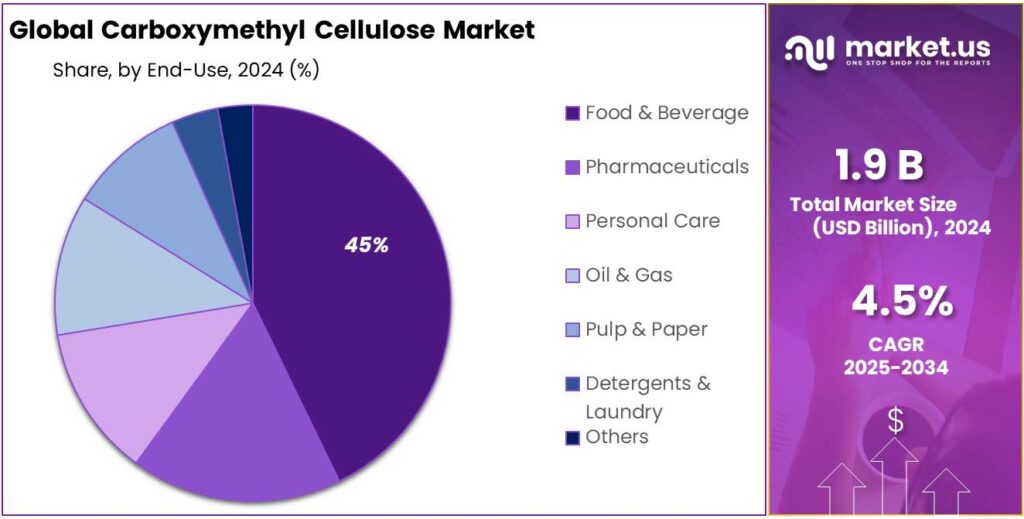
- Food & Beverage sector held a dominant position in the global Carboxymethyl Cellulose (CMC) market, capturing more than a 45.9% share.
- Asia Pacific region held a dominant position in the global carboxymethyl cellulose (CMC) market, capturing a 44.90% share, valued at approximately USD 0.8 billion.
By Purity Analysis
High Purity Carboxymethyl Cellulose (CMC) Dominates with 56.8% Market Share in 2024
In 2024, the above 95% purity segment of Carboxymethyl Cellulose (CMC) held a dominant market position, capturing more than a 56.8% share. This high-purity grade is essential for applications requiring stringent quality standards, such as pharmaceuticals, food, and personal care products. The demand for CMC with purity levels exceeding 95% has been steadily increasing due to its superior performance and safety profile in these critical sectors.
The pharmaceutical industry is a significant consumer of high-purity CMC, utilizing it as a binder, stabilizer, and disintegrant in tablet formulations. Its role in enhancing drug delivery systems and ensuring product stability underscores its importance in this sector. Similarly, the food industry relies on high-purity CMC for its thickening and stabilizing properties, particularly in low-fat and gluten-free products. The personal care industry also contributes to the demand, using CMC in formulations for skincare and haircare products due to its emulsifying and thickening capabilities.
By End Use Analysis
Carboxymethyl Cellulose (CMC) in Food & Beverage Sector: Leading with 45.9% Market Share in 2024
In 2024, the Food & Beverage sector held a dominant position in the global Carboxymethyl Cellulose (CMC) market, capturing more than a 45.9% share. This segment’s prominence is attributed to CMC’s versatile functionalities, including its role as a thickener, stabilizer, emulsifier, and moisture retention agent. These properties are particularly beneficial in the production of low-fat, gluten-free, and sugar-free food products, aligning with the growing consumer demand for healthier and cleaner-label options.
CMC’s application in dairy products, especially in ice creams and yogurts, is significant due to its ability to prevent ice crystallization and improve mouthfeel. In beverages, CMC ensures uniformity and prevents sedimentation, enhancing the overall consumer experience. The bakery industry utilizes CMC to improve dough handling, increase loaf volume, and extend freshness. Additionally, CMC serves as a fat replacer in processed foods, catering to the rising health-conscious consumer base.
Key Market Segments
By Purity
- Upto 80%
- 80%-95%
- Above 95%
By End Use
- Food & Beverage
- Pharmaceuticals
- Personal Care
- Oil & Gas
- Pulp & Paper
- Detergents & Laundry
- Others
Emerging Trends
Clean Label Movement in Carboxymethyl Cellulose (CMC) Applications
The clean label trend has become a significant driver in the food industry, influencing the adoption and perception of various food additives, including carboxymethyl cellulose (CMC). Consumers are increasingly seeking products with simple, recognizable ingredients, leading manufacturers to reformulate products to meet these preferences. CMC, traditionally used for its functional properties such as thickening, stabilizing, and emulsifying, is now being scrutinized under the clean label lens.
In response to consumer demand for transparency and natural ingredients, the European Union has allowed the use of “cellulose gum” as an alternative to “carboxymethyl cellulose” (E466) on food labels. This change aims to present a more familiar and less chemically-sounding term to consumers, aligning with the clean label movement’s emphasis on simplicity and naturalness in food labeling.
The clean label trend is not just about labeling but also about the sourcing and processing of ingredients. Manufacturers are increasingly looking for ways to produce CMC more sustainably, using renewable resources and environmentally friendly processes. This shift aligns with broader consumer concerns about sustainability and environmental impact, further driving the demand for cleaner, more natural food products.
Drivers
Rising Demand for Processed and Convenience Foods
Carboxymethyl cellulose (CMC), a versatile food additive, has become integral to the food industry due to its exceptional thickening, stabilizing, and emulsifying properties. As consumer preferences shift towards processed and convenience foods, CMC’s role in enhancing texture, extending shelf life, and improving product consistency has significantly contributed to its widespread adoption.
- In 2024, the global processed food industry accounted for over 520,000 metric tons of CMC consumption. This substantial usage underscores the growing reliance on CMC in the formulation of various food products.
Specifically, CMC is utilized in ice creams to prevent melting, in sauces to maintain consistency, and in baked goods to improve texture and moisture retention. Its ability to function as a stabilizer and emulsifier ensures that these products maintain their desired quality throughout their shelf life.
Government initiatives in various regions have also played a pivotal role in promoting the use of food additives like CMC. For instance, in the United States, the Food and Drug Administration (FDA) has recognized CMC as a safe and effective food additive, thereby encouraging its use in food processing. Similarly, the European Food Safety Authority (EFSA) has evaluated and approved the use of sodium carboxymethyl cellulose (E466) in food products, further legitimizing its application in the industry.
The increasing demand for ready-to-eat meals, dairy products, and baked goods has further propelled the consumption of CMC. Consumers’ busy lifestyles and the need for convenient food options have led to a surge in the production of processed foods. This trend is particularly evident in urban areas, where time constraints and the desire for quick meal solutions are prevalent.
Restraints
Health Concerns and Regulatory Scrutiny Over Carboxymethyl Cellulose (CMC)
Carboxymethyl cellulose (CMC), also known as cellulose gum, is a widely used food additive that serves as a thickener, stabilizer, and emulsifier in various processed foods. While it has been generally recognized as safe by regulatory authorities, emerging research has raised concerns about its potential health effects, particularly regarding gut health and inflammation.
Recent studies have highlighted the impact of CMC on the gut microbiome and intestinal health. A 2021 randomized controlled feeding study found that consuming 15 grams of CMC daily for 11 days led to increased abdominal discomfort and alterations in gut microbiota composition in healthy adults. The study also observed a reduction in short-chain fatty acids, which are vital for maintaining a healthy gut lining. Additionally, colonoscopies performed before and after the study revealed the presence of bacteria within the gut mucous lining, a feature associated with inflammatory bowel disease (IBD) and other inflammation-related conditions.
Despite these concerns, CMC continues to be approved for use in food products by regulatory bodies such as the U.S. Food and Drug Administration (FDA) and the European Food Safety Authority (EFSA). The FDA classifies CMC as a food additive that is generally recognized as safe when used in accordance with good manufacturing practices. Similarly, EFSA has evaluated CMC and concluded that it does not pose a safety concern when used within established limits.
In light of these health concerns, consumer advocacy groups have urged for more transparent labeling of food products containing CMC. The Center for Science in the Public Interest (CSPI) has highlighted the need for clearer information on food labels to help consumers make informed choices about the additives in their diets
Opportunity
Sustainable Production of Carboxymethyl Cellulose (CMC)
A significant growth opportunity for carboxymethyl cellulose (CMC) lies in its sustainable production methods, particularly utilizing agricultural waste as raw materials. This approach not only reduces production costs but also aligns with global environmental goals by minimizing waste and lowering carbon footprints.
Recent studies have demonstrated the feasibility of producing CMC from agricultural residues such as sugarcane leaves, corn leaves, and rice straw. For instance, research by Churam et al. (2024) explored the extraction of cellulose from sugarcane leaves, achieving a high degree of substitution (DS) of 0.86 using an alkaline carboxymethylation process. Similarly, Phan et al. (2021) utilized rice straw to produce CMC, resulting in a DS of 0.70. These findings indicate that agricultural waste can be a viable and cost-effective source for CMC production.
The adoption of such sustainable practices is supported by various governmental initiatives aimed at promoting green chemistry and circular economy principles. For example, the European Union’s Green Deal and the United Nations’ Sustainable Development Goals encourage industries to adopt environmentally friendly production methods. By sourcing cellulose from renewable agricultural residues, CMC manufacturers can reduce their reliance on fossil fuels and contribute to the reduction of greenhouse gas emissions.
Regional Insights
Asia Pacific Dominates Carboxymethyl Cellulose Market with 44.90% Share in 2024
In 2024, the Asia Pacific region held a dominant position in the global carboxymethyl cellulose (CMC) market, capturing a 44.90% share, valued at approximately USD 0.8 billion. This dominance is attributed to the region’s robust industrial base, cost-effective production capabilities, and increasing demand across various end-use industries such as food and beverages, pharmaceuticals, and personal care.
China stands out as the leading producer and consumer of CMC in the region, accounting for a significant portion of the market share. The country’s extensive manufacturing infrastructure, coupled with a large consumer base, drives the demand for CMC in various applications. India follows closely, with rapid industrialization and increasing consumption of processed foods, pharmaceuticals, and personal care products, further propelling the CMC market.

Key Regions and Countries Insights
- North America
- US
- Canada
- Europe
- Germany
- France
- The UK
- Spain
- Italy
- Rest of Europe
- Asia Pacific
- China
- Japan
- South Korea
- India
- Australia
- Rest of APAC
- Latin America
- Brazil
- Mexico
- Rest of Latin America
- Middle East & Africa
- GCC
- South Africa
- Rest of MEA
Key Players Analysis
AkzoNobel is a global leader in specialty chemicals, offering a diverse range of products, including carboxymethyl cellulose (CMC). The company emphasizes innovation and sustainability in its operations. AkzoNobel’s CMC products are utilized in various industries, such as food, pharmaceuticals, and personal care, providing solutions that enhance product performance and quality.
Established in 2001, Chongqing Lihong Fine Chemicals specializes in the production of sodium carboxymethyl cellulose (CMC) and polyanionic cellulose (PAC). With an annual production capacity of 63,000 metric tons, the company is a leading manufacturer in Asia. Its products cater to various industries, including food, pharmaceuticals, oil drilling, ceramics, and paper making. Chongqing Lihong Fine Chemicals is recognized for its commitment to quality and innovation in the cellulose derivatives market.
Daicel Corporation is a Japanese company engaged in the manufacture and sale of cellulose products, including carboxymethyl cellulose (CMC). The company’s CMC offerings are utilized in diverse applications, such as food, pharmaceuticals, and personal care products. Daicel’s expertise in cellulose chemistry and its focus on sustainable practices have established it as a significant player in the global CMC market.
Top Key Players Outlook
- AkzoNobel N.V.
- Ashland Global Holdings
- Chongqing Lihong Fine Chemicals
- Daicel Corporation
- DKS
- Dow Chemical Company
- J.M. Huber Corporation
- Lamberti
- Nippon Paper Industries
- Patel Industries
Recent Industry Developments
In 2024, Daicel’s CMC offerings, such as CMC2200, were utilized in various applications, including food, pharmaceuticals, and personal care products.
In 2024, Ashland reported sales of $522 million, with an adjusted EBITDA of $124 million, reflecting a 68% increase from the previous year.









