


Report Overview
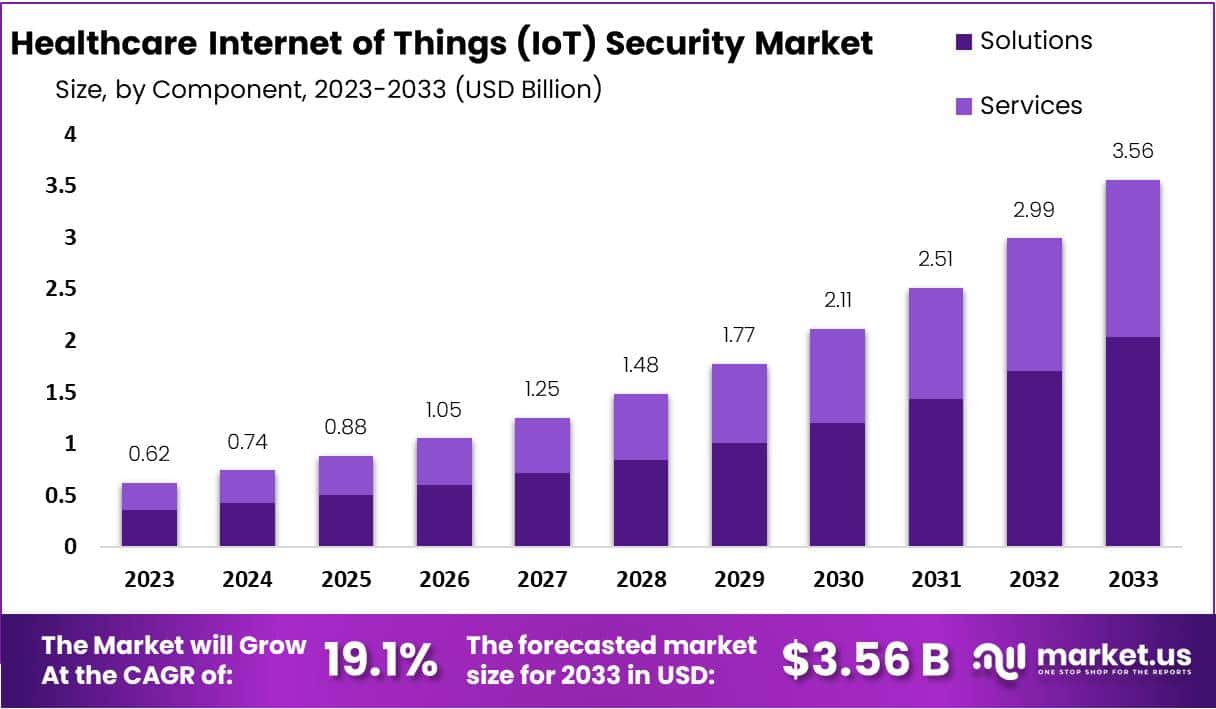
The Healthcare Internet of Things (IoT) Security Market Size is anticipated to reach a value of approximately USD 3.56 Billion by the year 2033, showing significant growth from its 2023 valuation of USD 0.62 Billion. This represents a compound annual growth rate (CAGR) of 19.1% during the forecast period spanning from 2024 to 2033.
About Healthcare Internet of Things (IoT) Security
Healthcare IoT (IoT) Security refers to measures and protocols implemented to secure interconnected devices and systems within healthcare that use IoT technology. IoT devices in healthcare include various sensors, devices, systems, wearable fitness trackers, smart medical devices, remote patient monitoring systems and more – these use of sensors allows patients to collect and exchange data for monitoring, diagnostics, treatment or any other healthcare-related purposes. These may include wearable fitness trackers, smart medical devices or remote patient monitoring systems as examples.
Assuring the security of healthcare IoT devices is of vital importance given their sensitive data nature – often including patient health information (PHI) and other confidential material. IoT security must guard against potential threats such as unauthorized access, data breaches, malware attacks, and any other cyber risks which could compromise patient privacy or threaten medical data integrity.
About Healthcare Internet of Things (IoT) Security Market
The Healthcare IoT Security Market encompasses solutions and services tailored specifically for IoT devices used in healthcare environments. As adoption of IoT expands within this sector, so does demand for strong security measures. This market includes products and services from various vendors that range from data encryption software and device monitoring tools, to consulting, risk evaluation services and managed security solutions.
Hardware security components are designed to safeguard IoT devices against physical and tampering threats, while cloud security solutions play an integral role in safeguarding data processed via cloud platforms – especially relevant for healthcare IoT deployments that utilize them. Compliance solutions play a pivotal role in healthcare organizations’ ability to comply with industry regulations and standards.
Healthcare IoT Security Market expansion is propelled by growing IoT adoption within healthcare, rising awareness of cybersecurity threats, and compliance requirements imposed on data protection regulations. To protect patient data while upholding healthcare systems integrity. This dynamic sector demands continuous investment in robust security solutions to safeguard patient privacy.
Authentication and authorization mechanisms, crucial in controlling IoT device access, can significantly reduce the ~21% of healthcare data breaches attributed to unauthorized access. A HIMSS study underlines the importance of robust protocols in preventing compromises to patient information. Effective device management practices, addressing challenges faced by ~56% of healthcare organizations, are essential for maintaining the integrity and security of IoT devices. As reported by Deloitte, regular updates and vulnerability patching contribute to secure device operation.
Secure networks and firewalls prevent unauthorized access, preserving sensitive healthcare data. Adherence to regulatory standards is crucial, as ~64% of healthcare organizations identify compliance as a top driver for implementing cybersecurity measures. Regulations like HIPAA and GDPR mandate specific security measures, emphasizing the importance of regulatory compliance in healthcare IoT security. Providers must navigate and comply with these standards to protect patient information and avoid legal consequences, making compliance a cornerstone in the landscape of healthcare IoT security.
Key Takeaways
- Market Growth: Anticipated to reach USD 3.56 Billion by 2033, the Healthcare IoT Security Market exhibits a robust 19.1% CAGR from 2024 to 2033.
- Dominant Segment: In 2023, the Solutions segment claimed over 57.1% market share, emphasizing the industry’s reliance on advanced security tools.
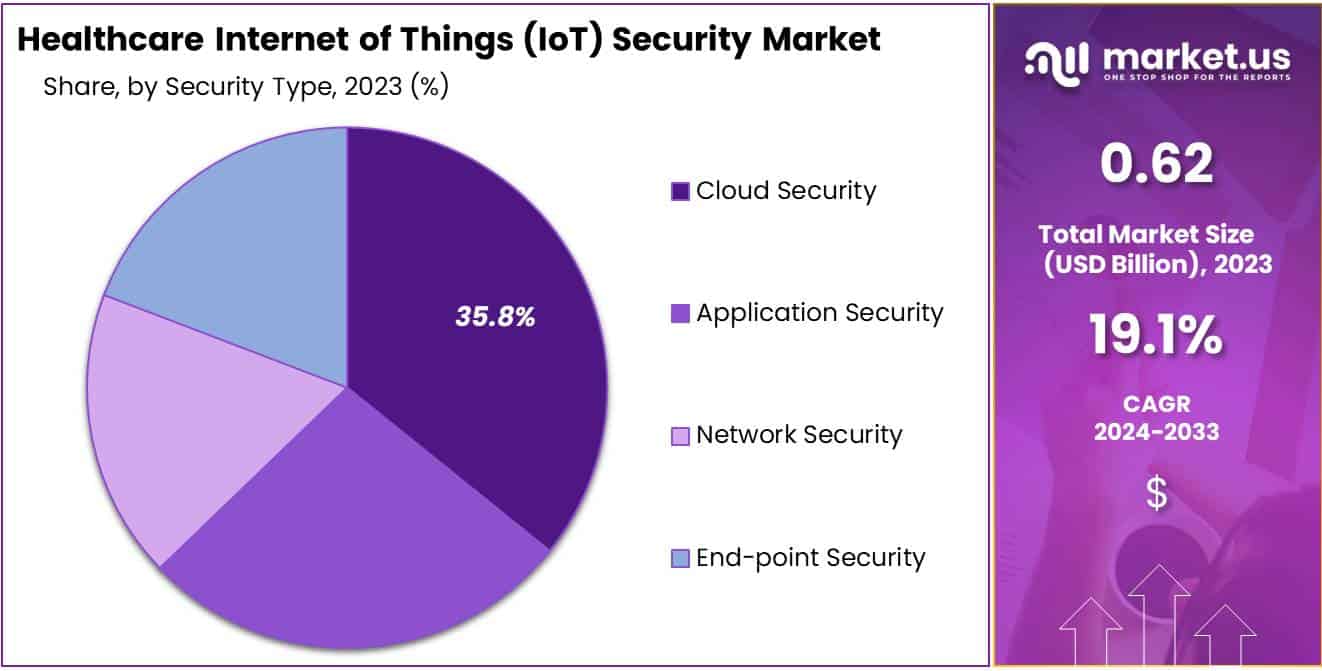
- Cloud Security Lead: With a 35.8% market share in 2023, Cloud Security stands out as a critical component in safeguarding healthcare data.
- Primary End-Use: Hospitals and Clinics secured a substantial 61.8% market share in 2023, emphasizing the urgent need for enhanced data protection.
- Budget Constraints: Healthcare IT spending faces challenges, with only 3-4% of the overall healthcare budget allocated, hindering advanced security integration.
- Telehealth Growth: Telehealth adoption presents a significant opportunity, with a projected CAGR of 17.3% by 2033, reflecting the market’s expanding scope.
- 5G Technology Impact: The emergence of 5G technology in healthcare opens new possibilities, driving the need for improved security solutions in IoT applications.
- Blockchain Integration: Blockchain usage for data integrity is a growing trend, offering transparency and security to enhance patient data protection.
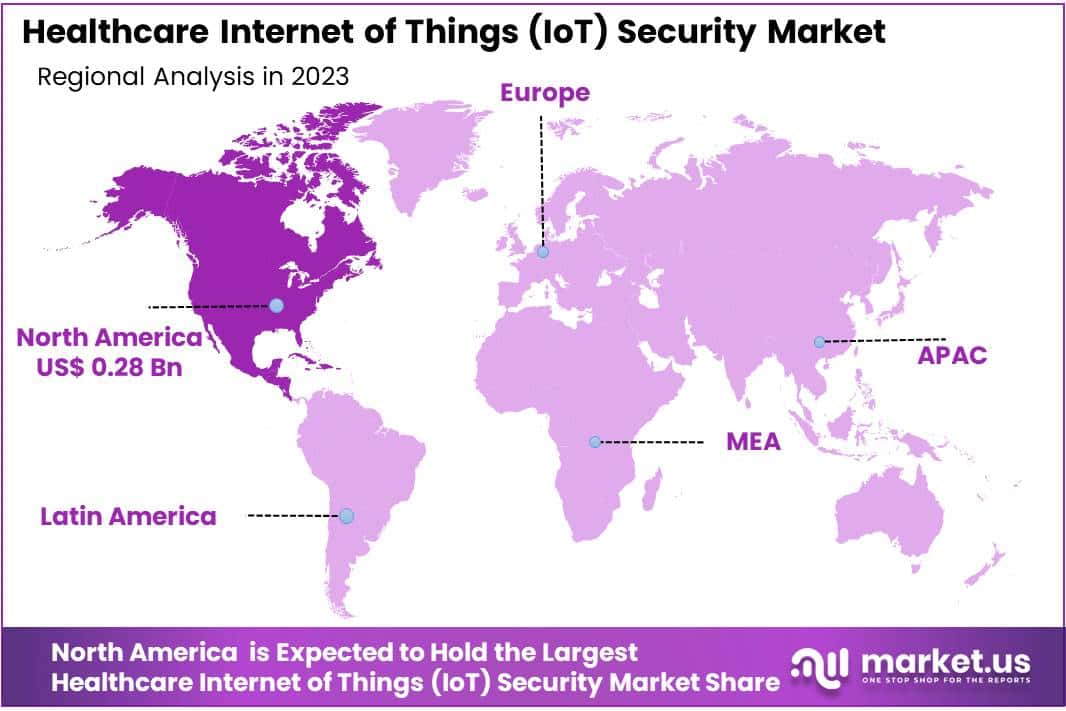
- Regional Leadership: In 2023, North America led with a 46.2% market share and USD 0.28 Billion valuation, driven by robust technological infrastructure and strict regulatory compliance.
- Global Potential: Europe, Asia-Pacific, and other regions show potential for market expansion, driven by increased cybersecurity awareness and growing healthcare IT infrastructure.
Component Analysis
In 2023, the Healthcare Internet of Things (IoT) Security Market saw significant leadership in its Solutions segment with over 57.1% market share in 2023. This segment played an essential part in shaping industry landscape by providing effective tools that safeguard healthcare IoT ecosystems.
Healthcare IoT security solutions included cutting-edge technologies and software designed to strengthen digital infrastructure, such as data privacy, device authentication, network integrity issues. As healthcare organizations adopted IoT technologies to improve patient care and operational efficiencies, the demand for robust security solutions experienced an exponential increase.
Services were an integral component of the healthcare IoT security market in 2023. They comprised various offerings such as consulting, implementation and support services that assisted healthcare providers in effectively deploying and managing security measures.
The Healthcare IoT Security Market’s dynamic landscape reflected the vital roles played by both solutions and services providers. Solutions’ growth underscored industry focus on adopting advanced and tailored security measures; concurrently, Services provided expert guidance and ongoing support when navigating healthcare IoT security complexities.
Security Type Analysis
In 2023, the Healthcare Internet of Things (IoT) Security Market made an impressionful appearance, with various security types playing crucial roles in protecting healthcare data. Of these types, Cloud Security proved particularly prominent, holding over 35.8% market share.
Application Security was an integral component of healthcare IoT security that ensured the safe functioning of medical applications. This subcomponent focused on safeguarding software systems so as to guarantee their safe functioning as part of medical applications.
Network Security was another essential player that provided protection for healthcare networks against potential cyber threats. Acting like a digital guard, Network Security protected against unauthorized access while guaranteeing data transmission integrity within healthcare IoT ecosystem.
Endpoint Security was an essential element of healthcare network security that focused on protecting individual devices connected to it. This segment prioritized protecting medical devices and equipment against vulnerabilities that may compromise patient data.
Cloud Security was the market’s star performer with its focus on protecting data stored in the cloud. As healthcare organizations increasingly adopted cloud-based solutions, robust cloud security measures became of critical importance; this segment addressed concerns related to data privacy, access control and encryption in this environment.
End-Use Analysis
In 2023, the Healthcare Internet of Things (IoT) Security Market demonstrated an impressive presence, with hospitals and clinics holding onto an overwhelming market share exceeding 61.8%. This impressive feat can be attributed to an urgent need for enhanced data protection within healthcare environments.
Hospitals and clinics as primary centers of patient care prioritized IoT security solutions in order to safeguard sensitive medical information. Utilizing IoT technologies for patient monitoring, data collection, communication and more demonstrates how crucial cybersecurity solutions are in protecting healthcare data confidentiality and integrity.
Ambulatory Surgical Centres were an integral component of the Healthcare IoT Security Market, accounting for an outstanding share. As these centers increasingly used IoT devices for efficient operations and enhanced patient care, their demand for robust security solutions increased considerably.
Research and Diagnostic Laboratories also showed an increasing inclination toward adopting IoT technologies into their workflows, even though this sector represents only a relatively smaller market share. Adoption of IoT devices for research purposes and diagnostic advancement was notable within this segment.
Key Market Segments
Component
- Solutions
- Services
Security Type
- Application Security
- Network Security
- End-point Security
- Cloud Security
End-Use
- Hospitals and Clinics
- Ambulatory Surgical Centres
- Research and Diagnostic Laboratories
Drivers
Rising Cybersecurity Concerns in Healthcare
Healthcare organizations’ increased reliance on connected devices exposes sensitive patient data to cyber attacks. With an upsurge in attacks targeting medical systems, the demand for IoT security solutions has skyrocketed – the HIMSS Cybersecurity Survey indicates 45% more cyber threats over last year, further underscoring their need.
Integrating IoT into Healthcare Operations
As more IoT devices enter healthcare operations – from patient monitoring devices to smart medical devices – this has highlighted the growing necessity for comprehensive security protocols. Deloitte’s Global Healthcare Outlook projected that adoption of IoT in healthcare reached ~$158 billion in 2022; such widespread use underscores how vitally important security solutions for IoT solutions are in protecting patient information.
Regulatory Mandates for Data Protection
As data protection regulations evolve, such as HIPAA (Health Insurance Portability and Accountability Act), their mandated security measures have become ever stricter for healthcare data. With penalties being levied against noncompliance, healthcare providers have invested in IoT security solutions as compliance becomes not only a legal necessity but a necessary precursor for investing in robust security solutions for IoT in healthcare.
Restraints
Budget Constraints in Healthcare IT Spending
Unfortunately, budget restrictions present healthcare organizations with an enormous challenge when it comes to IoT security. Frost & Sullivan has reported that only 3-4% of overall healthcare budget is allocated towards IT spending – this hinders integration of advanced security solutions, hindering enhancement of IoT security within healthcare environments.
Interoperability Challenges in IoT Devices
In healthcare settings, lack of standardized protocols and interoperability between IoT devices has hindered implementation of unified security measures. According to The Journal of Medical Internet Research, failure of communication among devices jeopardises their security protocols’ efficacy – therefore overcoming such interoperability challenges is paramount for creating an efficient security infrastructure for IoT.
Lack of Awareness and Education among Healthcare Professionals
One major barrier in the IoT security landscape of healthcare lies with limited awareness and education among healthcare staff, according to HIMSS. Many staff lack comprehensive knowledge regarding IoT security risks and best practices – thus hindering healthcare providers from making informed decisions regarding IoT implementation.
Opportunities
Increased Adoption of Telehealth Services
Telehealth adoption has experienced exponential growth since global events accelerated its adoption; creating an attractive growth opportunity in Healthcare Internet of Things (IoT) Security Market worldwide. According to market.us, by 2032, compound annual growth rate (CAGR) estimates of 17.3% are anticipated in this segment alone. Remote patient monitoring and virtual consultations have increased significantly, creating demand for robust IoT security solutions which provide lucrative prospects to market players.
Emergence of 5G Technology in Healthcare
With its high-speed data transmission and low latency capabilities, 5G technology is opening up new possibilities for IoT applications in healthcare systems worldwide. As healthcare systems increasingly adopt IoT devices enabled with 5G networks, requiring improved security solutions as part of this development process. The global 5G healthcare market is projected to experience considerable expansion.
Strategic Collaborations for Integrated Security Solutions
Healthcare organizations and technology providers who partner to develop integrated IoT security solutions offer an exciting growth opportunity. Healthcare IT News reports an increasing trend of partnerships aimed at creating comprehensive security frameworks. Not only does this collaboration foster innovation, but it also addresses multifaceted security challenges found within healthcare IoT security environments – driving market expansion in turn.
Trends
Integrating Blockchain for Data Integrity
Implementation of blockchain technology for ensuring data integrity has become a popular trend in healthcare IoT security markets, according to IEEE Access. Blockchain’s transparent and decentralized nature contributes to patient data security while its transparency facilitates building trust within healthcare systems, making this trend one that could shape its way into IoT security in healthcare in years to come.
Focus on User Authentication and Access Control
One notable trend in healthcare IoT security is an increased focus on user authentication and access control measures. Healthcare Innovation emphasizes the significance of implementing strong authentication protocols to safeguard sensitive medical data against unauthorzie access; multi-factor authentication and biometric verification have become popular ways of strengthening user level security.
Rise of AI-Powered Threat Detection
Frost & Sullivan has identified AI-powered threat detection as a significant trend within healthcare IoT security solutions, as it allows for proactive identification and mitigation of potential security risks. AI algorithms’ use in analyzing vast datasets enhances overall IoT security solutions’ effectiveness to effectively counter emerging cyber threats in real time.
Regional Analysis
In 2023, North America took the lead in terms of Healthcare Internet of Things (IoT) Security Market with an astounding market share of 46.2% and market valuation estimated at USD 0.28 Billion for the year.
North America’s robust technological infrastructure, particularly within healthcare facilities and IT ecosystems, was an instrumental factor in driving adoption of IoT security solutions. Cutting-edge healthcare facilities and IT ecosystems provided an ideal setting for the introduction of these measures.
North America is home to strict regulatory frameworks and an active approach towards data security compliance, driving up demand for robust IoT security solutions. Healthcare organizations prioritized adhering to regulatory standards, driving this demand.
With cyber-attacks increasingly targeting healthcare institutions, IoT security solutions became more in demand among North American providers to protect patient data and maintain system integrity. North American hospitals recognized the constantly evolving threat environment and sought comprehensive measures to secure their systems while safeguarding patient privacy and maintaining system integrity.
North America demonstrated its commitment to innovation and continuous improvement through significant investments in research and development, placing it as a pioneer in creating cutting-edge IoT security solutions tailored specifically for healthcare industries.
North America led the Healthcare IoT Security market in 2023, but other regions saw some market activity as well. Europe, Asia-Pacific and other parts of the world showed significant potential for expansion due to factors like increased cybersecurity awareness, expanding healthcare IT infrastructure expansion and expanding IoT integration within healthcare settings.
Key Regions
- North America
- The US
- Canada
- Mexico
- Western Europe
- Germany
- France
- The UK
- Spain
- Italy
- Portugal
- Ireland
- Austria
- Switzerland
- Benelux
- Nordic
- Rest of Western Europe
- Eastern Europe
- Russia
- Poland
- The Czech Republic
- Greece
- Rest of Eastern Europe
- APAC
- China
- Japan
- South Korea
- India
- Australia & New Zealand
- Indonesia
- Malaysia
- Philippines
- Singapore
- Thailand
- Vietnam
- Rest of APAC
- Latin America
- Brazil
- Colombia
- Chile
- Argentina
- Costa Rica
- Rest of Latin America
- Middle East & Africa
- Algeria
- Egypt
- Israel
- Kuwait
- Nigeria
- Saudi Arabia
- South Africa
- Turkey
- United Arab Emirates
- Rest of MEA
Key Players Analysis
As the healthcare IoT security landscape continues to develop, collaboration among key players becomes ever more essential. By pooling their talents together, synergies are formed that facilitate comprehensive and adaptable security solutions that protect healthcare data in an interconnected world.
Microsoft stands out as an innovator in the Healthcare Internet of Things (IoT) Security Market, using its innovative technological infrastructure to deliver cutting-edge solutions. Their focus on improving healthcare IoT security includes advanced encryption protocols and authentication mechanisms that ensure data integrity and confidentiality.
IBM brings extensive expertise in data analytics and artificial intelligence to healthcare IoT security. Their solutions focus on threat detection and prevention using AI-powered algorithms that identify anomalies immediately. IBM is recognized as a key contributor in shaping this new landscape of healthcare IoT.
Oracle, an industry giant, plays an pivotal role in fortifying healthcare IoT systems. By emphasizing secure data storage and access controls, they help establish a solid security foundation. Their cloud-based solutions also enhance scaleability while meeting stringent security requirements.
Intel Corporation, well-known for its hardware innovations, addresses healthcare IoT security through a series of stringent hardware-level security measures. Their products emphasize secure device authentication and communication to provide a strong foundation against cyber threats to healthcare IoT ecosystems.
Other than these key players, other contributors also play key roles in shaping the Healthcare IoT Security Market. From security software providers to startups specializing in niche aspects of IoT security, their efforts contribute to creating an innovative yet cooperative atmosphere, driving industry development forward.
Market Key Players
- Microsoft
- IBM
- Oracle
- Intel Corporation
- AO Kaspersky Lab
- Waracle
- ICtera
- Cisco Systems
- Deutsche Telekom AG
- iTechAtt
Recent Developments
- In October 2023, Microsoft expanded its commitment to healthcare IoT security by acquiring ReFirm Labs, an established medical device security firm. This acquisition strengthened Microsoft’s expertise in protecting firmware and embedded systems necessary for protecting medical devices against cyber attacks.
- In November 2023, IBM announced the “IBM Trustworthy Healthcare,” an integrated suite of solutions to secure healthcare data and devices throughout their lifecycle. These features include threat detection, vulnerability management and incident response specifically tailored for connected medical equipment.
- In August 2023, Intel Corporation joined forces with health IT leader Cerner to jointly develop secure chipsets for medical devices that integrate advanced security features directly into hardware, making it more difficult for hackers to compromise these vital healthcare devices.
- In December 2023, Cisco Systems announced that their “Cisco SecureX” platform has been expanded to offer customized healthcare-specific security capabilities, with unified visibility and control over medical devices connected to healthcare networks and enhanced protection measures within these environments.









