


Report Overview
In 2023, the global hybrid workplace market was valued at USD 4.9 Billion and is expected to reach USD 21.1 Billion by 2032. Between 2023 and 2032, this market is estimated to register a CAGR of 18.3%.
The hybrid workplace refers to a work environment that combines remote work and in-person work, allowing employees to have flexibility in choosing where and how they work. It involves a blend of on-site and remote work arrangements, often facilitated by the use of technology and digital communication tools.
The hybrid workplace market refers to the various products, services, and technologies that cater to the needs of organizations transitioning to a hybrid work model. This market encompasses a wide range of solutions, including collaboration software, video conferencing tools, project management platforms, cloud-based storage, cybersecurity solutions, and ergonomic equipment for home offices.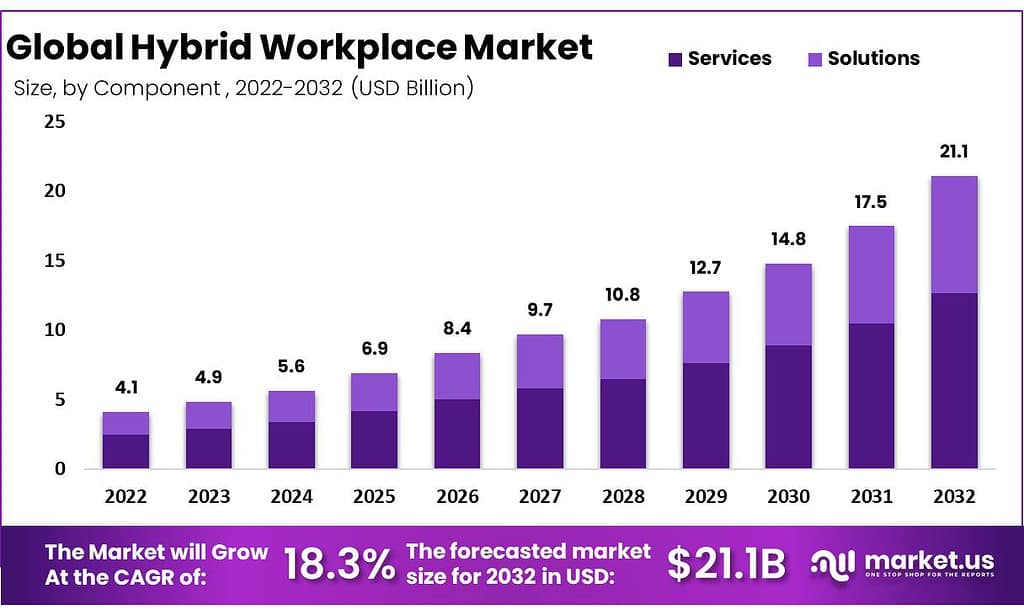
Note: Actual Numbers Might Vary In The Final Report
Key Takeaways
- The hybrid workplace market was valued at USD 4.1 Billion in 2022 and is projected to reach USD 21.1 Billion by 2032, with a CAGR of 18.3%.
- The hybrid workplace model combines office work and remote work, offering employees flexibility and aiding work-life balance, leading to increased market growth.
- Services account for 60% of market revenue, due to increasing demand for remote and online services such as virtual collaboration tools, IT support services and cybersecurity protection solutions.
- Small and midsized enterprises (SMEs) account for 72% of market shares; large enterprises are projected to experience growth due to the increasing adoption of hybrid models and growing office space demand.
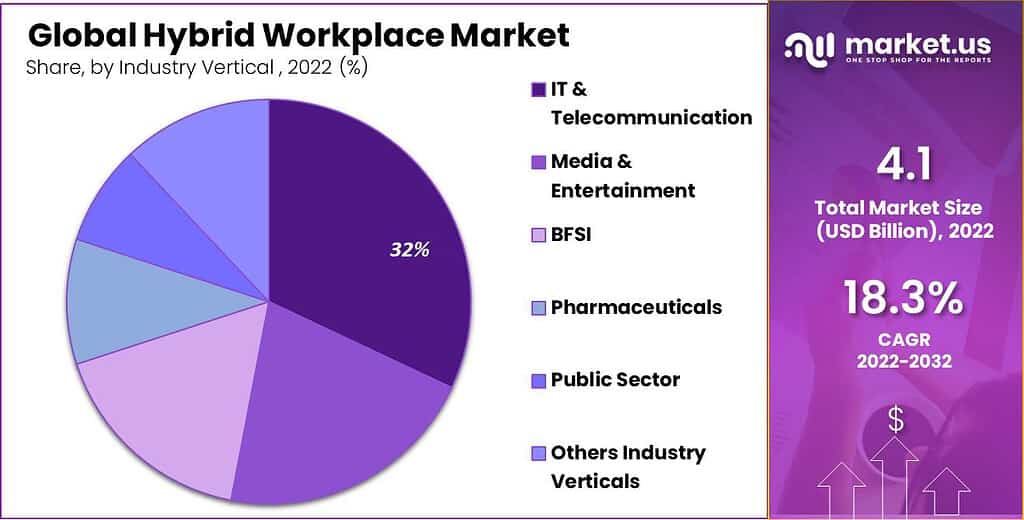
- The IT and telecommunication sector is the most lucrative industry vertical, holding the largest revenue share of 32% in the hybrid workplace market.
- The hybrid workplace model enhances productivity and flexibility, leading to increased demand. However, challenges such as home interruptions, monitoring remote employees, and the possibility of employee burnout act as market restraints.
- The shift to a hybrid workplace presents significant opportunities for technology solutions and cybersecurity services to ensure seamless communication and data protection for remote and in-office teams.
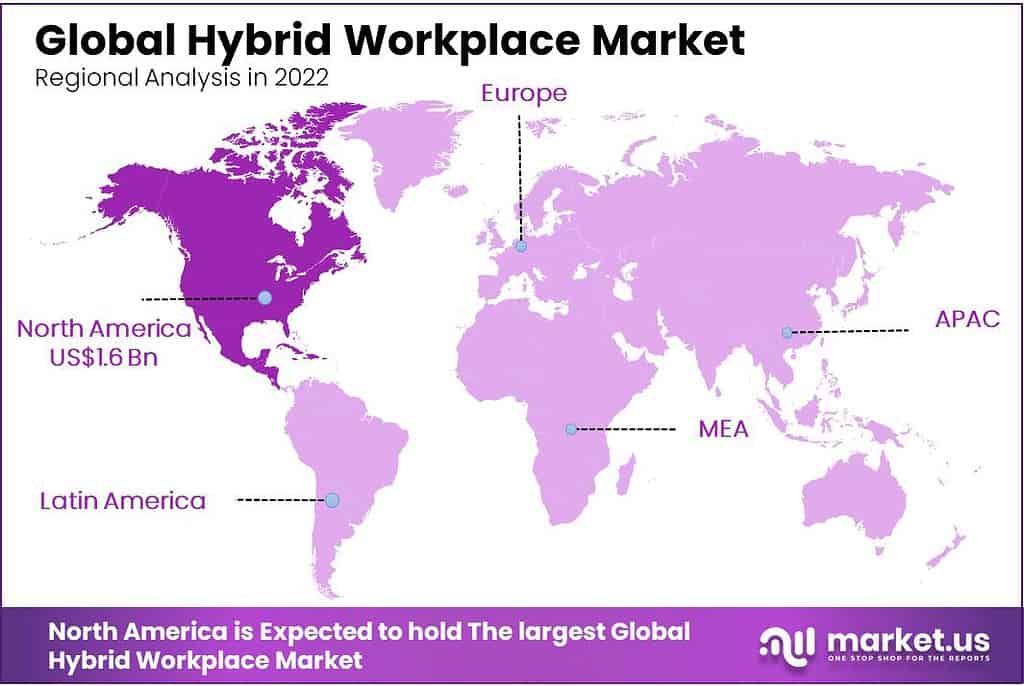
- The North America region is the most lucrative market, accounting for a significant share of about 39%, followed by Europe and the Asia-Pacific region.
- Key market players such as TCS, Target, Salesforce, Nike, and IBM are implementing strategies like mergers, collaborations, and acquisitions to enhance their market presence and quality.
Component Analysis
The Services Segment is the Most Lucrative in the Global Hybrid Workplace Market.
Based on components, the market for a hybrid workplace is segmented into solutions and services. Among these components, the services segment is the most lucrative in the global hybrid workplace market, with a market share of 60% globally.
This high market share is attributed to the growing demand for remote and online services that cater to the needs of customers and businesses in the hybrid work environment. These services may include virtual collaboration tools, IT support, cybersecurity services, remote training, and consulting services to help organizations optimize their hybrid work setup.
The solutions segment in the hybrid workplace market is expected to experience substantial growth in the forecast period, likely due to individuals’ increasing preference for solutions. These solutions could encompass various technological tools and software to facilitate seamless collaboration, communication, and task management for hybrid teams.
Size Analysis
Small & Medium-sized Enterprises Segment is Estimated to be the Most Lucrative Segment
By size, the hybrid workplace market is further divided into small & medium-sized enterprises and large enterprises. Among these, the small & medium-sized enterprises segment is estimated to be the most lucrative segment in the global hybrid workplace market, with a market share of 72%, and is anticipated to grow during the forecast period. Owing to reducing the cost, maintenance, and other utility for startups and small firms. Furthermore, large enterprises are expected to grow with a high CAGR rate during the forecast period. Owing to the preference for a hybrid model due to increasing concept office leases on a large scale which helps to grow the market in the forecast period.
Note: Actual Numbers Might Vary In The Final Report
Industry Vertical Analysis
IT & Telecommunication Segment is Estimated to be the Most Lucrative Segment
Based on industry verticals, the hybrid workplace market is segmented into the public sector, pharmaceuticals, media & entertainment, IT & telecommunication, BFSI, and other industry verticals. Among these industries’ verticals, the IT & telecommunication segment is estimated to be the most lucrative in the hybrid workplace market, with the largest revenue share of 32%. Owing to the preference of three fourth of all employees for a hybrid model. Media & entertainment segment is expected to grow at the highest CAGR during the forecast period from 2023 to 2032. Owing to the presence of the cloud system. Moreover, the public sector, pharmaceuticals, BFSI, and other industry verticals accept hybrid workplaces as a new norm.
Key Market Segments
Based on Component
- Solutions
- Services
Based on Size
- Small & Medium-sized Enterprises
- Large Enterprises
Based on Industry Vertical
- Public Sector
- Pharmaceuticals
- Media and Entertainment
- IT and Telecommunication
- BFSI
- Others Industry Verticals
Drivers
Increase the Productivity and Flexibility Increases the Demand for Hybrid Workspace
The hybrid workplace model allows employees to work from both the office and remote locations, allowing them to choose the most productive environment for their tasks. Some employees may work better in a quiet home setting, while others may prefer the collaborative atmosphere of the office. By offering this flexibility, organizations can tap into their employees’ peak productivity, leading to improved performance. In addition, adopting a hybrid workspace model can lead to cost savings for organizations. Reducing the size of office spaces can decrease overhead costs associated with rent, utilities, and maintenance. Additionally, employees working remotely can reduce utility costs in the office. These cost savings can contribute to the bottom line and allow businesses to allocate resources more efficiently.
Restraints
Home Interruption, Firm Watch on Employees, and Employee Burnout Are Restrictions for the Market
Productivity at home can be affected due to the children at home or meet of relatives at home in the hybrid workspace model, which can restrain the hybrid workspace. Furthermore, the firm cannot monitor an employee working from home. Moreover, individuals can’t learn from the company’s seniors due to working from home. Moreover, travel time and overhead costs increased for working from the office. These are some of the restrictions on the market. Collaborating with employees who work at home is harder because of the absence of Wi-Fi strength at the onsite work.
In the hybrid model, rather than fixed hours, you have to reach goals in a specific time, so they may need to work more hours by the employee, so the employee may feel overwhelmed by the work. Furthermore, there is the possibility of issue formation at a working time due to high flexibility, which presents various variations in the work. Also, the hybrid workspace model cannot be used in all industries.
Opportunity
Technology Solutions and Cybersecurity Services
The shift to a hybrid workplace demands robust technology solutions to enable seamless communication and collaboration between in-office and remote teams. Companies offering innovative tools for virtual meetings, project management, team communication, and workflow automation have significant opportunities in this market. With employees working from different locations and accessing company data remotely, the need for cybersecurity solutions became even more critical. Cybersecurity companies that can offer robust data protection, secure remote access, and threat detection services have a promising market.
Trends
Hybrid Workspace Model Has Large Popularity
The hybrid workplace model combines remote work and in-office presence. This shift has been driven by the realization that flexible work arrangements enhance productivity, work-life balance, and employee satisfaction. Additionally, the rising adoption of collaborative tools, cloud-based solutions, and advanced communication technologies further supports this paradigm. As businesses prioritize agility and resilience, the hybrid workplace approach is likely to gain even more momentum in the coming years, transforming the traditional work environment and redefining how teams collaborate and thrive.
Regional Analysis
North America is estimated to be the Most Lucrative Market.
In 2022, the North America market share had the largest market share, which is near about 39%, and will likely grow at a high CAGR rate in the forecast period from 2023 to 2032. Owing to a large number of IT big brand businesses presence, such as Google, Facebook, Micro soft, etc., in North America and the high adoption of hybrid workplaces.
However, the APAC region will grow at a high CAGR rate during the forecast period. Owing to the increase in several companies in IT or various sectors in the Asia region significantly due to countries such as India and China. Europe has the second highest market share across the globe. Owing to the high adoption rate of the hybrid model.
Note: Actual Numbers Might Vary In The Final Report
Key Regions and Countries Covered in this Report:
- North America
- The US
- Canada
- Europe
- Germany
- France
- The UK
- Spain
- Italy
- Russia
- Netherland
- Rest of Europe
- APAC
- China
- Japan
- South Korea
- India
- Australia
- New Zealand
- Singapore
- Thailand
- Vietnam
- Rest of APAC
- Latin America
- Brazil
- Mexico
- Rest of Latin America
- Middle East & Africa
- South Africa
- Saudi Arabia
- UAE
- Rest of MEA
Key Players Analysis
Key players with a strong presence in the market are using strategies like mergers, collaborations, expansion, and acquisitions which are anticipated to increase competition from competitors. These strategies are helping to grow its reach and quality in the market. Cloud-based data platform services can be used to store data and gain access from anywhere, further improving the hybrid work industry’s reach.
Market Key Players
- TCS
- Target
- Salesforce
- Nike
- Nationwide
- Klarna
- P. Morgan
- IBM
- General Motors Co.
- Ford Motor Co.
- Flipkart
- Citigroup
- Other Key Players
Recent Developments
- In Oct 2022, IBM Consulting announced that they are adopting a 3-day hybrid model, which can help increase senior interaction and productivity but was not penalized if they can’t work in the hybrid model.
- In Dec 2021, to accommodate hybrid workspaces, Salesforce reshaped the workplace from physical to hybrid, allowing you to sit from anywhere.









