


Market Overview
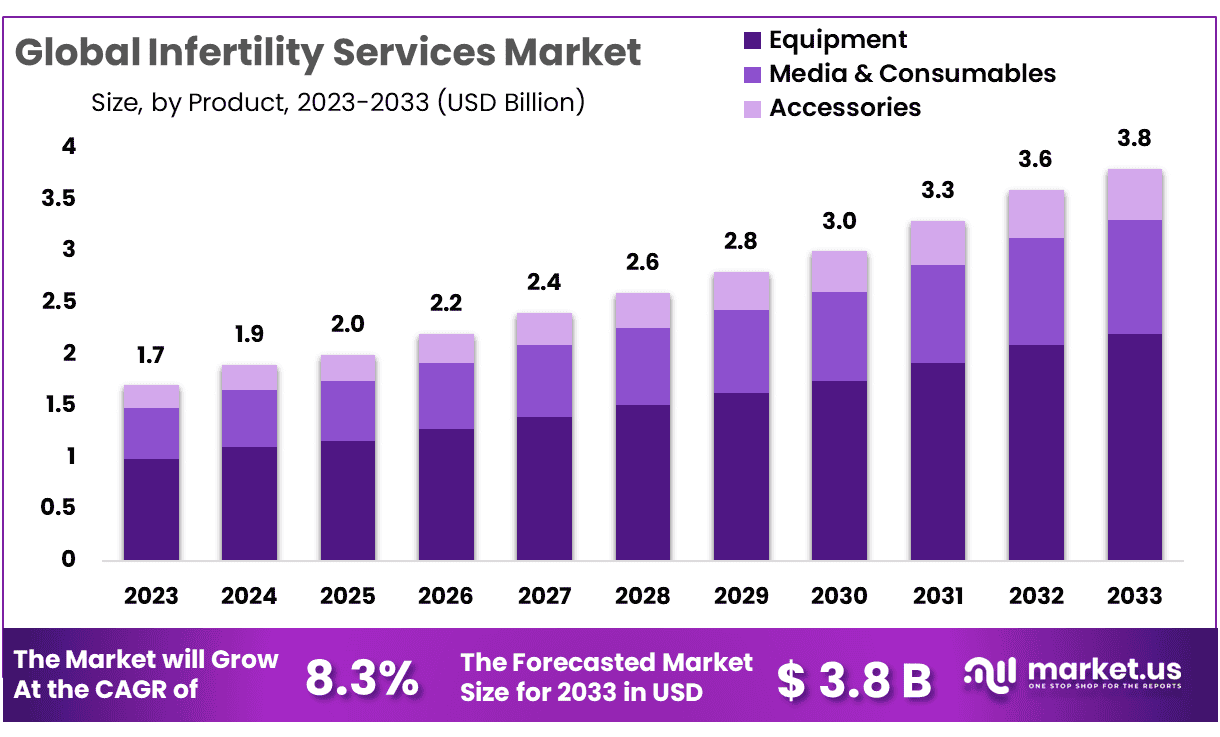
The Global Infertility Services Market size is expected to be worth around USD 3.8 Billion by 2033 from USD 1.7 Billion in 2023, growing at a CAGR of 8.3% during the forecast period from 2024 to 2033.
Infertility services include a variety of medical and therapeutic interventions designed to help individuals or couples who are having difficulty conceiving a child. These services typically include diagnostic evaluations, fertility treatments like in vitro fertilization (IVF), and counseling assistance. They play an important role in addressing reproductive health issues and assisting individuals in achieving their parenthood goals.
Infertility is a medical condition in which a woman unable to get pregnant due to certain circumstances. Infertility is related to both women and men. In men, infertility refers to low sperm count, blockages, and abnormal sperm function that prevent sperm delivery. Women who can conceive but not carry pregnancy are also diagnosed with infertility. Men and women are equally likely to be infertile. These issues of infertility are treated with infertility services to cure fertility and genetic problems related to conception. Fertility services include IVF (In vitro fertilization), IUI (Intrauterine insemination), intracytoplasmic sperm injection (ICSI), and some other surgeries and medications to treat infertility.
Key Takeaways
- Market Size: Infertility Services Market size is expected to be worth around USD 3.8 Billion by 2033 from USD 1.7 Billion in 2023.
- Market Growth: The market growing at a CAGR of 8.3% during the forecast period from 2024 to 2033.
- Product Analysis: In Infertility Services, equipment plays a pivotal role, commanding a substantial 58% market share.
- Procedure Analysis: Assisted Reproductive Technology (ART) emerges as a formidable force within the Infertility Services Market, commanding a significant 41% market share.
- Patient Type Analysis: In Patient Type the market landscape is marked by the dominance of Fertility Centers, which hold a commanding 61% market share.
- Regional Analysis: North American fertility treatment market dominated with a commanding share of 46.2%, generating a substantial market revenue of USD 0.78 billion.
- Rising Demand: The market is experiencing a growing demand for infertility services due to increasing infertility rates and delayed family planning.
- Technological Advancements: Advancements in assisted reproductive technologies, such as IVF and genetic testing, are improving success rates and expanding treatment options.
- Cost Challenges: High treatment costs and lack of insurance coverage remain significant barriers to accessing fertility services for many individuals and couples.
Product Analysis
In Infertility Services, equipment plays a pivotal role, commanding a substantial 58% market share. This dominance underscores the criticality of advanced technologies and tools in addressing infertility concerns. Among the array of equipment contributing to this dominance are Microscopes, Imaging Systems, Sperm Analyzer Systems, Ovum Aspiration Pumps, Micromanipulator Systems, Incubators, Gas Analyzers, Laser Systems, Cryosystems, Sperm Separation Devices, Media & Consumables, and a range of essential Accessories.
Microscopes and Imaging Systems enable precise observation and analysis of reproductive cells and tissues, aiding in accurate diagnosis and treatment planning. Sperm Analyzer Systems and Ovum Aspiration Pumps streamline the evaluation and retrieval processes. Micromanipulator Systems ensure precision in procedures such as in vitro fertilization.
Incubators create optimal conditions for embryo development, while Gas Analyzers and Laser Systems enhance the efficiency and safety of assisted reproductive techniques. Cryptosystems facilitate the long-term storage of reproductive samples, and Sperm Separation Devices are crucial for sperm-sorting procedures.
The availability of high-quality equipment empowers healthcare professionals in their mission to combat infertility, offering hope to countless individuals and couples. This market’s growth is poised to continue, driven by ongoing advancements in reproductive technologies and the increasing demand for effective solutions to infertility challenges.
Procedure Analysis
Assisted Reproductive Technology (ART) emerges as a formidable force within the Infertility Services Market, commanding a significant 41% market share. ART encompasses a diverse range of advanced procedures, each playing a pivotal role in addressing infertility issues. These procedures include In Vitro Fertilization (IVF), Intracytoplasmic Morphologically Selected Sperm Injection (IMSI), Gamete Donation, Intracytoplasmic Sperm Injection (ICSI), Surrogacy, Artificial Insemination, Intrauterine Insemination, Intracervical Insemination, Intratubal Insemination, Fertility Surgeries, Laparoscopy, Hysteroscopy, Myomectomy, Laparotomy, Tubal Ligation Reversal, Varicocelectomy, Microsurgical Reconstruction, Vasovasostomy, and Vasoepididymostomy.
IVF, a pioneering technique, involves fertilizing eggs with sperm outside the body, and ICSI takes this a step further by selecting the most viable sperm for injection. Gamete Donation, Surrogacy, and various insemination methods offer alternatives for couples facing specific challenges. Fertility surgeries, including laparoscopy and hysteroscopy, address anatomical issues, while vasectomy reversal procedures like vasovasostomy and vasoepididymostomy provide options for male infertility.
Patient Type Analysis
In Patient Type the market landscape is marked by the dominance of Fertility Centers, which hold a commanding 61% market share. This statistic underscores the pivotal role these specialized centers play in addressing fertility-related concerns. To gain a comprehensive understanding of the Infertility Services Market, it is crucial to dissect it along various dimensions.
The market can be bifurcated into Female and Male segments, catering to the unique reproductive needs of both genders. While female-focused services encompass a spectrum of treatments and procedures, male-centric offerings focus on addressing male infertility issues. This segmentation allows for tailored approaches to fertility challenges.
Furthermore, the End-Use distribution is significant, with Hospitals & Clinics and Research Institutes serving as vital conduits for infertility services. Hospitals & Clinics provide accessibility to a broad patient base, while Research Institutes contribute to advancing the field through innovative treatments and studies.

Key Market Segments
Product
- Equipment
- Microscopes
- Imaging Systems
- Sperm Analyzer Systems
- Ovum Aspiration Pumps
- Micromanipulator Systems
- Incubators
- Gas Analyzers
- Laser Systems
- Cryosystems
- Sperm Separation Devices
- Media & Consumables
- Accessories
Procedure
- Assisted Reproductive Technology
- In Vitro Fertilization
- – Intracytoplasmic Morphologically Selected Sperm Injection
- – Gamete Donation
- Intracytoplasmic Sperm Injection
- Surrogacy
- Artificial Insemination
- Intrauterine Insemination
- Intracervical Insemination
- Intratubal Insemination
- Fertility Surgeries
- Laparoscopy
- Hysteroscopy
- Myomectomy
- Laparotomy
- Tubal Ligation Reversal
- Varicocelectomy
- Microsurgical Reconstruction
- – Vasovasostomy
- – Vasoepididymostomy
- Others
Patient Type
- Female
- Male
- End-Use
- Fertility Centers
- Hospitals & Clinics
- Research Institutes
- Others
Key Drivers
The increasing prevalence of infertility – Infertility rates are on the rise due to a complex interplay of biological, lifestyle, and environmental factors. Biological factors encompass structural abnormalities in the reproductive systems, potentially leading to reduced egg or sperm counts, impediments in the path of egg travel, and diminished sperm motility, among others. These biological aspects are further influenced by lifestyle choices, including diet, exercise, age, body weight, alcohol, drug, and tobacco consumption. For example, the escalating prevalence of obesity is linked to reduced natural conception rates. Additionally, increased alcohol, drug, and cigarette use among both genders has contributed to rising infertility cases.
Contemporary societal trends also play a role, as more individuals are postponing family planning until their late thirties, heightening the risk of infertility, particularly for women, whose fertility declines with age. Government policies, such as the one-child policy in China, have reshaped family planning dynamics, leading to reduced fertility rates in various countries. These multifaceted factors collectively drive the demand for fertility services, which is expected to increase in the forecasted period.
The declining global fertility rate is due to increased access to contraception methods, leading to choosing to have children or not. Due to the use of contraceptives, women face irregular menstrual cycles. Also, blockage in fallopian tubes and other medical conditions in women is increasing. These factors have led to an increase in the adoption of infertility procedures and increasing revenue growth for the infertility services market.
Key Trends
Telemedicine and Remote Consultations
One prominent trend in the infertility services market is the integration of telemedicine and remote consultations. Patients can now consult fertility specialists, undergo initial evaluations, and receive counseling from the comfort of their homes. This trend not only enhances accessibility to infertility services but also minimizes the geographical constraints faced by couples seeking treatment.
There is a growing trend towards natural and holistic approaches to fertility treatment. Many individuals are opting for lifestyle modifications, nutrition, and alternative therapies alongside conventional medical treatments. This shift towards a more comprehensive and holistic approach provides new opportunities for service providers to diversify their offerings and cater to a broader range of patient needs.
Key Restraints
The prohibitive cost of fertility services – The supply side of the fertility services market faces several challenges, including a shortage of fertility clinics. Setting up these facilities involves substantial costs, and the availability of qualified and trained staff is limited. Additionally, stringent government regulations and rules further complicate the establishment of fertility clinics. Most of these service providers operate as private entities rather than public institutions, which contributes to the high cost of fertility services.
Moreover, many countries lack laws that offer reimbursement or insurance coverage for fertility treatments, placing the financial burden squarely on individuals or couples seeking assistance. These combined factors result in the exorbitant expenses associated with fertility services, rendering them unaffordable for a significant portion of the population and thereby constraining the market’s growth.
Key Opportunities
The enactment of more inclusive fertility service laws – Historically, fertility services were predominantly accessible to married couples experiencing difficulties conceiving naturally, excluding single individuals and homosexual couples. However, societal attitudes have evolved, with increased acceptance of the LGBTQ+ communities and the desire of single men and women to independently raise children.
In response to these shifting perspectives, governments have modified their laws to better accommodate these diverse groups, which is poised to benefit the market significantly.
Regional Analysis
The fertility services market undergoes analysis across various regions, including North America, Western Europe, Eastern Europe, APAC, Latin America, and the Middle East & Africa. In 2023, the North American fertility treatment market dominated with a commanding share of 46.2%, generating a substantial market revenue of USD 0.78 billion.
This dominance is expected to persist during the forecast period due to several contributing factors. First and foremost is the increasing prevalence of infertility in the region, driving the demand for fertility services. Additionally, the market is experiencing a surge in the number of product launches and approvals for fertility services products, further propelling its growth trajectory.
Furthermore, the adoption of key strategic initiatives by manufacturers of fertility services products is anticipated to fuel the expansion of the in-vitro fertilization (IVF) services market. These strategies include collaborations, acquisitions, agreements, business expansions, and partnerships, all aimed at enhancing the delivery of fertility services and meeting the growing demand.

Key Regions and Countries
North America
- The US
- Canada
- Mexico
Western Europe
- Germany
- France
- The UK
- Spain
- Italy
- Portugal
- Ireland
- Austria
- Switzerland
- Benelux
- Nordic
- Rest of Western Europe
Eastern Europe
- Russia
- Poland
- The Czech Republic
- Greece
- Rest of Eastern Europe
APAC
- China
- Japan
- South Korea
- India
- Australia & New Zealand
- Indonesia
- Malaysia
- Philippines
- Singapore
- Thailand
- Vietnam
- Rest of APAC
Latin America
- Brazil
- Colombia
- Chile
- Argentina
- Costa Rica
- Rest of Latin America
Middle East & Africa
- Algeria
- Egypt
- Israel
- Kuwait
- Nigeria
- Saudi Arabia
- South Africa
- Turkey
- United Arab Emirates
- Rest of MEA
Market Payer Analysis
The competitive landscape of the fertility services market offers comprehensive insights into each competitor. These insights encompass various aspects such as company background, financial performance, revenue generation, market potential, investment in research and development, recent market initiatives, global reach, production sites and facilities, production capacities, the strengths and weaknesses of the company, product launches, the range and diversity of products, and their dominance in specific applications. It’s important to note that the aforementioned data points specifically pertain to the companies’ activities within the fertility services market.
Market Key Players
- The Cooper Companies, Inc. (CooperSurgical)
- Merck KGaA (EMD Serono)
- Vitrolife AB
- Cook Medical Inc.
- Irvine Scientific (Fujifilm Holdings Corporation)
- Ferring Pharmaceuticals
- Genea Biomedx
- OvaScience, Inc. (Millendo Therapeutics)
- Monash IVF Group
- Progyny, Inc.
- The Fertility Institutes
Recent Developments
- The Cooper Companies, Inc. (CooperSurgical): CooperSurgical continued its commitment to innovation in fertility services, introducing advanced technologies and expanding its global presence.
- Merck KGaA (EMD Serono): EMD Serono focused on research and development efforts to introduce novel fertility treatments and medications.
- Vitrolife AB: Vitrolife remained at the forefront of IVF technology, launching cutting-edge products and solutions to improve success rates in assisted reproductive procedures.
- Cook Medical Inc.: Cook Medical continued to innovate in the field of infertility services, with a particular focus on improving the safety and efficacy of fertility treatments.
- Ferring Pharmaceuticals: Ferring Pharmaceuticals remained dedicated to providing pharmaceutical solutions for infertility, with a focus on patient-centric approaches.
- Genea Biomedx: Genea Biomedx continued to develop state-of-the-art laboratory equipment and software solutions for fertility clinics.









