


Market Overview
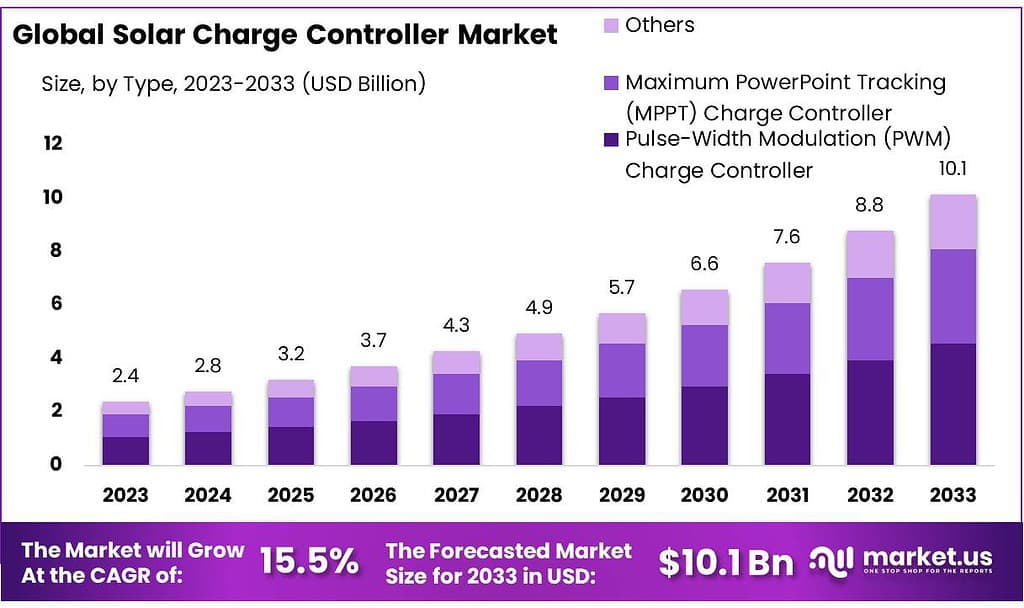
The Solar Charge Controller Market size is expected to be worth around USD 10.1 billion by 2033, from USD 2.4 Bn in 2023, growing at a CAGR of 15.5% during the forecast period from 2024 to 2033.
A solar charge controller, also known as a solar regulator, is a crucial component in photovoltaic systems. Its primary function is to regulate the voltage and current from solar panels to ensure efficient and safe charging of batteries.
By preventing overcharging and over-discharging, the solar charge controller enhances battery lifespan and safeguards the entire solar power system. It acts as a critical interface between the solar panels and the batteries, optimizing energy utilization and providing protection against potential damage.
Key Takeaways
- Market Growth: The Solar Charge Controller Market is set to reach USD 10.1 billion by 2033, witnessing a robust 15.5% CAGR from 2023’s USD 2.4 billion.
- Commercial Leadership: The commercial segment held a substantial 54.7% revenue share in 2021, with expectations of the most growth in the forecast period.
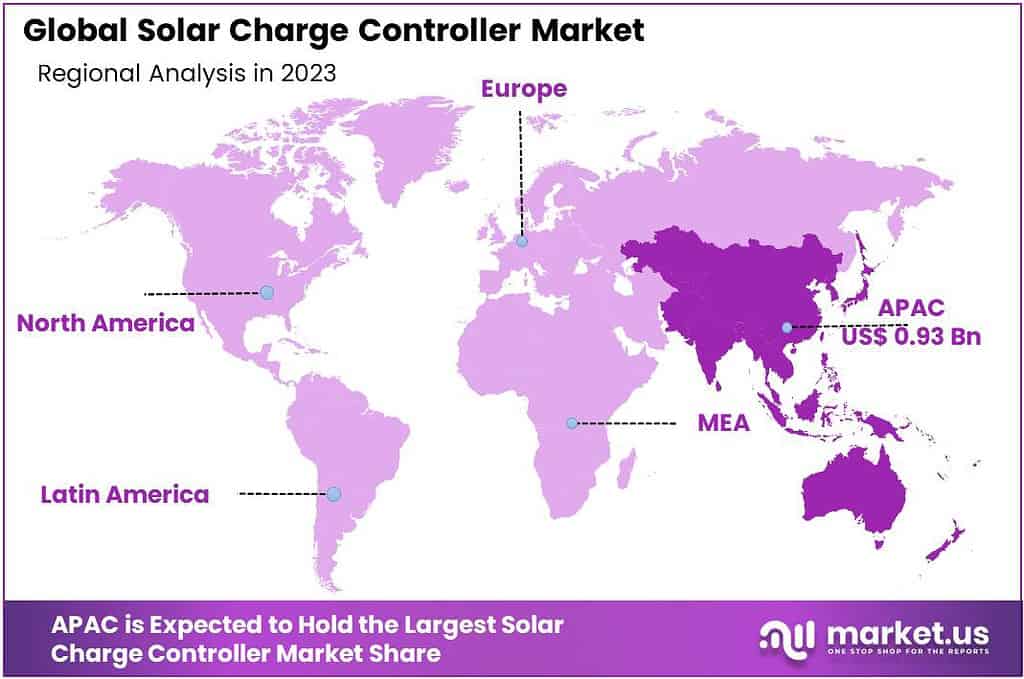
- Regional Insights: Asia Pacific (APAC) dominated with over 38.5% revenue share in 2023, with forecasted growth driven by China. North America is projected to grow at a 15.9% CAGR.
Type Analysis
In 2023, the Pulse-Width Modulation (PWM) Charge Controller dominated the Solar Charge Controller Market, accounting for more than 44.9% of the market share. PWM controllers have become an attractive option due to their simplicity and cost-efficiency. PWMs manage electricity flows between solar panels and batteries by periodically interrupting power flow – an inefficient solution compared to more sophisticated types but widely adopted due to affordability in smaller solar systems.
Maximum PowerPoint Tracking (MPPT) Charge Controllers have steadily gained ground due to their advanced technology. MPPT controllers optimize energy harvest from solar panels by continuously tracking and adjusting electrical operating point power points to extract maximum power from them, with their higher efficiency converting solar energy into usable electricity making them an attractive option for larger solar installations, despite their higher costs compared to PWM controllers.
Other types of charge controllers, while not as prevalent in the market as PWM or MPPT controllers, offer specific functionalities catering to unique solar setups or niche requirements. These controllers might include features like temperature compensation, programmable settings, or specialized designs to suit particular solar system configurations or challenging environmental conditions. Their usage is more specific and targeted towards distinct user needs within the solar energy landscape.
Market players are now investing in MMPT technology to improve power outputs using charge controller devices. Xantrex is an example of a company that manufactures advanced MMPT charging controllers. These charge controllers increase the daily energy harvest by 30% compared to conventional Pulse Width Modulation technology. This device has dual battery bank outputs to charge house and starter batteries.
By Battery Compatibility
In 2023, Lead-Acid batteries dominated the solar charge controller market by battery compatibility, securing a significant market share. This dominance is attributed to the widespread use of Lead-Acid batteries in solar power systems, especially in off-grid applications.
The compatibility and reliability of solar charge controllers with Lead-Acid batteries make them a preferred choice for various solar energy setups. These controllers efficiently manage the charging process, ensuring optimal performance and longevity of Lead-Acid batteries in solar applications. The lead-acid segment’s strong market share signifies its continued prominence in the solar charge controller landscape.
Application Analysis
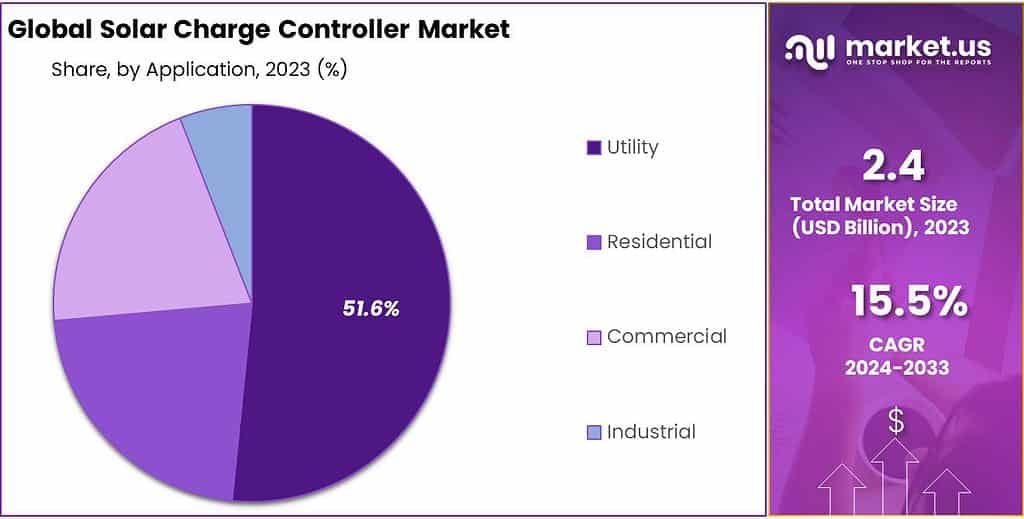
The commercial segment had a 54.7% revenue share in 2021 and will see the most growth over the forecast period. Demand for the solar charge controller is expected to rise with the rising power demand from communication base stations and data centers. The controller controls the battery’s health and ensures optimal functioning in commercial spaces.
The forecast period will see significant growth in the industrial segment. The MPPT solar charge controllers do not include load output terminals and are designed for large-scale projects. The controllers can be incorporated with massive off-grid converters in large-scale solar arrays. The forecast period will see a rise in demand for clean electricity and an increase in industrial-scale projects.
The market share of the residential segment was smaller than that of the industrial and commercial segments in 2021. In the residential segment, solar energy is a reliable source of secondary energy and provides power for all household appliances.
A solar charge controller is installed in residential solar panels. It monitors PV panel’s current flow and batteries over the day and blocks discharge flow back to panels during the night.
Key Market Segments
Type
- Pulse Width Modulation
- Maximum Power Point Tracking (MPPT)
- Others
By Battery Compatibility
- Lead-Acid
- Lithium-Ion
- Nickel-Cadmium
- Others
Application
- Industrial
- Commercial
- Residential
Drivers
Rising Solar Installations: With the rapid adoption of solar energy worldwide, demand for charge controllers has skyrocketed. Installations across residential, commercial, industrial, and utility sectors necessitate efficient charge controllers capable of managing electricity flow from solar panels to batteries efficiently and regulating it as needed.
Technological Advancements: Ongoing innovations in solar technology, particularly charge controller systems such as Maximum PowerPoint Tracking (MPPT) and Pulse-Width Modulation (PWM), improve efficiency and performance. Consumers searching for effective ways to utilize solar energy are drawn towards these innovations as consumers seek newer strategies to utilize it more effectively.
Government Incentives and Policies: Government-backed subsidies, tax benefits, and policies encouraging renewable energy adoption boost the solar market. Furthermore, supportive regulations regarding clean energy encourage investments in solar installations which increases demand for charge controllers. Many people worry about pollution and greenhouse gases hurting our planet.
That’s why more folks are turning to clean energy, like solar power. Solar technology has grown immensely popular because of its potential to protect the environment without harming it in any way. This big interest in solar energy means more people want things like solar charge controllers to make it work well. Reduced Costs: Falling costs associated with solar panels and related equipment – such as charge controllers – have contributed significantly to market expansion. Lower equipment prices make solar energy more accessible, prompting more consumers to adopt it as a power solution.
Restraints
Cost Constraints, One of the primary challenges associated with the Solar Charge Controller Market is initial setup costs. High expenses related to solar panel installations and equipment purchases – including charge controllers – can be an impediment to solar energy adoption among residential and commercial consumers alike, thus impacting decision-making processes when making a solar energy decision.
Technological Limitations, Technological restrictions persist within solar charge controllers despite advancements, including limited energy storage capacities and overall efficiency issues that pose obstacles. Enhancing these areas further is imperative to improving overall system performance and reliability when facing adverse conditions or irregular energy demands.
Regulatory Uncertainties, Conflicting policies and regulatory frameworks surrounding renewable energy sources can hinder their market expansion. Changes or uncertainties regarding government incentives, subsidies or support programs for solar installations could influence investment decisions as well as overall demand for charge controllers.
Weather Dependency, Solar power production relies heavily on sunlight availability, leaving it susceptible to weather variations that reduce sunlight or cloud cover. As cloudy days or reduced sunlight due to climate variations can reduce solar production, its consistency requires charge controllers in order to manage energy flow more effectively. Overcoming these obstacles is essential to maintaining and expanding the Solar Charge Controller Market, and guaranteeing greater accessibility and dependability of solar energy systems.
Opportunities
Technological Innovation, The constant innovation and improvement in solar charge controller technologies represent a unique opportunity. Research and development efforts dedicated to increasing their efficiency, reliability and functionality lead to better-performing and more durable products that serve consumers’ ever-evolving needs, providing promising avenues of growth.
Off-Grid Market Growth, The increasing demand for off-grid solar solutions – particularly those located in remote regions or those without access to traditional electricity grids – offers considerable market expansion potential for charge controller manufacturers. They play a critical role in these setups by managing power distribution and storage efficiently; with increasing off-grid solutions becoming popular worldwide, charge controller manufacturers are set for growth as this demand for their solutions creates an opportunity.
Government Support and Incentives, Government policies that foster renewable energy adoption create favorable conditions for market expansion. Offering various financial incentives, subsidies, and regulatory support encourage solar power use can create an ideal setting to spur demand for charge controllers in solar installations.
Emerging Markets with Untapped Potential, Emerging markets experiencing rapid industrialization and urbanization – particularly those focused on renewable energy – represent unexplored territory for manufacturers. Tapping into these markets by providing cost-effective charge controllers tailored specifically to each region’s specific needs could present manufacturers with immense growth opportunities. Leveraging these opportunities can drive advancements in solar charge controller technology and expand adoption of solar energy solutions across different markets.
Challenges
Cost Constraints, While solar system costs have declined significantly overall, initial expenses associated with installation – particularly charge controllers – remain a significant barrier to widespread adoption, particularly among residential and commercial sectors. High upfront costs can inhibit widespread adoption. Technological Limitations, Charge controllers face challenges due to technological restrictions. Energy storage capacities and overall efficiency become factors when faced with irregular energy needs or adverse weather conditions, thus diminishing their effectiveness and hampering performance.
Regulatory Uncertainties. Unpredictable regulations and policies related to renewable energy installations present unique challenges. Any fluctuations or uncertainties regarding government incentives, tariffs, or support programs could have significant ramifications on investment decisions for solar projects; as well as potentially impact demand for charge controllers.
Solar power generation is weather-dependent, and variations in weather patterns can have a substantial effect on its output. Cloudy days or reduced sunlight may hinder solar system performance, necessitating charge controllers for managing energy flow efficiently. Overcoming these hurdles requires concerted efforts from industry members in addressing technological constraints, streamlining regulations and developing more cost-effective solutions that ensure continued adoption and growth of solar charge controllers.
Regional Analysis
Asia Pacific (APAC) had the largest revenue share at over 38.5% in 2023. It is expected to experience the fastest growth during the forecast period. China contributes the bulk of the revenue share. The region’s market growth will be boosted by the growing electricity demand-supply gap and expansion of commercial office spaces.
Significant investments in China’s solar industry have resulted in lower costs of solar PV production and increased R&D to advance the solar charge controller tech. China and India are attempting to reduce the amount of fossil fuel-based electricity they generate and increase their renewable energy share. The forecast period will see a rise in solar energy power generation adoption.
North America is forecast to grow at a 15.9% CAGR over the forecast period. Due to its growing solar industry, significant growth is expected in this region. Growing adoption of clean energy target policies to lower greenhouse gas emissions is expected to increase demand for solar energy and boost regional market growth during the forecast period.
Key Regions and Countries
- North America
- US
- Canada
- Mexico
- Europe
- Germany
- UK
- France
- Italy
- Russia
- Spain
- Rest of Europe
- APAC
- China
- Japan
- South Korea
- India
- Rest of Asia-Pacific
- South America
- Brazil
- Argentina
- Rest of South America
- MEA
- GCC
- South Africa
- Israel
- Rest of MEA
Market Share Analysis
Competitiveness in the solar charger industry is influenced by strong R&D, skilled people, technology sourcing, and a high level of forwarding Integration. Several industry players are now focusing their attention on MPPT technology because of its many benefits, while also expanding their product line.
Manufacturers are creating MPPT controllers for mobile device charging, rural electricity, low-power industrial, and other high-power uses. To increase the company’s sales and revenue, distribution channels like different online portals and third-party supply agreements, as well as direct supply to end-users, have been strengthened.
Key Market Players
- Morningstar Corporation
- Easy Photovoltech Private Limited
- Vispra Solar
- Luminous Power Technologies (P) Ltd
- Beijing Epsolar Technology Co., Ltd.
- Victron Energy
- Sollatek UK Limited
- OutBack Power Technologies
- Xantrex Technologies
- Genasun
- Wenzhou Xihe Electric Co.,Ltd
- Phocos
- Steca – A KATEK Brand
- Arise India Ltd
Recent Developments
- Victron Energy: Introduced the BlueSolar MPPT 150/70-Tr, a high-voltage MPPT controller designed for off-grid systems.









