


Report Overview
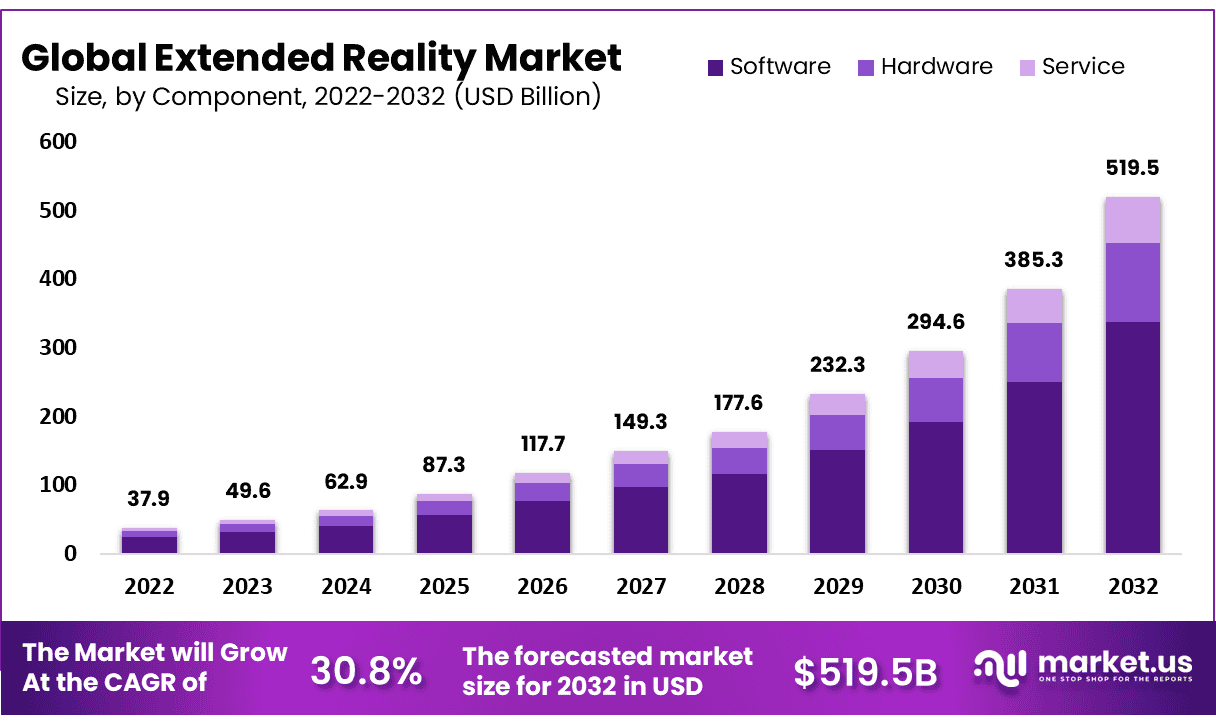
The Global Extended Reality (XR) Market size is expected to be worth around USD 519.5 Billion by 2032, from USD 49.6 Billion in 2023, growing at a CAGR of 30.8% during the forecast period from 2024 to 2033.
Extended Reality (XR) refers to a spectrum of technologies that combine virtual reality (VR), augmented reality (AR), and mixed reality (MR) to create immersive and interactive experiences. XR encompasses a wide range of applications that blend virtual elements with the real world, enabling users to engage with digital content in a more seamless and engaging manner.
The XR market has been rapidly expanding in recent years, driven by advancements in hardware, software, and content development. VR, AR, and MR technologies have become more accessible and affordable, leading to increased adoption across industries such as gaming, entertainment, education, healthcare, and manufacturing.
In the dynamic landscape of the Extended Reality (XR) market in 2022, Meta emerged as a dominant force within the consumer Virtual Reality (VR) sector, commanding an impressive estimated 80% market share, primarily attributed to the robust sales of its Meta Quest headsets.
This substantial market presence underscores Meta’s strategic focus on VR/AR technologies, as evidenced by its significant investment exceeding $10 billion in its Reality Labs segment during the 2021-2022 period. This financial commitment highlights the company’s ambition to lead and expand the VR/AR ecosystem, reflecting its confidence in the transformative potential of XR technologies.
Sony, with its PlayStation VR, maintained its leadership in the tethered VR segment, holding a 35% market share in 2022. The company’s sustained dominance in this segment is indicative of the strong synergy between its VR offerings and the extensive PlayStation gaming ecosystem. The anticipation surrounding Sony’s development of a next-generation PS VR, expected to launch in 2023, signals its ongoing commitment to enhancing the VR gaming experience, thereby reinforcing its position in the market.
The total investment in the XR market in 2022 reached approximately $16 billion, a figure that demonstrates the sector’s rapid growth and the increasing interest from tech giants and investors alike. Projections suggest that this investment volume could escalate to between $20 and $22 billion in 2023, contingent upon Apple’s speculated entry into the XR market and the sustained investment levels by incumbents such as Meta and Microsoft.
Key Takeaway
- Market Growth Projection: The extended reality market is projected to experience staggering growth with an expected compound annual growth rate of 30.8% between 2023-2032, reaching USD 519.5 billion by 2032.
- Driving Factors: The market’s expansion is being propelled by several factors, including an increasing prevalence of AR/VR gaming technology and advancements in hardware/software like powerful processors and enhanced graphics capabilities that make extended reality more immersive for both consumers and businesses alike.
- Dominant Segments: In terms of components, the software segment holds the largest share, accounting for 65% of the market in 2022. Regarding technology, AR (Augmented Reality) holds the dominant position, with a market share of 55% in 2022. Additionally, the gaming sector stands as the most lucrative end-user segment, capturing the largest revenue share of 45%.
- Growth Opportunities: The industry presents numerous growth opportunities, primarily driven by the continued adoption of XR technologies across various sectors such as gaming, healthcare, education, and retail. Moreover, the development of advanced hardware and software is expected to create more immersive XR experiences.
- Latest Trends: Integration of technologies such as AI, 5G networks, and blockchain is a prominent trend, indicating the continuous evolution of the extended reality industry. Additionally, the use of XR for virtual events and remote collaboration, as well as its application in healthcare for therapies and mental health treatments, are gaining significant traction.
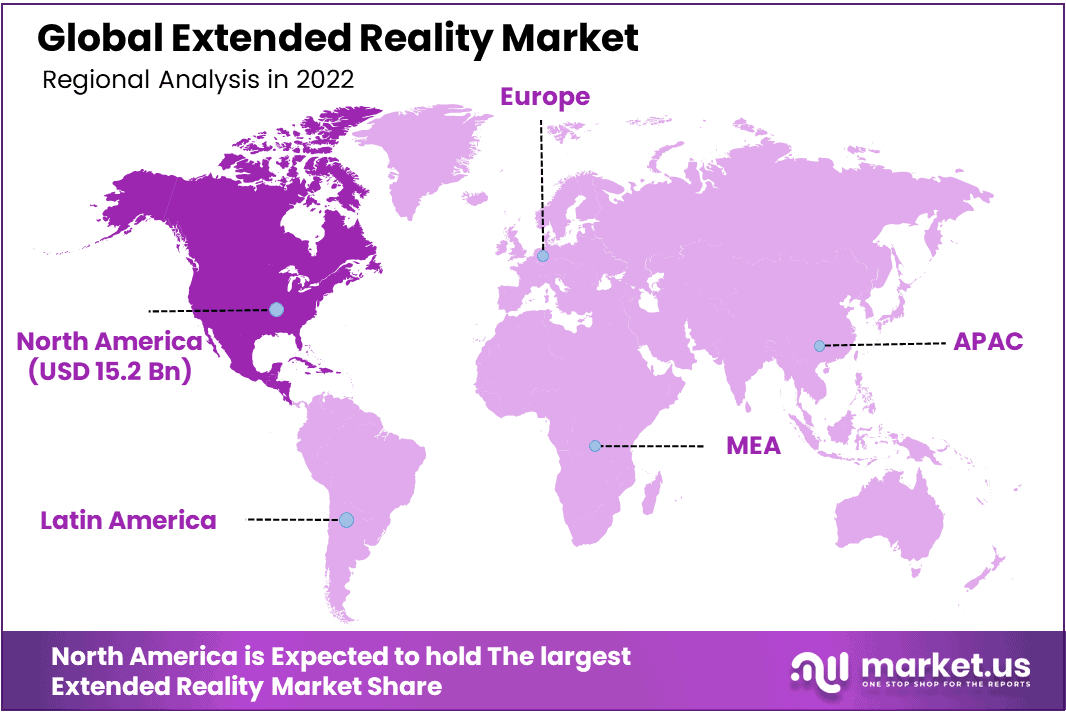
- Regional Dominance: North America leads the extended reality market, capturing the largest share of 40% in 2022 and anticipated to register a CAGR of 32.2% during the forecast period. The region’s growth is propelled by factors such as the increasing use of smartphones, the deployment of 5G, and the rising demand for extended technology across diverse applications.
- Key Market Players: Major players in the extended reality market include Microsoft, Google, Apple, Samsung, HTC, Sony, Qualcomm, Magic Leap, and Unity Technologies. These companies heavily invest in research and development to enhance their XR services, improve user experiences, and expand their market reach.
- Recent Developments: Notable recent developments in the industry include HTC Corporation’s launch of the VIVE XR Elite, a versatile mixed reality (MR) and virtual reality (VR) headset, and Samsung Electronics Co., Ltd.’s introduction of Dreamground, an innovative AR experience aimed at promoting creative thinking and discovery.
By Component Analysis
By Component Analysis, the software segment is projected to be the most lucrative in the global extended reality market, with a significant CAGR of 31%. In 2022, the software segment is expected to account for a substantial revenue share of 65%. This growth can be attributed to the increasing demand for software applications that drive immersive experiences in extended reality environments.
The software segment includes various components such as content creation tools, development platforms, and application software that enable the creation, deployment, and management of extended reality experiences. As organizations across industries recognize the value of extended reality in enhancing their products and services, the demand for software solutions will continue to rise, driving the growth of this segment.
By Technology Analysis
By Technology Analysis, AR (Augmented Reality) technology is estimated to be the most lucrative segment in the global extended reality market, with a significant market share of 55% and a projected CAGR of 29.9% in 2022.
AR technology overlays digital content onto the real world, enhancing user experiences and enabling a wide range of applications in gaming, retail, healthcare, and more. The increasing adoption of AR in smartphones, smart glasses, and other devices is driving the growth of this segment. With its potential to blend the digital and physical worlds seamlessly, AR technology offers immense opportunities for businesses to deliver interactive and engaging experiences to their customers.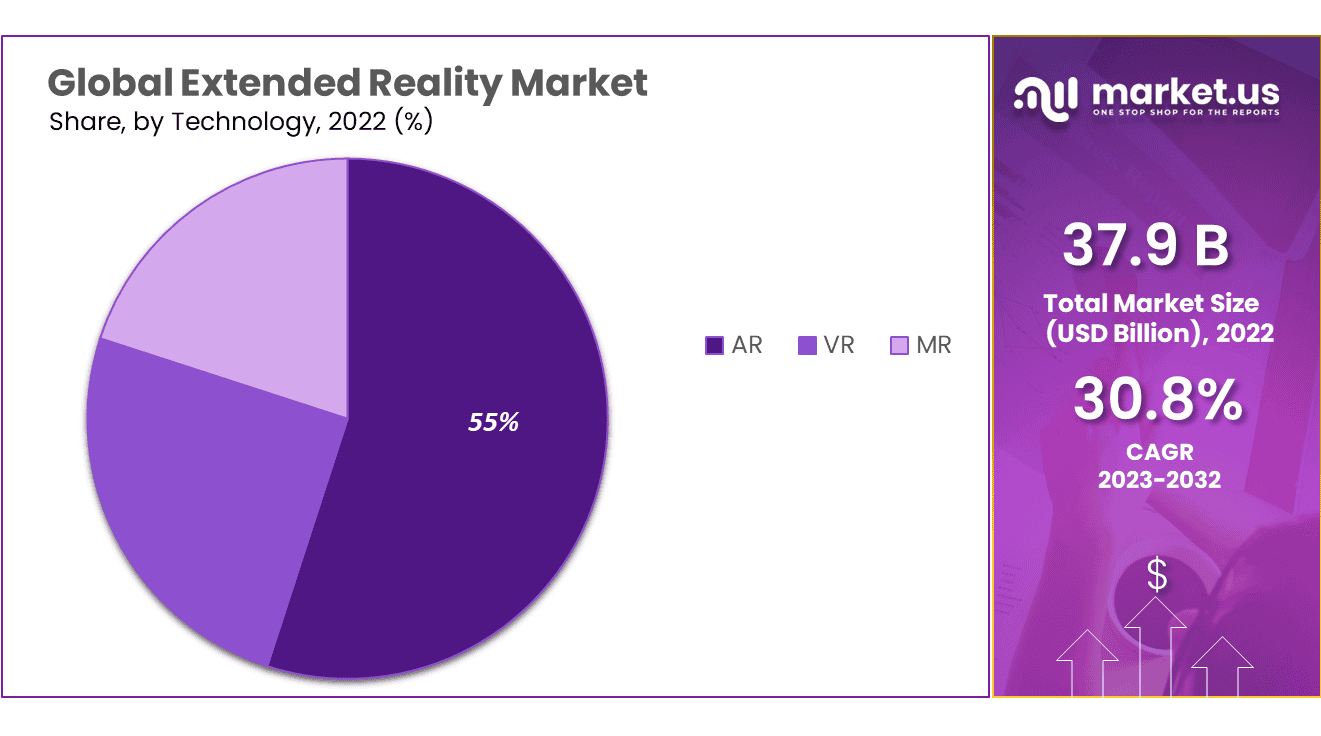
By End-User Analysis
By End-User Analysis, the gaming segment is estimated to be the most lucrative in the global extended reality market, accounting for the largest revenue share of 45% and projected to grow at a CAGR of 33.4% during the forecast period. The gaming industry has been at the forefront of adopting extended reality technologies, leveraging VR and AR to create immersive and realistic gaming experiences. The increasing popularity of VR gaming headsets and the development of AR-enabled mobile games have contributed to the growth of this segment.
As the demand for interactive and immersive gaming experiences continues to rise, the gaming segment is expected to maintain its dominance in the extended reality market. Furthermore, the integration of extended reality technologies into gaming consoles, PCs, and mobile devices is expected to drive the growth of this segment in the coming years.
Key Market Segments
Based on Component
- Hardware
- Software
- Service
Based on Technology
- AR
- VR
- MR
Based on End-User
- Gaming
- Retail
- Healthcare
- Manufacturing
- Media and Entertainment
- Education
- Aerospace and Defense
- Other End-Users
Driver
Availability of affordable VR devices
The availability of affordable virtual reality (VR) devices serves as a significant driver for the extended reality (XR) market. As VR technology becomes more accessible due to declining hardware costs and the introduction of budget-friendly devices, it opens up new opportunities for widespread adoption across various sectors.
Affordable VR headsets enable more consumers and businesses to experience immersive virtual environments, driving demand for XR content and applications. This accessibility fuels market growth by expanding the user base and stimulating innovation in VR technology, ultimately contributing to the overall development and advancement of the XR ecosystem.
Restraint
Excessive use of extended reality devices cause health issues
An important restraint facing the extended reality (XR) market is the potential for excessive use of XR devices to cause health issues. Prolonged exposure to virtual and augmented reality environments can lead to various physical and mental health concerns, including eye strain, headaches, motion sickness, and disorientation.
Moreover, extended use of XR devices may exacerbate existing conditions such as myopia or trigger symptoms of cybersickness. These health concerns pose challenges for widespread adoption and acceptance of XR technology, as users may be hesitant to engage with immersive experiences due to fears of adverse health effects. Addressing these concerns requires ongoing research, development of ergonomic designs, and implementing best practices for responsible XR usage to mitigate health risks and promote user well-being.
Opportunity
Growth of global travel and tourism industry
The growth of the global travel and tourism industry presents a significant opportunity for the extended reality (XR) market. XR technologies, including virtual reality (VR) and augmented reality (AR), offer innovative solutions for enhancing the travel experience, enabling users to explore destinations virtually, preview accommodations, and engage in immersive cultural experiences from the comfort of their homes.
With the rise of remote work and digital nomadism, XR-powered virtual travel experiences become increasingly relevant, providing opportunities for destination marketing, virtual tours, and travel planning tools. By leveraging XR technology to create compelling and interactive travel experiences, businesses in the travel and tourism industry can attract new customers, increase engagement, and differentiate themselves in a competitive market landscape.
Challenge
Display latency and limited field of view
A significant challenge confronting the extended reality (XR) market is the issue of display latency and limited field of view in XR devices. Display latency, or the delay between user input and the corresponding visual response in VR or AR environments, can lead to motion sickness, discomfort, and a suboptimal user experience. Similarly, the limited field of view in many XR headsets restricts the user’s peripheral vision, reducing immersion and potentially causing disorientation or feelings of claustrophobia.
Overcoming these technical challenges requires advancements in display technology, optimization of hardware and software integration, and innovation in design to create XR devices that deliver smooth, low-latency experiences with expansive fields of view. Addressing these challenges is essential for enhancing user comfort, improving adoption rates, and unlocking the full potential of extended reality technologies across diverse applications and industries.
Regional Analysis
North America is poised to maintain its stronghold as the most dominant region in the global extended reality (XR) market, boasting the largest market share of 40%. This significant market presence underscores North America’s pivotal role in driving innovation and adoption of XR technologies across various industries. The region’s robust ecosystem of tech companies, research institutions, and venture capital firms, coupled with a strong culture of innovation and entrepreneurship, positions it as a hub for XR development and investment.
Furthermore, North America is projected to sustain remarkable growth momentum, with a forecasted Compound Annual Growth Rate (CAGR) of 32.2% during the forecast period. This impressive growth rate reflects the region’s continued leadership in advancing XR technology and its applications, fueled by ongoing investments, partnerships, and strategic initiatives.
The convergence of XR with other transformative technologies such as artificial intelligence, 5G connectivity, and the Internet of Things further accelerates market expansion in North America, driving demand for XR solutions across diverse sectors including gaming, entertainment, healthcare, education, and enterprise.
Note: Actual Numbers Might Vary in the final report
Key Regions and Countries Covered in this Report
- North America
- The US
- Canada
- Mexico
- Western Europe
- Germany
- France
- The UK
- Spain
- Italy
- Portugal
- Ireland
- Austria
- Switzerland
- Benelux
- Nordic
- Rest of Western Europe
- Eastern Europe
- Russia
- Poland
- The Czech Republic
- Greece
- Rest of Eastern Europe
- APAC
- China
- Japan
- South Korea
- India
- Australia & New Zealand
- Indonesia
- Malaysia
- Philippines
- Singapore
- Thailand
- Vietnam
- Rest of APAC
- Latin America
- Brazil
- Colombia
- Chile
- Argentina
- Costa Rica
- Rest of Latin America
- Middle East & Africa
- Algeria
- Egypt
- Israel
- Kuwait
- Nigeria
- Saudi Arabia
- South Africa
- Turkey
- United Arab Emirates
- Rest of MEA
Key Players Analysis
Microsoft, Google, and Apple are the key players in the XR Market. Other key players include Samsung, HTC, Sony Qualcomm, Magic Leap, and Unity Technologies. These companies invest thoroughly in research & development to enhance their XR service, improve the user experience, and expand their reach. The XR industry is driven by the increasing demand from different industries such as gaming, healthcare & education.
Market Key Players
- Qualcomm Technologies Inc.
- Accenture PLC
- SoftServe Inc.
- SphereGen Technologies LLC
- Northern Digital Inc.
- Microsoft Corporation
- Softweb Solutions Inc. (Avnet Inc.)
- Tata Elxsi Limited
- Varjo Technologies Oy
- Talespin Reality Labs Inc
- Other Key Players
Recent Developments
- In February 2023, Sony released a new gaming device called PlayStation VR2 and PlayStation VR2 Sense Controller Charging Station. These products were designed to provide players with a unique and immersive gaming experience. The PS VR2 comes with some exciting features like headset feedback, eye tracking, 3D audio, and adaptive triggers. The PS VR2 Sense controllers also have haptic feedback, which adds a new level of realism to gameplay.
- In January 2023, HTC introduced their latest consumer flagship, the VIVE XR Elite. This device combines both mixed reality (MR) and virtual reality (VR) technologies into one compact and lightweight headset. It offers a range of powerful features and is suitable for various activities such as gaming, work, exercise, and more. It’s an excellent choice for people looking for a versatile and enjoyable experience.









