


Report Overview
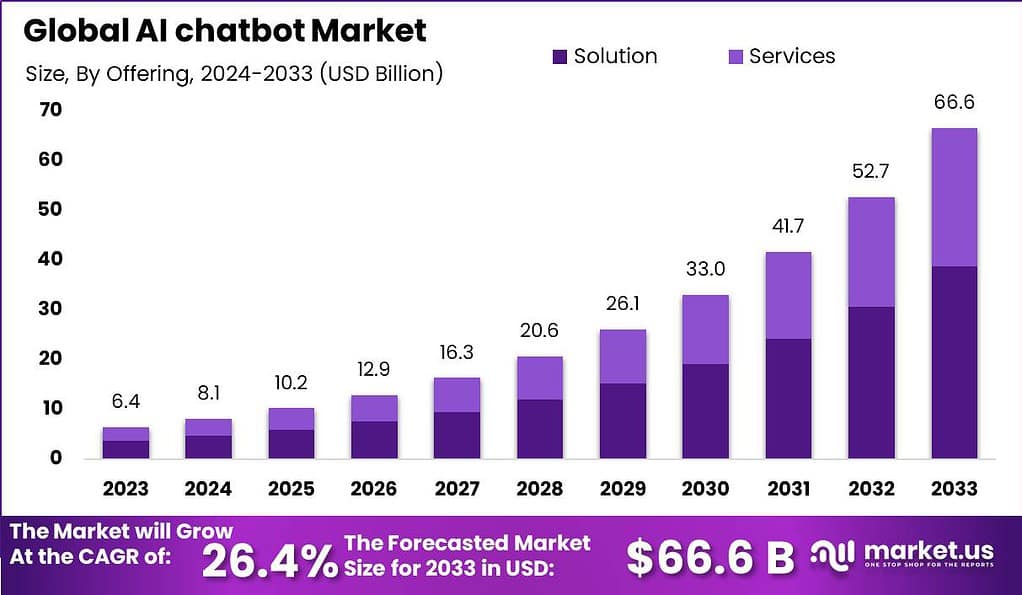
The Global AI chatbot Market size is expected to be worth around USD 66.6 Billion By 2033, from USD 6.4 Billion in 2023, growing at a CAGR of 26.4% during the forecast period from 2024 to 2033.
An AI chatbot is a software application designed to simulate conversation with human users, especially over the internet. It uses artificial intelligence (AI) techniques, including natural language processing (NLP), to understand user queries and generate responses. These chatbots are used in various applications, such as customer service, information retrieval, and ecommerce, providing users with immediate, round-the-clock assistance.
The AI chatbot market is experiencing rapid growth due to increased demand for automated customer support services and advancements in AI technology. Companies across industries are adopting AI chatbots to enhance customer interaction, reduce operational costs, and improve service efficiency.
The market is supported by the growing integration of AI capabilities in messaging platforms and the continuous development of machine learning models that make chatbots smarter. As businesses seek innovative ways to engage with customers, the AI chatbot market is expected to continue expanding significantly.
Moreover, AI chatbots offer scalability and cost-effectiveness for businesses. They can handle multiple conversations simultaneously, ensuring quick and efficient customer support. This capability allows businesses to handle a large volume of customer inquiries without the need to hire additional personnel, resulting in cost savings.
The advancement of AI technologies has also contributed to the growth of the chatbot market. Natural language processing capabilities have improved significantly, enabling chatbots to understand and respond to user queries more accurately. Machine learning algorithms allow chatbots to continuously learn and improve their responses based on user interactions, leading to more personalized and effective conversations.
In addition to customer service, AI chatbots are being utilized in various other applications. They can assist in lead generation, sales support, and product recommendations. Chatbots are also being integrated into messaging platforms and social media channels, allowing businesses to engage with customers on platforms they are already using.
The Global Generative AI in Chatbots Market is projected to grow significantly in the next decade. From a market size of USD 151.0 million in 2023, it is expected to reach approximately USD 1,714.3 million by 2033, with a compound annual growth rate (CAGR) of 27.5% from 2024 to 2033.
Similarly, the Global Chatbot Market itself was valued at USD 6 billion in 2023 and has been growing at a steady pace. With an annual growth rate of 23.9%, it is forecasted to achieve revenues of USD 42 billion by 2032.
The adoption of chatbots across different digital platforms has surged by 92% in recent years, indicating a growing trend towards automated customer interactions. Surveys show that 33% of consumers consider their live chat experiences as “very effective” in resolving their issues, and 68% appreciate the quick responses they receive from chatbots.
This positive reception is further highlighted by the fact that over 90% of consumers believe businesses should implement chatbots. Moreover, companies that have integrated chatbots into their operations report a 67% increase in sales, underscoring the significant impact of this technology on business performance.
Key Takeaways
- The Global AI chatbot Market size is expected to be worth around USD 66.6 Billion By 2033, growing at a CAGR of 26.4% during the forecast period from 2024 to 2033.
- In 2023, the Solution segment held a dominant market position within the AI chatbot market, capturing more than a 58.2% share.
- In 2023, the Cloud segment held a dominant market position within the AI chatbot market, capturing more than a 64.7% share.
- In 2023, the Website segment held a dominant market position within the AI chatbot market, capturing more than a 44.3% share.
- In 2023, the Retail and E-Commerce segment held a dominant market position in the AI chatbot market, capturing more than a 32.4% share.
- 47% of organizations will soon be using chatbots for customer care, and 40% plan to deploy virtual assistants. Interestingly, over 50% of enterprises are expected to invest more annually in bots and chatbot development than in traditional mobile app development.
- It’s projected that between 75-90% of queries will be handled by bots by 2024, indicating a significant shift towards automated customer service solutions. This could lead to savings of up to 50% in customer support costs.
- Moreover, more than 80% of employees report that AI boosts their productivity. Currently, as many as 54% of companies have already incorporated conversational AI into their operations.
- For businesses in certain industries, chatbot conversion rates can reach as high as 70%, demonstrating their effectiveness in engaging customers and driving business outcomes.
Offering Analysis
In 2023, the Solution segment held a dominant market position within the AI chatbot market, capturing more than a 58.2% share. This leadership can be attributed to several key factors. Firstly, the increasing adoption of AI solutions across various customer service platforms has fueled demand for robust chatbot solutions. These solutions are integral in automating responses and managing a high volume of user interactions without human intervention, leading to significant efficiency gains and cost reductions for businesses.
Moreover, advancements in AI and machine learning technologies have enhanced the capabilities of chatbot solutions, making them more appealing to businesses seeking sophisticated conversational agents. These solutions can handle complex queries with greater accuracy, learn from interactions to improve over time, and integrate seamlessly with existing business systems, such as CRM and ERP systems.
The push towards digital transformation initiatives by enterprises has further bolstered the adoption of AI chatbots as a pivotal component of their customer engagement strategies. The dominance of the Solution segment is also supported by the substantial investments in R&D by leading tech companies, aiming to deliver more intuitive and intelligent systems.
These investments have resulted in the development of AI chatbots that can provide personalized experiences, predict user needs, and initiate proactive actions to address customer requirements. This level of sophistication in chatbot solutions not only enhances customer satisfaction but also drives further market growth by setting new standards for automated customer interaction platforms.
Deployment Analysis
In 2023, the Cloud segment held a dominant market position within the AI chatbot market, capturing more than a 64.7% share. This dominance is largely due to the flexibility, scalability, and cost-effectiveness that cloud-based solutions offer.
Businesses, especially those with fluctuating demand and the need for high scalability, find cloud deployment highly advantageous. It allows them to scale their chatbot solutions up or down based on real-time needs without significant upfront investments in physical infrastructure.
Furthermore, cloud-based AI chatbots benefit from continuous updates and improvements made possible by cloud computing technology. Providers can deploy updates directly to the cloud infrastructure, ensuring that all users benefit from the latest advancements in AI and machine learning without additional costs or effort on their part. This ease of maintenance and upgrade, coupled with reduced operational costs, makes the Cloud segment particularly attractive.
The leadership of the Cloud segment is also reinforced by the increasing trust in cloud security measures and the growing adoption of mobile and remote work environments, which demand highly accessible and flexible solutions. As businesses continue to prioritize digital transformation and customer experience enhancements, cloud-based AI chatbots are set to maintain their leading position in the market, providing enterprises with powerful tools to engage with customers effectively and efficiently.

Application Analysis
In 2023, the Website segment held a dominant market position within the AI chatbot market, capturing more than a 44.3% share. This prominence is largely due to the critical role websites play as the primary digital storefront for many businesses, where the initial customer interaction often takes place.
AI chatbots on websites provide a dynamic communication tool that engages visitors instantly, offering immediate assistance like answering FAQs, guiding through site navigation, and helping in transaction processes. This immediate interaction enhances user experience and can significantly increase conversion rates.
Additionally, the integration of AI chatbots into websites allows businesses to collect valuable insights about user behavior, preferences, and feedback, which can be used to tailor marketing strategies and improve service offerings. This capability to act not only as a customer service agent but also as a data collection tool makes website-based chatbots particularly valuable to businesses aiming to enhance their digital presence and customer understanding.
The prevalence of the Website segment is also underpinned by technological advancements that make it easier to deploy sophisticated chatbots capable of natural language processing and personalized responses. As businesses continue to invest in digital transformation, the importance of having an effective online interaction model escalates, ensuring that AI chatbots remain an integral part of the website user experience. This trend is expected to continue as more businesses recognize the importance of enhancing customer engagement on their primary digital channels.
Industry Vertical Analysis
In 2023, the Retail and E-Commerce segment held a dominant market position in the AI chatbot market, capturing more than a 32.4% share. This segment’s leadership is driven by the crucial role that AI chatbots serve in enhancing customer interaction and streamlining online shopping experiences.
Retailers and e-commerce platforms utilize AI chatbots to provide instant customer service, including support for order inquiries, product information, and troubleshooting, which significantly improves customer satisfaction and loyalty. Moreover, AI chatbots in this sector are adept at personalizing shopping experiences by recommending products based on customer interactions and previous shopping behavior.
This capability not only increases sales but also boosts user engagement by offering a more tailored shopping journey. The integration of chatbots has also been pivotal in handling large volumes of customer queries efficiently, especially during peak shopping periods like holidays and sales events, which helps maintain high service quality without additional staffing costs.
The prominence of the Retail and E-Commerce segment is further supported by the ongoing digital transformation in retail. As more businesses shift online or enhance their e-commerce strategies, the demand for automated and intelligent customer service solutions like AI chatbots continues to grow. This trend is expected to persist as retail and e-commerce companies increasingly rely on technology to meet rising consumer expectations and competitive pressures in the digital marketplace.
Key Market Segments
By Offering
- Solution
- Services
By Deployment
- Cloud
- On-Premise
By Application
- Website
- Contact Centers
- Social Media
- Mobile Applications
By Industry Vertical
- Banking
- Financial Services
- Insurance (BFSI)
- Retail and E-commerce
- Information Technology & Telecom
- Healthcare
- Media & Entertainment
- Others
Driver
Enhanced Customer Engagement and Cost Efficiency
AI chatbots significantly enhance customer engagement and operational efficiency, driving their adoption across various industries. By providing round-the-clock service, chatbots handle routine inquiries without human intervention, allowing businesses to deliver instant responses to customer queries and increase overall satisfaction.
This not only improves customer retention rates but also optimizes staffing by freeing up human agents for more complex tasks, thus reducing operational costs. The ability of chatbots to manage thousands of interactions simultaneously without compromising the quality of service makes them highly valuable for businesses looking to scale efficiently in competitive markets.
Restraint
Privacy Concerns and Data Security Issues
Privacy concerns and data security issues present significant restraints in the adoption of AI chatbots. Handling sensitive customer information requires stringent data protection measures. However, the risk of data breaches and unauthorized access remains a major concern, as chatbots can potentially expose personal data to vulnerabilities.
Additionally, the use of chatbots raises questions about compliance with international data protection regulations, such as GDPR in Europe. Companies must invest heavily in securing chatbot interactions, which can deter smaller businesses or those in highly regulated industries from implementing these technologies.
Opportunity
Integration with Emerging Technologies
The integration of AI chatbots with emerging technologies such as blockchain, augmented reality (AR), and the Internet of Things (IoT) represents a substantial opportunity. For example, blockchain can enhance the security and transparency of chatbots, making them more trustworthy for handling transactions and sensitive information.
Similarly, combining chatbots with AR and IoT devices can create more immersive and interactive customer experiences, opening up new avenues for customer engagement and service delivery. This convergence of technologies could redefine interaction models in sectors like retail, healthcare, and real estate.
Challenge
Maintaining Human-like Interactions
One of the major challenges in deploying AI chatbots is maintaining a conversation that feels genuinely human-like and empathetic. While AI technologies have advanced, creating a chatbot that accurately understands nuances, emotions, and subtleties in human communication remains difficult.
Users can become frustrated if chatbots fail to comprehend complex queries or provide irrelevant responses. The ongoing challenge is to enhance natural language processing capabilities and emotional intelligence in chatbots to ensure they can handle a wide range of interactions without diminishing user satisfaction.
Growth Factors
- Increased Demand for Automation: Businesses are continuously seeking ways to automate customer service and operational processes to enhance efficiency and reduce costs. AI chatbots play a crucial role in automating interactions, handling routine inquiries, and providing 24/7 support without the need for human intervention.
- Advancements in AI and Machine Learning: The rapid advancements in AI, machine learning, and natural language processing technologies have significantly improved the capabilities of chatbots. These enhancements enable chatbots to offer more accurate, context-aware, and personalized responses, increasing their utility and adoption.
- Rise of Messaging Platforms: The proliferation of messaging platforms like WhatsApp, Facebook Messenger, and WeChat has created new channels for businesses to engage with customers. AI chatbots integrated into these platforms allow companies to leverage existing user bases and provide seamless support and engagement directly where customers are active.
- Growing Emphasis on Customer Experience: There is an increasing focus among businesses on improving customer experience as a differentiator in competitive markets. AI chatbots enhance customer interactions by providing quick responses, which is pivotal in improving customer satisfaction and loyalty.
- Expansion into New Verticals: Initially popular in customer service, AI chatbots are now expanding into new verticals such as healthcare for patient engagement, finance for personalized banking advice, and even government services for public assistance. This diversification is driving further growth in the chatbot market.
Emerging Trends
- Conversational AI for Complex Interactions: There is a growing trend toward developing chatbots capable of managing more complex and meaningful conversations. These advanced AI systems are being trained to understand context better and handle multi-turn conversations, mimicking human-like interactions more closely.
- Voice-Activated Chatbots: As voice-assisted technology becomes more prevalent, voice-activated chatbots are emerging as a significant trend. These chatbots are being integrated into devices and applications, allowing users to interact with systems through voice commands, enhancing accessibility and user-friendliness.
- AI Chatbots with Emotional Intelligence: Emerging developments in AI are focusing on emotional intelligence, enabling chatbots to recognize and respond to the emotional state of users. This trend is particularly influential in sectors like healthcare and customer support, where understanding emotional cues can significantly enhance interaction quality.
- Integration with IoT Devices: AI chatbots are increasingly being integrated with IoT devices to provide more dynamic and context-aware services. For example, a chatbot could interact with smart home devices to provide users with real-time information and control over their home environments.
- Use of Chatbots for Analytics and Insights: Beyond customer interaction, chatbots are being used to gather and analyze user data, providing businesses with insights into customer preferences, behavior, and feedback. This trend is enabling more data-driven decision-making and personalized marketing strategies.
Regional Analysis
In 2023, North America held a dominant market position in the AI chatbot market, capturing more than a 34.8% share. This leadership is primarily driven by the robust technological infrastructure and the early adoption of advanced AI technologies in the region. The demand for AI chatbot in North America was valued at USD 2.2 billion in 2023 and is anticipated to grow significantly in the forecast period.
North America, especially the United States, is home to leading AI technology companies and startups pioneering in the development of AI solutions, including chatbots. This concentration of tech giants and innovative startups provides a strong foundation for the adoption and growth of AI chatbots across various industries.
Furthermore, the region benefits from a highly digital-savvy consumer base that readily adopts new technologies, creating a fertile environment for AI chatbots to thrive in customer service, healthcare, and retail sectors. The presence of a competitive business environment also pushes companies in North America to adopt efficient and cutting-edge technologies like AI chatbots to enhance customer engagement and operational efficiency.
Additionally, significant investments in AI research and the supportive regulatory framework in North America contribute to the growth of the AI chatbot market. Businesses in North America are increasingly leveraging AI chatbots to gain competitive advantages such as cost reduction, improved customer service, and innovative product offerings.

Key Regions and Countries
- North America
- US
- Canada
- Europe
- Germany
- France
- The UK
- Spain
- Italy
- Russia
- Netherlands
- Rest of Europe
- Asia Pacific
- China
- Japan
- South Korea
- India
- Australia
- Singapore
- Thailand
- Vietnam
- Rest of APAC
- Latin America
- Brazil
- Mexico
- Rest of Latin America
- Middle East & Africa
- South Africa
- Saudi Arabia
- UAE
- Rest of MEA
Key Players Analysis
The AI chatbot market features a dynamic competitive landscape with several top key players driving innovation and growth. IBM is renowned for its sophisticated AI solutions, particularly in developing robust chatbots that serve various industry verticals with highly advanced conversational capabilities. Google and Microsoft are also pivotal, with their platforms, Dialogflow and Azure Bot Service respectively, offering extensive tools for building chatbots that integrate seamlessly with existing business infrastructures and cloud services.
OpenAI has made significant strides with innovative language models like GPT, which enhance the natural language processing capabilities of chatbots, making them more intuitive and human-like. Amazon leverages its AI expertise through Amazon Lex, providing a foundation for building conversational interfaces that are deeply integrated with other AWS services, enhancing both functionality and scalability.
NVIDIA contributes through its powerful GPU technologies that support the intensive computational needs of AI chatbot training models, ensuring faster and more efficient processing. Nuance Communications Inc. specializes in creating intelligent chatbot solutions that offer personalized customer interactions, especially in sectors like healthcare and telecommunications.
Top Key Players in the Market
- IBM
- OpenAI
- Microsoft
- Amazon
- NVIDIA
- Nuance Communications Inc.
- Aivo
- Acuvate
- Next IT Corp
- SAP
- SmartBots
Recent Developments
- IBM and Microsoft Collaboration: In 2023, IBM and Microsoft deepened their partnership to enhance the capabilities of AI chatbots through generative AI technologies. This collaboration has been particularly focused on improving efficiencies in healthcare and finance sectors by integrating advanced AI functionalities that can process and summarize complex data.
- NVIDIA and Microsoft have continued their long-standing collaboration to advance AI capabilities, particularly in generative AI applications for enterprises. In March 2024, they announced major integrations, leveraging NVIDIA’s latest AI technologies on Microsoft Azure, aimed at enhancing AI model training and deployment across industries









