


Report Overview
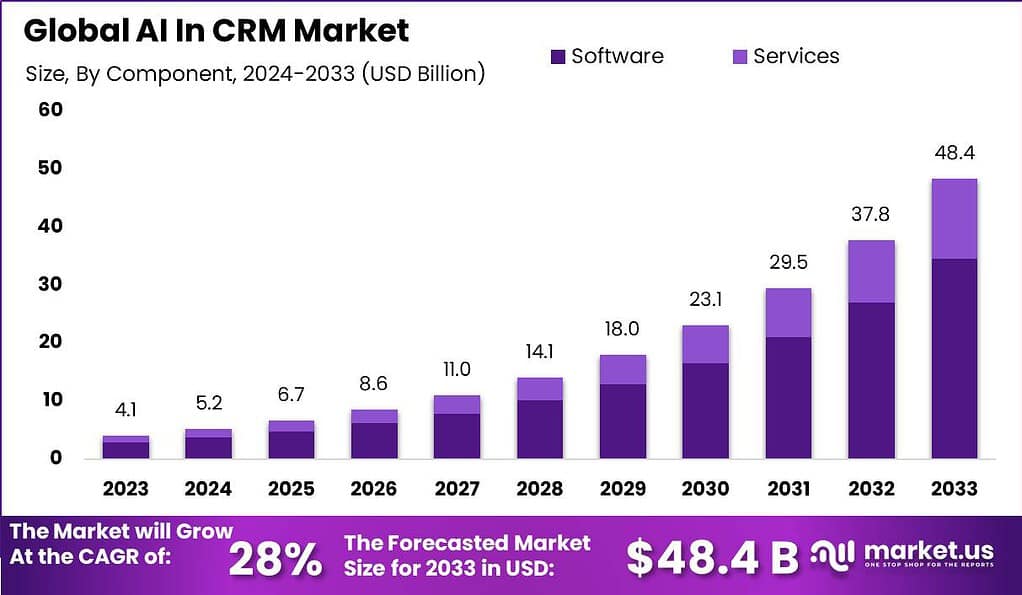
The Global AI In CRM Market size is expected to be worth around USD 48.4 Billion By 2033, from USD 4.1 Billion in 2023, growing at a CAGR of 28% during the forecast period from 2024 to 2033.
Artificial Intelligence (AI) has emerged as a game-changer in the field of Customer Relationship Management (CRM), revolutionizing how businesses interact and engage with their customers. AI-powered CRM systems utilize machine learning algorithms, natural language processing, and predictive analytics to automate tasks, personalize customer interactions, and provide actionable insights. These systems can analyze large volumes of customer data to predict behavior, identify trends, and recommend strategies, leading to improved customer satisfaction and retention.
The AI in CRM market has experienced robust growth and is projected to expand substantially in the coming years. This growth can be attributed to several factors, including the increasing adoption of AI technologies across various industries, the rising demand for enhanced customer experiences, and the need for efficient data management solutions. Businesses are increasingly recognizing the value of AI-driven CRM systems in gaining a competitive edge by fostering stronger customer relationships and optimizing sales and marketing efforts.
However, while AI brings immense opportunities for the CRM market, it also poses challenges. Data privacy and ethical considerations are critical aspects that need to be addressed when leveraging AI in CRM. Organizations must ensure the responsible and transparent use of customer data, adhering to regulatory and privacy guidelines.
In the evolving landscape of customer relationship management (CRM), a significant trend towards integrating artificial intelligence (AI) is evident. A notable 61% of companies are projected to adopt AI within their CRM systems in the next three years. This shift is anticipated to catalyze a 30-50% enhancement in customer response times, demonstrating AI’s capacity to streamline interactions efficiently.
The impact of AI on revenue generation is considerable, with 80% of marketing leaders acknowledging its direct influence on their company’s annual earnings. Speed remains a critical competitive advantage in customer dealings; 50% of deals are secured by vendors who respond first, an acceleration facilitated by AI in CRM platforms. Additionally, businesses that have incorporated AI into their CRM practices have witnessed a 44% surge in lead generation, emphasizing AI’s role in driving sales and marketing strategies.
Cost efficiency is another significant benefit reported by 41% of organizations, underscoring the economic advantage of AI integration in CRM systems. This integration also enhances offer acceptance rates by approximately 10%, further affirming AI’s effectiveness in improving business outcomes.
The ambition to expand AI utilization is robust, with 96% of surveyed enterprises planning to enhance their AI capabilities within CRM. This is in line with the widespread use of CRM software, especially among companies with more than eleven employees, where 91% utilize these systems, increasingly with AI enhancements.
Moreover, AI’s role in enriching customer interactions is notably impactful, potentially improving these interactions by up to 65%. The primary advantage, as identified by 31% of businesses, is the ‘virtual sales assistance’ that AI provides, highlighting its transformative potential in customer engagement strategies.
Key Takeaways
- The global market for AI in CRM is projected to expand significantly, with its value anticipated to surge from USD 4.1 Billion in 2023 to around USD 48.4 Billion by 2033. This represents a robust compound annual growth rate (CAGR) of 28% over the forecast period from 2024 to 2033.
- The Software segment held a dominant position in 2023, accounting for over 71.5% of the market share.
- The Machine Learning (ML) segment was the largest in 2023, capturing more than 48% of the market share.
- In the BFSI (Banking, Financial Services, and Insurance) sector, AI in CRM had a significant impact, with a market share of 21.3% in 2023.
- North America was the leading region in the AI in CRM market in 2023, holding a 37.4% market share.
Component Analysis
In 2023, the Software segment held a dominant market position in the AI in CRM market, capturing more than a 71.5% share. This substantial market share can primarily be attributed to the increasing adoption of AI-driven solutions within customer relationship management systems. As businesses continue to prioritize personalized customer experiences, the demand for intelligent software that can analyze customer data and provide actionable insights has surged.
The integration of AI capabilities enhances CRM functionalities such as customer data management, predictive analytics, and automated customer interactions, making the software segment crucial for modern enterprises. The leadership of the Software segment is further supported by its role in enhancing operational efficiency and decision-making processes.
AI-powered software tools are designed to automate routine tasks, reduce human error, and provide a more comprehensive understanding of customer behavior patterns. This ability to deliver real-time insights and forecasts enables businesses to make more informed strategic decisions. Additionally, the ongoing development and improvement of AI technologies contribute to the continuous enhancement of CRM software, ensuring that it remains a vital tool for businesses seeking to maintain competitive advantages in their respective markets.
Moreover, the expansion of the Software segment is bolstered by significant investments from key industry players in developing more sophisticated and user-friendly AI solutions. These advancements not only improve the effectiveness of CRM systems but also expand their applicability across various industries, including retail, finance, healthcare, and more.
The convergence of AI with cloud-based CRM solutions further enhances accessibility and scalability, driving broader market adoption. As a result, the Software segment’s leading position is likely to be sustained, supported by technological innovation and a strong demand for advanced, data-driven customer management tools.
Technology Analysis
In 2023, the Machine Learning (ML) segment held a dominant market position in the AI in CRM market, capturing more than a 48% share. This leadership is primarily due to the pivotal role that ML technology plays in enhancing customer relationship management systems. Machine Learning excels at processing large volumes of data and identifying patterns that are not immediately obvious to human analysts.
This capability enables businesses to tailor their customer interactions and marketing strategies with a high degree of personalization and precision, thereby significantly improving customer satisfaction and loyalty. The preeminence of the Machine Learning segment is also underpinned by its ability to adapt and improve over time.
Unlike static software solutions, ML algorithms learn from new data and interactions, continually refining their predictions and recommendations. This dynamic adaptation is crucial in environments where consumer preferences and behaviors are constantly evolving. By leveraging ML, companies can stay ahead of market trends and react swiftly to changes in customer dynamics, giving them a strategic advantage in competitive markets.
Furthermore, the integration of ML in CRM systems facilitates more efficient data management and analysis, reducing the workload on human employees and allowing them to focus on more strategic tasks. The automation of routine processes, such as lead scoring and customer segmentation, not only boosts operational efficiency but also enhances decision-making accuracy. As businesses increasingly recognize the value of data-driven strategies, the demand for ML technologies within CRM systems is expected to grow, ensuring the continued dominance of this segment in the market landscape.

End-Use Industry Analysis
In 2023, the BFSI (Banking, Financial Services, and Insurance) segment held a dominant market position in the AI in CRM market, capturing more than a 21.3% share. This significant share can be attributed to the critical need within the BFSI sector for enhanced customer relationship management driven by precise data analysis and personalized service offerings.
AI technologies, particularly in CRM systems, enable financial institutions to manage vast amounts of customer data efficiently, facilitating the delivery of customized financial products and services. This level of personalization is essential in a sector where customer retention and satisfaction are directly tied to the perceived value and tailored nature of service offerings.
The leadership of the BFSI segment is further reinforced by the increasing complexity of regulatory requirements and the need for compliance in the financial sector. AI-driven CRM tools help institutions navigate these challenges by ensuring that customer interactions are not only personalized but also compliant with regulatory standards. These tools can automate the compliance processes and reduce the risk of human error, which is particularly valuable in this highly regulated industry.
Moreover, the BFSI sector’s adoption of AI in CRM systems is propelled by the need to enhance security and fraud detection capabilities. Machine learning algorithms integrated into CRM systems can analyze transaction patterns and flag unusual activities, thereby improving the security of financial transactions and protecting sensitive customer information.
The combination of improved customer service, regulatory compliance, and enhanced security measures explains why the BFSI segment leads in the adoption of AI in CRM systems and continues to invest heavily in this technology to maintain competitive edge and customer trust.
Key Market Segments
Component
- Software
- Services
Technology
- Machine Learning (ML)
- Natural Language Processing (NLP)
- Other Technologies
End-Use Industry
- BFSI
- Retail & E-commerce
- IT & Telecommunications
- Healthcare
- Manufacturing
- Other End-Use Industries
Driver
One significant driver for the AI in CRM market is the rapid surge in AI applications across various industries, enhancing business operations and customer experiences. AI technologies are increasingly integrated into CRM systems, enabling businesses to personalize customer interactions and automate service delivery efficiently. This integration helps companies achieve better business outcomes and improve customer satisfaction, fostering a high rate of adoption across sectors such as healthcare, retail, banking, and more.
Restraint
A primary restraint in the AI in CRM market is the challenge related to data quality. The effectiveness of AI systems heavily relies on the quality of input data. Issues such as data biases or poor data quality can significantly undermine the performance of AI algorithms. This restraint is particularly prominent in sectors where data is vast and varied, necessitating rigorous data management strategies to ensure reliability and accuracy of AI applications.
Opportunity
The AI in CRM market presents significant opportunities for digital transformation and automation. AI technologies are well-positioned to transform monotonous and repetitive tasks, allowing human employees to engage in more creative and strategic roles. This shift not only enhances operational efficiency but also opens new avenues for innovation and service improvement, driving the future growth of businesses.
Challenge
One of the main challenges in deploying AI within CRM systems is the ‘black-box’ effect, where the decision-making process of AI algorithms is not transparent or explainable. This lack of transparency can lead to trust issues, particularly in industries like banking and healthcare where decision rationale is crucial. Ensuring that AI systems are interpretable and their decisions can be justified remains a significant hurdle for wider acceptance and implementation.
Growth Factors
- Increased Demand for Personalization: Businesses are investing heavily in AI-driven CRM systems to provide hyper-personalized experiences to customers, enhancing customer satisfaction and retention rates.
- Enhanced Data Analytics: AI in CRM allows for superior data analysis capabilities, helping businesses to understand customer patterns and predict future trends effectively.
- Operational Efficiency: Automation of routine tasks through AI reduces operational costs and improves efficiency, allowing staff to focus on more strategic initiatives.
- Improvements in Customer Service: AI-driven tools like chatbots and intelligent virtual assistants enhance the customer service experience by providing timely and relevant assistance.
- Integration with IoT and Big Data: Advanced CRM systems are integrating with IoT and big data, providing businesses with deeper insights into customer behavior and enabling proactive service offerings.
Emerging Trends
- Mobile Accessibility: Increasing adoption of mobile-friendly CRM solutions ensures that businesses can access critical data and perform CRM tasks on-the-go, enhancing flexibility and responsiveness.
- Voice and Conversational UIs: Integration of voice technology and conversational UIs in CRM systems is enhancing accessibility and making the technology easier and more pleasant to use.
- Greater Emphasis on Data Security: With the rising importance of data security, CRM systems are incorporating robust security features to protect sensitive customer information.
- AI and Machine Learning Enhancements: Continued advancements in AI and machine learning are making CRM tools more intelligent, capable of offering detailed insights and predictive analytics.
- Increased Focus on Customer Experience: Businesses are leveraging CRM systems to provide a seamless and personalized customer experience, using data to enhance interactions at every touchpoint.
Regional Analysis
In 2023, North America held a dominant market position in the AI in CRM market, capturing more than a 37.4% share. This significant market presence is largely due to the high concentration of leading technology companies and the early adoption of advanced AI technologies in the region. North American businesses have been at the forefront of integrating AI into CRM systems to enhance customer relationship management through automation and data-driven insights.
The demand for AI In CRM in North America was valued at US$ 1.5 billion in 2023 and is anticipated to grow significantly in the forecast period. The region’s strong economic landscape, coupled with substantial investments in R&D activities related to artificial intelligence, further strengthens its leading position in the global market. Additionally, North America’s robust regulatory and technological infrastructure supports the widespread adoption of AI across various industries, including finance, healthcare, and retail, which are major users of CRM solutions.
The demand for personalized customer experiences and the need for efficient data management solutions in these sectors drive the adoption of AI-enabled CRM systems. Moreover, the growing trend towards digital transformation among North American businesses encourages the continual upgrade of CRM systems with AI capabilities to improve operational efficiencies and customer engagement strategies.
This dominance is also supported by the availability of skilled professionals and cutting-edge technological advancements in the region. Educational institutions and tech hubs in North America continue to produce top-tier talent in the field of AI and machine learning, ensuring a steady supply of expertise to drive innovation within the CRM sector.

Key Regions and Countries
- North America
- US
- Canada
- Europe
- Germany
- France
- The UK
- Spain
- Italy
- Russia
- Netherlands
- Rest of Europe
- Asia Pacific
- China
- Japan
- South Korea
- India
- Australia
- Singapore
- Thailand
- Vietnam
- Rest of APAC
- Latin America
- Brazil
- Mexico
- Rest of Latin America
- Middle East & Africa
- South Africa
- Saudi Arabia
- UAE
- Rest of MEA
Key Players Analysis
The AI in CRM market is characterized by a dynamic competitive landscape where key players are continuously innovating and expanding their offerings. Prominent companies such as Salesforce, Microsoft, SAP, Oracle, and Adobe dominate the sector, leveraging their extensive technological capabilities and broad customer bases to integrate AI into their CRM solutions. These industry leaders are pivotal in shaping market trends through continuous investments in AI research and development, driving forward the capabilities of CRM systems to offer more personalized and predictive customer interactions.
Salesforce, for example, has been a pioneer with its Einstein AI, which seamlessly integrates with its CRM platform to provide enhanced analytics and customer insights. Similarly, Microsoft leverages its AI capabilities across its Dynamics 365 platform to optimize customer engagement and business processes. Oracle and SAP are also significant players, with each offering AI-powered CRM solutions that automate tasks and provide deeper insights into customer behavior, thus allowing businesses to tailor their strategies more effectively.
Top Key Players in the Market
- Salesforce Inc.
- Microsoft Corporation
- Oracle Corporation
- IBM Corporation
- SAP SE
- Zendesk Inc.
- Adobe Inc.
- C3.ai Inc.
- Zoho Corporation
- Genesys
- Freshworks Inc.
- Pegasystems Inc.
- Other Key Players
Recent Developments
- Salesforce Inc. introduced Einstein GPT in March 2023, the world’s first generative AI for CRM. This platform aims to deliver AI-generated content across various functions including sales, service, marketing, and IT, enhancing customer interactions and operational efficiency.
- C3.ai Inc. launched C3 AI CRM, a comprehensive AI-enabled CRM solution, designed to integrate seamlessly with existing platforms like Microsoft Dynamics and Salesforce. This new product, made available in late 2023, enhances sales forecasting and customer engagement through advanced AI capabilities
- Microsoft, Adobe, and C3.ai Collaboration: In 2023, Microsoft, Adobe, and C3.ai teamed up to launch a new AI-driven CRM solution called C3 AI CRM. This collaboration combines Microsoft Dynamics 365 with Adobe’s customer experience management solutions and C3.ai’s AI capabilities, creating an industry-specific platform designed to offer predictive insights across the revenue chain.
- Oracle Corporation announced in September 2023 the addition of around 50 generative AI features to its Fusion Cloud Applications Suite. These features aim to enhance customer experience, healthcare applications, and infrastructure, utilizing AI to provide more intuitive and efficient user interactions.









