


Report Overview
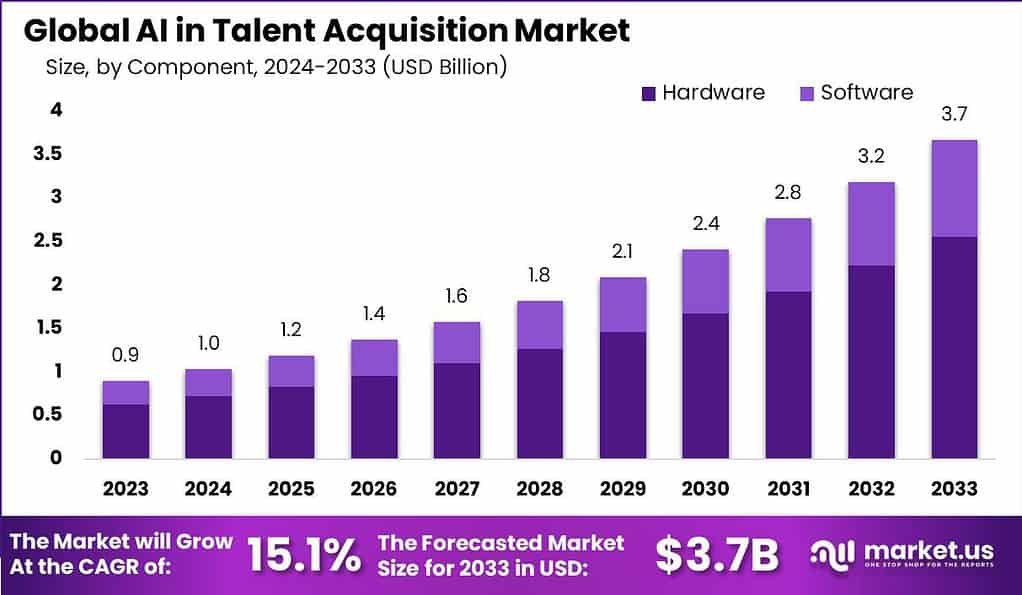
The Global AI in Talent Acquisition Market size is expected to be worth around USD 3.7 Billion By 2033, from USD 0.9 Billion in 2023, growing at a CAGR of 15.1% during the forecast period from 2024 to 2033.
The integration of Artificial Intelligence (AI) in talent acquisition is transforming how companies recruit and hire employees. AI technologies, such as machine learning and natural language processing, automate and streamline the recruitment process. These tools help in scanning resumes, analyzing candidate responses, and even conducting initial interviews, making the process faster and more efficient. AI-driven analytics can also predict candidate success and improve the quality of hires by matching candidates more accurately with job requirements.
In the AI in talent acquisition market, there is a growing trend of using these technologies to enhance recruitment strategies. Companies are investing in AI solutions to gain competitive advantages in attracting top talent. This market is expanding as more organizations recognize the benefits of reducing manual tasks and focusing on strategic decision-making. The demand for AI in this sector is driven by the need for efficient hiring processes and the desire to reduce recruitment costs while improving candidate experiences and outcomes.
This adoption is driving growth in the market, offering significant opportunities for technology providers and consulting services that specialize in AI-driven recruitment solutions. There are substantial opportunities for new entrants. The market’s rapid expansion and the ongoing innovation in AI technologies open doors for startups and new companies to introduce novel solutions or improve existing ones. New entrants can capitalize on niche markets within talent acquisition, such as automated onboarding processes or specialized recruitment analytics.
According to HR managers, 55% of them believe that AI will become a regular part of HR in the next five years, integrated into their recruitment software. This indicates a growing acceptance and recognition of AI’s potential in revolutionizing HR practices. As per Korn Ferry, AI technology has the capability to save recruiters approximately 15 hours per week, offering substantial time savings that can be redirected towards more strategic activities.
The adoption of AI in talent acquisition has seen a significant surge over the past five years, with a staggering 450% increase, as highlighted by a study conducted by Talent Tech Labs. This demonstrates the growing trend of organizations leveraging AI to enhance their recruitment processes and make more informed hiring decisions.
In terms of its impact, LinkedIn’s Global Recruiting Trends 2018 report revealed that 76% of respondents acknowledged that AI would have a significant impact on recruiting, indicating a widespread recognition of its potential benefits. IBM’s Talent Acquisition team further supports this notion by showcasing the tangible outcomes of AI implementation. Their use of Watson, an AI technology, resulted in a 23% reduction in the time to hire and an impressive 300% improvement in the candidate conversion rate.
However, despite the positive outlook, there remain concerns and apprehensions surrounding AI in HR. According to a survey conducted by HR.com, 40% of HR professionals reported that the fear of the unknown is the biggest challenge facing AI. This suggests that while the potential benefits are recognized, there is still a need for education and understanding to address any uncertainties or misconceptions regarding the use of AI in talent acquisition.
Key Takeaways
- The AI in talent acquisition market is expected to reach USD 3.67 billion in the year 2033 with a CAGR of 15.1% during the forecast period and was valued at USD 0.9 Billion in the year 2023.
- Based on components, the solution segment is leading the market with as largest share of 69.7% in the year 2023.
- On segments based on application, the candidate sourcing segment has the largest market share of 27% in the year 2023.
- Based on industry vertical, the IT & telecommunication segment has the largest market share of 25.5% in the year 2023.
- The North America region has attributed to the largest market share of 39.5% in the year 2023.
- 96% of senior HR professionals believe AI has the potential to greatly enhance talent acquisition and retention.
- According to Perlman+Perlman, approximately 19% of organizations are currently using AI and machine learning for talent acquisition.
- MRINetwork reported that 59% of job seekers fear that AI could result in reduced human interaction during the hiring process.
- Allegis found that 63% of job candidates feel comfortable interacting with AI in the early stages of the application process.
- CEOWORLD Magazine states that 67% of hiring managers and recruiters believe that AI saves them time.
- TalentLyft suggests that by automating repetitive tasks, AI can reduce the time to hire by 34%.
Component Analysis
In 2023, the Solution segment held a dominant position in the AI in talent acquisition market, capturing more than a 69.7% share. This significant market share is largely due to the increasing demand for automated and efficient recruitment processes that can handle the complexities of modern hiring needs. AI-driven solutions, such as applicant tracking systems (ATS) and candidate relationship management (CRM) systems, are highly sought after.
These technologies automate several steps of the recruitment process, from scanning resumes for keywords to scheduling interviews and communicating with candidates. This not only speeds up the hiring process but also enhances the accuracy in matching candidates with the right job profiles, which is crucial in obtaining the best talent. The leading position of the Solution segment is further reinforced by its ability to provide substantial cost savings and improved operational efficiency for organizations.
Companies are able to reduce their reliance on manual processes and minimize human errors, leading to more consistent and reliable hiring outcomes. Additionally, the integration of advanced analytics and machine learning in these solutions enables continuous improvement of recruitment strategies based on data-driven insights. For instance, predictive analytics can forecast hiring needs and candidate success, which optimizes resource allocation and planning.
The prevalence of the Solution segment in the AI in talent acquisition market is expected to continue as more organizations recognize the potential of AI to transform their recruitment practices. As these technologies evolve, they become more accessible and cost-effective, making them an attractive option for companies of all sizes. This segment’s growth is also driven by the increasing availability of customizable solutions that can cater to specific industry needs, further driving its adoption across various sectors.
Application Analysis
In 2023, the Candidate Sourcing segment held a dominant market position in the AI in Talent Acquisition market, capturing more than a 27% share. This segment leads primarily due to the increasing need for efficient and effective sourcing tools that can reduce the time and costs associated with finding qualified candidates.
The adoption of AI-driven technologies in candidate sourcing allows companies to automate the search and initial contact processes, leveraging data analytics and machine learning to identify potential candidates from a larger pool more accurately and quickly than traditional methods. AI in candidate sourcing not only streamlines the recruitment process but also enhances the quality of hires by enabling more precise matching of job requirements with candidate profiles.
Technologies such as natural language processing and predictive analytics help in scanning online job boards, social media platforms, and professional networks to identify and engage with prospective candidates. This capability is particularly valuable in competitive job markets where the demand for skilled professionals outstrips supply.
Furthermore, the integration of AI tools in candidate sourcing contributes to a more data-driven approach to recruitment. These tools provide HR professionals with insights and patterns regarding talent availability, candidate preferences, and the effectiveness of different sourcing channels. This intelligence allows organizations to optimize their recruitment strategies, improve candidate experiences, and ultimately, increase the conversion rates from candidate to hire.
Industry Vertical Analysis
In 2023, the IT and Telecommunication segment held a dominant market position in the AI in Talent Acquisition market, capturing more than a 25.5% share. This prominence is attributed to the rapid technological advancements and the high demand for skilled professionals within these industries. IT and telecommunications companies are at the forefront of adopting innovative technologies to enhance their recruitment processes, driven by the need to source talent that can navigate and thrive in a highly dynamic technological environment.
AI-driven solutions in talent acquisition are particularly valuable in the IT and Telecommunication sector due to the complex nature of the job roles and the technical skills required. These tools enable more efficient resume screening, predictive candidate assessment, and tailored candidate engagement strategies, which are critical for identifying and securing top-tier talent in a competitive market.
Moreover, AI facilitates a deeper analysis of candidate data, helping to match technical skills and potential cultural fit more accurately than traditional recruitment methods. Furthermore, the continuous evolution of technologies such as cloud computing, big data, and cybersecurity within the IT and Telecommunication industries necessitates a recruitment approach that can adapt quickly.
AI in talent acquisition offers the agility to keep up with these changes, providing these sectors with a strategic advantage in attracting and retaining the necessary human capital to drive innovation and growth. As technology continues to advance and integrate deeper into business operations, the reliance on AI tools within these sectors is expected to grow, further cementing the leading position of the IT and Telecommunication segment in the AI in Talent Acquisition market.

Key Market Segments
By Component
- Solution
- Services
By Application
- Candidate Sourcing
- Resume Screening
- Interview Scheduling
- Candidate Engagement
- Other Applications
By Industry Vertical
- IT & Telecommunication
- BFSI
- Healthcare
- Retail & E-Commerce
- Manufacturing
- Other Industry Verticals
Drivers
Enhanced Efficiency and Quality of Hires
The adoption of AI in talent acquisition significantly enhances the efficiency of recruitment processes. AI tools streamline time-consuming tasks such as resume screening, candidate sourcing, and initial assessments, which substantially reduces the time and effort required to identify suitable candidates. Furthermore, AI-driven algorithms are adept at matching candidates’ qualifications with job requirements, leading to higher-quality candidate pools and improved hiring outcomes. This efficiency not only shortens the time-to-hire but also ensures that critical roles are promptly filled, minimizing productivity losses and adverse revenue impacts.
Restraints
Overreliance on Technology
While AI streamlines recruitment processes and enhances efficiency, there is a risk of overreliance on technology which can overshadow human judgment, intuition, and empathy. This may lead to challenges in assessing candidates’ suitability and cultural fit, as automated systems may not fully capture the nuances of human interactions and personal traits. Thus, organizations must find a balance between leveraging technological advancements and maintaining essential human-centered decision-making in their recruitment strategies.
Opportunities
Data-Driven Decision Making
AI in talent acquisition opens up significant opportunities for data-driven decision-making. By utilizing AI analytics tools, hiring managers gain valuable insights into recruitment trends, candidate behaviors, and performance metrics. These insights enable organizations to optimize their recruitment strategies, forecast future talent needs, and make informed decisions that enhance the effectiveness of their hiring processes. This predictive capability helps in adapting to market changes more dynamically and positioning the organization for strategic advantages in talent management.
Challenges
Ethical Considerations and Bias
One of the primary challenges in implementing AI in talent acquisition is navigating the ethical considerations associated with algorithmic decision-making. AI systems may inadvertently perpetuate or even exacerbate biases present in the training data, leading to fairness concerns and potential legal repercussions. Additionally, the use of AI raises concerns about privacy and the security of candidate data. Organizations must prioritize ethical AI practices, ensure compliance with data protection regulations, and carefully monitor AI systems to mitigate these risks and uphold fairness and integrity in their recruitment processes.
Latest Trends
- Automated Sourcing and Recruitment: AI technologies are streamlining candidate sourcing, utilizing data analysis to quickly identify top talent for specific roles. This includes analyzing resumes and job applications across various platforms to pinpoint critical skills and qualifications, making the recruitment process more efficient.
- Advanced Candidate Interaction Tools: The use of AI chatbots and voicebots is transforming candidate engagement. These tools automate initial interactions, using natural language processing to mimic human conversation, thus speeding up the screening process and enhancing the candidate experience.
- Enhanced Interview Processes: AI is also revolutionizing the interview process through online video interviewing and AI-driven interview scheduling. These technologies help in assessing candidates more effectively and scheduling interviews without the logistical hassles typically involved, thereby reducing time-to-hire.
- Focus on Employee Well-Being and Work-Life Balance: Organizations are increasingly prioritizing the well-being of their employees, recognizing that a healthy work-life balance enhances productivity and job satisfaction. This trend is facilitated by AI in managing work schedules and helping create more flexible work environments.
- Emphasis on Remote and Hybrid Work Models: AI is playing a crucial role in enabling the shift towards remote and hybrid work models, allowing organizations to tap into a broader talent pool and supporting diverse working arrangements.
Growth Factors
- Increasing Need for Efficiency in Recruitment: AI significantly reduces the time and effort required in sourcing and screening candidates, which is a primary driver for its adoption in talent acquisition strategies.
- Demand for Improved Candidate Experience: AI enhances the candidate journey, from application to hiring, by personalizing interactions and providing timely feedback. This not only improves the recruitment process but also boosts the employer’s brand image.
- Skills Gap and Upskilling Initiatives: As AI technologies evolve, there is a growing need for skills that align with new technological capabilities. Organizations are increasingly investing in upskilling programs to bridge this gap, integrating AI both as a tool and an area of skill development.
- Data-Driven Decision Making: AI enables more informed recruitment decisions through data analytics, helping organizations identify patterns and insights that can improve hiring strategies and predict future hiring needs.
- Diversity, Equity, and Inclusion: AI tools are being used to minimize unconscious bias in the recruitment process, promoting a more diverse and inclusive workforce. This not only improves social equity but also benefits organizations by bringing a wider range of perspectives and ideas.
Regional Analysis
In 2023, North America held a dominant market position in the AI in talent acquisition market, capturing more than a 39.5% share. This region’s leadership is largely due to the widespread adoption of advanced technologies and the concentration of major AI firms within its borders, particularly in the United Group and Canada. These countries are recognized for pioneering innovative applications of AI in recruitment processes, aiming to optimize the efficiency and effectiveness of talent acquisition strategies.
The demand for AI in Talent Acquisition in North America was valued at US$ 0.3 billion in 2023 and is anticipated to grow significantly in the forecast period. The significant investment in AI and machine learning technologies by North American enterprises is further bolstered by supportive governmental policies promoting technological innovation and digital transformation in the workforce. For instance, initiatives aimed at funding AI research and facilitating partnerships between the private sector and educational institutions help sustain the region’s leading position in the market.
Additionally, North America benefits from a highly skilled workforce that is adept at developing and implementing AI solutions, which in turn drives further adoption and refinement of these technologies in talent acquisition processes. This robust ecosystem fosters continuous advancements and adoption of AI tools across various industries, maintaining North America’s significant market share in this sector.

Key Regions and Countries
- North America
- US
- Canada
- Europe
- Germany
- France
- The UK
- Spain
- Italy
- Russia
- Netherlands
- Rest of Europe
- Asia Pacific
- China
- Japan
- South Korea
- India
- Australia
- Singapore
- Thailand
- Vietnam
- Rest of APAC
- Latin America
- Brazil
- Mexico
- Rest of Latin America
- Middle East & Africa
- South Africa
- Saudi Arabia
- UAE
- Rest of MEA
Key Players Analysis
The AI in talent acquisition market features a dynamic landscape with several key players that drive innovation and market growth. IBM Corporation, Oracle Corporation, and SAP SE are among the industry giants that lead the field with their robust AI-driven platforms designed to streamline recruitment processes. These companies provide comprehensive solutions that integrate AI to enhance job matching accuracy, candidate sourcing, and recruitment analytics.
Cornerstone OnDemand, Inc. and Jobvite Inc. are notable for their focus on delivering user-friendly and efficient recruitment software that leverages AI to optimize the hiring lifecycle. Their platforms help organizations reduce hiring time and improve the quality of hires by employing sophisticated algorithms for candidate screening and engagement.
SmartRecruiters, Inc. and Entelo specialize in offering cutting-edge tools that utilize AI to enhance passive candidate sourcing and engagement strategies, enabling companies to tap into a broader talent pool. These platforms are equipped with advanced analytics to help recruiters make data-driven decisions.
Top Key Players in the Market
- IBM Corporation
- Oracle Corporation
- SAP SE
- Cornerstone OnDemand, Inc.
- Jobvite Inc.
- SmartRecruiters, Inc.
- Entelo
- Cielo Talent
- Yello Co
- Greenhouse Software
- Visier Inc.
- Beamery
- Other Key Players
Recent Developments
- IBM Corporation has continued to push the boundaries of AI in recruitment, focusing on enhancing AI tools for HR processes. In January 2024, IBM introduced the watsonx Orchestrate solution, designed to automate data-intensive tasks, enabling HR teams to focus more on strategic activities. This development underscores IBM’s commitment to integrating AI to streamline talent acquisition processes.
- Oracle Corporation has been actively enhancing its AI capabilities within its Human Capital Management (HCM) Cloud platform. In November 2023, Oracle launched new AI-driven features aimed at improving candidate experience and recruitment efficiency. These features leverage machine learning to provide more personalized job recommendations and automated interview scheduling.
- SAP SE has also made strides in the AI recruitment space. In December 2023, SAP announced a collaboration with several leading tech firms to integrate advanced AI analytics into its SuccessFactors suite, which aims to better predict candidate fit and streamline the hiring process.
- Cornerstone OnDemand Inc. expanded its AI capabilities through the acquisition of Saba Software in early 2023. This acquisition aimed to enhance Cornerstone’s talent management solutions with Saba’s robust AI-driven learning and talent development tools, thus offering a more comprehensive suite for talent acquisition and management.
- Jobvite Inc. introduced significant updates to its AI-powered recruitment platform in mid-2023, focusing on improving diversity hiring. The new features include advanced AI algorithms designed to reduce bias in hiring and improve the overall inclusivity of recruitment processes.
- SmartRecruiters Inc. launched a new AI feature in September 2023 that uses predictive analytics to identify high-potential candidates. This innovation helps recruiters focus their efforts on candidates most likely to succeed in their roles, enhancing recruitment efficiency and effectiveness.









