


Report Overview
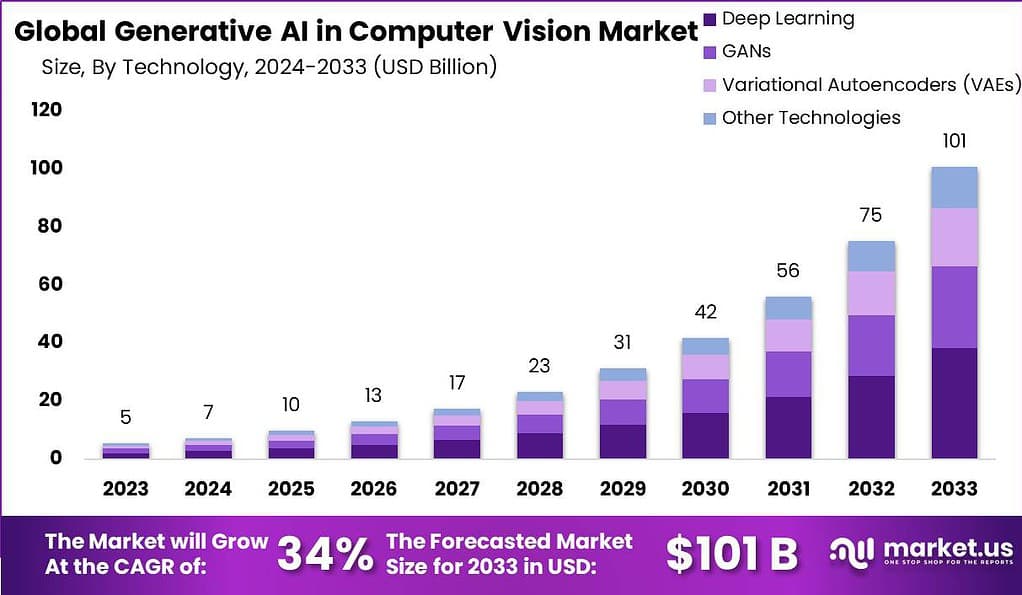
The Global Generative AI in Computer Vision Market size is expected to be worth around USD 101 Billion By 2033, from USD 5 Billion in 2023, growing at a CAGR of 34% during the forecast period from 2024 to 2033.
Generative AI in computer vision has emerged as a powerful tool that combines the capabilities of generative models and computer vision techniques. It involves the use of deep learning models, such as generative adversarial networks (GANs) and variational autoencoders (VAEs), to generate new and realistic visual content based on existing data or learned patterns. This technology has revolutionized various aspects of computer vision, including image synthesis, image editing and restoration, style transfer, and image-to-image translation.
The market for generative AI in computer vision has witnessed significant growth in recent years. With the increasing availability of large-scale datasets and advancements in deep learning algorithms, businesses across diverse industries are recognizing the potential of generative AI in enhancing their computer vision applications. Industries such as healthcare, entertainment, e-commerce, and autonomous vehicles have been particularly keen on adopting generative AI to improve their visual data processing tasks.
One of the key applications of generative AI in computer vision is data augmentation. By generating synthetic data, generative models help in expanding existing datasets and increasing the diversity of training samples. This becomes especially useful when collecting labeled datasets is expensive or time-consuming. The ability to create realistic synthetic data allows for more effective training of computer vision models, leading to improved accuracy and performance.
Another significant application is image synthesis, where generative models can generate new images that are visually similar to the training data. This has found applications in advertising, gaming, and virtual reality, where realistic visuals are crucial for creating immersive experiences. Additionally, generative AI models excel in image editing and restoration tasks, such as enhancing image quality, removing noise or artifacts, and restoring damaged or degraded images. These capabilities have valuable implications in fields like medical imaging, forensics, and historical image preservation.
According to survey, The Global Computer Vision Market is expected to reach approximately USD 58.9 billion by 2033, growing at a CAGR of 13.5% during the forecast period from 2024 to 2033. This growth is driven by factors such as the increasing adoption of computer vision technology and advancements in deep learning algorithms.
Similarly, the Global Generative AI Market is projected to be worth around USD 255.8 billion by 2033, with a CAGR of 34.2% during the same period. The growing applications of generative AI and the need for data augmentation are fueling the market’s expansion. These forecasts indicate significant opportunities for businesses and industries leveraging computer vision and generative AI technologies.
Key Takeaways
- The Generative AI in Computer Vision Market size is expected to be worth around USD 101 Billion By 2033, growing at a CAGR of 34% during the forecast period from 2024 to 2033.
- In 2023, the Deep Learning segment emerged as a dominant force in the generative AI in computer vision market, capturing a significant market share of over 38%.
- In 2023, the Content Creation and Enhancement segment emerged as a dominant player in the generative AI in computer vision market, capturing a significant market share of over 25%.
- In 2023, the Healthcare segment emerged as a dominant force in the generative AI in computer vision market, capturing a significant market share of over 19%.
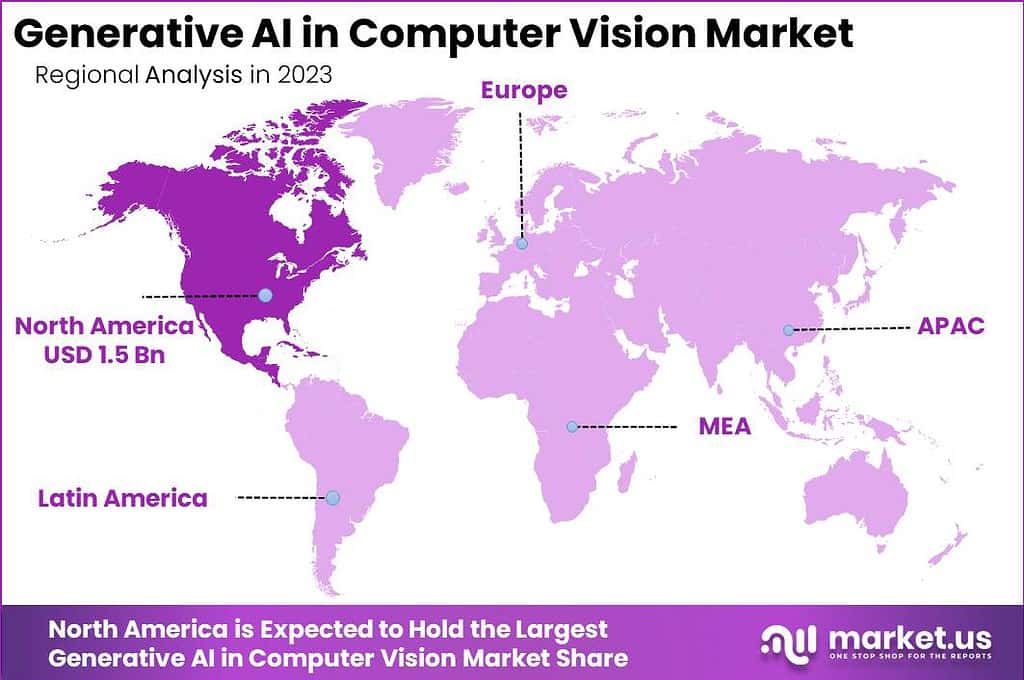
- In 2023, North America emerged as the dominant region in the generative AI in computer vision market, capturing a significant market share of more than 31.7%.
Technology Analysis
In 2023, the Deep Learning segment emerged as a dominant force in the generative AI in computer vision market, capturing a significant market share of over 38%. Deep learning technology has been a driving force behind the advancements in generative AI models, enabling them to learn complex patterns and generate high-quality visual content. The deep learning algorithms used in computer vision tasks have demonstrated remarkable capabilities in image synthesis, image editing and restoration, style transfer, and image-to-image translation.
The widespread adoption of deep learning techniques by various industries, such as healthcare, entertainment, e-commerce, and autonomous vehicles, has contributed to the leading position of the Deep Learning segment in the generative AI in computer vision market. Deep learning models excel at learning hierarchical representations from vast amounts of data, allowing them to capture intricate details and generate realistic visual content.
The ability of deep learning algorithms to automatically learn features and patterns from data has revolutionized the field of computer vision. This has resulted in improved accuracy and performance in tasks such as object recognition, image segmentation, and scene understanding. The robustness and versatility of deep learning models have made them the go-to choice for developing generative AI solutions in computer vision.
Furthermore, the Deep Learning segment’s dominance can be attributed to the extensive research and development efforts focused on advancing deep learning architectures and algorithms. Researchers and organizations are continually exploring new techniques and architectures, such as convolutional neural networks (CNNs) and recurrent neural networks (RNNs), to enhance the capabilities of deep learning models in computer vision tasks. This continuous innovation and refinement of deep learning technology have propelled its market position in the generative AI in computer vision landscape.
Application Analysis
In 2023, the Content Creation and Enhancement segment emerged as a dominant player in the generative AI in computer vision market, capturing a significant market share of over 25%. The Content Creation and Enhancement segment encompasses applications that leverage generative AI models to create and enhance visual content. This segment’s leading position can be attributed to the increasing demand for advanced content creation tools and the growing need for enhancing and optimizing visual assets across various industries.
Content Creation and Enhancement applications of generative AI in computer vision enable businesses to generate high-quality and visually appealing images and videos. These applications find utility in industries such as advertising, gaming, virtual reality, and entertainment, where compelling visual content plays a crucial role. Generative AI models excel in synthesizing new images and videos that closely resemble real-world data, allowing businesses to create realistic and engaging visual experiences for their target audience.
Additionally, generative AI models are employed in enhancing and optimizing existing visual content. They can remove noise, artifacts, or imperfections from images, improving visual quality and clarity. This capability is particularly valuable in fields such as photography, graphic design, and digital media, where high-quality visuals are essential. By leveraging generative AI in content creation and enhancement, businesses can streamline their creative processes, improve productivity, and deliver visually impactful content.
The Content Creation and Enhancement segment’s market leadership is driven by the increasing demand for visually appealing content across industries, coupled with the advancements in generative AI models. As businesses seek to captivate their audience and differentiate themselves in a competitive landscape, the adoption of generative AI for content creation and enhancement is expected to witness continued growth.

Industry Vertical Analysis
In 2023, the Healthcare segment emerged as a dominant force in the generative AI in computer vision market, capturing a significant market share of over 19%. The Healthcare industry has been a frontrunner in adopting generative AI in computer vision due to its potential to revolutionize medical imaging, diagnostics, and patient care. The leading position of the Healthcare segment can be attributed to the increasing demand for accurate and efficient medical imaging solutions, the growing prevalence of chronic diseases, and the need for personalized healthcare.
Generative AI in computer vision has the potential to greatly enhance medical imaging technologies, such as MRI, CT scans, and X-rays. By leveraging generative AI models, healthcare professionals can improve the accuracy and speed of diagnoses, leading to better patient outcomes. These models can assist in image reconstruction, noise reduction, and segmentation, enabling physicians to obtain clearer and more detailed images for interpretation. Moreover, generative AI can aid in the detection and analysis of anomalies, assisting radiologists in identifying early signs of diseases and abnormalities.
The Healthcare segment’s market leadership is also driven by the increasing demand for personalized medicine and precision healthcare. Generative AI models can analyze large volumes of patient data, including medical images, genetic information, and clinical records, to identify patterns and provide personalized treatment plans. This capability has the potential to revolutionize disease management, treatment optimization, and drug discovery in the healthcare industry.
As the healthcare industry continues to prioritize digital transformation and the adoption of advanced technologies, the Healthcare segment is expected to maintain its leading position in the generative AI in computer vision market. The potential for improving patient care, enhancing diagnostics, and enabling personalized medicine positions generative AI as a key enabler of innovation in the healthcare sector.
Key Market Segments
Technology
- Deep Learning
- Generative Adversarial Networks (GANs)
- Variational Autoencoders (VAEs)
- Other Technologies
Application
- Content Creation and Enhancement
- Image and Video Synthesis
- Image-to-Image Translation
- Style Transfer
- Other Applications
Industry Vertical
- Healthcare
- Automotive
- Retail
- Entertainment and Media
- Manufacturing
- Other Industry Verticals
Driver
Increasing Availability of Large-Scale Labeled Datasets Fuels Generative AI in Computer Vision Market
The availability of large-scale labeled datasets is a key driver in the growth of the generative AI in computer vision market. Labeled datasets are essential for training and fine-tuning generative AI models, allowing them to learn and generate high-quality visual content. With advancements in data collection techniques and the proliferation of digital content, there is a wealth of labeled data available for training generative AI models.
These datasets provide valuable resources for researchers and developers to create more sophisticated generative AI models, leading to improved performance and enhanced capabilities in applications such as image synthesis, style transfer, and content creation. The abundance of labeled data empowers the development of robust and accurate generative AI solutions in computer vision.
Restraint
Ethical and Legal Concerns Surrounding the Misuse of Generative AI Technology
One significant restraint faced by the generative AI in computer vision market is the ethical and legal concerns associated with the misuse of generative AI technology. As generative AI models become more powerful and capable of generating highly realistic visual content, there is an increased risk of misuse and potential harm. The unauthorized creation and distribution of deepfake content, which involves manipulating or fabricating visual content using generative AI, have raised concerns about privacy, security, and misinformation.
The potential misuse of generative AI in computer vision, such as creating fake identities, counterfeit products, or misleading information, poses significant ethical and legal challenges. Addressing these concerns and establishing regulatory frameworks to govern the responsible use of generative AI technology is crucial to maintain trust and ensure the ethical deployment of these powerful tools.
Opportunity
Integration of Generative AI and VR/AR Technologies Unleashes Immersive Experiences
An exciting opportunity in the generative AI in computer vision market lies in the integration of generative AI and virtual/augmented reality (VR/AR) technologies. Combining generative AI with VR/AR has the potential to create highly immersive and realistic virtual environments. Generative AI models can be used to synthesize virtual objects, scenes, and characters, making VR/AR experiences more visually compelling and interactive.
Industries such as gaming, entertainment, education, and training can benefit from this integration by offering enhanced experiences with lifelike visuals and realistic simulations. The integration of generative AI and VR/AR technologies opens up new avenues for innovative applications, including virtual product prototyping, virtual tourism, virtual training simulations, and interactive storytelling, revolutionizing the way we experience and interact with virtual worlds.
Challenge
Interpretability and Explainability of Generative AI Models Pose a Significant Hurdle
One of the significant challenges faced by the generative AI in computer vision market is the interpretability and explainability of generative AI models. While these models have demonstrated impressive capabilities in generating visual content, understanding the decision-making process and inner workings of these models remains a challenge. Deep learning algorithms used in generative AI are complex, and the black-box nature of these models makes it difficult to explain the reasoning behind their outputs.
This lack of interpretability poses challenges in fields where transparency and accountability are crucial, such as healthcare diagnostics or legal applications. Overcoming the challenge of interpretability requires the development of methods and techniques to provide insights into the decision-making process of generative AI models, ensuring transparency and enabling users to trust and validate the outcomes generated by these models.
Growth Factors
- Increasing Adoption of AI in Various Industries: The widespread adoption of artificial intelligence (AI) across industries is a significant growth factor for the generative AI in computer vision market. Industries such as healthcare, automotive, retail, entertainment, manufacturing, and others are leveraging generative AI to enhance their operations, improve efficiency, and deliver innovative products and services.
- Advances in Deep Learning Techniques: The continuous advancements in deep learning techniques, such as convolutional neural networks (CNNs) and generative adversarial networks (GANs), have significantly contributed to the growth of the generative AI in computer vision market. These techniques enable the development of more sophisticated generative AI models, allowing for higher-quality image synthesis, style transfer, and content creation.
- Growth in Big Data and Cloud Computing: The exponential growth of big data and the availability of cloud computing infrastructure have provided a solid foundation for the expansion of the generative AI in computer vision market. The ability to store, process, and analyze vast amounts of data in the cloud allows for more efficient training and deployment of generative AI models, fostering their widespread adoption.
- Increasing Demand for Personalized Experiences: There is a growing demand for personalized experiences in various industries, including healthcare, retail, and entertainment. Generative AI in computer vision enables the creation of personalized content, tailored recommendations, and customized products, meeting the evolving needs and preferences of consumers.
- Rise of Edge Computing: The rise of edge computing, where data processing and analysis occur closer to the data source, is driving the growth of generative AI in computer vision. By deploying generative AI models at the edge, industries can achieve real-time and low-latency processing, enabling applications such as real-time object recognition, autonomous vehicles, and smart surveillance systems.
Emerging Trends
- Explainable AI: There is a growing emphasis on developing explainable AI models in the generative AI in computer vision market. With the increasing complexity of generative AI models, researchers and developers are focusing on techniques to provide interpretability and transparency, enabling users to understand and trust the decision-making process of these models.
- Combination of Generative AI and Reinforcement Learning: The combination of generative AI and reinforcement learning is an emerging trend in the field. By integrating reinforcement learning algorithms with generative AI models, researchers aim to enhance the capabilities of computer vision systems, enabling them to learn from interactions and improve their performance over time.
- Cross-Domain Application of Generative AI: Generative AI in computer vision is expanding beyond traditional applications and entering new domains. For example, generative AI is being used in architecture and design to generate realistic 3D models, in fashion to create virtual try-on experiences, and in sports analytics to generate virtual simulations for training and analysis.
- Ethical Considerations and Responsible AI: The ethical considerations surrounding generative AI in computer vision are gaining attention. There is a growing focus on ensuring responsible and ethical use of generative AI, addressing issues related to privacy, bias, fairness, and the potential societal impact of generated content.
- Collaborative AI: Collaborative AI, where generative AI models work in tandem with human experts, is an emerging trend. This approach leverages the strengths of both generative AI systems and human creativity to generate high-quality content, foster creative collaborations, and drive innovation in various fields such as art, design, and content creation.
Regional Analysis
In 2023, North America emerged as the dominant region in the generative AI in computer vision market, capturing a significant market share of more than 31.7%. The region’s leading position can be attributed to several key factors. Firstly, North America has been at the forefront of technological advancements, particularly in the field of AI and computer vision.
The presence of major tech companies, research institutions, and leading universities in the United States has fostered a culture of innovation and provided a strong foundation for the development and adoption of generative AI in computer vision. Furthermore, the region has a robust ecosystem that supports the growth of the generative AI market.
The availability of funding and investment opportunities, coupled with favorable government initiatives and policies, has fueled the development and commercialization of generative AI technologies. Additionally, North America has a large pool of skilled AI researchers, data scientists, and computer vision experts, which further strengthens the market’s position.
Moreover, industries in North America, such as healthcare, automotive, and entertainment, have been early adopters of generative AI in computer vision applications. The demand for advanced computer vision solutions to improve medical diagnostics, enhance autonomous driving systems, and create immersive entertainment experiences has contributed to the market’s growth in the region.
Key Regions and Countries
- North America
- US
- Canada
- Europe
- Germany
- France
- The UK
- Spain
- Italy
- Russia
- Netherlands
- Rest of Europe
- Asia Pacific
- China
- Japan
- South Korea
- India
- Australia
- Singapore
- Thailand
- Vietnam
- Rest of APAC
- Latin America
- Brazil
- Mexico
- Rest of Latin America
- Middle East & Africa
- South Africa
- Saudi Arabia
- UAE
- Rest of MEA
Key Players Analysis
The generative AI in computer vision market is led by key players who are driving innovation and advancements in this field. Companies such as NVIDIA Corporation, Intel Corporation, Microsoft Corporation, IBM Corporation, Google LLC, Facebook, Inc., OpenAI, Samsung Electronics Co., Ltd., Qualcomm Technologies, Inc., and Amazon Web Services (AWS) are among the top players in this market.
These companies offer a range of hardware, software, and cloud-based solutions that enable the development, training, and deployment of generative models in computer vision applications. They have made significant contributions to the field through the development of powerful processors, AI frameworks, platforms, and advanced tools.
Additionally, these key players have invested in research and development, leading to breakthroughs in areas such as GANs, deep learning, image synthesis, and object detection. The competition among these players is fierce as they strive to enhance the capabilities of generative AI in computer vision and cater to the growing demand for intelligent and visually-driven applications.
Top Key Players in the Market
- NVIDIA Corporation
- Intel Corporation
- Microsoft Corporation
- IBM Corporation
- Google LLC
- Facebook, Inc.
- OpenAI
- Samsung Electronics Co., Ltd.
- Qualcomm Technologies, Inc.
- Amazon Web Services (AWS)
- Other Key Players
Recent Developments
- In October 2023, Tech Mahindra introduced its ‘Vision amplifAIer’ solution as part of the TechM amplifAI suite. This offering aims to enhance computer vision applications for enterprises by providing end-to-end management of computer vision projects. The solution focuses on streamlining the process and reducing the complexity associated with computer vision, making it accessible to a wider range of users.
- In April 2023, Meta, a leading player in the industry, unveiled their ground-breaking AI model called DINOv2. This model is designed to train high-performance computer vision models and has the potential to revolutionize the field of computer vision. DINOv2 boasts remarkable capabilities in image recognition, enabling it to accurately identify individual objects within images, video frames, and other visual inputs. This advancement is expected to significantly enhance the accuracy and efficiency of computer vision systems, opening up new possibilities in various industries.









