


Report Overview
The Global Educational Tourism Market size is expected to be worth around USD 1,667 Billion By 2033, from USD 450 Billion in 2023, growing at a CAGR of 14% during the forecast period from 2024 to 2033.
Educational tourism refers to a form of travel that combines educational experiences with recreational activities. It involves visiting different destinations to learn about their culture, history, art, science, and other subjects. The primary goal of educational tourism is to provide participants with a deeper understanding of the world and enhance their knowledge through immersive and interactive experiences.
The educational tourism market has experienced significant growth in recent years. With the increasing emphasis on experiential learning and personal development, more people are seeking educational travel opportunities. Students, families, professionals, and even retirees are actively participating in educational tourism programs.
The market for educational tourism encompasses a wide range of providers and offerings. Educational travel companies, schools, universities, and non-profit organizations often organize educational tours and programs. These programs can be focused on specific subjects like history, science, or art, or they can offer a broader cultural experience.
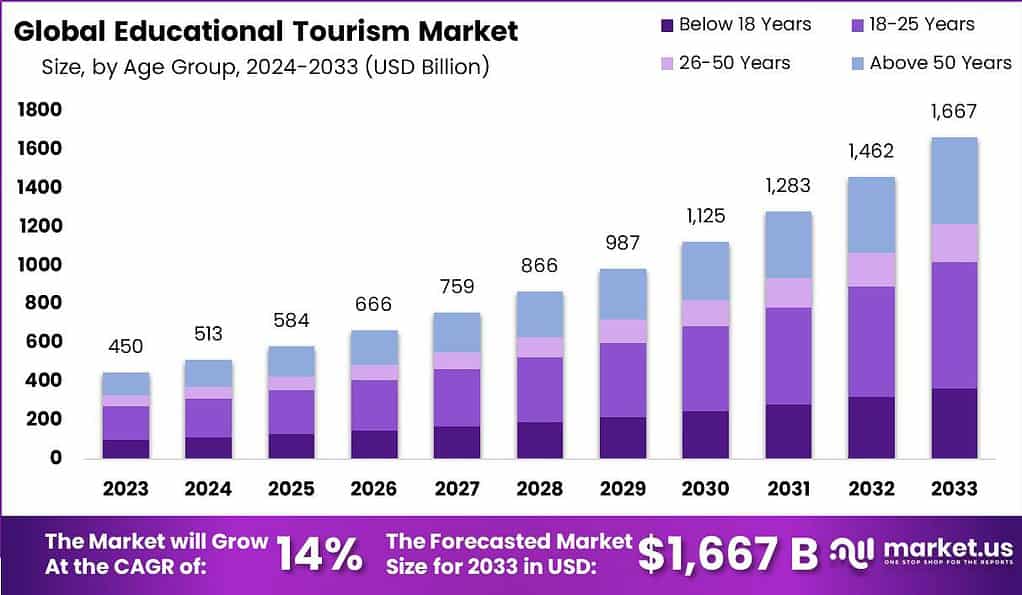
The educational tourism market has seen a rise in specialized programs designed for specific age groups or interests. For example, there are educational tours tailored for students pursuing STEM (Science, Technology, Engineering, and Mathematics) education, language immersion programs for individuals interested in learning a new language, and eco-tourism programs that focus on environmental education and conservation.
The benefits of educational tourism extend beyond acquiring knowledge. Participants have the opportunity to develop cross-cultural understanding, enhance critical thinking and problem-solving skills, and foster personal growth. Educational tourism also promotes sustainable tourism practices by supporting local communities, preserving cultural heritage, and creating awareness about environmental issues.
According to an article by the Indian Express, before the viral outbreak, 132,620 Indian students had chosen Canada for their higher studies. However, this number dropped to 43,624 in 2020. In the later stages of the pandemic, only fully vaccinated students who had completed all formalities and waited two weeks after their second dose were eligible to travel.
Key Takeaways
- The Global Educational Tourism Market size is expected to be worth around USD 1,667 Billion By 2033, from USD 450 Billion in 2023, growing at a CAGR of 14% during the forecast period from 2024 to 2033.
- In 2023, the 18-25 years segment held a dominant market position within the educational tourism market, capturing more than a 39.1% share.
- In 2023, the Higher Education segment held a dominant market position in the educational tourism sector, capturing more than a 64% share.
- In 2023, Asia-Pacific held a dominant market position in the educational tourism market, capturing more than a 40.2% share.
Age Group Analysis
In 2023, the 18-25 years segment held a dominant market position within the educational tourism market, capturing more than a 39.1% share. This significant market share can be attributed primarily to the global surge in university and college students seeking educational experiences abroad that complement their academic pursuits. This age group is particularly inclined towards programs that offer credit transfer options, internships, and experiential learning opportunities that are integral to their educational and career objectives.
Furthermore, this demographic is more adaptable and often more willing to immerse themselves in different cultures, which enhances the appeal of educational tourism. Additionally, the availability of scholarships and funding programs specifically targeted at this age group has facilitated access to educational travel opportunities.
Organizations and educational institutions are increasingly partnering to create specialized programs that cater to the educational and career aspirations of young adults, thereby driving the growth of this segment. These programs often include language courses, cultural immersion programs, and international volunteer projects, which are highly valued by students seeking to enhance their resumes and gain global exposure.
Moreover, the appeal of combining travel with learning and the desire for personal development among young adults contribute to the sustained interest and growth in this segment. As educational tourism providers continue to innovate and tailor experiences that align with the expectations and interests of this age group, the 18-25 years segment is likely to maintain its leading position in the market.
To support this trend, educational tourism marketers are encouraged to develop engaging content that highlights the unique benefits and transformative potential of their offerings, thereby attracting even more participants from this age group.
Education Level Analysis
In 2023, the Higher Education segment held a dominant market position in the educational tourism sector, capturing more than a 64% share. This segment’s substantial market share is driven by the increasing number of university and college students participating in study abroad programs, international internships, and field-specific educational tours. These experiences are highly valued in higher education for providing students with a global perspective and enhancing their employability in an increasingly interconnected world.
Moreover, higher education institutions are actively promoting these opportunities as a core component of their curricula to attract and retain students who seek diverse and comprehensive educational experiences. The prevalence of international collaborations between universities also fuels this segment’s growth. These partnerships often result in reciprocal study abroad programs, where students have numerous opportunities to study in partner institutions across different countries.
Additionally, the growing trend of international conferences, seminars, and workshops, which are typically targeted at university students, researchers, and professionals, contributes to the robustness of this segment. To capitalize on the continuing expansion of this market segment, educational tourism providers are encouraged to create specialized programs that cater specifically to college and university level students.
These might include tailored cultural immersion modules, professional development workshops, and industry visits that align with the students’ academic and career objectives. Such targeted offerings not only enhance the learning experience but also significantly enrich the students’ social and professional networks.

Key Market Segments
Age Group
- Below 18 Years
- 18-25 Years
- 26-50 Years
- Above 50 Years
Education Level
- Higher Education
- Primary Education
- Secondary Education
Driver
Increasing Demand for Global Exposure and Cultural Competence
One of the primary drivers of the educational tourism market is the increasing demand for global exposure and the development of cultural competence among students and professionals. As globalization intensifies, there is a growing emphasis on gaining international experience and understanding diverse cultures, which educational tourism facilitates effectively. Programs that combine travel with learning opportunities abroad are becoming essential for individuals looking to enhance their educational and professional profiles.
For instance, universities and organizations are expanding their international programs to include study abroad options, internships, and cultural exchange programs that provide participants with practical experience in a global context. This trend is supported by the fact that employers increasingly value such international exposure when hiring, as it often correlates with enhanced problem-solving skills and adaptability in diverse environments.
Restraint
High Costs Associated with Travel and Study Abroad Programs
A significant restraint in the educational tourism market is the high cost associated with travel and study abroad programs. The expenses related to airfare, accommodation, tuition, and daily living can be prohibitive for many potential participants. Additionally, while some scholarships and financial aid options are available, they are often highly competitive and may not cover all costs, limiting accessibility for a broader audience.
These financial barriers can deter students, especially from lower-income backgrounds, from participating in educational tourism opportunities, thus restricting market growth. Efforts to increase funding and financial support options could mitigate this restraint, but it remains a substantial challenge for the industry as a whole.
Opportunity
Technological Integration and Online Learning Platforms
The integration of technology in educational tourism presents significant opportunities for market expansion. Online learning platforms and virtual reality (VR) experiences are revolutionizing how educational content is delivered and experienced. These technologies allow for the virtual exploration of historical sites, museums, and cultural landmarks, making educational tourism more accessible to individuals who cannot travel due to financial or physical limitations.
Additionally, many educational institutions are now offering hybrid programs that combine online courses with short-term travel modules, thereby providing a flexible and cost-effective approach to international education. This digital shift not only broadens the reach of educational tourism but also enhances its appeal by incorporating innovative learning methods.
Challenge
Maintaining Educational Quality and Authenticity
A persistent challenge in the educational tourism market is maintaining the quality and authenticity of the educational experiences offered. As the market grows, there is a risk that commercial pressures could lead to the dilution of educational content in favor of more lucrative tourist experiences.
Ensuring that programs are both educationally enriching and culturally authentic requires rigorous planning, qualified instructors, and collaboration with local communities and institutions. Moreover, the challenge of balancing educational objectives with the logistical demands of travel can complicate program development and execution, potentially impacting the overall learning outcomes for participants.
Growth Factors
- Increasing Globalization and Cultural Exchange: The push towards a more interconnected world has increased the demand for educational tourism. This is driven by both students and professionals seeking to gain international experience and cultural fluency, which are highly valued in the global job market.
- Government and Institutional Support: Many governments and educational institutions are increasingly supporting international education programs through scholarships and partnerships with foreign institutions. This support not only makes educational tourism more accessible but also encourages cultural exchanges and enhances diplomatic relations.
- Rise in Disposable Income: As global income levels rise, more families and individuals can afford educational travel. This economic uplift allows a broader demographic to participate in overseas learning experiences, contributing significantly to market growth.
- Technological Advancements: The use of technology in education, including virtual reality and online learning platforms, has expanded the scope of educational tourism. These technologies enable virtual tours and remote learning opportunities, making educational travel more accessible and flexible.
- Focus on Lifelong Learning and Skill Development: There is a growing trend towards lifelong learning and the development of soft skills, such as communication and leadership, which are often emphasized in educational travel programs. These programs offer practical experiences that are difficult to replicate in traditional learning environments.
Emerging Trends
- Virtual and Hybrid Educational Programs: In response to travel restrictions and the increasing demand for flexible learning options, there has been a rise in virtual and hybrid educational programs that combine online learning with short-term physical travel.
- Focus on Sustainable and Responsible Travel: There is an increasing emphasis on sustainability in tourism. Educational programs are now incorporating lessons on environmental conservation and promoting activities that have minimal environmental impact, aligning with global sustainability goals.
- Cultural Immersion Programs: Rather than just visiting historical sites or attending classes, more educational tourism programs are focusing on deep cultural immersion. These programs often include home stays, community projects, and interactions with local artisans, offering a more authentic experience.
- Increased Use of Big Data and AI: Providers are using big data and artificial intelligence to tailor educational travel experiences to individual preferences and learning objectives. These technologies help in understanding trends, participant feedback, and in improving program offerings.
- Partnerships Between Educational and Corporate Sectors: There is a growing trend of partnerships between educational institutions and corporations to offer internships and training programs abroad. These opportunities provide practical experience and career benefits, making educational tourism more attractive to participants seeking professional advancement.
Regional Analysis
In 2023, Asia-Pacific held a dominant market position in the educational tourism market, capturing more than a 40.2% share. This leadership can be primarily attributed to the region’s robust educational infrastructure and the growing appeal of its diverse cultural and educational opportunities to international students.
The demand for Educational Tourism in Asia-Pacific was valued at US$ 343.9 billion in 2023 and is anticipated to grow significantly in the forecast period. Countries like China, Japan, South Korea, and Australia are prominent destinations that offer a combination of high-quality education and cultural enrichment, making them highly attractive for educational tourists. Moreover, governments in these countries have implemented favorable policies, such as simplified visa processes and scholarships, to attract more international students.
Additionally, Asia-Pacific benefits from its strategic geographical location and economic pricing, which are pivotal in drawing educational tourists from both Western and neighboring regions. The area’s universities are increasingly recognized for their competitive academic programs and partnerships with universities worldwide, further enhancing their appeal.
The rise in middle-class income levels in several APAC countries also boosts the capacity of local students to travel abroad within the region for educational purposes. This intra-regional educational tourism is supported by improvements in regional connectivity and infrastructure, making travel more accessible and affordable.
Europe, following Asia-Pacific, also represents a significant share of the educational tourism market, driven by its historic academic institutions and the extensive variety of study programs offered in multiple languages. North America remains a strong contender due to its prestigious universities and professional development opportunities that attract learners globally.

Key Regions and Countries
- North America
- US
- Canada
- Europe
- Germany
- France
- The UK
- Spain
- Italy
- Russia
- Netherlands
- Rest of Europe
- Asia Pacific
- China
- Japan
- South Korea
- India
- Australia
- Singapore
- Thailand
- Vietnam
- Rest of APAC
- Latin America
- Brazil
- Mexico
- Rest of Latin America
- Middle East & Africa
- South Africa
- Saudi Arabia
- UAE
- Rest of MEA
Key Players Analysis
The educational market is highly competitive, with several key players contributing to its growth and diversity. EF Education First stands out as a pioneer, offering a wide range of educational programs worldwide that combine language learning with cultural immersion. WorldStrides excels in providing experiential programs that extend learning beyond the classroom into real-world applications, making it a favorite among educational institutions.
ACIS Educational Tours is renowned for its meticulously planned itineraries that emphasize experiential learning and cultural exposure, tailored to the needs of students and educators alike. Travel For Teens focuses on teen travel programs, offering unique experiences designed to foster independence and global awareness among young participants. Similarly, Rustic Pathways leads with service-based travel programs in remote areas, which appeal to students looking to contribute to community projects while gaining educational insights.
Top Key Players in the Market
- EF Education First
- WorldStrides
- ACIS Educational Tours
- Travel For Teens
- Rustic Pathways
- Global Educational Travel
- Road Scholar
- Envoys
- Educational Tours, Inc.
- GO Educational Tours
- Other Key Players
Recent Developments
- Global Educational Travel has expanded its offerings by introducing STEM-focused travel programs in Asia, launched in February 2024, catering to the increasing demand for science and technology education.
- In February 2024, Mastereign Group teamed up with STIC Travel to offer educational tours in Singapore specifically designed for Indian students. These tours focus on sustainability and cultural exchange, providing enriched learning experiences.
- In June 2023, WorldStrides announced the acquisition of Casterbridge Tours, enhancing its portfolio of specialized travel experiences for students and educators.
- In November 2023, Rustic Pathways launched the Climate Leaders Fellowship Summit in Guatemala, aimed at engaging students in environmental sustainability projects.
- In November 2023, EF Education First expanded its offerings by launching new STEM-focused tours, emphasizing hands-on learning and collaborations with field experts. This initiative is designed to cater to the increasing demand for specialized educational experiences that combine travel with in-depth subject matter exploration.









