


Report Overview
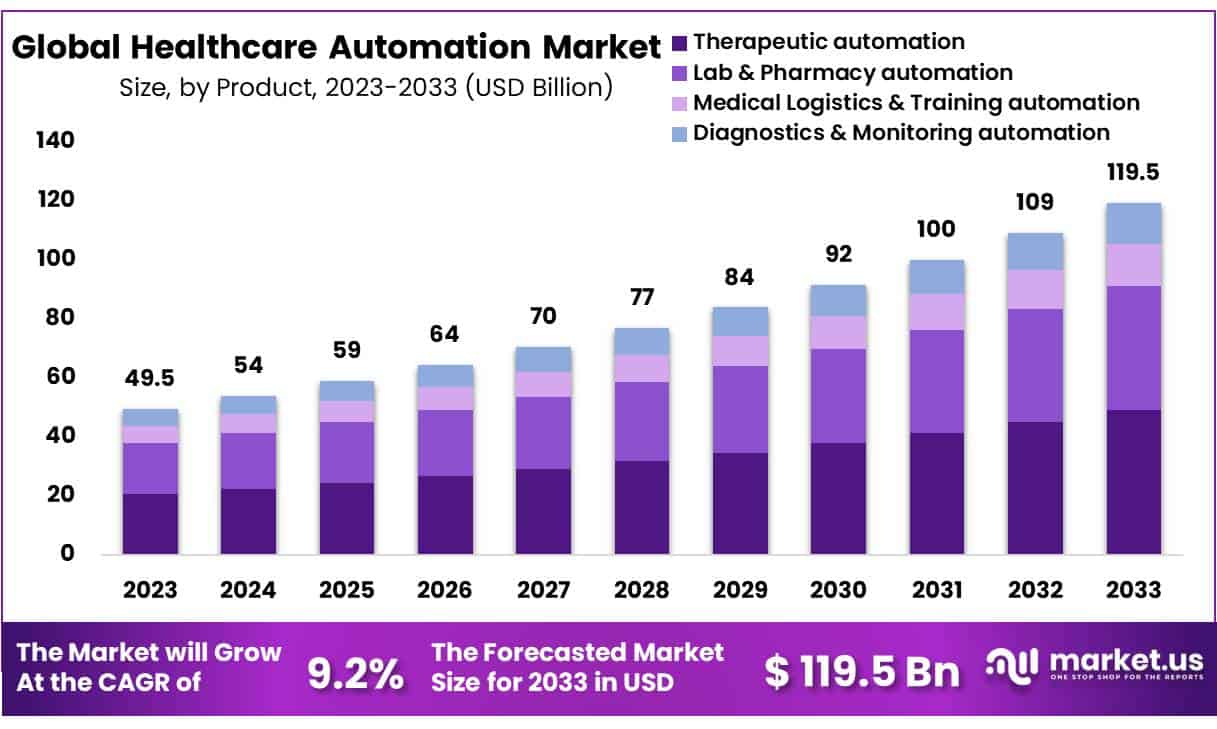
The Global Healthcare automation Market size is expected to be worth around USD 119.5 Billion by 2033 from USD 49.5 Billion in 2023, growing at a CAGR of 9.2% during the forecast period from 2024 to 2033.
Healthcare automation encompass usage of advanced technologies such as artificial intelligence, data analytics and robotics to streamline the workflow and ameliorate overall efficiency of work. This helps healthcare industry to extract maximum benefits with the aim to drive down operational efficiencies, reduction care cost combined with enhancement of care quality.
Some of the crucial application of healthcare automation includes assistance towards medical professionals and hospital administrators to conduct day to day activities seamlessly, and treat and manage patient care with more efficiency.
- According to Indiana University data, 2014, patient outcomes up scaled by 50% by virtue of doctors using artificial intelligence for treatment decisions, while the cost of healthcare has reduced to half.
One of the significant application of healthcare automation includes smart scheduling applications where it allows appointments with nurses depending upon patients’ proximity matching medical specialty to the patient’s need, followed by scheduling best match nurse to have a home visit. This further assist the nurses to have real time patient information with a single interface, offering best possible care for the patients.
In addition to this, it helps reduce wait time for patients, ameliorate facilities to appropriately care for patients and save time required for collection and maintenance of information. This is because of patients’ reports, billing and prescription being automated, enabling hospital staff to have quick access towards pertinent information for carrying out treatment during the entire process.
Key Takeaways
- Market Size:Healthcare automation Market size is expected to be worth around USD 119.5 Billion by 2033 from USD 49.5 Billion in 2023.
- Market Growth: The market growing at a CAGR of 9.2% during the forecast period from 2024 to 2033.
- Product Analysis: Therapeutic automation segment capturing a laudable market share of 56.2% in the year 2023.
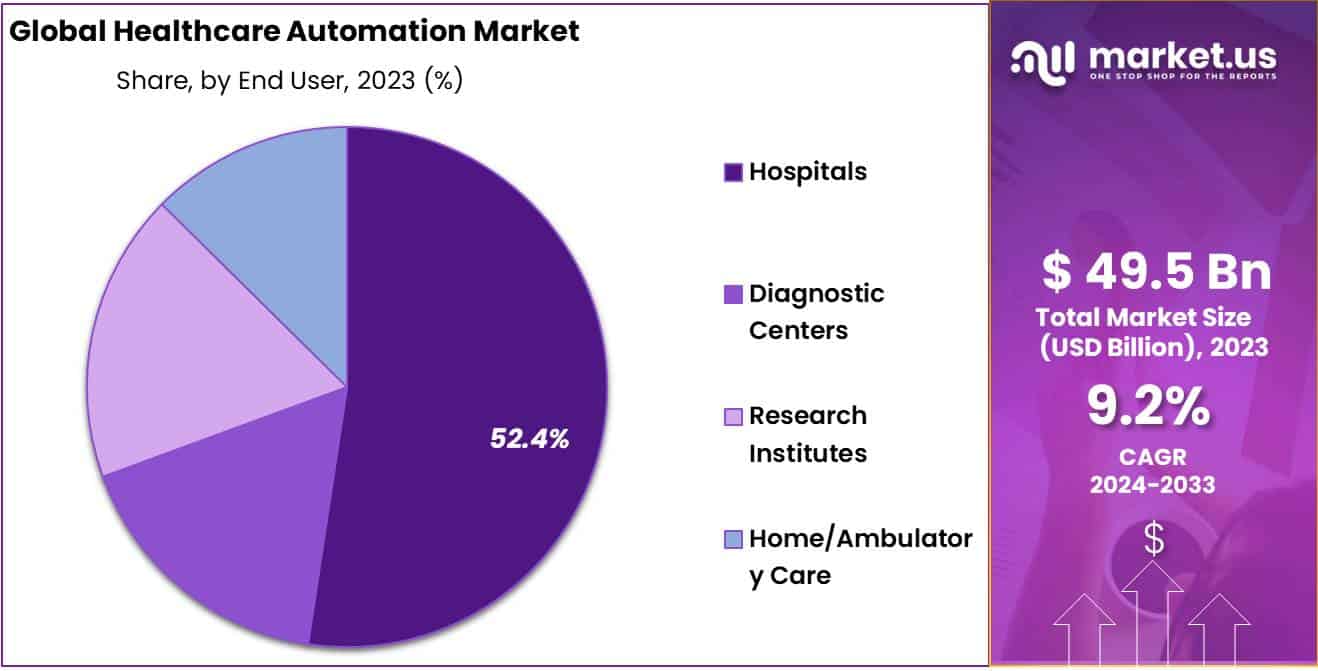
- End-Use Analysis: Hospital and diagnostic centers segment dominate 52.4% market share in the year 2023.
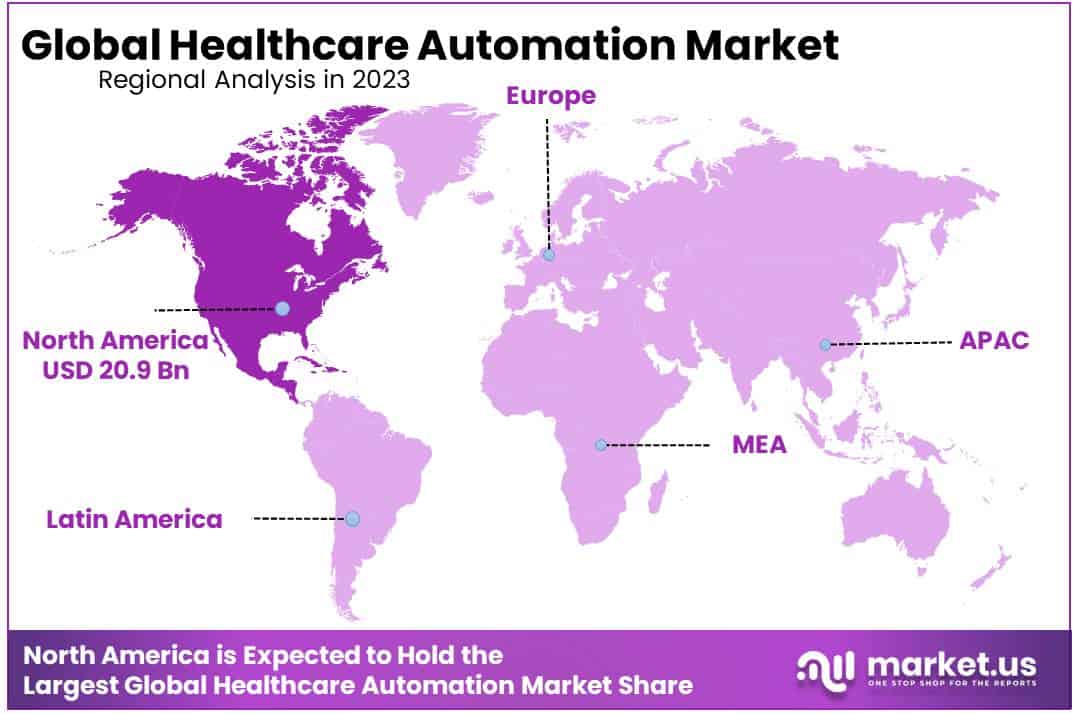
- Regional Analysis: North America leads the global healthcare automation market capturing a prominent market revenue share of 42.3% in the year 2023.
- Cost Reduction: Automation reduces operational costs by minimizing human error, speeding up processes, and optimizing resource utilization, leading to significant cost savings for healthcare providers.
- Technological Innovations: Advancements in robotic systems, AI, and machine learning are enhancing automation in various healthcare applications, including surgery, diagnostics, and patient management, contributing to market growth.
- Challenges: The market faces challenges such as high initial investment costs, integration with existing systems, and concerns about data privacy and cybersecurity, which can hinder adoption.
- Regulatory Landscape: Stringent regulatory requirements for the implementation of automated systems in healthcare ensure patient safety and efficacy, which also drive the demand for compliant and reliable automation solutions.
By Product analysis
An instrumental role is played by therapeutic automation segment
Based on product, the global healthcare automation market is broadly fragmented into Therapeutic Automation, Lab & Pharmacy Automation, Medical Logistics & Training Automation and Diagnostics & Monitoring Automation segments. Amongst all the vital categories, an instrumental role is played by therapeutic automation segment capturing a laudable market share of 56.2% in the year 2023. The growth of the segment is contributed by rising prevalence of chronic disorders coupled with advancements in technology and medication system.
Following close, another significant market share is withheld by medical logistics and training automation category and is expected to rise during the prophecy period. The stability of medical logistics and training automation segment is ascribed to the rising acceptance of healthcare automation (AGV, pneumatic tubes, RFID, and RTLS) in diagnostic centers as well as hospitals all over the world.
- Automation in medical technology also includes precision medicine, robotics and the use of smart wearables, which is expected to grow by 5%this year. The sales are expected to register US$ 800 billion by 2030.
In addition to this, patient care is improved with the advent of smart development applications. This assist the patients to get an appointment with attendants close to their proximity and proactively coordinate pharmaceutical claims to patient needs, followed by visit of medical helper towards the patients at homes.
By End User Analysis
Hospitals and diagnostic centers makes more usage of healthcare automation
Based on end use, the global healthcare automation market is categorized into Hospital, Research Institutes, Home/Ambulatory Care and Diagnostics Centre segments. A commendable market revenue shares of 52.4% is clutched by hospital and diagnostic centers in the year 2023. The supremacy of segments owes to heightened usage of automated equipment in diagnostics, treatment and laboratories. The market further excels with the growing use of automation pharmacies and hospitals, especially in 2 and 3 tier cities of the growing regions of Asia Pacific such as India.
- Computerized healthcare services are now offered by institutions like Apollo and Fortis in India that are functioning in tier 2 and tier 3 towns.
Owing to the existence of government-assisted agencies and rising acceptance of new product launches into the market place, research laboratories and institute segment is projected to flourish at an optimistic compound annual growth rate of 9.2%. Research institutes provide reliable, accurate, qualified and timeless testing, helping in accessibility of test results which were impossible to obtain. Thus declines inaccuracies and offers an audit trial of test which leads to confirm compliance requirements.
Key Market Segments
By Product
- Therapeutic Automation
- Lab & Pharmacy Automation
- Medical Logistics & Training Automation
- Diagnostics & Monitoring Automation
By End User
- Hospital
- Research Institutes
- Home/Ambulatory Care
- Diagnostics Centre
Drivers
Rise in Geriatric population
Global healthcare automation market is robustly thriven by rising geriatric population across the globe. According to world health Organization 2013 report, age related illness including dementia, and Parkinson’s disease across the globe is scaling with the rise in elderly population. This creates a paramount burden on healthcare and medical resources along with enhanced dependencies and families and caregivers. Incorporation of automation in healthcare allow time conserving and accurate detection of diseases leading a significant impact on treatment outcomes.
In comparison to the medical professionals detecting only few number of samples and images, artificial intelligence assists to process millions of samples in compact period of time. In addition to this, artificial intelligence and machine learning also help to save cost and time of drug discovery, which currently stands at an average of the USD 2.5 billion and 10-15 years respectively.
- According to Parkinson’s Canada report in November 2021, around 100,000 Canadians lived with Parkinson’s and more than 25 people diagnosed with Parkinson’s’ disease every day
- According to government of Canada in April 2022, cases exceeding 90,000 individuals, age 40 and older are currently suffering from Parkinson’s disease in Canada.
Incorporation of Healthcare information technology
Advancements in healthcare information technology has led to ease in diagnosis and making treatment plans in a quick-witted and accurate way. Implementation of automation technology such as machine learning and artificial intelligence consolidates staff and thereby minimize the expense of treatment procedures. Thus, technology enables the healthcare sectors to save current staff members’ time combined with time of healthcare facilities.
- According to World Health Organization report, the shortage of healthcare workers was around 7.2 million in 2013, and is anticipated to register 12.9 million by 2035.
Restraints
Cyber security
Global healthcare automation market is at risk of hindrance by virtue of one of the crucial impeding factor, i.e., cyber security. The healthcare data is susceptible to leak or theft. In United States market, around 13 million healthcare or records of patients are being stolen and sold every year. Majority of such theft comprise information technology incidents encompassing humans working in security chains. Thus, healthcare organizations are left with major concerns of data privacy and confidentiality related to patients’ data.
Complexity and high of the system
Robotic process automation (RPA) necessitates layers and layers of software, in case if it is not effectively documented, managed and governed, making business improvements harder to achieve. In addition, the cost of the system is troublesome for many organizations. This includes cost related to server maintenance, cloud service fees, and data storing expenses.
Further, the cost raises in the form of licensing cost, where license are a must to pertain the legal right for RPA software usage. Thus, the high cost of implementing and maintaining robotic process automation systems restricts many small and medium healthcare organization with limited budgets to implement such costly software into their workflow.
- According to statistics by Deloitte, small and medium sized enterprise must invest between $4000 to $ 15,000 for a single bot. in contrast, large sized enterprise spends up to $20 million for a RPA solution featuring up to 500 robots.
Opportunities
Lucrative opportunities encounter due to rising advancements and funding by market players
The global healthcare automation market is projected to flourish remarkable growth opportunities during the forecast period. This is by virtue of improvements carried out in several healthcare automation technologies. In addition to this, growing investments from government coupled with up swinging acceptance of healthcare automation system especially in medical logistics operation, pharmacy, laboratories and others further provides lucrative opportunities for major market players operating in healthcare automation market.
This implementation assists the healthcare staff in reduction of work load, streamlining the entire process within compact period of time. Furthermore, industry players are into growing their product portfolios by making growth strategies, mergers and acquisitions amongst them and with healthcare organization to enhance their overall revenue growth.
- In July 2021, a healthcare automation provider, Olive, announced its new funding of around US$ 400 million led by Vista Equity Partners. The company emphasizes on automation of administrative work for healthcare organizations.
Latest Trends
Healthcare automation market scale its revenue due to various incorporation of new emerged techniques into the workflow. Some of these include:
Robotic Process Automation (RPA): The adoption of RPA in healthcare assists to automate repetitive tasks including claims processing, data entry and appointment scheduling. Thus, reduction in errors with more efficient outcomes are provided, declining the burden of healthcare staff.
Artificial Intelligence and Machine Learning: There is improvisation in patient care, diagnostics, and drug discovery due to the incorporation of artificial intelligence and machine learning in healthcare organizations. Hefty volumes of medical data are analyzed by AI based algorithms to identify patterns, interpret outcomes and help the healthcare providers to take more informed decisions.
Medical Robots: The market for healthcare automation scaled rapidly with the implementation of medical robots in surgeries, patient care and rehabilitation. This results in ameliorated outcomes within compact period of time as the surgical robots allow greater precision and minimally invasive procedures.
Impact of macroeconomic factors
Globalization in the form of international trade and supply chain dynamics highly influences the availability and pricing of healthcare automation technologies. The expense of automation technologies utilized in healthcare organizations is notably affected by the changes occurring in trade policies, currency exchange rates and tariffs.
The demand for healthcare automation is further influenced by rising healthcare spending across the globe. Many countries comprise of individuals having severe diseases or rising elderly population necessitating investments to innovate technologies addressing healthcare challenges, thus leading to growth of the market.
Regional Analysis
North America Holds Significant Share of the Global Healthcare Automation Market
North America leads the global healthcare automation market capturing a prominent market revenue share of 42.3% in the year 2023. The regional growth is highly attributed to the rising advancements in healthcare and IT facilities.
In addition, automation in healthcare sector and escalating funding in research and development further bolsters the growth of the market within North America. Due to quick improvements in healthcare infrastructure and rising patient awareness regarding cardiovascular diseases, diabetes and cancer, the region is highly adopting automated systems for healthcare industries.
- In 2018, Healthfinch, a Madison based healthcare IT company, with the aim to continue supporting and building its Charlie Practice, Automation Platform, raised the US$ 17 million since 2011.
Key Regions and Countries
- North America
- The US
- Canada
- Europe
- Germany
- France
- The UK
- Spain
- Italy
- Russia
- Netherland
- Rest of Europe
- APAC
- China
- Japan
- South Korea
- India
- Australia
- New Zealand
- Singapore
- Thailand
- Vietnam
- Rest of APAC
- Latin America
- Brazil
- Mexico
- Rest of Latin America
- Middle East & Africa
- South Africa
- Saudi Arabia
- UAE
- Rest of MEA
Market Players Analysis
Healthcare Automation market is fragmented in nature due to presence of several companies operating regionally as well as globally. The industry is facing intense competition due to the emergence of new players with innovative product offerings. Some of the dominant players of global healthcare automation market include Siemens AG, Medtronic Plc, Danaher Corporation, Accuray Inc., and Tecan Group, etc.
Market Key Players
The following are some of the major players in the industry
- General Electric Company
- Intuitive Surgical, Inc.
- Stryker Corporation
- Danaher Corporation
- Swisslog Holding AG
- Zimmer Biomet
- Tecan Group ltd
- GE Healthcare
- Medtronic Plc
- Siemens AG
Recent Development
- General Electric Company (May 2024): General Electric Company acquired a healthcare AI startup to enhance its automation capabilities. This acquisition aims to integrate advanced AI-driven analytics with GE’s existing technologies, improving diagnostic tools and workflow efficiencies.
- Stryker Corporation (March 2024): Stryker Corporation merged with a leading robotics company to expand its automated surgical systems portfolio. This merger aims to drive advancements in minimally invasive surgeries, improving patient care and operational efficiency.
- Danaher Corporation (February 2024): Danaher Corporation introduced the DxMax series, a new line of automated diagnostic platforms designed to streamline laboratory workflows with advanced robotics and AI capabilities for faster and more accurate results.
- GE Healthcare (June 2024): GE Healthcare unveiled the Vivid Ultra, an AI-powered imaging system with advanced automation features for real-time image analysis, aiming to support radiologists in making quicker and more precise diagnoses.
- Medtronic Plc (January 2024): Medtronic Plc launched the Hugo™ RAS system, a robotic-assisted surgery platform with advanced automation features designed to enhance surgical precision and efficiency across various procedures.
- Siemens AG (March 2024): Siemens AG acquired a healthcare automation software firm to enhance its digital health solutions. This acquisition aims to improve clinical workflow automation and patient data management, reducing administrative burdens.









