


Report Overview
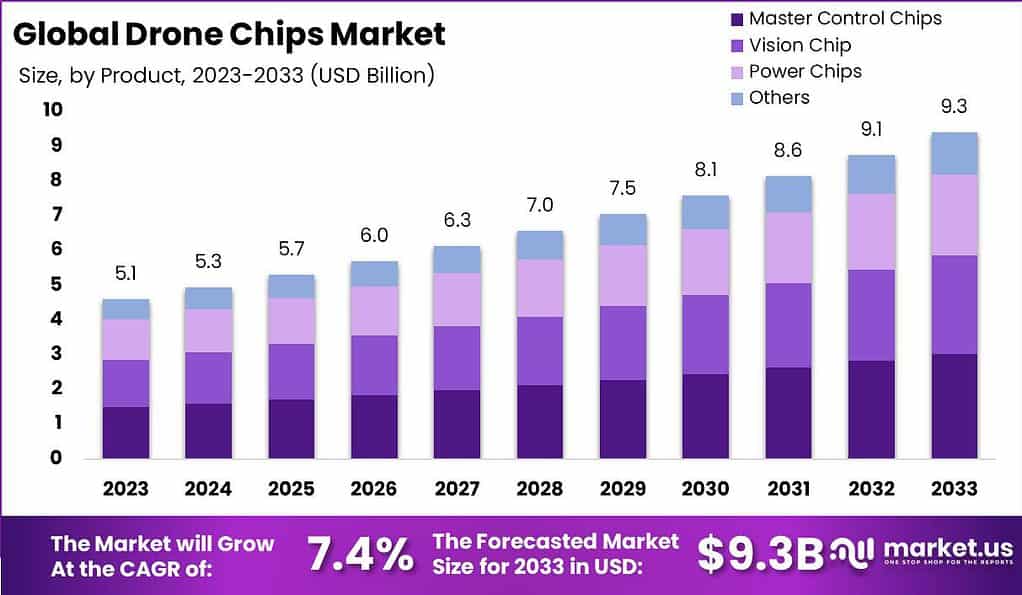
The Global Drone Chips Market size is expected to be worth around USD 9.3 Billion By 2033, from USD 5.1 Billion in 2023, growing at a CAGR of 7.4% during the forecast period from 2024 to 2033.
Drone chips, also known as microprocessors or integrated circuits, are essential components that power the operation of drones. They play a critical role in controlling the drone’s flight, processing data, and enabling communication between different parts of the drone system. The drone chips market refers to the industry involved in the manufacturing and distribution of these chips.
The drone chips market is experiencing significant growth due to the increasing adoption of drones across various industries. The demand for efficient and powerful chips is driven by the need for advanced features in drones, such as better navigation, improved communication, and enhanced data processing capabilities. The rise of industries such as agriculture, logistics, and surveillance, which extensively use drones for tasks like crop monitoring, delivery services, and security operations, further boosts the market
Technological advancements have also contributed to the expansion of the drone chips market. Manufacturers are continuously developing more advanced chips with improved processing power, longer battery life, and better communication capabilities. These advancements enable drones to perform complex tasks accurately and reliably, further driving their adoption in different industries.
However, the market faces several challenges. One of the primary concerns is the high cost of advanced drone chips, which can be a barrier for small and medium-sized enterprises. Additionally, issues related to power consumption and heat dissipation in high-performance chips pose significant technical challenges. Regulatory hurdles and privacy concerns associated with drone operations also impact market growth, as stringent regulations can limit the deployment and usage of drones in certain areas.
Despite these challenges, the drone chips market offers opportunities for further development. One such opportunity lies in the increasing demand for autonomous drones. Autonomous drones operate without human intervention, relying on advanced algorithms and sensors. These drones require powerful chips to process large amounts of data in real-time, creating opportunities for chip manufacturers to cater to this growing market segment.
Another opportunity arises from the integration of artificial intelligence (AI) and machine learning (ML) technologies in drones. AI-powered drones can analyze data collected during flight and make intelligent decisions, allowing them to adapt to changing conditions and perform complex tasks. This integration demands sophisticated chips with specialized AI and ML capabilities, presenting opportunities for chip manufacturers to explore new markets.
According to WorldMetrics, the average cost of a professional drone is approximately $2,000. Consumer drones dominate the market, holding approximately 95% of the total drone market globally. The use of drones has significantly improved efficiency in various industries; for example, they have reduced the time it takes to inspect a roof by 75%.
Additionally, about 70% of drone users are hobbyists, highlighting the widespread appeal of drones for recreational purposes. In the logistics sector, drones are predicted to reduce delivery times by 85%, showcasing their potential to revolutionize supply chain management.
Furthermore, oil and gas companies can decrease inspection costs by about 50% using drones, underscoring the cost-saving benefits in industrial applications. The industrial drone market is projected to reach $13 billion by 2025, indicating substantial growth and investment opportunities in this sector.
Key Takeaways
- The Drone Chips Market is projected to reach a value of USD 9.3 Billion by 2033 with a compound annual growth rate (CAGR) of 7.4% during the forecast period from 2024 to 2033.
- In 2023, the Master Control Chips segment dominated the market, accounting for more than 32.3% of the market share.
- Similarly, the Civilian Drones segment held a significant market position, capturing over 37.5% of the market share.
- North America led the market with a substantial position, representing more than 35.7% of the market share and generating USD 1.8 billion in revenue in 2023.
Type Analysis
In 2023, the Master Control Chips segment held a dominant market position, capturing more than a 32.3% share of the Drone Chips market. This segment leads primarily because Master Control Chips are the core component of drone operation systems. These chips coordinate all critical functions of a drone, from navigation and stability to communication and payload management. Their central role ensures that all other drone components operate harmoniously and efficiently, which is essential for both simple and complex drone operations.
The prominence of Master Control Chips in the market is further bolstered by the increasing complexity of tasks drones are assigned. As drones are increasingly used in sophisticated applications such as remote sensing, aerial photography, and automated delivery systems, the demand for robust and reliable control systems rises.
Master Control Chips, designed to meet these demanding specifications, thus see a higher adoption rate. Their ability to integrate advanced technologies like AI and real-time data processing also contributes to their market dominance, making them indispensable in high-performance drones. Furthermore, the development and enhancement of Master Control Chips continue to receive significant attention from manufacturers aiming to improve drone efficiency and functionality.
This focus not only maintains the segment’s lead in the market but also drives innovation within the broader drone technology ecosystem, ensuring ongoing growth and expansion. The critical nature of these chips in advancing drone capabilities makes the Master Control Chips segment a key area of interest for stakeholders looking to invest in the high-potential drone industry.
Application Analysis
In 2023, the Civilian Drones segment held a dominant market position, capturing more than a 37.5% share of the Drone Chips market. This segment’s leadership stems primarily from the widespread adoption of drones for personal and commercial uses, ranging from photography and videography to monitoring and surveying applications. The increasing affordability and accessibility of drone technology have allowed more consumers and businesses to explore the benefits of drones, thereby boosting the demand for chips that power these versatile devices.
Civilian drones require reliable and efficient chips to perform a variety of tasks that need precise control and data processing capabilities. As drones become more integrated into everyday activities, such as recreational flying, real estate photography, and small-scale agriculture, the need for advanced chips that can facilitate these functions continues to grow. This has encouraged chip manufacturers to innovate and develop products that cater specifically to the needs of the civilian market, ensuring the segment’s continued dominance.
Moreover, the ease of use and the ongoing improvements in drone regulations have made civilian drones more appealing to the general public. This regulatory evolution, combined with technological advancements in drone chips that offer longer flight times and enhanced data security, has further solidified the position of the Civilian Drones segment in the market. These factors collectively contribute to its leading status and suggest a robust growth trajectory moving forward.

Key Market Segments
By Type
- Master Control Chips
- Vision Chip
- Power Chips
- Others
By Application
- Civilian Drones
- Industrial Drones
- Other
Driver
Technological Advancements in Chip Capabilities
A significant driver of the Drone Chips market is the continuous technological advancements in semiconductor technology, which enhance the performance capabilities of drones. Innovations such as increased processing power, better energy efficiency, and improved connectivity features in drone chips allow drones to execute complex operations more efficiently.
These enhancements are crucial as they extend the range of applications for drones, from simple aerial photography to more complex tasks like real-time data collection and automated cargo delivery. As chip technology progresses, it enables drones to handle higher payloads and navigate more effectively under varying environmental conditions, thus broadening their usability across several industries.
Restraint
Regulatory and Safety Concerns
The growth of the Drone Chips market faces significant restraints due to stringent regulatory frameworks governing drone operations across different regions. Safety concerns, particularly relating to data privacy, airspace intrusion, and potential accidents, have prompted regulators to impose strict controls on drone flights, especially in populated areas.
These regulations can limit the deployment of drones and by extension, affect the demand for drone chips. The regulatory landscape requires ongoing navigation as it evolves in response to both technological advancements and societal impacts of drone usage.
Opportunity
Expansion into Emerging Markets
Emerging markets present lucrative opportunities for the Drone Chips industry, driven by the increasing adoption of drones for commercial and governmental applications. These markets are witnessing a surge in the use of drones for agriculture, healthcare delivery, and infrastructure monitoring, which necessitates robust, efficient, and cost-effective drone chips.
The expansion potential is further magnified by the ongoing digital transformation in these regions, where businesses and governments are keen to adopt innovative technologies to enhance operational efficiencies and service delivery.
Challenge
Technological Complexity and Integration Issues
One of the primary challenges in the Drone Chips market is the complexity associated with designing and integrating advanced chips into various drone models. As drones become more sophisticated, ensuring compatibility between different chip technologies and drone hardware can be problematic.
Manufacturers must continually innovate to overcome integration hurdles that arise due to the rapid pace of technological advancements in both drone and chip technologies. Moreover, maintaining the balance between cost and performance also poses a challenge, as consumers demand more features at lower prices
Growth Factors
- Increasing Applications Across Industries: The deployment of drones is expanding across various sectors such as agriculture, delivery services, and surveillance, which demands advanced chip technology for better performance and efficiency.
- Technological Advancements: Continuous improvements in chip technology enhance drone capabilities, enabling more complex functionalities like improved navigation, data processing, and energy efficiency.
- Rise in Commercial and Recreational Drone Use: As drones become more affordable and accessible, there is a significant increase in their use for both commercial applications and recreational purposes, fueling the demand for high-quality drone chips.
- Government and Defense Investments: Significant investments by government and defense sectors in drone technology for surveillance, security, and military uses contribute to the growth of the drone chips market.
- Global Expansion into Emerging Markets: The expanding market in emerging regions, supported by advancements in local technology and increased governmental backing, provides a considerable growth avenue for drone chip manufacturers.
Emerging Trends
- Autonomy and AI Integration: Advances in artificial intelligence and machine learning are making drones more autonomous, capable of complex decision-making and operations without human intervention.
- Miniaturization of Drone Chips: There is a trend towards making drone chips smaller, more efficient, and capable of operating with less power without compromising performance, catering to the growing demand for compact drones.
- Enhanced Connectivity Solutions: With the roll-out of technologies like 5G, drone chips are increasingly equipped to handle better connectivity, enabling faster data transmission and improved operational efficiency.
- Increased Use in Consumer Electronics: Beyond traditional applications, drone chips are finding uses in consumer electronics for applications like delivery drones and personal photography drones, driven by consumer demand for high-tech gadgets.
- Sustainability and Energy Efficiency: There is a growing emphasis on making drones more energy-efficient and environmentally friendly, which influences the development of new chip technologies that use less energy and reduce the environmental footprint of drone operations.
Regional Analysis
In 2023, North America held a dominant market position, capturing more than a 35.7% share, holding USD 1.8 billion in revenue. This leading status can be attributed to several key factors. Primarily, the region’s robust technological infrastructure and the presence of leading drone manufacturers have driven the demand for advanced drone chips.
The U.S. has been at the forefront, with its significant investments in defense and commercial drone applications, thereby pushing the boundaries of drone technology and increasing chip demand. Additionally, North America benefits from stringent regulatory frameworks that foster innovation while ensuring safety in drone operations.
These regulations have compelled drone manufacturers to adopt high-standard chips that enhance the operational capabilities and safety of drones. The ongoing research and development activities, supported by substantial funding from both government and private entities, have also spurred the growth of the drone chips market in this region. For instance, the integration of AI and IoT in drones for better data collection and autonomous operation has become a major trend, further boosting the chip market.

Key Regions and Countries
- North America
- US
- Canada
- Europe
- Germany
- France
- The UK
- Spain
- Italy
- Russia
- Netherlands
- Rest of Europe
- Asia Pacific
- China
- Japan
- South Korea
- India
- Australia
- Singapore
- Thailand
- Vietnam
- Rest of APAC
- Latin America
- Brazil
- Mexico
- Rest of Latin America
- Middle East & Africa
- South Africa
- Saudi Arabia
- UAE
- Rest of MEA
Key Players Analysis
The drone chips market is highly competitive with several key players driving innovation and growth through strategic initiatives such as acquisitions, product launches, and mergers. Among the leading companies, Qualcomm, Intel, and NVIDIA are pivotal, leveraging their extensive technological expertise to develop advanced drone chipsets that enhance drone capabilities such as navigation, connectivity, and image processing.
Qualcomm has been instrumental in launching innovative products that cater to the evolving needs of the drone industry. Their recent advancements in AI-enabled drone chips have set new standards in drone operational efficiency and data processing capabilities. Intel, another major player, continues to expand its footprint in the drone chips market by focusing on high-performance computing chips that support complex drone operations. Their collaboration with drone manufacturers for tailored chip solutions exemplifies their strategic approach to market expansion.
STMicroelectronics and Texas Instruments (TI) have also made significant contributions to the market with their specialized sensor chips and microcontrollers, which are crucial for drone stability and control. Samsung and Rockchip have enhanced the capabilities of consumer drones by integrating powerful processors that support high-resolution video streaming and advanced flight controls.
In terms of strategic mergers and acquisitions, companies like Ambarella have strengthened their market position by acquiring smaller tech firms to enhance their video processing chip technologies. This strategy not only expands their technological capabilities but also broadens their market reach in the global arena.
Top Key Players in the Market
- Qualcomm
- Intel
- STMicroelectronics
- TI
- Samsung
- ATMEL
- Nuvoton
- XMOS
- NVIDIA
- Rockchip
- Ambarella
- Leadcore Technology
- Hisilicon
- Allwinner Technology
Recent Developments
- In January 2024, Qualcomm introduced its new series of drone chips at CES 2024. These chips are designed to enhance drone performance by integrating advanced 5G capabilities, artificial intelligence (AI), and edge computing features. This launch aims to provide superior connectivity and processing power, facilitating the development of more autonomous and efficient drones.
- NVIDIA, in June 2023, released its latest generation of GPU-based chips for drones. These chips are equipped with advanced AI capabilities, enabling drones to perform more complex tasks such as high-resolution imaging and data analysis. The new GPUs are also optimized for better energy efficiency, which is crucial for extending drone flight times.
- July 2023: Samsung unveiled a new high-performance memory chip for drones, which significantly enhances data processing speeds and storage capacity, aimed at improving the performance of professional-grade drones.









