


Report Overview
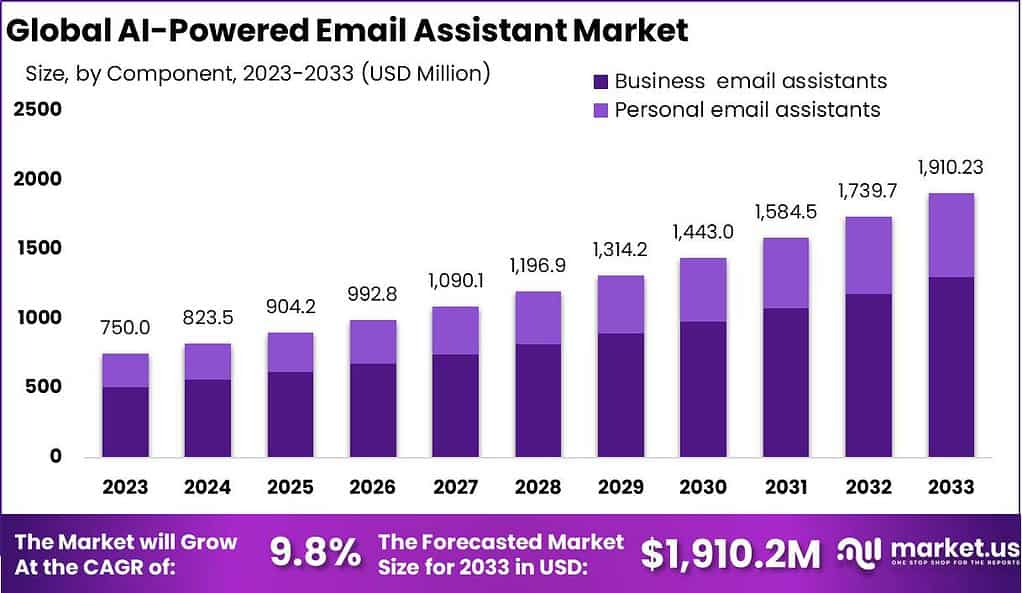
The Global AI-Powered Email Assistant Market size is expected to be worth around USD 1,910.2 Million by 2033, from USD 750 Million in 2023, growing at a CAGR of 9.8% during the forecast period from 2024 to 2033.
An AI-powered Email Assistant is a tool designed to help manage and streamline email-related tasks using artificial intelligence. It automates processes such as sorting incoming emails, providing suggested responses, scheduling emails, and summarizing email threads. This technology enhances productivity by saving time and reducing the workload associated with email management.
The AI-powered Email Assistant market is poised for substantial growth, driven by advancements in artificial intelligence and increasing adoption across various industries. The market’s expansion can be attributed to the rising need for efficient email management solutions that enhance productivity and streamline communication processes.
AI-powered email assistants leverage natural language processing (NLP) and machine learning algorithms to automate routine tasks such as sorting emails, generating responses, and scheduling meetings, thereby reducing the cognitive load on users. The growing reliance on digital communication in the corporate sector has significantly contributed to the market’s growth. Enterprises are increasingly deploying AI-powered email assistants to manage high volumes of emails, improve response times, and ensure consistency in communication.
Additionally, the integration of AI assistants with existing email platforms and enterprise software enhances their functionality and appeal to end-users. However, market growth is not without challenges. Data privacy concerns and the potential for misuse of sensitive information pose significant risks. Regulatory compliance and the need for robust cybersecurity measures are paramount to addressing these concerns and ensuring user trust.
According to research done by usemotion, 75% of professionals express interest in using AI for content writing, email management, and task automation, 28% of marketers already use AI to create email copy and respond to emails, 46% of US companies utilize AI tools such as virtual assistants and chatbots in the year 2023. Additionally, 49.5% of email marketers recognize AI’s positive impact on overall automation efficiency while only 1.1% attribute its function solely to copywriting assistance.
Key Takeaways
- The AI-powered Email Assistant Market is projected to reach a valuation of approximately USD 1,910.2 million by 2033, up from USD 750 million in 2023. This growth is anticipated to occur at a compound annual growth rate (CAGR) of 9.8% over the forecast period from 2024 to 2033.
- In 2023, the Business email assistants segment held a dominant market position, capturing more than a 68% share of the AI-powered email assistant market.
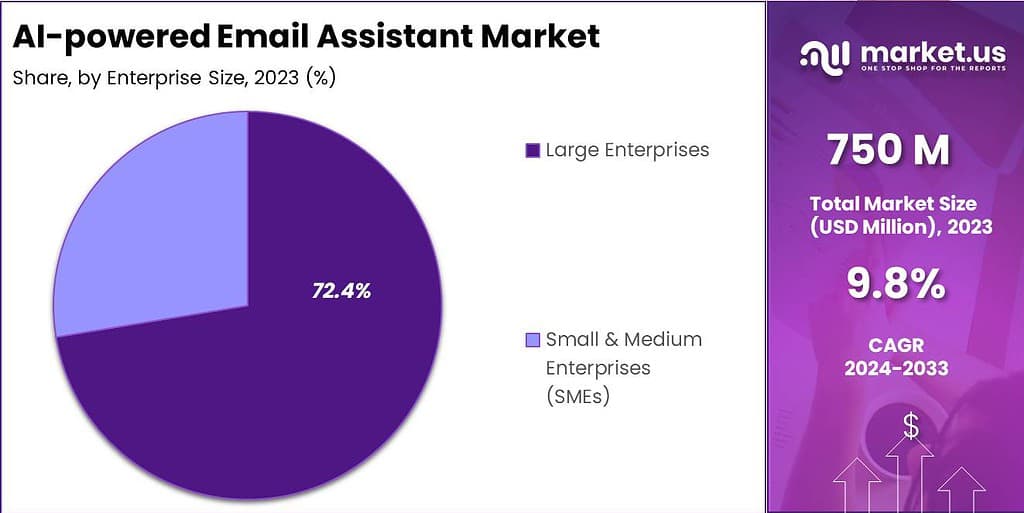
- In 2023, the Large Enterprises segment held a dominant market position, capturing more than a 72.4% share of the AI-powered email assistant market.
- In 2023, the Marketing & Communication segment held a dominant market position in the AI-powered email assistant market, capturing more than a 37.5% share.
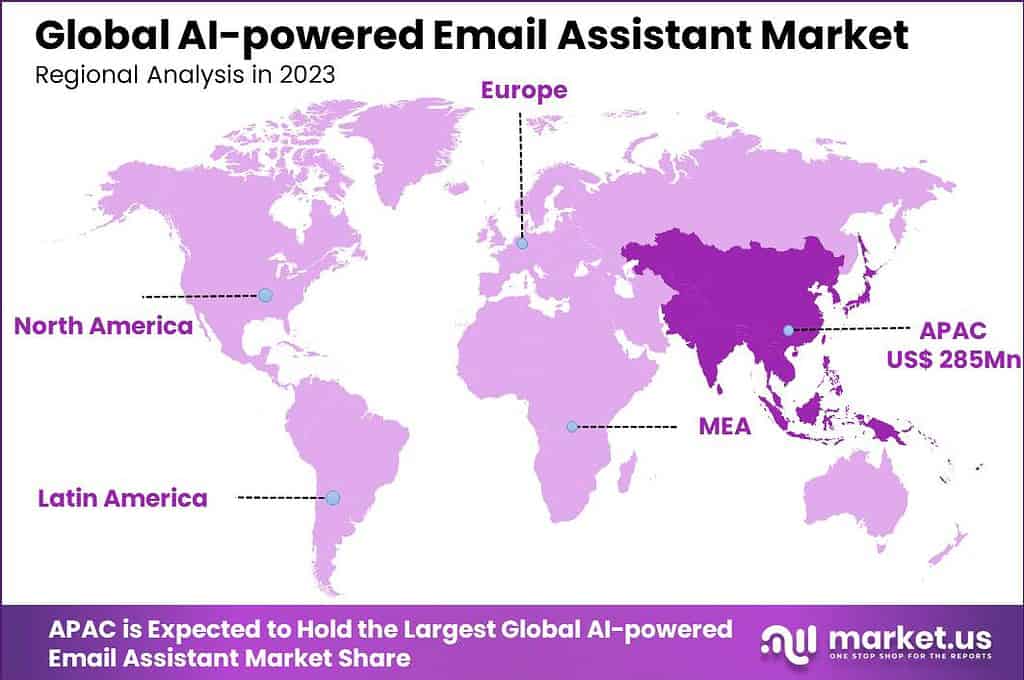
- In 2023, the Asia Pacific region held a dominant position in the AI-powered email assistant market, capturing more than a 38% share, with revenues reaching approximately USD 285 million.
Type Analysis
In 2023, the Business email assistants segment held a dominant market position, capturing more than a 68% share of the AI-powered email assistant market. This dominance is primarily due to the high demand for efficient email management solutions in corporate environments. Business email assistants are designed to handle a large volume of emails, streamline communication, and enhance productivity by automating routine tasks such as sorting, prioritizing, and responding to emails.
These capabilities are particularly beneficial for businesses that need to manage extensive client communications and internal correspondence efficiently. The leading position of the Business email assistants segment can be attributed to several key factors. First, the increasing adoption of AI technologies in the workplace has driven demand for smart email management tools that can reduce the workload on employees and improve overall operational efficiency.
Second, these assistants offer advanced features like natural language processing, sentiment analysis, and integration with other business tools such as CRM systems, making them indispensable for businesses aiming to maintain seamless communication and customer service. Furthermore, the rise in remote work and the need for more effective virtual collaboration have further propelled the growth of this segment, as businesses seek to maintain high levels of productivity and communication standards in a distributed work environment.
On the other hand, the Personal email assistants segment, while growing, remains comparatively smaller. Personal email assistants are gaining traction among individual users who seek to manage their personal email more efficiently, organize their inboxes, and automate responses.
However, the market penetration of personal email assistants is not as significant as that of business email assistants, mainly because individual users have less complex email management needs compared to businesses. Despite this, the Personal email assistants segment is expected to grow steadily as more individuals recognize the benefits of AI-powered tools in managing their personal digital communications.
Enterprise Size Analysis
In 2023, the Large Enterprises segment held a dominant market position, capturing more than a 72.4% share of the AI-powered email assistant market. This significant lead is primarily attributed to the substantial resources and higher budgets available to large organizations, allowing them to invest heavily in advanced technologies.
Large enterprises often have complex communication needs, requiring sophisticated email management solutions that can streamline workflows, enhance productivity, and improve customer engagement. The ability to integrate AI-powered tools into existing systems and scale them across multiple departments further strengthens their market position.
Large enterprises benefit from AI-powered email assistants through enhanced efficiency and accuracy in handling large volumes of email traffic. These tools leverage machine learning algorithms to automate routine tasks, prioritize emails, and provide actionable insights, which are crucial for managing extensive communication networks.
Additionally, large organizations are increasingly focusing on personalized customer interactions, where AI-powered email assistants can play a pivotal role by analyzing customer data to generate tailored responses. The integration of these advanced technologies supports their strategic initiatives and drives competitive advantage in a rapidly evolving business environment.
Application Analysis
In 2023, the Marketing & Communication segment held a dominant market position in the AI-powered Email Assistant market, capturing more than a 37.5% share. This leadership can be attributed primarily to the escalating demand for automation in creating and managing large-scale email campaigns.
Marketing teams across various industries are increasingly leveraging AI-powered email assistants to personalize content, segment audiences, and analyze consumer behavior. This technology allows for the tailoring of messages based on user preferences and interactions, enhancing engagement rates and ultimately boosting conversion rates.
Furthermore, the rise in digital marketing expenditure, especially in sectors such as retail, e-commerce, and entertainment, has propelled the adoption of AI technologies. AI-powered email assistants optimize communication strategies by suggesting the best times to send emails, predicting the effectiveness of certain wordings, and even recommending content adjustments based on real-time performance metrics.
This capacity for dynamic adaptation not only improves outcomes but also significantly reduces the workload on marketing professionals, allowing them to focus on strategy and creative development. As AI technology continues to advance, the integration of more sophisticated natural language processing and machine learning models is making these tools even more capable.
This evolution is expected to continue driving the growth of the Marketing & Communication segment, as more organizations recognize the value of AI in achieving a competitive advantage in consumer engagement and brand loyalty. The segment’s dominance is further supported by ongoing innovations that enhance user experience and provide actionable insights through advanced data analytics, positioning Marketing & Communication as a critical area for investment in the AI-powered email assistant market.
Key Market Segments
By Type
- Personal email assistants
- Business email assistants
By Enterprise Size
- Large Enterprises
- Small & Medium Enterprises (SMEs)
By Application
- Marketing & Communication
- Sales
- Customer Service
- HR& Recruitment
- Others
Driver
Increasing Adoption of AI in Business Operations
The increasing adoption of AI in business operations is a significant driver for the AI-powered Email Assistant market. Businesses are continually seeking innovative solutions to enhance productivity and streamline processes, and AI-powered email assistants provide a substantial advantage by automating routine email tasks. These tasks include sorting emails, generating responses, scheduling meetings, and prioritizing messages, which collectively save time and reduce the cognitive load on employees.
By leveraging natural language processing (NLP) and machine learning algorithms, AI-powered email assistants can understand and respond to emails contextually and accurately, improving the efficiency of communication. Moreover, the integration of AI email assistants with existing enterprise software, such as customer relationship management (CRM) systems, enables businesses to maintain a consistent and professional tone in communications, enhancing customer relationships and satisfaction.
Restraint
Data Privacy and Security Concerns
Data privacy and security concerns present a significant restraint for the AI-powered Email Assistant market. As these tools handle a large volume of sensitive and confidential information, including personal data, financial details, and proprietary business communications, the potential for data breaches and unauthorized access is a critical issue.
The increasing sophistication of cyberattacks amplifies these risks, making robust data protection measures essential for AI-powered email assistants. Organizations and individuals alike are highly aware of the implications of data breaches, which can lead to substantial financial losses, legal consequences, and reputational damage.
Compliance with stringent data protection regulations, such as the General Data Protection Regulation (GDPR) in Europe and the California Consumer Privacy Act (CCPA) in the United States, adds another layer of complexity. These regulations mandate strict controls over how personal data is collected, stored, and processed, requiring significant investment in cybersecurity infrastructure and continuous monitoring.
Opportunities
Integration with Advanced Analytics and CRM Systems
Integration with advanced analytics and customer relationship management (CRM) systems presents a significant opportunity for the AI-powered Email Assistant market. By combining AI email assistants with advanced analytics platforms, businesses can gain deeper insights into communication patterns, customer preferences, and engagement metrics.
These insights enable companies to optimize their email strategies, personalize marketing campaigns, and improve overall customer service. For instance, AI-powered analytics can identify the most effective email formats, content types, and sending times, allowing for more targeted and impactful communications.
Moreover, integrating AI email assistants with CRM systems enhances the efficiency and effectiveness of customer relationship management. This integration ensures that all email interactions are seamlessly synchronized with customer data, providing a comprehensive view of each customer’s history and preferences. Consequently, businesses can deliver more personalized and relevant communications, fostering stronger customer relationships and increasing satisfaction.
Challenges
Technological Complexity and User Adoption
Technological complexity and user adoption represent significant challenges for the AI-powered Email Assistant market. Implementing AI-powered solutions often requires substantial technical expertise and a thorough understanding of machine learning algorithms and natural language processing (NLP).
Many organizations may struggle with integrating these advanced technologies into their existing systems and workflows, creating a barrier to widespread adoption. The complexity of setting up and maintaining AI-powered email assistants can be daunting, particularly for small and medium-sized enterprises (SMEs) that may lack the necessary resources and technical capabilities.
Additionally, user adoption is a critical challenge. Employees may resist transitioning to AI-powered tools due to fears of job displacement, concerns about the reliability of AI-generated content, or simply the discomfort of changing their established routines. Overcoming this resistance requires effective change management strategies, including comprehensive training and support to ensure users understand the benefits and functionalities of AI email assistants.
Growth Factors
- Advancements in Artificial Intelligence: Continuous improvements in AI, particularly in natural language processing (NLP) and machine learning, enhance the capabilities and accuracy of email assistants.
- Increased Business Productivity Needs: Organizations seek solutions to automate routine tasks and streamline communication processes, boosting demand for AI-powered email assistants.
- Integration with Enterprise Software: Seamless integration with existing systems such as CRM and enterprise resource planning (ERP) software increases the utility and adoption of AI email assistants.
- Rising Adoption of Digital Transformation: Companies undergoing digital transformation initiatives are more likely to adopt AI solutions, including email assistants, to modernize their operations.
- Enhanced Email Management: AI-powered email assistants offer advanced features like sorting, prioritizing, and automated responses, significantly improving email management efficiency.
- Personalization and Customer Engagement: The ability to personalize communications and enhance customer engagement through data-driven insights propels market growth.
Latest Trends
- Enhanced Natural Language Processing (NLP): Ongoing improvements in NLP technologies enable more accurate and context-aware email drafting and response capabilities.
- Integration with Advanced Analytics: AI-powered email assistants are increasingly integrated with analytics platforms, providing deeper insights into email performance and user engagement.
- Personalization and Hyper-Personalization: Advanced AI algorithms allow for more personalized email content and interactions, tailoring messages to individual recipient preferences and behaviors.
- AI-Driven Predictive Analytics: Predictive analytics features are being incorporated to forecast email outcomes, optimize send times, and predict user responses.
- Voice-Activated Email Assistants: The integration of voice recognition technology allows users to compose, read, and manage emails through voice commands.
- Multi-Language Support: AI-powered email assistants are expanding to support multiple languages, making them accessible to a global user base.
Regional Analysis
In 2023, the Asia Pacific region held a dominant position in the AI-powered Email Assistant market, capturing more than a 38% share, with revenues reaching approximately USD 285 million. This robust growth is largely driven by the rapid digital transformation across emerging economies such as China, India, and Southeast Asia.
The region’s massive small and medium enterprise (SME) sector, coupled with its burgeoning digital user base, has created a fertile ground for the adoption of AI technologies. As businesses in the region strive to enhance customer relationships and streamline communication processes, AI-powered email assistants are increasingly being employed to manage large volumes of email interactions efficiently and effectively.
Despite Asia Pacific’s strong performance, North America is emerging as another influential player in the market. This region’s market dominance is underpinned by its advanced technological infrastructure and the early adoption of AI solutions across various industries, including retail, healthcare, and financial services.
Companies in North America are leveraging AI-powered email assistants not only for improving customer service and marketing but also for optimizing sales and HR operations. The integration of AI into email systems in North America is further facilitated by substantial investments in AI and machine learning startups, alongside rigorous research and development activities.
The presence of major technology firms and startups in North America, particularly in the United States and Canada, continues to drive innovation in the AI-powered email assistant space. These companies are at the forefront of developing new features like predictive analytics, sentiment analysis, and automated personalization, which are critical in enhancing the effectiveness of email communication.
North America’s market is expected to expand significantly, with projections suggesting a robust growth trajectory fueled by continuous technological advancements and a growing emphasis on customer experience optimization.
Key Regions and Countries
North America
- US
- Canada
Europe
- Germany
- France
- The UK
- Spain
- Italy
- Russia
- Netherlands
- Rest of Europe
Asia Pacific
- China
- Japan
- South Korea
- India
- Australia
- Singapore
- Thailand
- Vietnam
- Rest of APAC
Latin America
- Brazil
- Mexico
- Rest of Latin America
Middle East & Africa
- South Africa
- Saudi Arabia
- UAE
- Rest of MEA
Key Players Analysis
The AI-Powered Email Assistant market is characterized by robust activity from a host of significant players, each contributing to the technological advancements and strategic market dynamics through various initiatives such as acquisitions, product launches, and mergers.
Missive, Superflows, and SaneBox are pivotal in enhancing collaborative email management, workflow automation, and intelligent inbox organization, respectively. Lavender and Scribbly have recently launched new features aimed at improving email personalization and response drafting using AI-driven insights.
Superhuman and AI Mailer stand out with their rapid deployment of AI to streamline email handling, setting high standards in user experience and interface design. Flowrite and Tugan have been active in expanding their reach and capabilities through strategic partnerships and incremental updates to their platforms.
Notable among product launches, Copy.ai and Phrasee have introduced innovative tools that leverage AI to generate persuasive and contextually relevant email content, aiding in marketing and daily communications. Nanonets and BEE Pro have focused on integrating AI to enhance email design and template effectiveness, directly impacting marketing campaign efficiencies.
Top Key Players in the Market
- Missive
- Superflows
- SaneBox
- Lavender
- Scribbly
- Superhuman
- AI Mailer
- Flowrite
- Tugan
- Copy.ai
- Phrasee
- Nanonets
- BEE Pro
- Sender
- Crystal
- Persado
- Polymail
- Other Key Players
Recent Developments
- March 2023: Lavender launched a new feature called the Personalization Assistant, which integrates with email clients to suggest ways to personalize emails based on recipient data and provide real-time coaching.
- April 2023: Missive announced the release of a new collaboration tool that enhances team email management by allowing shared business mailboxes and task assignments within the inbox.
- June 2023: Superhuman launched an update to its AI assistant, improving the speed and accuracy of email drafting and response suggestions.









