


Report Overview
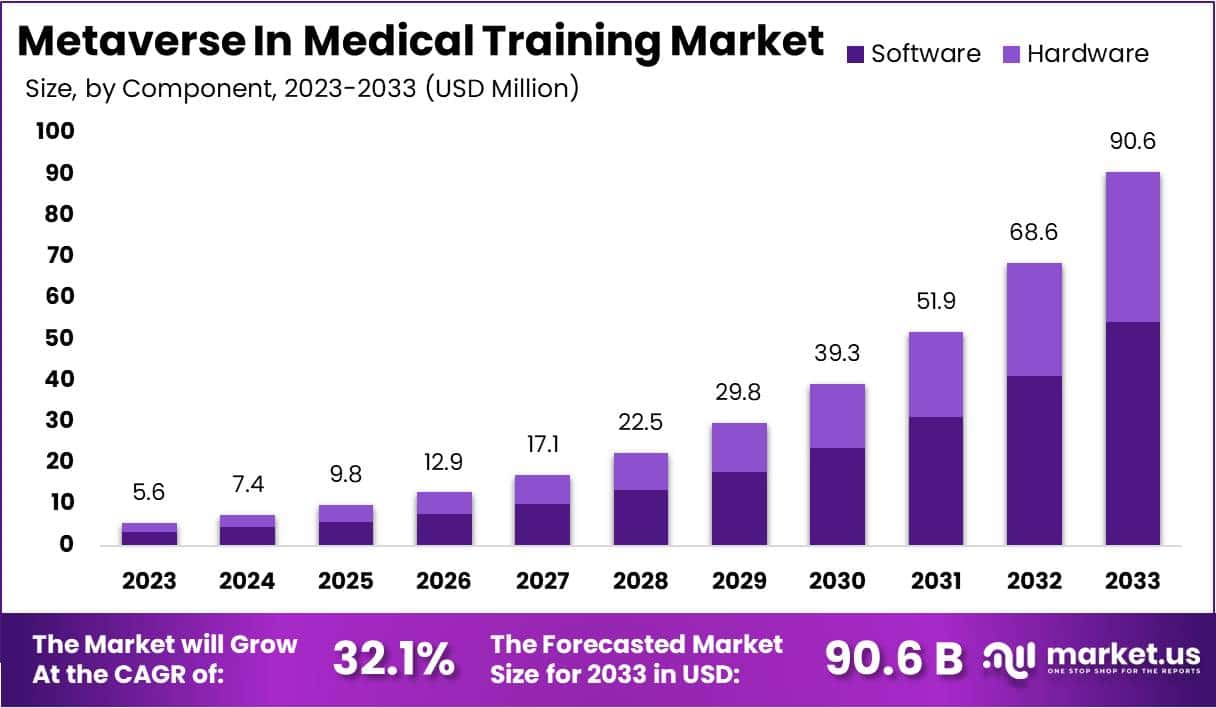
The Global Metaverse In Medical Training Market Size is expected to be worth around USD 90.6 Billion by 2033, from USD 5.6 Billion in 2023, growing at a CAGR of 32.1% during the forecast period from 2024 to 2033.
The metaverse is transforming medical training through advancements in extended reality (XR) technologies, including virtual reality (VR), augmented reality (AR), and mixed reality (MR). These tools are enhancing interactive learning and enabling remote collaboration, fueled by the demand for immersive training environments. Such developments allow for individual learning and global practitioner collaboration. Institutions like the Johns Hopkins School of Nursing are adopting VR to simulate various medical scenarios, while the University of Central Florida College of Nursing utilizes AR to teach complex anatomy.
These XR technologies are not only revolutionizing education but are also improving patient care and surgical precision. According to a report by Accenture, 81% of healthcare executives believe the metaverse will significantly influence their organizations by advancing training and enhancing patient outcomes. Additionally, the Boston Consulting Group highlights the potential for these technologies to reduce healthcare delivery costs and increase operational efficiencies.
The practical applications of the metaverse in healthcare are evident in virtual hospitals and training facilities, which improve medical tourism and offer comprehensive training platforms. The use of digital twins and simulated procedures facilitates risk-free surgical practices and diagnostics, enhancing access to care and diagnostic accuracy. This ongoing innovation in the metaverse is proving vital in closing gaps in medical education and healthcare delivery.
However, integrating the metaverse into healthcare presents several challenges, such as ensuring data security, accommodating less tech-savvy populations, and managing high initial setup costs. Despite these hurdles, the continuous development and substantial investments into this technology suggest a significant, enduring impact on the healthcare sector.
Key Takeaways
- The market is expected to grow from USD 5.6 billion in 2023 to USD 90.6 billion by 2033, with a CAGR of 32.1%.
- In 2023, the hardware segment held over 62% of the market share, driven by VR headsets and AR glasses.
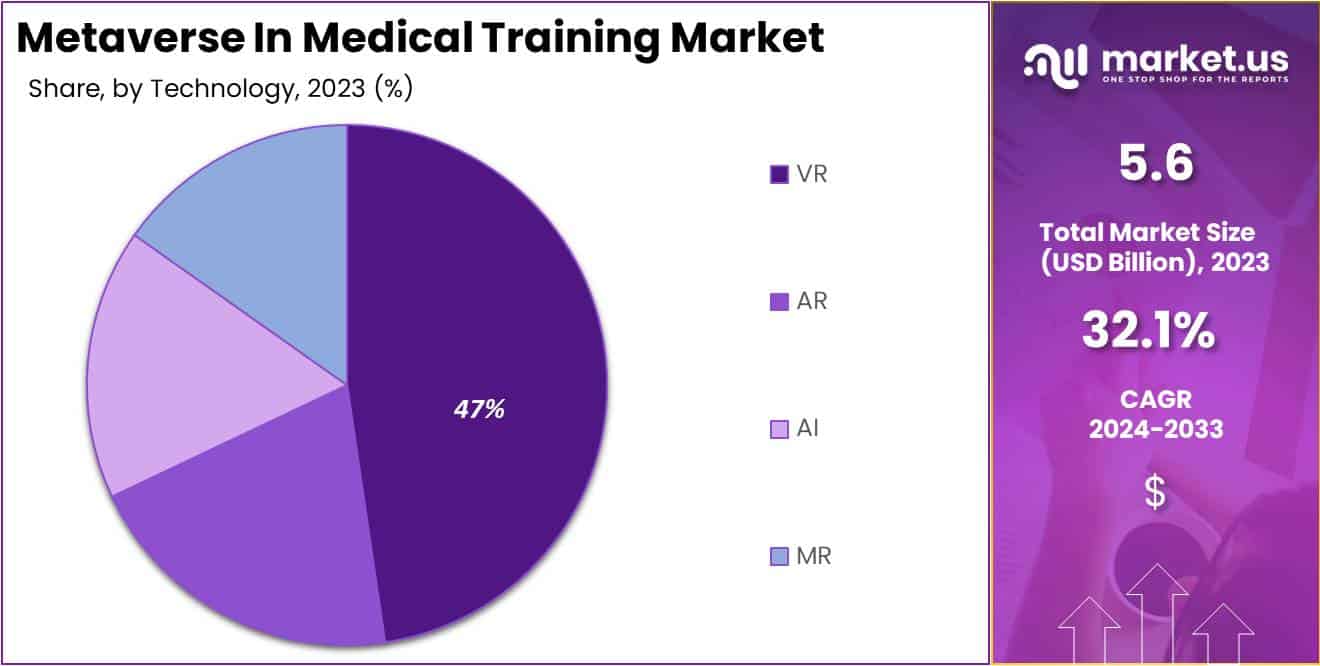
- The VR technology segment captured more than a 47% share in 2023, due to its immersive capabilities in medical training.
- VR headsets led the devices segment with a 43% market share in 2023, followed by AR devices and mixed reality platforms.
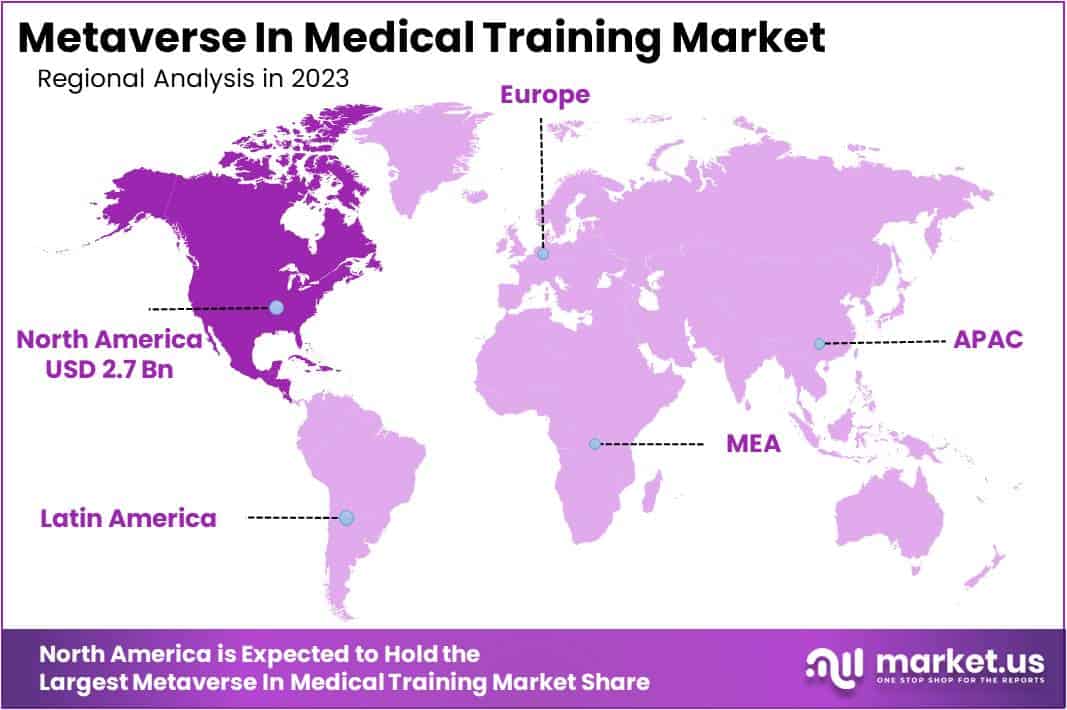
- North America dominated the market in 2023, holding a 38% share with a market value of USD 2.7 billion.
- Enhanced simulation capabilities in the metaverse offer risk-free, realistic environments for practicing complex medical procedures.
- High implementation costs, ranging from $60,000 to $1 million, present a barrier to metaverse adoption in medical training.
- Expanding remote learning through metaverse technologies improves access, reduces costs, and enhances the quality of medical training.
- Collaborations between tech companies and healthcare institutions are driving the adoption of metaverse technologies in medical training.
- 81% of healthcare executives believe the metaverse will significantly influence their organizations by advancing training and enhancing patient outcomes.
Component Analysis
In 2023, the hardware segment notably dominated the component sector of the Metaverse in Medical Training Market, securing over 62% of the market share. This dominance is largely driven by the necessity for sophisticated physical devices such as VR headsets and AR glasses. These devices are indispensable for creating immersive and realistic training environments in medical education. Additionally, the segment benefits significantly from continuous advancements in graphical processing units (GPUs) and enhanced processing speeds, which are crucial for delivering smooth and interactive simulations.
Furthermore, innovations in sensor technology and haptic feedback are enhancing the hardware segment’s impact. These technological improvements enable more precise simulations of complex medical procedures, providing medical students with a hands-on, virtual practice environment before transitioning to real-world applications. With ongoing technological developments and increasing investments in healthcare IT, the hardware segment is poised for sustained growth. The growing endorsement of Metaverse technologies by medical schools and training institutions highlights the expanding influence and potential of this innovative training approach.
Technology Analysis
In 2023, the VR segment held a dominant market position in the Technology Segment of the Metaverse in Medical Training Market, capturing more than a 47% share. This significant market share can be attributed to VR’s immersive capabilities, which provide realistic simulations for medical training. Healthcare professionals benefit from VR technology as it allows for detailed, interactive scenarios that enhance both learning and practical application.
Advancements in VR hardware and software have further propelled its adoption. Improved graphical fidelity and user interfaces have made VR tools more accessible and effective for complex medical procedures training. Hospitals and medical schools are increasingly investing in VR to reduce training costs and improve the safety and effectiveness of medical education.
The market growth is also driven by collaborations between tech companies and medical institutions. These partnerships focus on developing tailored VR solutions that address specific educational needs in the healthcare sector. Looking ahead, the VR segment is expected to continue its growth trajectory, driven by technological innovations and increasing awareness of its benefits in medical training.
Devices Analysis
In 2023, the VR Headsets segment held a dominant market position in the Devices Segment of the Metaverse in Medical Training Market, capturing more than a 43% share. This prominence is attributed to the immersive and interactive learning experiences VR technology offers to medical professionals.
AR devices are also significant, offering augmented overlays that enhance real-world training scenarios. Their practical applications in surgeries and diagnostics contribute to improved precision and learning outcomes. This segment is poised for robust growth as AR technology becomes more accessible and integrated into medical education.
Mixed Reality platforms, combining elements of VR and AR, are emerging as pivotal in advanced medical training environments. They provide a hybrid experience, enabling more complex and nuanced medical training scenarios. As these platforms evolve, they are expected to capture a larger market share, driven by their ability to simulate highly realistic medical scenarios.
End User Analysis
In 2023, the VR Headsets segment emerged as the predominant category in the Metaverse in Medical Training Market within the End User segment. It accounted for over 41% of the market share. This segment benefits significantly from its immersive technology, which enhances learning and skill acquisition in medical training environments.
Following VR Headsets, AR Devices also made a substantial impact, streamlining complex procedures and interactive learning. Their real-time data overlay directly onto the physical world supports intricate medical training applications. This technology is particularly beneficial in surgical simulations and anatomy education.
Mixed Reality Platforms are gaining traction, offering a blend of VR and AR capabilities. These platforms provide a seamless integration of real-world and digital elements, creating a highly interactive and engaging learning environment for medical trainees. The ability to interact with both physical and virtual elements significantly enhances the training experience.
Key Market Segments
By Component
- Software
- Hardware
By Technology
- AR
- VR
- AI
- MR
By Devices
- VR Headsets
- AR Devices
- Mixed Reality Platforms
By End User
- Medical Schools and Universities
- Hospitals and Healthcare Institutions
- Pharmaceutical Companies
- Others
Drivers
Enhanced Simulation Capabilities
Enhanced simulation capabilities in the metaverse are proving to be a significant driver for its adoption in the medical training market. This technology allows medical professionals to practice complex procedures in a risk-free, highly realistic virtual environment. Such simulations are particularly valuable in fields like surgery and emergency response, where hands-on experience is crucial but opportunities for safe, real-world practice can be limited.
The metaverse’s simulation environments offer several advantages. They are accessible from anywhere, reducing the need for physical infrastructure and enabling a scalable training model that can rapidly adapt to the latest medical knowledge and techniques. For instance, during the COVID-19 pandemic, the necessity for remote and versatile training options became especially clear, accelerating the adoption of AR and VR technologies in healthcare.
Moreover, a survey by BCG highlighted that over 70% of healthcare executives acknowledge the use of metaverse technologies in their operations, with a strong belief that its importance will continue to grow. These advancements underscore the transformative potential of enhanced simulation capabilities provided by the metaverse, promising not only improved training outcomes but also broader innovations in healthcare delivery and management.
Restraints
High Implementation Costs
High implementation costs present a significant barrier to the adoption of metaverse technologies in medical training. The development of a metaverse, tailored for healthcare applications, requires substantial initial investments.
Estimates suggest that the cost to develop such technologies can range from $60,000 to $1 million, depending on the complexity of the virtual environment and the medical procedures it intends to simulate. This includes expenses for sophisticated VR/AR hardware, advanced game engines, and ongoing content creation to ensure realistic and effective training scenarios.
Furthermore, maintaining compatibility across various platforms and devices, along with ensuring robust network infrastructure, adds additional layers of complexity and cost. These financial requirements can be prohibitive for many institutions, particularly those in resource-limited settings, making it difficult to justify the high upfront and ongoing expenditures associated with implementing and updating metaverse technologies.
Opportunities
Expanding Remote Learning
The expansion of remote learning in the medical training market through the metaverse presents significant opportunities, as recent data underscores. This shift is largely fueled by the necessity for distance education propelled by the COVID-19 pandemic.
In the healthcare sector, metaverse technologies not only improve access by connecting patients and providers globally but also enhance the precision of medical diagnostics and the overall quality of surgeries. Furthermore, these technologies aid in reducing costs across care delivery, medical training, and data management, marking a new era in healthcare education and practice.
Trends
Increasing Collaboration Between Tech and Healthcare Institutions
The trend of increasing collaboration between technology companies and healthcare institutions is shaping the future of medical training through the metaverse. These partnerships leverage advanced technologies like virtual reality (VR), augmented reality (AR), and mixed reality (MR) to create immersive, interactive training environments.
For instance, 81% of healthcare executives believe the metaverse will positively impact their organizations, with nearly half expecting transformational changes. VR training modules have already demonstrated effectiveness; a UK study found that 92% of participants trained via VR gained adequate understanding compared to only 16% with traditional methods.
Regional Analysis
In 2023, North America held a dominant market position, capturing more than a 38% share with a market value of USD 2.7 billion. This leadership can be attributed to several key factors.
Firstly, the region benefits from a robust healthcare infrastructure. Advanced facilities and technologies are readily available, providing a fertile ground for the adoption of innovative solutions. Secondly, North America has a history of early adoption of new technologies. This trend continues with metaverse applications in medical training.
The United States plays a significant role in this market dominance. Substantial investments from both government and private sectors drive the integration of metaverse technologies into medical education. These investments support the development of immersive and interactive learning experiences for medical professionals.
Moreover, there is a growing focus on enhancing medical education. The need for better training methods is clear, and the metaverse offers promising solutions. Immersive simulations and virtual environments provide realistic and effective training scenarios.
Government initiatives also play a crucial role. Supportive policies and funding for healthcare innovation encourage the adoption of these technologies. Collaboration between technology firms and medical institutions further accelerates market growth.
Key Regions and Countries
- North America
- US
- Canada
- Europe
- Germany
- France
- The UK
- Spain
- Italy
- Russia
- Netherland
- Rest of Europe
- Asia Pacific
- China
- Japan
- South Korea
- India
- New Zealand
- Singapore
- Thailand
- Vietnam
- Rest of APAC
- Latin America
- Brazil
- Mexico
- Rest of Latin America
- Middle East & Africa
- South Africa
- Saudi Arabia
- UAE
- Rest of MEA
Key Players Analysis
In the Metaverse in Medical Training Market, several key players are driving innovation and adoption through their advanced technologies. NVIDIA Corporation, with its cutting-edge graphics processing units (GPUs), plays a pivotal role by enabling high-quality simulations and virtual environments crucial for medical training. Their advancements in artificial intelligence and machine learning further support interactive and personalized training programs. Microsoft contributes significantly with its Azure cloud platform and HoloLens mixed reality devices, providing robust tools for immersive training experiences that help medical professionals practice procedures and enhance skills in a virtual setting.
GE Healthcare leverages its expertise in medical imaging and diagnostics, integrating their technologies with virtual reality platforms to offer realistic training modules replicating real-life scenarios. This integration allows trainees to gain practical experience without the associated risks of live patients. Medtronic Plc focuses on surgical training and procedure rehearsals, using the Metaverse to allow surgeons to practice complex procedures with their advanced medical devices. Additionally, other key players, including tech firms specializing in VR and AR applications, software developers, and healthcare organizations, collectively drive innovation and improve the quality of medical training.
Market Key Players
- NVIDIA Corporation
- Microsoft
- GE Healthcare
- Medtronic Plc
- Siemens Healthineers AG
- Surgical Science
- 3D Systems
- CAE Healthcare
- Precision OS
Recent Developments
- In May 2023: Siemens Healthineers opened a Education and Development Center (EDC) in Erlangen, Germany. The center, built with an investment of approximately €60 million over three years, provides training using VR glasses and simulators. This facility enhances the company’s capacity for medical training, integrating practical and theoretical education with advanced technologies.
- In May 2023: At the Microsoft Ignite 2023 event, new features for the industrial metaverse were showcased, including advancements in AI and digital twins. These technologies are being used to create realistic and interactive training environments for medical professionals, enabling them to practice procedures and patient interactions safely and effectively.
- In March 2023: During the NVIDIA GTC 2023, NVIDIA announced various advancements in AI computing systems, including sessions on how generative AI and the metaverse can be utilized across industries such as medical training. This event highlighted the integration of AI to enhance training and simulation in medical fields.
- In January 2023: GE Healthcare launched a strategic collaboration with several leading medical institutions to integrate metaverse technologies into their training programs. This initiative aims to develop high-fidelity virtual simulations for medical training, enhancing the practical skills of medical professionals through immersive experiences. The collaboration focuses on surgical procedures, patient diagnostics, and interdisciplinary training, leveraging VR and AR technologies.









