


Report Overview
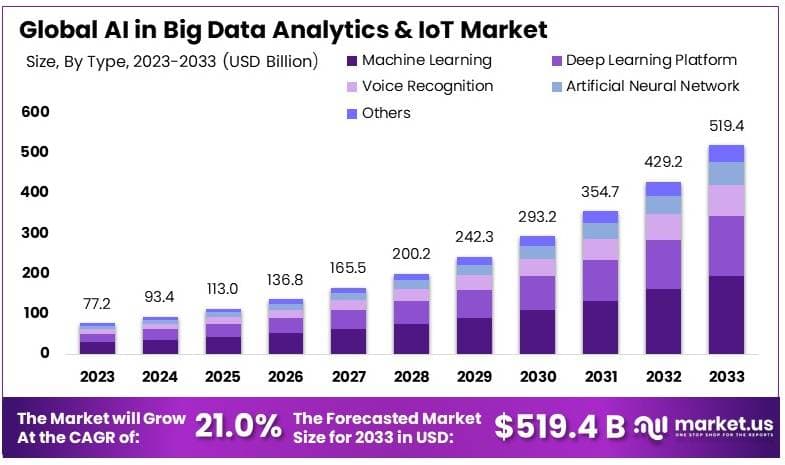
The Global AI in Big Data Analytics and IoT Market size is expected to be worth around USD 519.4 Billion by 2033, from USD 77.2 Billion in 2023, growing at a CAGR of 21.0% during the forecast period from 2024 to 2033.
The AI in Big Data Analytics and IoT Market centers on the use of artificial intelligence to analyze vast amounts of data generated by the Internet of Things (IoT). AI enhances the ability to process and interpret data, leading to more informed decision-making and improved operational efficiency. This market is expanding rapidly as businesses increasingly rely on data-driven insights.
AI-powered tools in this market analyze data from connected devices, enabling predictive maintenance, real-time monitoring, and advanced analytics. These tools help companies optimize operations, reduce downtime, and improve customer experiences. Key industries include manufacturing, healthcare, and smart cities.
The demand for AI in Big Data Analytics and IoT is expected to grow as more devices become interconnected. Companies that harness AI to analyze IoT data can unlock new opportunities, improve efficiency, and stay competitive. The focus should be on developing AI solutions that can scale with the increasing volume of data.
The AI in Big Data Analytics and IoT market is rapidly expanding as businesses seek to leverage these technologies for competitive advantage and operational efficiency. By 2024, 84% of businesses are expected to implement AI, recognizing its potential to offer a significant edge over competitors. This widespread adoption reflects the growing importance of AI and IoT in driving business success across various industries.
Companies that have integrated IoT devices into their supply chains are already seeing substantial benefits. Over 70% of these companies report significant improvements in operational efficiency and visibility. This enhanced visibility allows for more precise monitoring and management of supply chain activities, leading to better decision-making and reduced operational disruptions.
The combination of AI and IoT is also proving invaluable in specific applications like energy management and safety. Predictive models using AI and IoT have achieved up to 90% accuracy in forecasting energy consumption in smart buildings.
This high level of accuracy enables more efficient energy use, reducing costs and supporting sustainability initiatives. In the construction industry, real-time AI and IoT-based monitoring systems have reduced hazardous incidents by 30% through early risk detection. These safety improvements not only protect workers but also minimize costly project delays.
Furthermore, companies that employ AI and Big Data Analytics to enhance supply chain resilience have reported a 50% faster recovery time from disruptions compared to those not using these technologies. This resilience is crucial in today’s volatile market environment, where supply chain disruptions can have significant financial and operational impacts.
The integration of Artificial Intelligence with Big Data Analytics and IoT is reshaping how businesses operate, offering new levels of efficiency, safety, and resilience. As adoption rates continue to rise, companies that successfully harness these technologies will likely see sustained competitive advantages. The future of the AI in Big Data Analytics and IoT market looks promising, with continued innovation expected to drive further growth and transformation across industries.
Key Takeaways
- The AI in Big Data Analytics and IoT Market was valued at USD 77.2 billion in 2023 and is expected to reach USD 519.4 billion by 2033, with a CAGR of 21.0%.
- Machine Learning dominates the type segment with 37.5% due to its critical role in analyzing vast amounts of IoT data and enabling predictive insights.
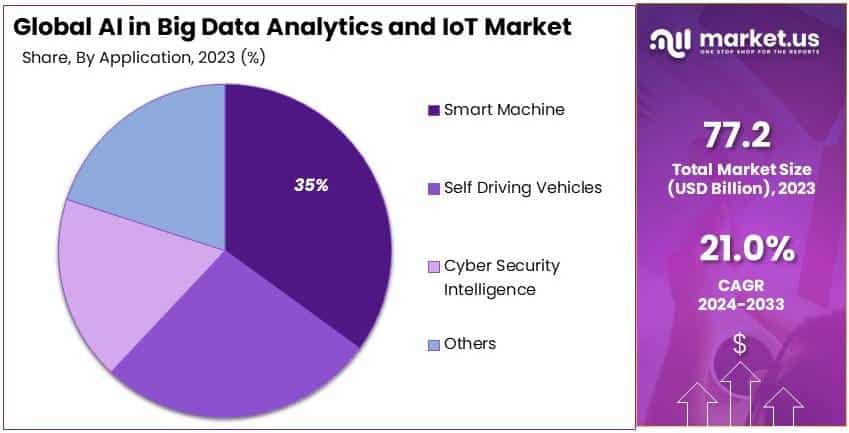
- Smart Machine leads the application segment with 35%, driven by the increasing demand for automation and intelligent systems in various industries.
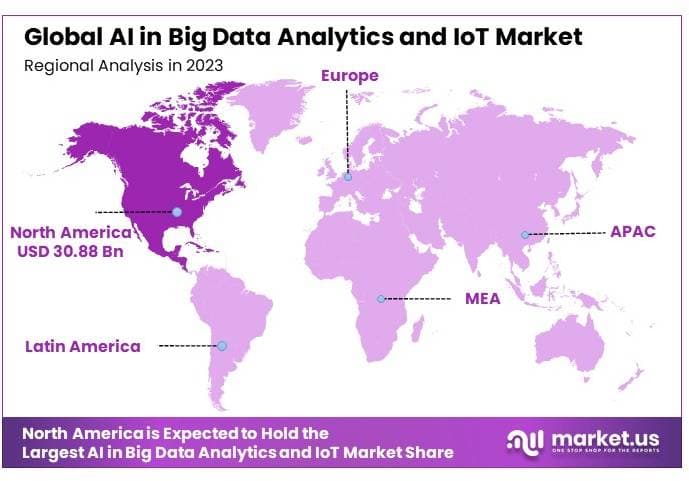
- North America dominates with 40% due to its advanced technological infrastructure and early adoption of AI in big data analytics.
Type Analysis
The Machine Learning sub-segment dominates with 37.5% due to its extensive application across diverse industries in enhancing data analysis.
In the AI in Big Data Analytics and IoT market, the Type segment includes various technologies such as Machine Learning, Deep Learning Platforms, Speech and Voice Recognition, Artificial Neural Networks, and others. Machine Learning (ML) holds the dominant position with a market share of 37.5%.
This prominence is due to ML’s capability to analyze large volumes of data and make intelligent decisions without explicit programming. Its applications span numerous sectors including healthcare, finance, manufacturing, and more, where it drives efficiency by automating complex decision-making processes and detecting patterns and insights that humans cannot easily find.
ML’s adaptability and learning capabilities make it exceptionally valuable for businesses looking to leverage big data to gain a competitive edge. By integrating ML with big data analytics and IoT devices, companies can optimize operations, predict maintenance issues, personalize customer experiences, and improve overall outcomes.
Deep Learning Platforms, Voice Recognition, and Artificial Neural Networks are other important sub-segments within this category. Each plays a crucial role in specific applications; for example, Deep Learning excels in handling unstructured data like images and videos, Voice Recognition is pivotal in enhancing user interactions, and Neural Networks are fundamental in predictions and classifications tasks.
Application Analysis
The Smart Machine sub-segment dominates with 35% due to its transformative impact on automating and optimizing business operations.
In the Application segment of the AI in Big Data Analytics and IoT market, Smart Machines represent the leading sub-segment with a 35% share. This category includes intelligent systems that utilize AI to perform tasks traditionally requiring human intelligence, such as learning, reasoning, and problem-solving. Smart machines are increasingly being deployed across various sectors like manufacturing, healthcare, and automotive to improve efficiency, reduce human error, and increase productivity.
The dominance of Smart Machines is fueled by their ability to integrate seamlessly with IoT devices, allowing for enhanced automation and data-driven decision-making. In manufacturing, for example, smart machines predict maintenance needs, optimize production processes, and manage supply chains dynamically. In healthcare, they assist in patient diagnostics, treatment personalization, and management of medical records, significantly improving care outcomes.
Self-Driving Vehicles, Cyber Security Intelligence, and other applications also play pivotal roles in the AI in Big Data Analytics and IoT landscape. Self-Driving Vehicles utilize complex algorithms to navigate and make decisions in real-time, which has profound implications for transportation and logistics. Cyber Security Intelligence applications leverage AI to detect and respond to threats more efficiently, an increasingly critical application given the growing sophistication of cyber attacks.
Each of these applications not only contributes to the advancement and practical implementation of AI but also pushes the envelope on what these technologies can achieve in complex, real-world environments. The growth and innovation within these applications are crucial for the continuous evolution and expansion of AI capabilities in the modern digital landscape.
Key Market Segments
By Type
- Machine Learning
- Deep Learning Platform
- Voice Recognition
- Artificial Neural Network
- Others
By Application
- Smart Machine
- Self-Driving Vehicles
- Cyber Security Intelligence
- Others
Driver
Real-Time Analytics, Edge Computing, and Data Governance Drive Market Growth
The AI in Big Data Analytics and IoT market is being significantly influenced by advancements in real-time analytics, edge computing, and robust data governance practices. Real-time analytics, enabled by AI, is crucial as it allows businesses to process and analyze data as it is generated.
This capability is particularly important in IoT environments where the continuous influx of data from connected devices requires immediate analysis to derive actionable insights. The integration of AI with IoT enables organizations to make informed decisions swiftly, improving operational efficiency and driving innovation.
Edge computing is another driving force in this market. By moving data processing closer to the source—such as IoT devices—edge computing reduces latency and enhances the speed of data analysis. This is especially beneficial in scenarios where immediate responses are critical, such as in autonomous vehicles or industrial automation. The combination of AI with edge computing allows for more efficient data management and real-time decision-making, which is essential in a rapidly evolving technological landscape.
Data governance software is also playing a pivotal role in this market’s growth. As organizations increasingly rely on AI and Big Data, ensuring the quality, security, and compliance of data has become paramount. Effective data governance frameworks help in maintaining data integrity, which is crucial for accurate analytics and decision-making.
Restraint
Regulatory, Data Privacy, and Infrastructure Challenges Restraint Market Growth
The growth of AI in the Big Data Analytics and IoT Market is significantly hindered by a combination of regulatory, data privacy, and infrastructural challenges. One of the primary barriers is the complex and evolving regulatory environment surrounding data collection, storage, and usage.
Governments across the globe have implemented stringent data protection laws, such as the General Data Protection Regulation (GDPR) in the European Union and the California Consumer Privacy Act (CCPA) in the United States. These regulations impose strict guidelines on how data can be collected, processed, and stored, particularly when it involves personal or sensitive information.
Data privacy concerns further exacerbate these challenges. As IoT devices proliferate, they generate vast amounts of data, much of which is personal or sensitive. The potential for data breaches and unauthorized access is a significant concern for both consumers and businesses. This concern leads to hesitancy in adopting AI and IoT technologies, especially in industries like healthcare and finance, where data privacy is paramount.
Infrastructural limitations also play a critical role in restraining market growth. The successful implementation of AI in big data analytics and IoT depends on the availability of advanced and reliable telecommunications networks, such as 5G, which are necessary for real-time data processing and communication between devices.
Opportunity
Data Integration, Predictive Analytics, and Real-Time Processing Provide Opportunities
The AI in Big Data Analytics and IoT Market presents significant opportunities for players, driven by the need for effective data integration, advanced predictive analytics, and real-time processing capabilities. Data integration offers a key opportunity as businesses generate and collect vast amounts of data from various IoT devices.
AI can help integrate and harmonize this data, providing a unified view that enhances decision-making processes. By effectively managing and analyzing diverse data streams, companies can uncover valuable insights that drive innovation and operational efficiency.
Predictive analytics is another critical opportunity. AI-powered analytics can forecast trends, detect anomalies, and predict future outcomes by analyzing historical and real-time data from IoT devices. This capability is particularly valuable in industries like manufacturing, where predictive maintenance can prevent costly equipment failures, and in retail, where customer behavior predictions can optimize inventory management.
Real-time processing is also a significant growth factor. The ability of AI to process and analyze data in real-time enables businesses to respond quickly to changing conditions. In sectors like transportation and logistics, real-time AI analytics can optimize routes, reduce fuel consumption, and improve delivery times. This responsiveness not only enhances operational efficiency but also improves customer satisfaction.
Challenge
Integration Complexities Challenge Market Growth
Integration complexities significantly challenge the growth of AI in the Big Data Analytics and IoT market. As businesses increasingly adopt IoT devices, they generate vast amounts of data that need to be analyzed in real-time. However, integrating AI with existing big data analytics systems and IoT networks is a complex process. This complexity often stems from the diversity of data sources, formats, and technologies involved.
Different IoT devices may use various protocols and standards, making it difficult to unify data streams for seamless AI processing. This lack of standardization requires businesses to invest in custom integration solutions, which can be time-consuming and costly. These integration challenges can slow down the implementation of AI in big data analytics, limiting the market’s growth potential.
Moreover, the rapid evolution of IoT devices and big data technologies adds another layer of complexity. As new technologies emerge, existing systems may become outdated, requiring continuous upgrades and adaptations. This ongoing need for updates increases operational costs and can create disruptions in business processes.
Additionally, the skills required to manage and integrate AI with big data analytics and IoT systems are highly specialized. The shortage of skilled professionals in this field can further complicate integration efforts, leading to delays and additional expenses.
Security concerns also play a role in these integration challenges. Ensuring that integrated systems are secure from cyber threats is critical but adds to the complexity and cost of implementation. Businesses must balance the need for advanced analytics with the necessity of secure and reliable integration.
Growth Factors
- Real-Time Data Processing: AI enables real-time processing of vast amounts of data generated by IoT devices. This allows businesses to make immediate, informed decisions, enhancing responsiveness and improving operational efficiency across various industries.
- Predictive Maintenance: AI analyzes data from IoT sensors to predict equipment failures before they occur. This predictive maintenance reduces downtime, lowers maintenance costs, and extends the life of machinery, driving growth in industrial applications.
- Enhanced Security: AI strengthens security in IoT networks by detecting and responding to cyber threats in real time. This proactive security approach builds trust in IoT systems, encouraging more businesses to adopt these technologies.
- Optimized Resource Management: AI helps companies optimize resource usage by analyzing IoT data to identify inefficiencies. This leads to better energy management, cost savings, and sustainability efforts, making AI and IoT more attractive to businesses.
- Scalability of IoT Solutions: AI enables IoT systems to scale efficiently by managing the increasing volume and complexity of data. This scalability is crucial for businesses as they expand their IoT deployments, ensuring continued growth and innovation.
- Improved Customer Experience: AI-driven analytics can personalize customer interactions by analyzing IoT data, leading to more tailored services and products. This enhanced customer experience boosts satisfaction and loyalty, contributing to market growth.
Emerging Trends
- Real-Time Data Processing: AI is enabling real-time processing of massive data streams generated by IoT devices. This trend allows businesses to make immediate decisions, optimizing operations and responding quickly to changing conditions in sectors like manufacturing and logistics.
- Predictive Maintenance: AI is being used to predict equipment failures before they occur by analyzing IoT data. This trend reduces downtime, extends the life of machinery, and lowers maintenance costs, making it highly valuable for industries reliant on heavy equipment.
- Enhanced Security and Privacy: AI is improving the security of IoT networks by detecting and responding to cyber threats in real time. This trend is critical as more devices become interconnected, ensuring the protection of sensitive data and preventing unauthorized access.
- Smart Cities and Infrastructure: AI and IoT are driving the development of smart cities by optimizing traffic flow, energy use, and public services. This trend is creating opportunities for businesses to develop innovative solutions that improve urban living conditions and sustainability.
- Personalized Consumer Experiences: AI analyzes data from IoT devices to provide personalized experiences in sectors like retail and healthcare. This trend enhances customer satisfaction by delivering tailored services and products, driving growth in consumer-facing industries.
- Scalable IoT Solutions: AI is helping businesses scale their IoT deployments by managing the increasing volume and complexity of data. This trend ensures that companies can expand their IoT networks efficiently, supporting growth in various sectors, including agriculture and energy.
Regional Analysis
North America Dominates with 40% Market Share in the AI in Big Data Analytics and IoT Market
North America’s substantial 40% market share with valuation of USD 30.88 Bn in the AI in Big Data Analytics and IoT market is driven by the region’s technological leadership and strong innovation ecosystem. Home to leading tech giants and startups alike, North America invests heavily in R&D, fostering advancements in AI and IoT technologies. The robust digital infrastructure and a culture that promotes technological adoption also contribute to this high market share.
North America’s market dynamics are characterized by the integration of AI with big data and IoT across various industries such as healthcare, automotive, and manufacturing. The region’s businesses are keen on utilizing AI-driven analytics to gain insights that drive efficiency, improve products, and enhance customer experiences. Additionally, supportive government policies regarding technology use in business further fuel market growth.
The future influence of North America in the AI in Big Data Analytics and IoT market is poised to grow even stronger. With ongoing technological advancements and increasing investments in IoT and AI, the region is expected to maintain or increase its market dominance. The focus on developing new applications and improving connectivity technologies will likely propel further integration of AI and IoT, enhancing market capabilities and leading global trends.
Regional Analysis for Other Markets:
- Europe: Europe maintains a competitive stance in the market, underpinned by strict data protection regulations that promote trust in AI and IoT applications. The region’s emphasis on privacy and security attracts investments in secure AI solutions, facilitating growth. With a focus on sustainability and efficiency, European industries are increasingly adopting AI IoT systems.
- Asia Pacific: Asia Pacific shows significant growth potential in AI and IoT integration due to its rapid industrialization and adoption of digital technologies. The region benefits from a large base of technology users and increasing governmental support for smart city initiatives and digital transformation in industries, driving demand for advanced analytics solutions.
- Middle East & Africa: The Middle East and Africa are experiencing growing adoption of AI and IoT, particularly in sectors like energy, logistics, and smart cities. As governments invest in technological infrastructure to diversify from traditional industries, AI and IoT are becoming key components of this transformation, offering substantial growth opportunities.
- Latin America: In Latin America, the adoption of AI and IoT is evolving with the digitalization of businesses. As the region works towards overcoming infrastructural challenges, increasing focus on innovation and smart technologies in sectors such as agriculture and retail is driving the demand for AI-powered big data analytics and IoT solutions.
Key Regions and Countries covered іn thе rероrt
- North America
- US
- Canada
- Mexico
- Europe
- Germany
- UK
- France
- Italy
- Russia
- Spain
- Rest of Europe
- Asia Pacific
- China
- Japan
- South Korea
- India
- Rest of Asia-Pacific
- South America
- Brazil
- Argentina
- Rest of South America
- Middle East & Africa
- GCC
- South Africa
- Israel
- Rest of MEA
Key Players Analysis
The AI in Big Data Analytics and IoT market is rapidly evolving, driven by the need for advanced data processing and connectivity solutions. Google Inc., Microsoft Corporation, and IBM Corporation are the leading players shaping this market.
Google Inc. is a dominant force with its extensive AI and cloud capabilities. Through platforms like Google Cloud and its AI tools, Google enables businesses to analyze vast amounts of data and integrate IoT solutions. Google’s innovative approach and massive data resources give it a strong market position.
Microsoft Corporation is another key player, offering powerful AI and IoT solutions through its Azure cloud platform. Microsoft’s strategic focus on AI integration across its cloud services and IoT offerings helps businesses manage and analyze big data effectively. Its broad customer base and continuous innovation make Microsoft a significant market influencer.
IBM Corporation is a pioneer in AI and analytics, with its Watson platform leading the way in big data analytics and IoT. IBM’s deep expertise in AI-driven solutions and its focus on enterprise-level applications provide it with a strategic advantage in the market. The company’s strong partnerships and long-standing presence in the industry reinforce its market influence.
These companies are driving the AI in Big Data Analytics and IoT market through their technological innovations, strategic positioning, and market leadership. Their influence is expected to grow as businesses increasingly adopt AI and IoT solutions.
Top Key Players in the Market
- Google Inc.
- Microsoft Corporation
- IBM Corporation
- Amazon.com Inc.
- Salesforce.com
- Intel Corporation
- Nvidia Corporation
- Baidu Inc.
- Cisco Systems Inc.
- Infineon Technologies AG
- Other Key Players
Recent Developments
- July 2023: Google introduced significant updates to its BigQuery platform, integrating advanced AI capabilities to enhance data analytics for IoT applications. These updates include machine learning models that can process and analyze massive IoT data streams in real-time, enabling businesses to derive actionable insights faster. Google reported a 20% increase in BigQuery usage among enterprises dealing with IoT data, contributing to an uptick in cloud service revenue.
- August 2023: Microsoft integrated OpenAI’s models into its Azure IoT Central platform, offering developers AI-driven analytics tools that simplify the process of extracting insights from IoT data. This integration aims to help businesses automate data analysis and improve decision-making processes. The move has resulted in a 15% growth in Azure IoT Central adoption, particularly among manufacturing and logistics companies.
- June 2023: IBM expanded its Watson IoT Platform by incorporating new AI algorithms that enhance predictive maintenance and real-time analytics. These enhancements are designed to help industries like manufacturing and healthcare optimize their operations by predicting equipment failures before they happen. IBM reported a 10% increase in revenue from its IoT solutions division, driven by these AI advancements.









