


Report Overview
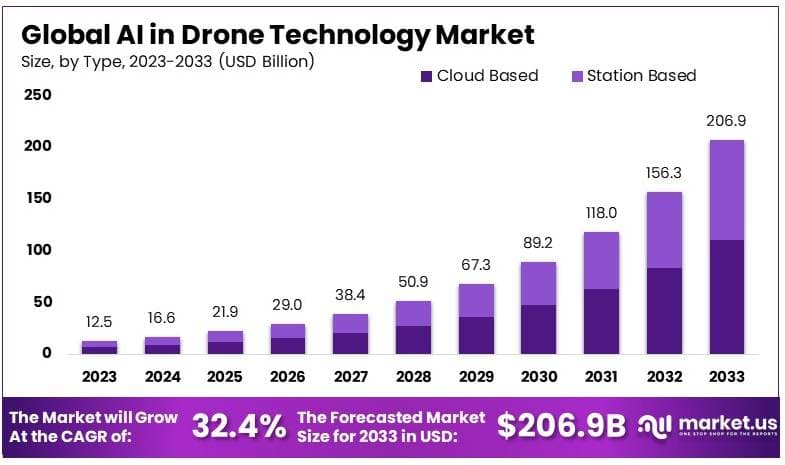
The Global AI in Drone Technology Market size is expected to be worth around USD 206.9 Billion by 2033, from USD 12.5 Billion in 2023, growing at a CAGR of 32.4% during the forecast period from 2024 to 2033.
The AI in Drone Technology Market focuses on the integration of artificial intelligence into drone operations. AI enhances drone capabilities in areas such as navigation, data collection, and autonomous decision-making. This market is growing rapidly as industries recognize the potential of drones to improve efficiency and reduce costs.
Key applications of AI in this market include precision agriculture, aerial surveillance, and delivery services. AI-driven drones can analyze vast amounts of data in real-time, enabling more accurate decision-making and faster response times. Industries such as agriculture, logistics, and defense are major adopters.
As the use of drones expands, the role of AI in enhancing their capabilities will become increasingly important. Companies that invest in AI-powered drones can achieve significant operational advantages, such as improved accuracy and reduced labor costs. The focus should be on developing AI solutions that address specific industry needs.
For instance, DJI’s Agras series, equipped with AI technology, has demonstrated remarkable results, such as achieving an 80% reduction in insect damage in large-scale farming operations, including a 60-hectare potato field in Washington State. Additionally, in Japan, AI-powered drones have enabled rice producers to increase their yields by approximately USD 5,425 per hectare through more efficient fertilizer application.
Government support is also crucial in fostering the growth of AI in drone technology. In the United States, the Federal Aviation Administration (FAA) has authorized over 400,000 commercial drone operators, with a significant portion utilizing AI-driven drones.
This regulatory environment, coupled with strong government backing, ensures the safe and efficient deployment of drones in various industries. Globally, countries like Japan and China are making substantial investments in artificial intelligence and drone technologies, promoting research, development, and training through government-backed programs.
The integration of AI with drone is not only enhancing operational efficiency but also driving significant economic benefits. The ability of AI-driven drones to perform tasks with greater precision and speed is revolutionizing traditional methods in agriculture, logistics, and beyond. As regulatory frameworks continue to evolve and support the adoption of these technologies, the market for AI in drone technology is poised for substantial growth.
The combination of AI and drone technology is expected to play a pivotal role in shaping the future of various industries. Companies that invest in these technologies will likely gain a competitive edge by improving operational efficiency, reducing costs, and enhancing productivity. As the market expands, the role of AI in drone technology will become increasingly integral to the success of businesses in a rapidly evolving global landscape.
Key Takeaways
- The AI in Drone Technology Market was valued at USD 12.5 billion in 2023 and is expected to reach USD 206.9 billion by 2033, with a CAGR of 32.4%.
- Cloud-Based is the dominant type with 53.4% owing to its flexibility in managing and analyzing drone data remotely.
- Military & Defense dominates the application segment with 38.2% due to the critical role of AI in enhancing drone capabilities for defense operations.
- North America leads with 36.2% due to its strong defense sector and investment in drone technology.
Type Analysis
The Cloud Based sub-segment dominates with 53.4% due to its scalability, flexibility, and enhanced data processing capabilities.
In the AI in Drone Technology market, the Type segment is divided into Station Based and Cloud Based solutions. Cloud Based solutions dominate this market with a share of 53.4%, primarily due to the substantial advantages they offer in terms of scalability, flexibility, and advanced data processing capabilities.
Cloud based AI platforms enable drones to access vast computing resources on-demand, which is crucial for processing the large volumes of data drones collect during their operations. This capability is essential for applications requiring real-time data analysis and decision-making, such as monitoring, surveying, and remote sensing.
The scalability of cloud based systems allows businesses and organizations to easily expand their drone operations without significant investments in physical infrastructure. This flexibility is particularly advantageous for sectors like smart agriculture, construction, and environmental monitoring, where operational scales can vary widely across different projects and geographic locations.
While Cloud Based solutions hold the majority share, Station Based solutions are also significant, particularly in environments where constant internet connectivity is a challenge or where data security concerns predominate. These solutions are favored in military and defense applications, where drones often operate in remote or hostile environments requiring robust, autonomous systems that can function independently of cloud connectivity.
Application Analysis
The Military & Defense sub-segment dominates with 38.2% due to critical applications in surveillance and combat operations.
In the Application segment of the AI in Drone Technology market, Military & Defense is the dominant sub-segment, capturing 38.2% of the market. This dominance is driven by the critical role drones play in modern military operations, including surveillance, reconnaissance, and combat missions.
AI enhances these capabilities by enabling drones to perform complex tasks autonomously, such as tracking targets, navigating challenging terrains, and identifying threats using advanced image recognition technologies.
The integration of AI into military drones significantly increases their effectiveness and reduces the risk to human life by carrying out dangerous missions remotely. AI-driven drones are capable of real-time decision-making, which is crucial in dynamic combat environments where rapid response times and adaptability are essential.
Besides Military & Defense, other applications such as Consumer Electronics, Construction, and Agriculture also greatly benefit from AI in drones. In Consumer Electronics, drones are used for photography and entertainment; in Construction, they are utilized for surveying and inspecting structures; and in Agriculture, drones aid in crop monitoring and health assessment.
The growth and innovation in these applications reflect the expanding capabilities of AI in drones, not only in enhancing existing functionalities but also in pioneering new uses that continue to revolutionize industries. As AI technology advances, its integration in drone applications across these diverse sectors is expected to deepen, further expanding the impact and market presence of this technology.

Key Market Segments
By Type
- Station-Based
- Cloud-Based
By Application
- Consumer Electronics
- Construction
- Agriculture
- Military & Defense
- Others
Driver
Enhanced Autonomy and Intelligence Drive Market Growth
The integration of AI into drone technology is significantly driving the growth of the AI in Drone Technology market. One of the primary factors is the enhanced autonomy that AI brings to drones.
AI algorithms enable drones to perform complex tasks independently, such as navigating through challenging environments and avoiding obstacles without human intervention. This capability is crucial in sectors like agriculture, where AI-powered drones can monitor crop monitoring and optimize resource use, leading to higher yields and reduced waste.
Moreover, AI improves the intelligence of drones, allowing them to analyze data in real time and make instant decisions. This is particularly beneficial in emergency services, where drones equipped with AI can conduct search and rescue operations efficiently by covering large areas quickly and identifying individuals in need of help through advanced imaging techniques.
Additionally, AI’s role in data collection and processing is transformative. Drones can gather vast amounts of data and, using AI, analyze it to provide actionable insights. For example, in infrastructure inspection, AI-powered drones can detect faults such as cracks or corrosion in real time, helping to prevent costly repairs and ensuring safety.
Furthermore, the rise of drone package delivery services is another driving factor. Companies are increasingly using AI-enabled drones for deliveries, which can optimize routes, navigate complex urban environments, and reduce delivery times. This innovation not only cuts costs but also enhances efficiency in logistics and e-commerce.
Restraint
Regulatory, Technological, and Operational Barriers Restraint Market Growth
The growth of AI in the Drone Technology Market is significantly constrained by a combination of regulatory challenges, technological limitations, and operational concerns. One of the foremost barriers is the complex and evolving regulatory landscape governing drone operations.
In many countries, stringent regulations from aviation authorities, such as the Federal Aviation Administration (FAA) in the United States and the European Union Aviation Safety Agency (EASA), impose strict guidelines on drone usage, especially when integrated with AI for autonomous operations.
Technological limitations further hinder the market’s growth. AI systems in drones require sophisticated hardware and software to function effectively, including advanced sensors, high-processing power, and reliable connectivity. However, the current technology infrastructure is not always capable of supporting these requirements, particularly in remote or challenging environments where drones are often deployed.
Operational concerns also play a significant role in restraining the adoption of AI in drone technology. There is often resistance from industries that are traditionally risk-averse, such as agriculture or construction, where the integration of AI-driven drones might disrupt established workflows.
Opportunity
Automation, Data Collection, and Enhanced Precision Provide Opportunities
The AI in Drone Technology Market offers significant opportunities for industry players, driven by the increasing demand for automation, advanced data collection, and enhanced precision. Automation presents a key opportunity, as AI-driven drones can autonomously perform tasks such as surveying, monitoring, and deliveries with minimal human intervention.
Data collection is another critical growth factor. AI-enabled drones can gather vast amounts of data from hard-to-reach areas, providing real-time insights that are invaluable in industries like agriculture, construction, and environmental monitoring.
By leveraging AI to analyze this data, companies can make more informed decisions, optimize processes, and improve outcomes. This capability opens new avenues for innovation and offers a competitive edge to businesses that capitalize on it.
Enhanced precision is also a substantial opportunity. AI technology allows drones to perform tasks with a high degree of accuracy, such as precision agriculture, where drones can target specific areas for spraying or planting, reducing waste and increasing yield. In industries like logistics and delivery, precision in navigation and drop-off points ensures timely and accurate service, leading to higher customer satisfaction.
Challenge
Regulatory, Safety, and Technical Challenges Hinder Market Growth
The growth of AI in the drone technology market faces several significant challenges, including regulatory hurdles, safety concerns, and technical limitations. Regulatory issues are one of the primary obstacles. The drone industry is subject to stringent regulations that vary widely by country and region.
These regulations govern everything from flight operations to data usage, creating a complex landscape that can slow down the adoption of AI in drones. Companies must navigate these diverse regulatory requirements, which often involve lengthy approval processes and significant compliance costs, thereby limiting the speed at which AI can be integrated into drone operations.
Safety concerns also play a crucial role in challenging the market’s growth. As drones become more autonomous through AI, ensuring their safe operation is paramount. The risk of accidents, whether due to technical failures or AI malfunctions, raises significant concerns. These safety risks can lead to stricter regulations, further complicating the deployment of AI-driven drones.
Technical limitations present another barrier. Integrating AI into drones requires advanced hardware and software capabilities, which can be expensive and complex to develop. Issues such as limited battery life, processing power constraints, and the need for real-time data processing add to the technical challenges.
Growth Factors
- Autonomous Navigation: AI enables drones to navigate autonomously, avoiding obstacles and adjusting to dynamic environments. This reduces the need for human intervention, making drone operations more efficient and expanding their use in complex scenarios.
- Enhanced Data Collection: AI allows drones to collect and analyze vast amounts of data in real-time, providing valuable insights for industries like agriculture, construction, and environmental monitoring. This capability increases the demand for AI-powered drones in data-intensive applications.
- Improved Safety: AI enhances drone safety by enabling real-time monitoring and automatic responses to potential hazards. This reduces the risk of accidents, making drones more reliable for commercial and industrial use, thus driving market growth.
- Cost Efficiency: AI optimizes drone operations, reducing energy consumption and maintenance needs. This cost efficiency makes drones more accessible to businesses of all sizes, encouraging wider adoption across various sectors.
- Advanced Delivery Systems: AI is revolutionizing drone delivery by optimizing flight paths, managing multiple deliveries, and ensuring timely delivery of goods. This innovation is particularly important for e-commerce and logistics, fueling the growth of AI in drones.
- Regulatory Compliance: AI helps drones comply with complex aviation regulations by automating the documentation and adherence to flight rules. This ensures safer and more lawful drone operations, facilitating the expansion of drone usage in regulated industries.
Emerging Trends
- Autonomous Flight Capabilities: AI is enabling drones to fly autonomously, making real-time decisions based on environmental data. This trend is reducing the need for human pilots, allowing for more complex missions in industries like agriculture, surveillance, and delivery services.
- Advanced Obstacle Detection and Avoidance: AI-powered obstacle detection systems are becoming more sophisticated, allowing drones to navigate safely in challenging environments. This trend is expanding the use of drones in urban areas, forests, and other complex terrains, reducing the risk of accidents.
- Precision Agriculture: AI in drone technology is transforming agriculture by providing precise monitoring and treatment of crops. This trend allows farmers to optimize resource use, improve crop yields, and reduce costs, making agriculture more efficient and sustainable.
- AI-Driven Data Analytics: Drones equipped with AI can collect and analyze vast amounts of data, providing actionable insights in real-time. This trend is particularly valuable in industries like construction, mining, and environmental monitoring, where timely data is critical for decision-making.
- Improved Delivery Systems: AI is enhancing the efficiency of drone delivery systems by optimizing flight paths, managing multiple deliveries, and ensuring timely arrival of goods. This trend is driving the growth of drone-based logistics, particularly in e-commerce and last-mile delivery.
- Integration with IoT Networks: AI-powered drones are increasingly being integrated with IoT networks, enabling seamless communication with other devices and systems. This trend is opening up new possibilities for smart cities, disaster management, and large-scale infrastructure monitoring.
Regional Analysis
North America Dominates with 36.2% Market Share in the AI in Drone Technology Market
North America’s leading 36.2% market share with USD 4.52 Bn in the AI in drone technology market is primarily driven by robust technological advancements and significant investments in research and development. The presence of major drone manufacturers and tech companies that integrate AI enhances drone capabilities and applications. This region also benefits from favorable government regulations that support drone testing and commercial use.
The market dynamics in North America are influenced by a strong demand for drones in both commercial and recreational sectors. The integration of AI allows for improved data collection, autonomous operations, and better safety features, which are critical for expanding drone applications in areas like agriculture, delivery services, and surveillance. High consumer adoption and technological literacy further fuel market growth.
The future impact of North America’s dominance in the AI in drone technology market is expected to grow with ongoing technological innovations and increasing acceptance of drones in various sectors. As AI continues to evolve, it will likely lead to even more sophisticated and autonomous drone solutions, ensuring that North America maintains a strong market presence.

Regional Analysis for Other Markets:
- Europe: Europe maintains a strong market presence, supported by stringent safety and privacy regulations that promote the responsible adoption of drone technologies. The region’s focus on integrating drones into national airspace safely and efficiently positions it as a leader in regulatory frameworks, which drives AI advancements in drone technology.
- Asia Pacific: Asia Pacific is rapidly expanding in this sector, driven by increasing technological adoption and investments in AI and drone research. Countries like China and Japan are leading in manufacturing and deploying drones, utilizing AI for various applications including disaster management and agricultural monitoring, indicating robust market growth potential.
- Middle East & Africa: In the Middle East and Africa, the use of drones equipped with AI is growing, particularly in infrastructure development and monitoring. The region’s investment in smart city initiatives and renewable energy projects fuels the demand for advanced drone technologies, setting the stage for market expansion.
- Latin America: Latin America’s market is developing as regional businesses and governments begin to recognize the potential benefits of drone technology in areas like agriculture and surveying. While currently smaller in scale, increased investment and interest in AI applications for drones are expected to drive growth in the coming years.
Key Regions and Countries covered іn thе rероrt
- North America
- US
- Canada
- Mexico
- Europe
- Germany
- UK
- France
- Italy
- Russia
- Spain
- Rest of Europe
- Asia Pacific
- China
- Japan
- South Korea
- India
- Rest of Asia-Pacific
- South America
- Brazil
- Argentina
- Rest of South America
- Middle East & Africa
- GCC
- South Africa
- Israel
- Rest of MEA
Key Players Analysis
In the AI in Drone Technology market, a few companies stand out due to their strong strategic positioning, technological impact, and market influence.
Intel, Qualcomm, and Skycatch are recognized as the top three key players driving innovation and growth in this market. These companies leverage their advanced AI and technology capabilities to lead in drone technology.
Intel has established itself as a leader through its powerful AI chips and processors, which are crucial for advanced drone operations. Intel’s strong focus on AI and data processing gives it a significant edge, allowing drones to perform complex tasks with precision. This positions Intel as a key influencer in the market.
Qualcomm plays a critical role by providing AI-enabled chipsets that power many drones. Its expertise in mobile and wireless technology, combined with AI, enhances the performance and connectivity of drones. Qualcomm’s strategic focus on AI-driven drones strengthens its market position and impact.
Skycatch has made a significant impact by focusing on AI-powered drone solutions for industrial applications, particularly in construction and mining. Its ability to offer real-time data processing and analytics through AI gives it a strategic advantage, making it a strong player in the market.
These companies are at the forefront of the AI in Drone Technology market, driving innovation and shaping the future of drone capabilities. Their advanced AI technologies and strategic positioning ensure their continued dominance in this rapidly evolving industry.
Top Key Players in the Market
- Intel
- Qualcomm
- Skycatch
- DroneSense
- Aidronesoftware
- Auterion
- DRONE VOLT
- Folio3 AI
- FlytBase
- Scale
Recent Developments
- August 2023: Intel introduced a new line of AI-powered drones specifically designed for the agriculture sector. These drones are equipped with advanced AI algorithms that can analyze crop health in real-time, optimize irrigation systems, and predict yields with greater accuracy. Intel has reported a 15% increase in sales within its drone division, largely driven by the adoption of these AI-enabled drones by large agricultural enterprises.
- July 2023: Qualcomm acquired Auterion, a leading open-source software platform for drones, to enhance its AI and robotics capabilities. This acquisition is part of Qualcomm’s broader strategy to dominate the AI-driven drone market, particularly in applications such as surveying, mapping, and delivery services. The acquisition is expected to boost Qualcomm’s revenue from its AI and drone technology segments by 20% in the next fiscal year.









