


Report Overview
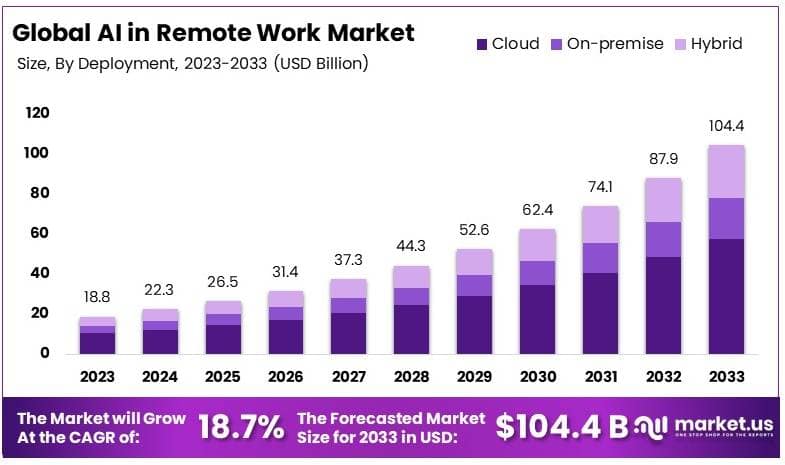
The Global AI in Remote Work Market size is expected to be worth around USD 104.4 Billion by 2033, from USD 18.8 Billion in 2023, growing at a CAGR of 18.7% during the forecast period from 2024 to 2033.
The AI in Remote Work Market centers on the use of artificial intelligence to support and enhance remote work environments. AI technologies optimize productivity, communication, and security for remote teams. This market has seen rapid growth, driven by the global shift toward remote and hybrid work models.
Key features of AI in this market include virtual assistants, automated task management, and AI in cybersecurity solutions. These tools help remote workers stay organized, collaborate effectively, and maintain data security. AI also enables personalized work experiences, adapting to individual preferences and workflows.
As remote work becomes a permanent fixture in many organizations, the demand for AI-driven tools will continue to rise. Companies that adopt AI to support remote work can improve employee satisfaction, enhance productivity, and ensure data security. The focus should be on selecting AI solutions that align with the unique needs of remote teams.
The AI in Remote Work market is rapidly evolving, driven by the growing reliance on AI tools among remote workers, particularly in IT and business services. As remote work becomes more entrenched, 76% of professionals now believe that AI skills are essential to stay competitive in the job market.
This shift is further evidenced by 69% of workers who feel that AI can accelerate their career progression, while 79% indicate that AI skills broaden their job opportunities. This growing emphasis on AI skills has led to a 160% increase in the use of LinkedIn Learning courses related to AI among non-technical professionals, signaling a strong commitment to upskilling across various job roles.
AI is not only transforming existing roles but also creating new ones. Notably, 68% of this year’s fastest-growing jobs in the U.S. did not exist 20 years ago, with AI being a significant driver of this change. Furthermore, 12% of recruiters are already creating new roles specifically tied to AI usage, highlighting the increasing demand for AI expertise in the remote work environment.
The rise of remote work has also led to significant shifts in job markets. In regions like Spokane County, Washington, job postings related to IT have nearly doubled, with computer-related employment growing at an annual rate of 1.8%—three times faster than overall employment. This trend reflects the strong demand for remote workers in tech fields, as organizations increasingly seek talent that can operate effectively in a remote or hybrid workplace.
Organizations are also realizing substantial cost savings through remote work. For example, companies in Australia are saving approximately USD 7,579 per employee annually on office space and lower wages by hiring remote talent.
In the U.S., companies can save an average of USD 11,000 per year for each employee working remotely half of the time. These savings, coupled with the increased flexibility and access to a broader talent pool, are driving further adoption of AI and remote work strategies.
As AI continues to integrate into the remote work landscape, it is expected to play a pivotal role in shaping the future of work. Companies that invest in AI-driven remote work solutions are likely to benefit from increased productivity, cost savings, and a more agile workforce, positioning them for long-term success in an increasingly digital and decentralized work environment.
Key Takeaways
- The AI in Remote Work Market was valued at USD 18.8 billion in 2023 and is expected to reach USD 104.4 billion by 2033, with a CAGR of 18.7%.
- Cloud deployment mode dominates with 55% due to its scalability and essential role in supporting remote work environments.
- Communication and Collaboration Tools lead the AI solution type segment with 35%, driven by the need for effective remote team interactions.
- Large Enterprises dominate the organization type segment with 60%, reflecting their substantial investment in AI to enhance remote work productivity.
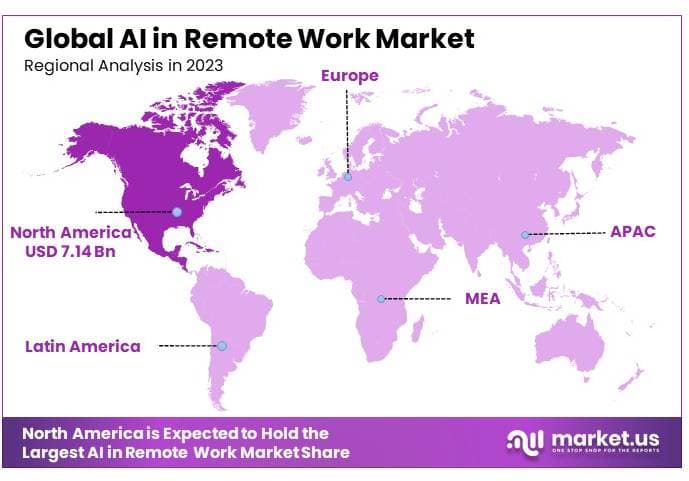
- North America leads with 38% due to its strong corporate culture of remote work and investment in related AI technologies.
Deployment Analysis
The Cloud sub-segment dominates with 55% due to its flexibility, scalability, and cost-effectiveness for remote work environments.
In the AI in Remote Work Market, deployment options are categorized into Cloud, On-premise, and Hybrid, with Cloud-based solutions dominating the field with a 55% market share. This dominance is driven by the inherent advantages of cloud computing in supporting remote work environments, where flexibility, scalability, and accessibility are crucial.
Cloud deployment allows employees and teams to access AI-driven tools and data from anywhere, facilitating seamless communication and collaboration across different locations and time zones.
The cloud infrastructure supports a wide range of AI applications that enhance remote workplace services, from intelligent communication tools to advanced cybersecurity solutions that protect data outside the traditional office perimeter.
Moreover, the cost-effectiveness of cloud solutions, due to their pay-as-you-go pricing models, makes them highly attractive to companies of all sizes, helping to minimize IT overhead while still leveraging advanced technological capabilities.
While Cloud leads in deployment, On-premise solutions are preferred by organizations that require stringent data control for compliance and security reasons. However, these are often more costly and less flexible compared to cloud solutions. Hybrid models combine the security benefits of On-premise with the flexibility of Cloud deployments, catering to organizations that seek a balanced approach to their remote work infrastructure.
AI Solution Type Analysis
The Communication and Collaboration Tools sub-segment dominates with 35% due to their critical role in enabling effective teamwork.
In the AI Solution Type category of the Remote Work Market, Communication and Collaboration Tools lead with a 35% market share. This category’s prominence underscores the essential role these tools play in maintaining the productivity and cohesion of dispersed teams.
AI-enhanced communication tools not only facilitate real-time interactions but also incorporate advanced features like sentiment analysis and automatic meeting summaries, which improve the quality of communications and help in managing team dynamics effectively.
AI-driven collaboration tools, such as onlind project management software and shared virtual workspaces, are designed to synchronize tasks and workflows seamlessly across different locations, ensuring that all team members have timely access to the information they need. The integration of AI helps these tools learn from user interactions to optimize processes and predict team needs, further enhancing productivity and efficiency.
While Communication and Collaboration Tools are the leading sub-segment, other AI solutions like Productivity Enhancement Tools, Cybersecurity, and Workforce Analytics also significantly contribute to the remote work ecosystem.
Productivity tools help in automating routine tasks and organizing work more efficiently, cybersecurity solutions protect sensitive information and systems from cyber threats, and workforce analytics provide insights into employee performance and engagement, which are crucial for managing remote teams effectively.

Organization Type Analysis
Large Enterprises dominate with 60% due to their capacity to invest in.
In the Organization Type segment of the AI in Remote Work Market, Large Enterprises hold a dominant position with a 60% share. This dominance is largely due to the resources and infrastructure that large organizations possess, which allow them to invest in and benefit from advanced AI solutions.
Large enterprises often face complex challenges in managing extensive remote workforces, including ensuring communication, maintaining security, and managing productivity. AI solutions provide these organizations with the tools necessary to address these challenges effectively.
The capacity of large enterprises to implement comprehensive AI strategies enables them to leverage these technologies to facilitate smooth operations and maintain competitive advantages in a rapidly evolving work environment. AI tools in large enterprises are often integrated across multiple departments and geographic locations, creating a cohesive technology-driven approach to remote work.
Meanwhile, Small and Medium-sized Enterprises (SMEs) also benefit from AI in remote work, particularly as cloud-based AI solutions become more accessible and affordable. For SMEs, AI can level the playing field, allowing them to compete with larger companies by enhancing communication, improving security, and boosting productivity without the need for significant IT investments.
Key Market Segments
By Deployment
- Cloud
- On-premise
- Hybrid
By AI Solution Type
- Communication and Collaboration Tools
- Productivity Enhancement Tools
- Cybersecurity
- Workforce Analytics
By Organization Type
- Large Enterprises
- SMEs
Driver
Technological Adaptability Drives Market Growth
The growth of AI in the Remote Work market is propelled by several driving factors that are transforming how businesses operate. One key factor is the enhanced productivity associated with remote work. Studies indicate that remote workers tend to experience fewer distractions, leading to higher efficiency and effectiveness in their tasks.
Another significant driver is the growing demand for flexible work arrangements. Remote work has become increasingly attractive, with 50% of employers now believing that remote work is the future of the workplace. This shift is supported by AI technologies that facilitate seamless communication, collaboration, and project management, making it easier for remote teams to stay connected and productive.
Additionally, the ability to tap into a global talent pool is further accelerating the adoption of AI in remote work environments. AI-driven online recruitment and employee monitoring tools allow companies to efficiently manage a distributed workforce, ensuring that they can hire the best talent regardless of geographic location. As a result, businesses are not only saving on costs but also improving their overall operational effectiveness.
Also, the continuous advancement of AI tools that monitor and enhance employee performance is helping organizations maintain high productivity levels while supporting remote work models. These tools provide insights into employee engagement, task completion, and overall performance, allowing managers to make data-driven decisions to optimize team output.
Restraint
Regulatory, Technological, and Organizational Barriers Restraint Market Growth
The growth of AI in the Remote Work Market is significantly restrained by a combination of regulatory challenges, technological limitations, and organizational resistance. Regulatory issues are a major concern, particularly with data privacy laws like the General Data Protection Regulation (GDPR) in the European Union and various national cybersecurity laws.
Technological limitations also hinder market growth. Effective AI solutions for remote work require robust infrastructure, including high-speed internet, secure networks, and advanced software capabilities.
However, not all regions or businesses have access to these resources, especially in rural or underserved areas. Additionally, the integration of artificial intelligence into existing remote work systems can be complex and costly, creating a barrier for small and medium-sized enterprises (SMEs) that lack the necessary technical expertise.
Organizational resistance is another significant factor. Many companies are hesitant to fully embrace AI in remote work due to concerns about data security, the potential for reduced human oversight, and the fear of job displacement. Employees may also resist AI tools if they feel these technologies are intrusive or threaten their job security. This resistance can slow down the adoption of AI technologies, even when they offer clear benefits.
Opportunity
Automation, Collaboration, and Employee Monitoring Provide Opportunities
The AI in Remote Work Market presents significant opportunities for industry players, driven by the growing demand for automation, enhanced collaboration, and advanced employee monitoring. Automation is a key opportunity, as businesses increasingly seek to streamline remote work processes.
AI-powered tools can automate routine tasks such as scheduling, project management, and task assignments, reducing the workload on employees and improving overall productivity. This allows remote teams to focus on more strategic and creative aspects of their work.
Collaboration is another critical growth factor. AI can facilitate seamless communication and collaboration among remote teams by integrating various tools and platforms. AI-driven collaboration tools can enhance virtual meetings with features like real-time transcription, translation, and content sharing, making remote work more efficient and engaging.
Employee monitoring also provides substantial opportunities. With the shift to remote work, businesses are increasingly concerned about productivity and security. AI can offer sophisticated monitoring solutions that track employee activity, monitor performance, and ensure data security without being overly intrusive. These tools help companies maintain high productivity levels while also protecting sensitive information.
Challenge
Security, Collaboration, and Technology Gaps Challenge Market Growth
The growth of AI in the remote work market is challenged by several key factors, including security concerns, collaboration difficulties, and technology gaps. Security is a significant issue as remote work relies heavily on digital platforms where sensitive company data is often accessed from various locations.
Ensuring that AI systems can protect this data against cyber threats is critical, but it remains a complex task. Companies are wary of adopting AI solutions that might expose them to increased risk of data breaches, which can lead to a slower uptake of AI technologies in remote work environments.
Collaboration is another challenge. Remote work depends on seamless communication and teamwork across distances, and while AI can enhance these processes, integrating AI into existing collaboration tools can be difficult. Many businesses use a variety of platforms, and ensuring that AI can work smoothly across these different systems is a challenge.
Technology gaps also play a crucial role in hindering market growth. The successful implementation of AI in remote work requires robust internet infrastructure, high computing power, and up-to-date software. However, not all regions or companies have access to the necessary technology.
Growth Factors
- Enhanced Virtual Collaboration: AI-powered tools improve virtual collaboration by offering features like smart scheduling, document sharing, and real-time editing. These tools help remote teams work together seamlessly, regardless of location, boosting productivity and project success.
- Automated Task Management: AI automates routine tasks such as scheduling, reminders, and task assignments, reducing the administrative burden on remote workers. This automation allows employees to focus on higher-value tasks, improving efficiency and job satisfaction.
- Advanced Communication Tools: AI enhances communication by providing real-time translation, sentiment analysis, and smart replies. These features help bridge communication gaps and ensure clear, effective interactions between remote team members across different languages and time zones.
- Personalized Workflows: AI can analyze work patterns and suggest personalized workflows that align with individual productivity peaks. This customization helps remote employees manage their time better, increasing efficiency and reducing burnout.
- Enhanced Security: AI strengthens cybersecurity in remote work environments by detecting and responding to potential threats. This ensures that sensitive company data remains protected, even when accessed from various locations, fostering trust in remote work systems.
- Improved Employee Engagement: AI tools can monitor and analyze employee engagement levels, offering insights and recommendations to managers. This helps in maintaining high morale and productivity among remote teams, supporting long-term success in a remote work setup.
Emerging Trends
- AI-Powered Productivity Tools: AI is enhancing productivity by automating routine tasks, such as scheduling, task management, and document processing. This trend allows remote workers to focus on higher-value activities, improving efficiency and contributing to better work outcomes.
- Enhanced Virtual Collaboration Platforms: AI is being integrated into collaboration tools to improve communication, manage workflows, and facilitate real-time collaboration. This trend is essential for remote teams, enabling seamless interaction and teamwork, regardless of geographic location.
- AI-Driven Performance Analytics: AI tools are increasingly used to monitor and analyze employee performance in remote settings. This trend provides managers with insights into productivity levels and helps in identifying areas for improvement, leading to more effective team management.
- Personalized Learning and Development: AI is transforming remote training by offering personalized learning experiences based on individual needs and preferences. This trend helps employees upskill and adapt to new challenges, making remote work more productive and engaging.
- Virtual Reality (VR) and Augmented Reality (AR) Integration: The integration of AI with VR and AR is creating immersive remote work experiences, from virtual meetings to training sessions. This trend is making remote work more interactive and effective, particularly for industries requiring hands-on collaboration.
- Enhanced Cybersecurity with AI: AI is playing a crucial role in securing remote work environments by detecting and mitigating cyber threats in real-time. This trend is essential as remote work continues to grow, ensuring that sensitive data remains protected and compliance is maintained.
Regional Analysis
North America Dominates with 38% Market Share in the AI in Remote Work Market
North America’s 38% market share with valuation of USD 7.14 Bn in the AI in Remote Work market is largely driven by its technological infrastructure and a strong culture of innovation. The widespread adoption of remote work practices, especially highlighted during the COVID-19 pandemic, has accelerated the deployment of AI solutions to enhance productivity and communication. Major tech companies in this region are at the forefront of developing AI tools that facilitate seamless remote collaboration and workflow automation.
The regional dynamics in North America are shaped by a highly digital workforce and the integration of AI into everyday business processes. Companies here leverage AI for task automation, real-time decision-making, and to personalize remote work experiences. This high adoption rate is supported by robust IT systems and a regulatory environment that encourages digital transformation in the workplace.
The future influence of North America in the AI in Remote Work market is expected to expand further. With ongoing advancements in AI and machine learning, coupled with a growing trend towards hybrid and fully remote work arrangements, the region is likely to continue leading in innovative workplace solutions. This will likely result in increased productivity and more sophisticated remote work technologies.
Regional Analysis for Other Markets:
- Europe: Europe holds a significant share of the market, supported by strong data protection laws that facilitate the secure implementation of AI technologies. The region’s emphasis on worker rights and data security drives the development of AI tools that comply with strict regulations, promoting sustainable growth in the AI in Remote Work sector.
- Asia Pacific: Asia Pacific is rapidly catching up in this market, driven by its large, young, and tech-savvy population. The region’s increasing investment in digital infrastructure and the rise of tech startups focused on remote work solutions contribute to its growing market share. Expansion is expected to continue as more businesses adopt remote working models.
- Middle East & Africa: The Middle East and Africa are experiencing modest growth in this market. Increasing internet penetration and government initiatives aimed at digitalizing the economy are beginning to support the adoption of AI in remote work. As regional businesses start to recognize the efficiency benefits, demand for AI-driven remote work solutions is set to increase.
- Latin America: In Latin America, growth in the AI in Remote Work market is emerging, driven by improvements in digital infrastructure and growing economic pressures to boost productivity. As companies in the region continue to adopt flexible work policies, the use of AI to manage remote teams and workflows is expected to rise, fueling market growth.
Key Regions and Countries covered іn thе rероrt
- North America
- US
- Canada
- Mexico
- Europe
- Germany
- UK
- France
- Italy
- Russia
- Spain
- Rest of Europe
- Asia Pacific
- China
- Japan
- South Korea
- India
- Rest of Asia-Pacific
- South America
- Brazil
- Argentina
- Rest of South America
- Middle East & Africa
- GCC
- South Africa
- Israel
- Rest of MEA
Key Players Analysis
The AI in Remote Work market is driven by a few key companies that have established strong positions through their advanced technologies, strategic approaches, and significant market influence.
Microsoft Corporation, Google LLC, and Zoom Video Communications, Inc. are the top three players leading the market. These companies leverage AI to enhance productivity, collaboration, and communication in remote work environments.
Microsoft Corporation has a strong impact on the market through its AI-powered tools in Microsoft 365, including Teams. Its integration of AI to automate tasks, enhance communication, and provide real-time collaboration gives it a strategic advantage in the remote work space. Microsoft’s large customer base and continuous innovation solidify its market leadership.
Google LLC is a key player with its AI-driven solutions like Google Workspace. Google uses AI to optimize remote work by improving virtual meetings, email management, and collaboration. Its robust cloud infrastructure and AI expertise enable Google to maintain a strong market presence and influence.
Zoom Video Communications, Inc. has rapidly become a leader in the remote work market by incorporating AI features into its video conferencing platform. AI-driven enhancements like background noise suppression and real-time analytics improve user experience. Zoom’s focus on innovation and ease of use has made it a critical player in remote work.
These companies dominate the AI in Remote Work market by combining cutting-edge AI technology with strong platforms for communication and collaboration, ensuring their leading positions in this rapidly growing sector.
Top Key Players in the Market
- Microsoft Corporation
- Google LLC
- Zoom Video Communications, Inc.
- Slack Technologies, Inc.
- IBM Corporation
- Cisco Systems, Inc.
- Salesforce.com, Inc.
- Amazon Web Services, Inc. (AWS)
- Adobe Inc.
- Asana, Inc.
- Atlassian Corporation Plc
- Box, Inc.
- Zoho Corporation
- Other Key Players
Recent Developments
- May 2024: Zoom expanded its AI capabilities across Zoom Workplace. The AI Companion tool, which has seen widespread adoption, now supports drafting quick replies in Team Chat, enhanced customization for enterprises, and improved external collaboration controls. This development is part of Zoom’s broader strategy to integrate AI into all aspects of workplace communication, aiming to boost productivity and streamline operations.
- August 31, 2023: IBM and Salesforce announced a collaboration to accelerate AI adoption in customer relationship management (CRM). IBM Consulting will leverage Salesforce’s AI technologies, including Einstein and Service Cloud, alongside IBM’s watsonx platform, to enhance customer and employee experiences. This partnership highlights the growing role of AI in transforming business processes across industries.









