


Report Overview
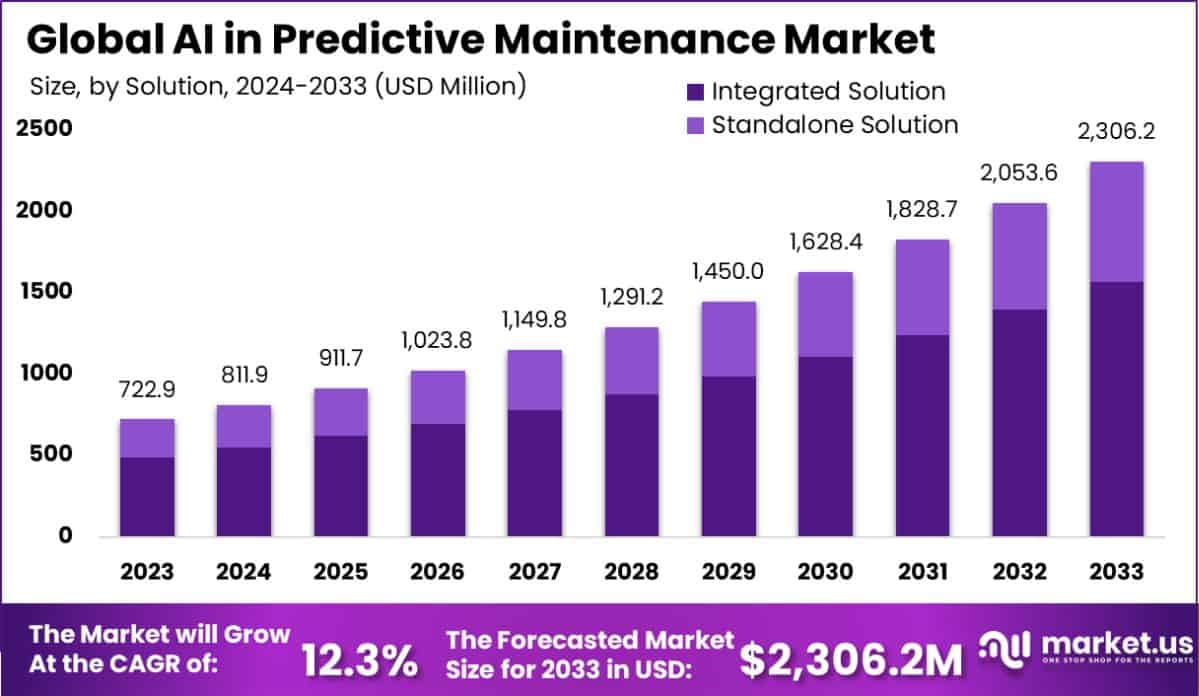
The Global AI in Predictive Maintenance Market size is expected to be worth around USD 2,306.2 Million By 2033, from USD 722.9 Million in 2023, growing at a CAGR of 12.3% during the forecast period from 2024 to 2033.
The AI in Predictive Maintenance Market encompasses technologies leveraging artificial intelligence to forecast equipment failures, enabling proactive maintenance strategies. This sector enhances operational efficiency and reduces downtime across industries, proving pivotal for decision-makers aiming to optimize asset management and maintenance scheduling.
The AI in Predictive Maintenance Market leverages advanced analytics to forecast equipment failures, ensuring timely interventions that enhance operational uptime and extend asset life. This sector is witnessing significant growth, driven by its ability to reduce maintenance costs and improve machine efficiency.
The increasing integration of IoT devices and machine learning offers vast opportunities for innovation and market expansion. Businesses are increasingly adopting these AI-driven systems to gain a competitive edge, positioning the market for substantial growth in the coming years.
According to Vidyatec.com, the adoption of predictive maintenance can reduce equipment stoppages by 30-50% and prolong equipment life by 20-40%. Furthermore, AI-driven strategies are significantly reducing maintenance costs—by up to 40%, offering substantial economic benefits.
This market is not only in industries reliant on heavy machinery but also in emerging sectors like autonomous vehicles. Forbes highlights that with an expected 10% of vehicles to become self-driving by 2030, the reliance on predictive maintenance will be crucial for ensuring safety and operational efficiency.
However, there is a notable challenge in consumer perception; over 75% of consumers are wary of misinformation generated by AI, which could influence the acceptance and implementation of AI in predictive maintenance.
AImagazine.com reinforces the value of AI in this domain, noting that implementing predictive maintenance strategies can further reduce maintenance costs by up to 25%. This data underscores the potential of AI-enhanced predictive maintenance to not only optimize maintenance schedules but also significantly cut costs, presenting a compelling case for its broader adoption across various sectors.
Key Takeaways
- The Global AI in Predictive Maintenance Market size is expected to be worth around USD 2,306.2 Million By 2033, from USD 722.9 Million in 2023, growing at a CAGR of 12.3% during the forecast period from 2024 to 2033.
- In 2023, Integrated Solution held a dominant market position in the By Solution segment of AI in Predictive Maintenance Market, capturing more than a 68% share.
- In 2023, Manufacturing held a dominant market position in the industry segment of AI in Predictive Maintenance Market, capturing more than a 25% share.
- North America will dominate a 36% market share in 2023 and hold USD 260.2 Million in revenue of the AI in Predictive Maintenance Market.
By Solution Analysis
In 2023, Integrated Solution held a dominant market position in the By Solution segment of the AI in Predictive Maintenance Market, capturing more than a 68% share. This dominance is attributed to the growing demand for comprehensive solutions that combine various maintenance functionalities into a single, streamlined platform. Integrated solutions offer enhanced capabilities such as real-time data analysis, automated reporting, and predictive analytics, which significantly improve operational efficiency and decision-making processes for businesses across multiple industries.
On the other hand, Standalone Solutions accounted for the remaining market share. These solutions are typically adopted by organizations that require specific functionalities or have less complex maintenance needs. Although they cover a smaller portion of the market, standalone solutions are crucial for small to medium-sized enterprises that prioritize cost-effective, flexible solutions tailored to specific tasks without the need for extensive integration.
The segmentation within the AI in Predictive Maintenance Market reflects the varied needs and strategies of businesses looking to optimize their maintenance operations. Integrated solutions continue to lead due to their ability to provide a holistic approach to maintenance management, but standalone solutions remain relevant for their customization capabilities and scalability, catering to a diverse range of industry requirements.
By Industry Analysis
In 2023, Manufacturing held a dominant market position in the By Industry segment of the AI in Predictive Maintenance Market, capturing more than a 25% share. This sector’s prominence is driven by the critical need to minimize equipment failure and optimize production processes. Manufacturing facilities benefit significantly from AI’s ability to analyze large datasets and predict maintenance needs, thereby reducing downtime and associated costs.
Other key segments include Automotive & Transportation and Aerospace & Defense, which also leverage AI in predictive maintenance to enhance the reliability and efficiency of their operations. These industries particularly value the technology for its ability to extend the lifespan of complex machinery and reduce unexpected breakdowns, crucial for maintaining safety and performance standards.
Healthcare, Telecommunications, and Other Applications also integrate AI-driven predictive maintenance to various extents. In healthcare, the technology ensures the reliability of smart medical devices, while telecommunications operators utilize it to maintain network equipment. The diverse application across these sectors underscores the versatility and expanding scope of AI in predictive maintenance, highlighting its growing importance as a tool for ensuring operational continuity and efficiency across different industries.

Key Market Segments
By Solution
- Integrated Solution
- Standalone Solution
By Industry
- Automotive & Transportation
- Aerospace & Defense
- Manufacturing
- Healthcare
- Telecommunications
- Other Applications
Drivers
AI Predictive Maintenance Market Drivers
The AI in Predictive Maintenance Market is experiencing substantial growth, driven by several key factors. Firstly, the increasing demand for operational efficiency is a significant driver. Businesses are seeking to minimize downtime and reduce maintenance costs, making AI-driven solutions highly attractive.
Additionally, the proliferation of data from connected devices offers an unprecedented amount of information for predictive analysis, enhancing the accuracy of maintenance predictions. This technology enables companies to anticipate failures before they occur, thereby preventing expensive repairs and operational disruptions.
Moreover, advancements in machine learning and AI technologies have made these predictive systems more accessible and effective, encouraging more industries to adopt this proactive maintenance approach. This convergence of technology advancement and operational necessity is propelling the market forward, making AI in predictive maintenance a critical tool in modern industry operations.
Restraint
Challenges in AI Predictive Maintenance
Despite the growing adoption of AI in predictive maintenance, several restraints hinder its broader market penetration. A primary challenge is the high initial investment required for integrating advanced AI technologies. These costs include not only the acquisition of software and hardware but also significant expenditures for training personnel and restructuring existing systems.
Additionally, the complexity of AI systems demands a high level of technical expertise, which can be scarce and expensive. Another significant barrier is data privacy and security concerns, as predictive maintenance systems rely heavily on continuous data collection and analysis, raising issues around data handling and protection.
These factors combine to limit the adoption rate among smaller enterprises and industries with limited budgets or less technical readiness, posing a considerable challenge to the market’s expansion.
Opportunities
Growth Opportunities in AI Maintenance
The AI in Predictive Maintenance Market is ripe with opportunities, especially as industries increasingly focus on efficiency and cost reduction. One of the most promising opportunities lies in the expansion of the Internet of Things (IoT), which connects a vast array of devices and machinery, providing the continuous data necessary for AI algorithms to predict failures accurately.
This connectivity enables a more granular and immediate analysis, enhancing predictive capabilities. Additionally, the ongoing improvements in AI and machine learning algorithms are making these systems even more reliable and effective, opening up new applications across diverse sectors like manufacturing, automotive, and aerospace.
Furthermore, the growing trend towards digital transformation in traditional industries presents a significant opportunity for integrating AI predictive maintenance solutions, offering a pathway to modernize operations and gain competitive advantages. These factors collectively create a fertile environment for growth in the AI predictive maintenance sector.
Challenges
Challenges Facing AI Maintenance Adoption
Adopting AI in predictive maintenance presents notable challenges that can impede its widespread implementation. The complexity and sophistication of AI systems necessitate significant expertise and training, which can be resource-intensive and costly, particularly for small and medium-sized enterprises.
Additionally, integrating these advanced systems into existing infrastructure often requires substantial upfront investment and can disrupt current operations. Data quality and availability also pose major hurdles; AI systems require high-quality, comprehensive data to function effectively, and not all organizations have access to such data or the capacity to manage it effectively.
Moreover, concerns about data security and privacy continue to be significant, as predictive maintenance systems involve extensive data collection and analysis. These challenges must be addressed to fully realize the potential benefits of AI in predictive maintenance across various industries.
Growth Factors
- Technological Advancements: Continuous innovations in AI and machine learning technologies improve the accuracy and efficiency of predictive maintenance systems, making them more attractive to potential users.
- Increasing Equipment Complexity: As machinery and equipment become more complex, the need for sophisticated maintenance solutions like AI-driven predictive maintenance grows, ensuring optimal operational performance.
- Cost Reduction Needs: Organizations are focusing on reducing maintenance costs, and AI predictive maintenance offers a compelling solution by minimizing unplanned downtime and extending equipment lifespan.
- Regulatory Compliance: Stricter regulations regarding equipment safety and emissions are pushing industries to adopt more reliable maintenance strategies, with AI providing a compliant and efficient approach.
- Data Proliferation from IoT Devices: The explosion of data from connected devices provides the necessary inputs for AI algorithms to predict potential failures more accurately, enhancing the scope of predictive maintenance.
- Growing Demand for Remote Monitoring: In the wake of global challenges like the COVID-19 pandemic, the demand for remote monitoring solutions has surged, with AI predictive maintenance playing a crucial role in facilitating this shift.
Emerging Trends
- Increased Use of Edge Computing: Edge computing enhances AI predictive maintenance by processing data directly at the source, reducing latency and improving response times for maintenance actions.
- Integration with Digital Twins: Digital twins, virtual replicas of physical systems, are being integrated with AI to simulate and predict equipment failures more accurately, enabling more precise maintenance planning.
- Adoption of 5G Technology: The rollout of 5G networks is accelerating the capabilities of AI in predictive maintenance by facilitating faster and more reliable data transmission, crucial for real-time analytics.
- Focus on Sustainability: Companies are increasingly leveraging AI in predictive maintenance to not only improve efficiency but also reduce their environmental impact by optimizing equipment usage and reducing waste.
- Advancements in Machine Learning Algorithms: Continuous improvements in machine learning algorithms are making AI systems more accurate at predicting failures, even in complex scenarios with variable conditions.
- Expansion into New Industries: AI-driven predictive maintenance is expanding beyond traditional sectors like manufacturing and automotive to new areas such as renewable energy and smart cities, broadening the market’s scope.
Regional Analysis
The AI in Predictive Maintenance Market is segmented into several key regions, each exhibiting unique growth dynamics and potential. North America is the dominating region, holding a 36% market share with a valuation of USD 260.2 million. This leadership is driven by robust technological infrastructure, early adoption of AI technologies, and significant investments in IoT and machine learning across industries such as manufacturing, automotive, and healthcare.
Europe follows closely, with a strong focus on adopting AI-driven technologies to enhance operational efficiency and comply with stringent regulatory standards. The region’s emphasis on innovation and sustainability supports the integration of predictive maintenance solutions across its industrial sectors.
Asia Pacific is witnessing rapid growth due to increasing industrialization, particularly in China and India. The region benefits from rising technology adoption and a growing emphasis on cost reduction and efficiency in manufacturing processes.
Meanwhile, the Middle East & Africa, and Latin America are emerging as significant markets with increasing investments in digital transformation. These regions are exploring predictive maintenance to improve the longevity and efficiency of their expanding industrial and telecommunications sectors, leveraging AI to foster economic development and technological integration.

Key Regions and Countries
- North America
- US
- Canada
- Europe
- Germany
- France
- The UK
- Spain
- Italy
- Russia
- Netherlands
- Rest of Europe
- Asia Pacific
- China
- Japan
- South Korea
- India
- Australia
- Singapore
- Thailand
- Vietnam
- Rest of APAC
- Latin America
- Brazil
- Mexico
- Rest of Latin America
- Middle East & Africa
- South Africa
- Saudi Arabia
- UAE
- Rest of MEA
Key Players Analysis
In 2023, several key companies are shaping the global AI in Predictive Maintenance Market, each bringing unique capabilities and strategic innovations.
DB E.C.O. Group stands out with its environmentally conscious approach, integrating AI to enhance the sustainability and efficiency of operations. Their focus on eco-friendly practices aligns well with the global push towards sustainability, making their solutions particularly appealing to industries looking to meet stricter environmental regulations while optimizing maintenance processes.
Radix Engineering and Software offers tailored AI solutions that cater to complex industrial environments. Their strength lies in customizing applications to suit specific client needs, which enhances the functionality and effectiveness of predictive maintenance systems. Radix’s ability to merge engineering expertise with advanced AI technologies positions them as a pivotal player for clients requiring highly specialized predictive maintenance solutions.
machinestalk, on the other hand, excels in the realm of IoT and connectivity, providing robust platforms that facilitate seamless data integration and real-time analytics. Their solutions enable more precise and timely predictions, optimizing maintenance schedules and reducing downtime significantly. As industries increasingly rely on IoT devices, machinestalk’s offerings become essential for harnessing the full potential of AI in predictive maintenance.
Top Key Players in the Market
- DB E.C.O. Group
- Radix Engineering and Software
- machinestalk
- KCF Technologies, Inc.
- Infinite Uptime
- OCP Maintenance Solutions
- Emprise Corporation
- ONYX Insight
- Gastops
- PROGNOST Systems GmbH
- Other Key Players
Recent Developments
- In June 2023, KCF Technologies announced the launch of a new AI-driven predictive maintenance platform designed to enhance industrial equipment monitoring. The platform leverages advanced analytics to detect anomalies and predict equipment failures with greater accuracy, aimed at reducing unplanned downtime and maintenance costs for clients across various sectors.
- In March 2023, Infinite Uptime secured an additional $15 million in Series B funding to expand its AI predictive maintenance solutions globally. The funding aims to enhance their technological capabilities and increase their market presence, particularly in Asia and Europe. Infinite Uptime specializes in providing real-time data analytics and diagnostic solutions to improve the operational efficiency of heavy machinery and industrial equipment.
- In January 2023, OCP Maintenance Solutions launched a new service that integrates AI with thermal imaging to predict maintenance needs in electrical and mechanical systems. This innovative approach not only enhances the accuracy of predictive maintenance but also significantly extends the lifecycle of critical infrastructure components.









