


Report Overview
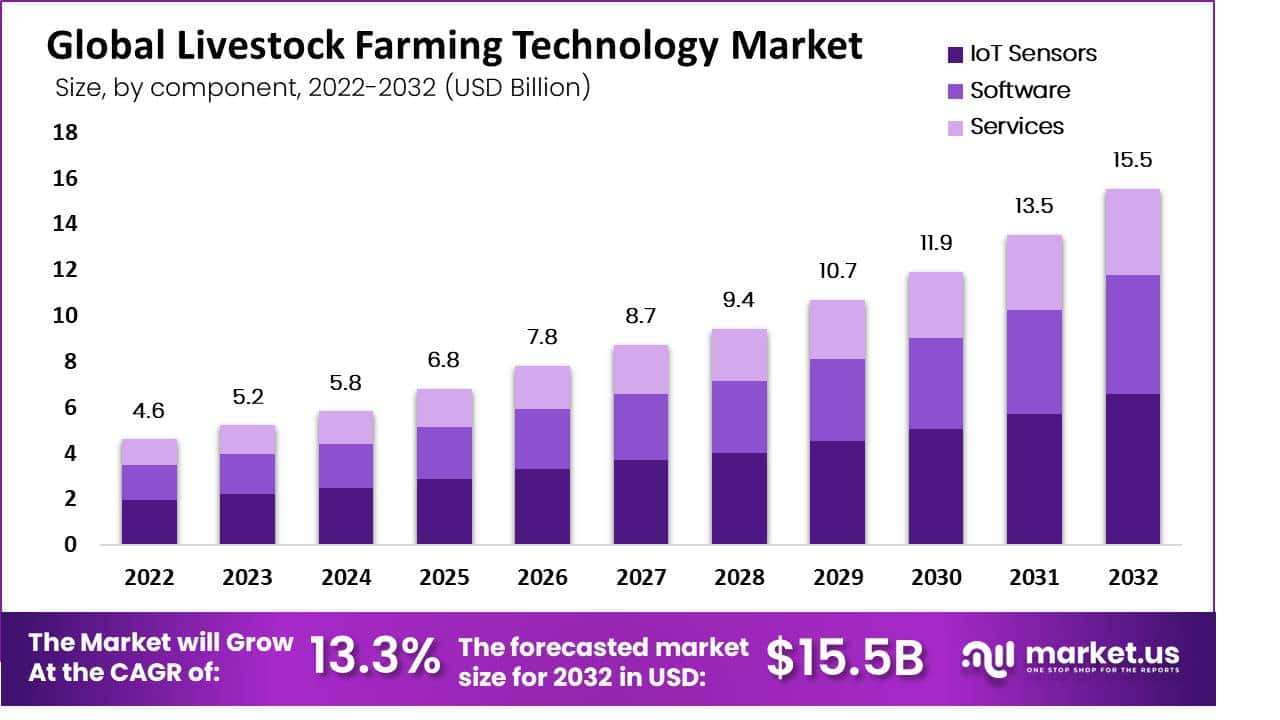
The Global Livestock Farming Technology Market size is expected to be worth around USD 15.5 Billion By 2032, from USD 5.2 Billion in 2023, growing at a CAGR of 13.3% during the forecast period from 2023 to 2032.
Livestock farming technology encompasses a range of innovative tools and solutions designed to improve the efficiency, productivity, and sustainability of animal husbandry. This sector has seen significant growth due to the increasing demand for protein sources and the need to manage large-scale livestock operations more effectively. Key technologies include automated feeding systems, health monitoring devices, genetic engineering, and precision farming techniques. These technologies help farmers monitor the health and growth of their animals, optimize feed usage, and reduce labor costs.
The Livestock Farming Technology Market is poised for substantial growth, influenced by a convergence of factors. A global increase in protein consumption necessitates more efficient livestock management, which is being enabled by rapid technological advancements such as IoT sensors and precision farming. These innovations not only enhance productivity but also animal welfare by enabling real-time monitoring of health and environmental conditions.
Additionally, sustainability concerns are prompting a shift towards more responsible farming practices, further fueled by governmental support through incentives and funding for tech adoption in agriculture. The market is ripe with opportunities, particularly in developing regions like Asia-Pacific, where technological integration into farming is accelerating due to government investments and a growing technological infrastructure.
Note: Actual Numbers Might Vary In The Final Report
Key Takeaway
- Market Growth Projection: The Livestock Farming Technology Market is expected to grow at a CAGR of 13.3%, reaching USD 15.5 billion by 2032 from USD 4.6 billion in 2022.
- Definition of Livestock Farming Technology: Livestock farming technology refers to modern technologies and systems used to increase efficiency, sustainability and productivity of livestock farming operations – such as automatic feeding systems, watering systems and wearable sensors that monitor animal behavior and health.
- Driving Factors: An ever-increasing global population and demand for animal-derived products combined with an emphasis on animal welfare and environmental concerns has resulted in the adoption of livestock farming technology.
- Restrictions to Adoption: High initial investments, lack of knowledge and skills among some farmers, and the absence of reliable high-speed internet in certain rural areas are some of the major obstacles to the widespread adoption of livestock farming technology, particularly among low-income and remote regions.
- Dominant Components: IoT sensors and software are among the primary elements in livestock farming technology markets, with IoT sensors playing an increasingly vital role in providing valuable data that improves animal welfare and operations.
- System Segmentation: Milking robotics systems and precision feeding systems are the two key livestock farming technology market segments, with milking robotics systems dominating this sector of the market.
- Application Analysis: Livestock health and behavior monitoring as well as milk harvesting are the two key applications driving growth in the livestock farming technology market.
- Farm Size Impact: Large farms represent the most profitable segment in the market, followed by mid-sized ones; technology adoption plays a pivotal role in efficiently and effectively running such large operations.
- Key Regions: North America and Europe are two key markets for livestock farming technology, with North America dominating due to advanced technologies and favorable government policies. Europe has also seen impressive growth due to its focus on animal welfare, food safety and environmental concerns.
- Key Market Players: Key players in the Livestock Farming Technology industry include DeLaval, Allflex, GEA Farm Technology, Afimlik BouMatic Lely International Dairymaster Livestock Improvement Corporation Fancom Fullwood Packo among many others.
Drivers
Day by day global population is increasing and the demand for animal-based products such as meat, egg, milk, etc. is also increasing. So, the farmers can use the new technology for improving animal productivity, health, and efficiency. Government is concerned about the welfare of animals raised for food. So, it can help farmers for providing better care for their animals.
Livestock farming generates huge environmental problems to reduce it farmers can use the minimum harmful inputs, improve resource efficiency, reduce waste, etc. Farmers can use precision agricultural practices such as automation, remote sensing, and data analytics to monitor animal health, and water use, to improve overall efficiency and optimize feed.
Restraints
In low-income countries and small-scale farms, livestock farming technology adoption is not possible because it requires a huge initial investment. So, it can barrier for farmers to adopt this technology.
Adopting this technology requires enough knowledge and skills but many farmers have not that much knowledge and skills especially older and less tech-savvy farmers so, this can be a limit for the adoption of these technologies. In developing countries and remote regions, there is a problem with reliable and high-speed internet, and this technology requires high-speed internet so, it is not possible in many rural areas.
Component Analysis
The component segment is categorized as IoT Sensors, Software, and Services. Among these segments, IoT sensors are dominated the livestock farming technology market. This component generates valuable data on an animal that can be used the improve animal welfare and optimize operations. By using this technology farmers can measure or monitor the animal such as air quality, temperature, humidity, or animal behavior. This information can be used for improvement, increase productivity, reduce waste, identify health issues, etc.
A software component is the fastest growing segment in the livestock farming technology market. This software is used to improve productivity, and efficiency and also to enhance animal welfare. This system is also beneficial for farmers to make decisions, automate tasks in their operations, and reduce errors.
System Analysis
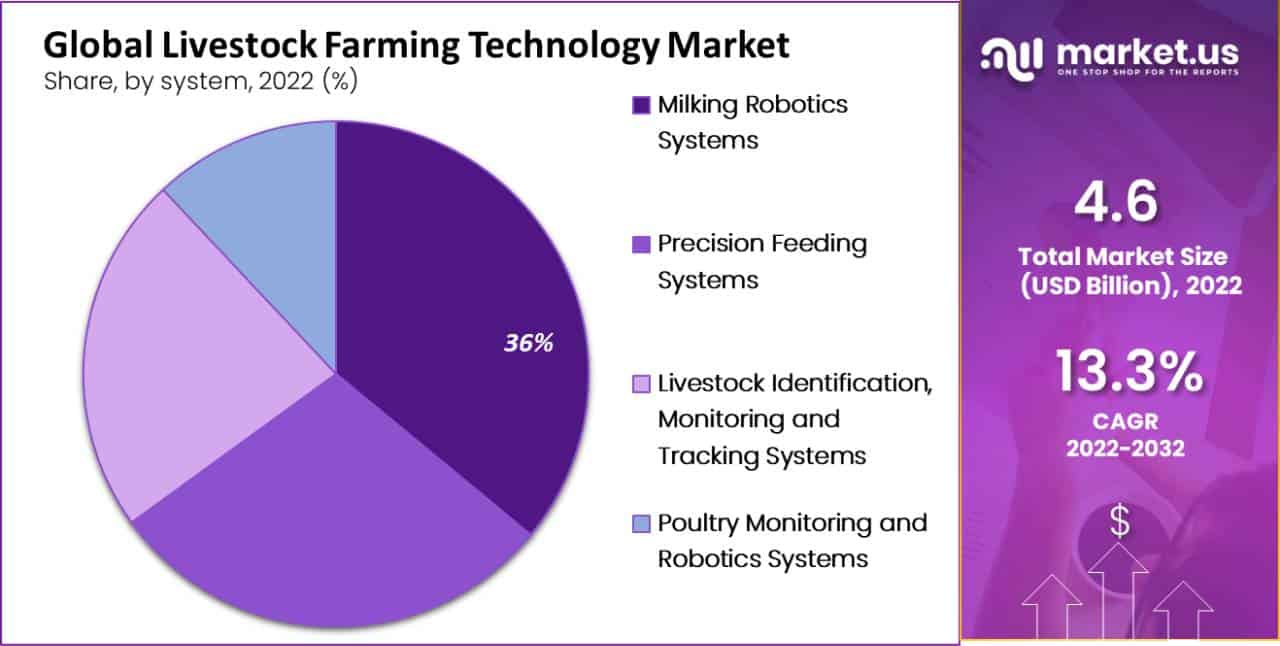
The system segment is categorized as milking robotics systems, precision feeding systems, livestock identification, monitoring and tracking systems, and poultry monitoring and robotics systems. Among these segments, the milking robotics system segment is dominated in the global livestock farming technology market. By using milking robotics system technology farmers can manage their daily operations more effectively and efficiently such as feed, and equipment, and also track and manage the livestock.
The precision feeding system is the fastest growing segment in the system analysis of the livestock farming technology market. The benefits of this technology are for farmers as well as animals. With the help of this technology, farmers can give exact feed to their animals according to their individual needs.
 Note: Actual Numbers Might Vary In The Final Report
Application Analysis
Based on application, the market for livestock farming technology is segmented into milk harvesting, feeding management, livestock health, behavior monitoring, and others. Among these segments, the livestock health and behavior monitoring segment is dominant in the livestock farming technology market. This application provides real-time data by using analytics and advanced sensors.
By using this, farmers can monitor the behavior and health of the animal and make a decision and also improve the animal welfare. The benefits of this include farmers can detect diseases early, identify welfare issues, and increase efficiency.
Milk harvesting is one of the fastest growing segments in the livestock farming technology market. With the help of this farmers can collect the milk more effectively and efficiently from their dairy animals. By using this technology farmers can reduce the labor cost, also improve milk quantity and quality and automate the milking process.
Farm Size Analysis
Based on farm size, the market for Livestock Farming Technology is segmented into small farms, mid-sized farms, and large farms. Among these farm sizes, the large farm segment is the most lucrative in the livestock farming technology market. In large farms, there are thousands of animals so, to manage them is difficult. By using these technologies farmers can manage their daily operations, reduce costs, improve animal welfare, and also help to optimize efficiency.
Mid-sized farms are the fastest growing segment in the livestock farming technology market. In this the animals are between 100 to 1000 and to manage them advanced technology is required. By using this technology farmers can improve animals’ efficiency as well as welfare.
Key Market Segments
Based on Component
- IoT Sensors
- Software
- Services
Based on System
- Milking Robotics Systems
- Precision Feeding Systems
- Livestock Identification, Monitoring and Tracking Systems
- Poultry Monitoring and Robotics Systems
Based on Application
- Milk Harvesting
- Feeding Management
- Livestock Health and Behavior Monitoring
- Others
Based on Farm Size
- Small Farms
- Mid-sized Farms
- Large Farms
Opportunity
Nowadays people are becoming more health conscious and environmentally conscious so, they demand organic and sustainably produced animal products. This technology can help farmers to meet this demand by reducing waste, minimizing the use of harmful inputs, and improving resource efficiency.
With the help of sensors, automated equipment, and monitoring systems farmers can do the feeding, waste management, and watering of the animal. By this farmers can increase productivity and efficiency and also can save time, reduce labor and increase their overall output. Farmers can improve their efficiency, reduce their environmental impact and provide higher-quality products to consumers. By using monitoring system farmers can track the animal and detect the illness early.
Trending factors
In the livestock farming technology market, the recent trends are such as precision livestock farming which involves using many technologies such as data analytics, sensors, cameras, and others. It is helpful for the farmer to optimize animal welfare and health.
Nowadays IoT is rising in popularity in this market. With the help of sensors and other devices, farmers can monitor and manage their livestock. To save time and reduce labor cost is possible by using automated feeding systems. Robotics can use in milking, cleaning, etc.
Regional Analysis
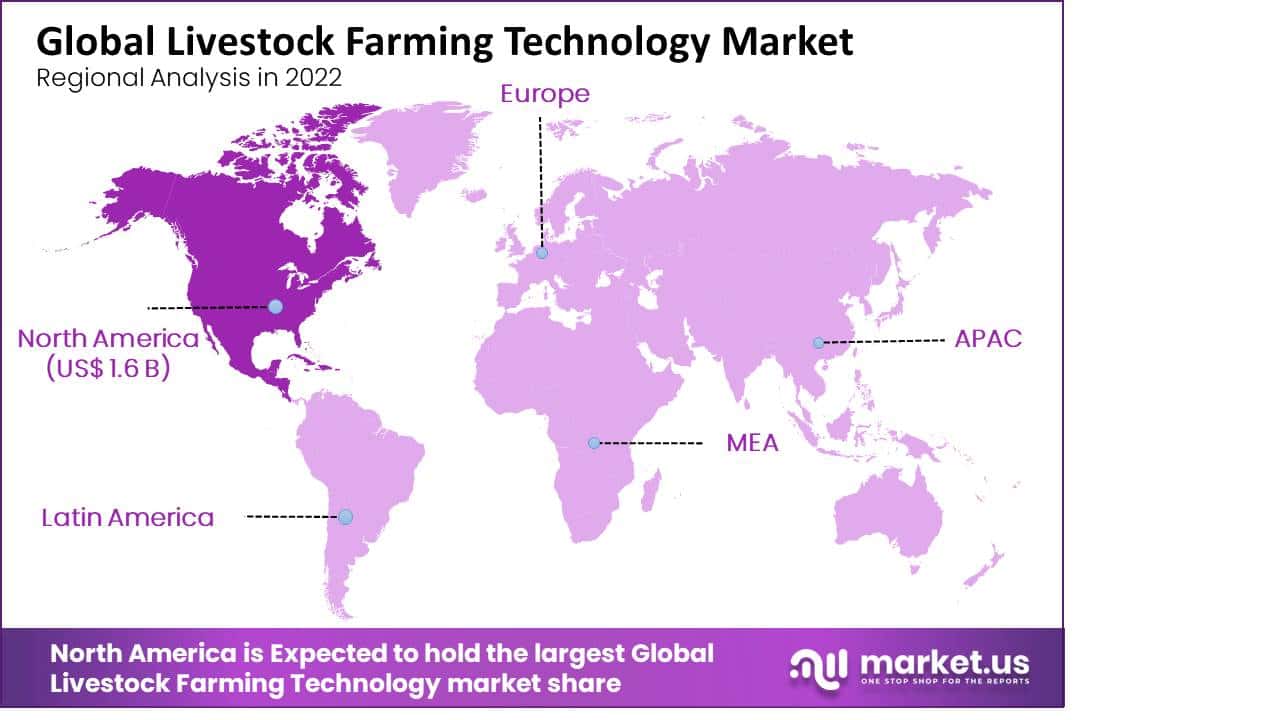
North America is estimated to be the most lucrative market in the global livestock farming technology market, with the largest market share of more than 35% in 2022. Because of advanced technologies, favorable government policies and large-scale livestock production have led to high demand in North America. Precision livestock farming, data analytics, and automation are the key technologies for them.
Europe is the fastest growing market in the livestock farming technology market. Europe is known for animal welfare, food safety, and environmental concerns. Europe is adopting biotechnology, sustainable farming practices, and precision livestock farming the increasing effectiveness and efficiency of the animal.
Note: Actual Numbers Might Vary In The Final Report
Key Regions and Countries Covered in this Report
- North America
- The US
- Canada
- Mexico
- Western Europe
- Germany
- France
- The UK
- Spain
- Italy
- Portugal
- Ireland
- Austria
- Switzerland
- Benelux
- Nordic
- Rest of Western Europe
- Eastern Europe
- Russia
- Poland
- The Czech Republic
- Greece
- Rest of Eastern Europe
- APAC
- China
- Japan
- South Korea
- India
- Australia & New Zealand
- Indonesia
- Malaysia
- Philippines
- Singapore
- Thailand
- Vietnam
- Rest of APAC
- Latin America
- Brazil
- Colombia
- Chile
- Argentina
- Costa Rica
- Rest of Latin America
- Middle East & Africa
- Algeria
- Egypt
- Israel
- Kuwait
- Nigeria
- Saudi Arabia
- South Africa
- Turkey
- United Arab Emirates
- Rest of MEA
Market Share and Key Players Analysis
The Global Livestock Farming Technology Market is highly competitive, with a large number of players vying for market share. The Livestock Farming Technology Market demonstrates the industry’s focus on innovation and the development of advanced technologies for better production, effectiveness, efficiency, and animal welfare.
Market Key Players
Listed below are some of the most prominent Livestock Farming Technology industry players.
- DeLaval
- Allflex
- GEA Farm Technology
- Afimlik
- BouMatic
- Lely International
- Dairymaster
- Livestock Improvement Corporation
- Fancom
- Fullwood Packo
- Others
Recent Developments
- In 2021, DeLaval launched the VMS V300, the latest version of the robotic milking system, which can milk up to 3,000 cows per day.
- In 2021, Lely launched the Vector, a modular feeding system that can be customized to meet the needs of individual farms.
- In 2020, Allflex launched SenseHub, a cloud-based platform that uses sensors to monitor the health and behavior of individual cows in real time, helping farmers identify and address health issues before they become serious.









