


Report Overview
The Global AI in Fraud Detection Market size is expected to be worth around USD 108.3 Billion by 2033, from USD 12.1 Billion in 2023, growing at a CAGR of 24.5% during the forecast period from 2024 to 2033.
The AI in Fraud Detection Market involves using artificial intelligence to identify and prevent fraudulent activities across various industries. AI algorithms analyze vast amounts of data in real-time, detecting unusual patterns and anomalies that indicate potential fraud. This market is critical for sectors such as finance, insurance, and e-commerce, where fraud prevention is essential.
AI-driven solutions enhance the speed and accuracy of fraud detection and prevention, reducing financial losses and improving security. The market is expanding rapidly as businesses increasingly rely on artificial intelligence to protect against sophisticated fraud schemes, driven by the need for more robust and adaptive security measures.
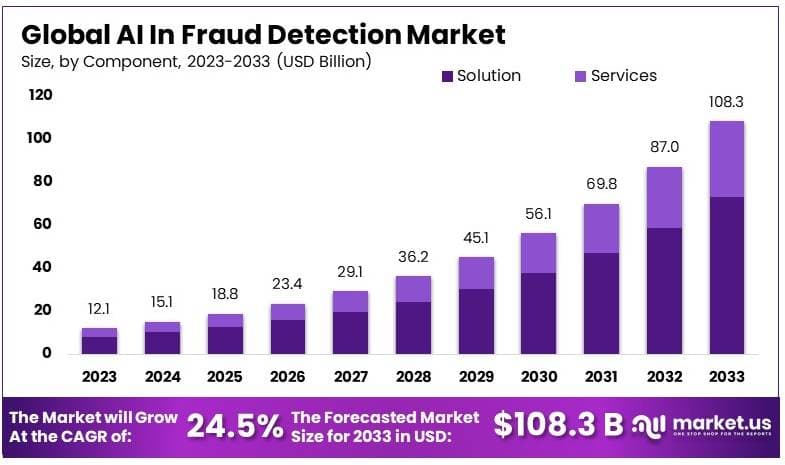
The AI in fraud detection market is demonstrating considerable growth, driven by the increasing sophistication of fraud schemes and the critical need for advanced protective measures within financial institutions. The adoption of AI technologies is seen as an essential strategic response to these challenges, promising heightened accuracy and faster detection rates.
Currently, over 50% of financial institutions are preparing to deploy AI solutions to identify new and unknown types of fraud. These technologies, particularly machine learning (ML) and predictive analytics, are highly valued for their ability to discern emerging fraud patterns and substantially reduce false positives.
Moreover, 94% of payments professionals acknowledge the indispensable role of AI in monitoring transactions and pinpointing suspicious activities. This broad consensus underscores the technology’s impact on safeguarding financial flows and maintaining system integrity across banking platforms.
The financial stakes are notably high in sectors like insurance, where fraud represents significant losses. Annually, insurance fraud extracts approximately USD 308.6 billion from U.S. insurers, with nearly 60% of these companies now utilizing AI to mitigate this pervasive issue.
The technology’s application ranges from identifying patterns indicative of fraudulent claims to automating the verification processes, thus speeding up response times and reducing human oversight errors.
One of the most prevalent threats today is business email compromise, which the FBI’s Internet Crime Complaint Center reports as causing considerable financial damage. In 2022 alone, there were 21,832 recorded instances of this type of fraud, culminating in losses nearing USD 2.7 billion. The scale and frequency of these fraud cases highlight the urgent need for robust, AI-driven detection tools that can swiftly flag and halt these fraudulent transactions before they result in financial loss.
Furthermore, a study by Biocatch reveals that while a majority of financial institutions (74%) are already leveraging AI for financial-crime detection and (73%) for fraud detection, there is a unanimous expectation among these entities that both financial crime and fraud activities will intensify in 2024.
The trajectory of the AI in fraud detection market is set for dynamic expansion as more financial institutions recognize AI’s potential to revolutionize fraud prevention mechanisms. This trend indicates not only a shift towards more technologically integrated security postures but also highlights the necessity for continuous advancement in AI capabilities to keep pace with evolving fraud tactics.
Key Takeaways
- The AI In Fraud Detection Market was valued at USD 12.1 billion in 2023 and is expected to reach USD 108.3 billion by 2033, with a CAGR of 24.50%.
- In 2023, Solution dominated the component segment with 67.2%, underscoring the importance of AI-based fraud detection tools.
- In 2023, Payment Fraud led the application segment with 49.4%, driven by the need to combat growing payment-related fraud.
- In 2023, Large Enterprises dominated the organization size segment with 68.0%, highlighting their investment in fraud detection solutions.
- In 2023, BFSI led the industry vertical segment with 26.5%, indicating high adoption in the financial sector.
- In 2023, North America dominated the region with 38.9%, reflecting its advanced AI infrastructure in fraud detection.
Component Analysis
Solution dominates with 67.2% due to its essential role in implementing robust fraud detection mechanisms.
In the AI in Fraud Detection market, the Solution component notably dominates, holding a 67.2% share. This substantial percentage underscores the critical need for comprehensive fraud detection solutions that integrate advanced algorithms to identify, prevent, and manage fraudulent activities effectively. Solutions in this market encompass a range of software tools that leverage artificial intelligence to analyze patterns and anomalies that could indicate fraudulent behavior.
Services, although essential for implementing, maintaining, and optimizing these solutions, occupy a smaller segment of the market. These services include consulting, training, and support that enhance the functionality and effectiveness of AI solutions in fraud detection.
The predominance of the Solution component is propelled by continuous advancements in AI technologies, which are becoming increasingly adept at handling large volumes of data and providing real-time analytics.
This capability is crucial for organizations across various sectors aiming to minimize the risk of fraud, which can lead to significant financial losses and reputational damage. As the complexity of fraudulent schemes increases, the demand for sophisticated AI solutions that can outpace such threats is expected to rise, further driving growth in this market segment.
Application Analysis
Payment Fraud dominates with 49.4% due to the increasing volume of online transactions and associated risks.
Payment Fraud emerges as the dominant application in the AI in Fraud Detection market, accounting for 49.4% of this segment. The high incidence of payment fraud, particularly in online and mobile transactions, has driven the demand for AI-based solutions that can effectively detect and prevent such activities. AI technologies in this area are designed to identify unusual transaction patterns and verify user identity to mitigate the risk of fraud.
Other applications like Identity Fraud, Insurance Fraud, Money Laundering, and various other forms of financial irregularities also significantly benefit from AI in fraud management. AI’s role in these areas includes analyzing behavioral patterns, cross-referencing data points, and providing predictive insights to preempt potential fraud.
The leadership of Payment Fraud in the application segment is further emphasized by the digital economy’s expansion, where the volume of electronic transactions continues to grow exponentially. This trend suggests a continuous and expanding market for AI solutions dedicated to securing transaction processes and enhancing the integrity of financial systems worldwide.
Organization Size Analysis
Large Enterprises dominate with 68.0% due to their capacity to invest in advanced AI solutions for comprehensive fraud detection.
Large Enterprises hold the largest share in the AI in Fraud Detection market by organization size, with a dominance of 68.0%. This segment’s prominence is largely due to the significant resources that large enterprises can allocate towards implementing advanced AI solutions. These organizations often face higher risks of sophisticated fraud attempts due to their extensive customer bases and large-scale operations, making robust fraud detection systems critical.
Small and Medium-Sized Enterprises (SMEs), while increasingly adopting AI in fraud detection, still face challenges such as limited budgets and less specialized IT personnel. However, as AI solutions become more accessible and scalable, SMEs are gradually recognizing the value of investing in these technologies to protect their operations.
The dominant position of Large Enterprises is likely to spur further innovation in AI solutions tailored to the needs of these organizations. As AI technology evolves, its adoption is expected to broaden across smaller businesses, potentially equalizing the distribution of AI usage in fraud detection across different organization sizes in the future.
Industry Vertical Analysis
BFSI dominates with 26.5% due to its inherent vulnerability to various types of financial frauds.
In the Industry Vertical analysis of the AI in Fraud Detection market, the BFSI (Banking, Financial Services, and Insurance) sector stands out, occupying 26.5% of the market. This dominance is driven by the sector’s inherent susceptibility to various types of fraud, including but not limited to payment fraud, identity theft, and insurance claims fraud.
The complex nature of transactions and the vast amounts of personal and financial data handled by these institutions necessitate robust AI-driven fraud detection systems.
Other industry verticals like IT and Telecommunications, Healthcare, Manufacturing, Retail and E-commerce, and the Government and Public Sector also integrate AI solutions to combat fraud, tailored to their specific operational risks and regulatory requirements.
The leading role of BFSI in this market segment underscores the critical need for continuous advancements in AI capabilities to keep pace with the evolving sophistication of fraud schemes. As AI technologies advance, their integration into the fraud detection strategies of BFSI and other sectors is expected to become more pronounced, playing a pivotal role in safeguarding assets and maintaining trust in financial systems globally.

Key Market Segments
By Component
- Solution
- Services
By Application
- Payment Fraud
- Identity Fraud
- Insurance Fraud
- Money Laundering
- Other Applications
By Organization Size
- Small and Medium-Sized Enterprises
- Large Enterprises
By Industry Vertical
- BFSI
- IT and Telecommunications
- Healthcare
- Manufacturing
- Retail and E-commerce
- Government and Public Sector
- Other Industry Verticals
Driver
Rising Cyber Threats and Need for Real-Time Analysis Drive Market Growth
The AI in Fraud Detection Market is fueled by the rising incidence of cyber threats, the need for real-time data analysis, and the increasing complexity of fraudulent activities. The growing number of cyber threats is a significant driver, as organizations face more sophisticated attacks that can compromise sensitive information.
The need for real-time data analysis also plays a critical role in driving the market. As financial transactions and online activities increase in volume and speed, businesses require solutions that can instantly detect anomalies and potential fraud.
AI systems excel at processing large amounts of data in real-time, enabling organizations to respond quickly to potential threats. This capability is essential in minimizing financial losses and protecting customer trust, which further accelerates the adoption of AI in fraud detection.
Additionally, the increasing complexity of fraudulent schemes is pushing organizations to adopt more advanced technologies. Traditional methods of fraud detection are often inadequate against sophisticated schemes that evolve rapidly. AI offers the ability to learn from new patterns and adapt to emerging threats, making it an indispensable tool for modern fraud prevention.
Restraint
High Costs, Complexity, and False Positives Restrain Market Growth
The AI in Fraud Detection Market faces challenges due to high costs, system complexity, and the issue of false positives. The high costs associated with developing and implementing AI-based fraud detection systems are a significant barrier. Many organizations, especially smaller ones, find it difficult to justify the investment, which slows market adoption.
System complexity also restrains growth. AI fraud detection solutions often require sophisticated integration with existing systems and a high level of expertise to manage. This complexity can be daunting for businesses, leading to hesitation in adopting these technologies.
Additionally, the problem of false positives—where legitimate transactions are incorrectly flagged as fraudulent—creates further concerns. High rates of false positives can lead to customer dissatisfaction and operational inefficiencies, causing organizations to be cautious about fully relying on AI systems.
Opportunity
Advanced Algorithms and Real-Time Analysis Provide Opportunities for Market Growth
The implementation of advanced algorithms in AI presents substantial opportunities in the AI in Fraud Detection Market. These algorithms can analyze vast amounts of transactional data in real time, enabling businesses to detect fraudulent activities as they occur.
This real-time analysis reduces the response time, allowing companies to mitigate potential losses quickly. Furthermore, AI’s ability to learn and adapt from new patterns of fraud enhances its effectiveness, making it a powerful tool for continuous improvement in fraud detection strategies.
The integration of AI with big data analytics also enables more accurate predictions and risk assessments, helping companies to proactively prevent fraud before it happens. As cyber threats become more sophisticated, the demand for AI-driven fraud detection systems is expected to increase, providing significant growth opportunities for technology providers.
Businesses that leverage these advanced capabilities can not only protect their assets but also build trust with their customers, further driving market expansion.
Challenge
Data Quality and Complexity Challenge Market Growth
Data quality and complexity present significant challenges to the growth of AI in the fraud detection market. AI systems rely heavily on large volumes of accurate data to identify fraudulent activities effectively. However, poor data quality can lead to incorrect predictions and missed fraud detection opportunities, undermining the system’s reliability.
Another challenge is the complexity of fraud patterns, which are constantly evolving. Fraudsters continuously develop new methods to bypass detection, making it difficult for AI systems to keep up. This requires continuous updates and enhancements to the AI algorithms, which can be resource-intensive and costly.
The high cost of implementing AI technology in fraud detection is also a barrier. Many organizations, especially smaller ones, may struggle to afford the advanced AI tools needed to stay ahead of sophisticated fraud schemes. This can limit the adoption of AI across the industry and create disparities between companies.
Moreover, the need for skilled personnel to manage and interpret AI systems poses another challenge. The shortage of experts in AI and fraud detection can hinder the effective deployment and optimization of these technologies.
Growth Factors
- Increasing Volume of Digital Transactions: With the rise in online transactions, AI is essential for monitoring and analyzing vast amounts of data in real time. This ability to process large volumes of data helps in detecting and preventing fraud more effectively.
- Sophistication of Cyber Attacks: As cyber threats become more complex, AI provides advanced tools to identify and counteract fraudulent activities. AI’s ability to learn and adapt to new threats is crucial in staying ahead of cybercriminals.
- Cost-Effective Fraud Prevention: AI reduces the costs associated with manual fraud detection by automating the process and minimizing the need for human intervention. This cost-effectiveness is attractive to businesses looking to protect themselves without excessive spending.
- Improved Accuracy and Speed: AI systems can quickly analyze patterns and detect anomalies that may indicate fraud, providing faster and more accurate results than traditional methods. This speed and precision are essential in minimizing financial losses.
- Regulatory Compliance: AI helps organizations comply with strict regulatory requirements by ensuring consistent monitoring and reporting of suspicious activities. This compliance is vital in industries such as finance, where regulations are stringent.
- Real-Time Fraud Detection: AI enables real-time monitoring of transactions, allowing immediate detection and response to fraudulent activities. This real-time capability is critical in preventing fraud before significant damage occurs.
Emerging Trends
- AI-Powered Behavioral Analytics: AI is increasingly being used to analyze user behavior and detect anomalies that may indicate fraud. This trend will grow as companies seek more sophisticated ways to identify and prevent fraudulent activities.
- Integration of AI with Blockchain Technology: The combination of AI and blockchain offers a powerful tool for fraud detection by providing secure, transparent, and tamper-proof transaction records. This trend is expected to expand, enhancing trust and security in digital transactions.
- AI in Identity Verification: AI-driven identity verification tools are becoming more popular, providing accurate and efficient ways to verify user identities. This trend will continue as companies prioritize security in user authentication processes.
- Machine Learning in Fraud Detection Models: Machine learning algorithms are being increasingly used to develop more accurate fraud detection models. This trend will likely grow as businesses invest in AI to improve their fraud prevention strategies.
- AI for Predictive Analytics in Fraud: AI is being used to predict potential fraud by analyzing historical data and identifying patterns. This trend will expand as companies look to move from reactive to proactive fraud prevention.
- Adoption of AI in Mobile Fraud Detection: As mobile transactions increase, AI is being used to detect and prevent fraud on mobile platforms. This trend will continue to grow, driven by the need to secure mobile payment systems and protect users.
Regional Analysis
North America Dominates with 38.9% Market Share in AI in Fraud Detection Industry
North America’s prominent 38.9% market share with a valuation of USD 4.70 Bn in the AI in fraud detection market is driven by its sophisticated financial services sector and high-tech adoption rates. The region’s proactive stance on cybersecurity and fraud prevention, supported by substantial investments in AI, fuels this dominance.
The market dynamics in North America are influenced by the integration of AI technologies across various sectors including banking, insurance, and e-commerce, which require robust fraud detection systems. The availability of advanced computing infrastructure and skilled professionals further enables the deployment of complex AI solutions.
The future influence of North America in the AI in fraud detection market is expected to grow as the region continues to innovate and invest in AI. With increasing digital transactions and heightened cybersecurity threats, demand for AI-driven fraud detection tools is anticipated to rise, solidifying the region’s market position.

Regional Insights
- Europe: Europe maintains a strong position in the market, driven by stringent regulations on data protection and fraud prevention. The region’s commitment to ethical AI use and privacy compliance supports continued growth in AI adoption for fraud detection.
- Asia Pacific: Asia Pacific shows rapid growth in AI for fraud detection due to its expanding digital economy and increasing incidences of cyber fraud. Governments and businesses are actively investing in AI to safeguard economic transactions and data integrity.
- Middle East & Africa: The Middle East and Africa are slowly adopting AI in fraud detection, with growth spurred by the need to secure expanding digital banking and mobile money services against fraud.
- Latin America: Latin America is experiencing growth in AI for fraud detection as regional businesses seek to combat the high rates of digital and payment fraud. Investments in AI technologies are increasingly viewed as essential for competitive and secure business operations.
Key Regions and Countries covered іn thе rероrt
- North America
- US
- Canada
- Mexico
- Europe
- Germany
- UK
- France
- Italy
- Russia
- Spain
- Rest of Europe
- Asia Pacific
- China
- Japan
- South Korea
- India
- Rest of Asia-Pacific
- South America
- Brazil
- Argentina
- Rest of South America
- Middle East & Africa
- GCC
- South Africa
- Israel
- Rest of MEA
Key Players Analysis
The AI in Fraud Detection market is crucial for protecting businesses and consumers from financial crimes. Among the leading companies, IBM Corporation, FICO, and SAS Institute Inc. stand out as the top three players driving innovation and market influence.
IBM Corporation is a key leader in this market, offering advanced AI-driven fraud detection solutions through its IBM Watson platform. IBM’s strong background in AI and machine learning enables it to provide sophisticated tools for detecting and preventing fraud. The company’s global reach and trusted reputation make it a significant player, impacting various industries with its cutting-edge technology.
FICO is another major force in the AI in Fraud Detection market. Known for its credit scoring systems, FICO also provides AI-powered fraud detection solutions. Its FICO Falcon Fraud Manager is widely used by financial institutions to identify fraudulent activities in real-time. FICO’s long-standing expertise in analytics and risk management, combined with its focus on innovation, gives it a strong strategic position in the market.
SAS Institute Inc. is a critical player with its AI-based fraud detection software. SAS leverages its deep analytics expertise to offer solutions that help businesses detect and mitigate fraud effectively. The company’s tools are used across various sectors, including banking and insurance, giving SAS a significant market influence. Its commitment to continuous improvement and AI integration ensures its leadership in the industry.
These three companies lead the AI in Fraud Detection market through their advanced technology, strategic positioning, and strong market influence. Their contributions are essential in shaping the future of fraud detection, setting standards for security and efficiency in the industry.
Top Key Players in the Market
- IBM Corporation
- Google LLC
- SAS Institute Inc.
- SAP SE
- FICO
- ACI Worldwide
- Experian plc
- Fiserv, Inc.
- Verisk Analytics, Inc.
- NICE Ltd.
- Veriff
- Matellio Inc.
- Other Key Players
Recent Developments
- 2024: IBM has been actively enhancing its AI-driven fraud detection systems, particularly for financial institutions. IBM announced the integration of new AI models into its financial fraud detection suite, focusing on anomaly detection and risk scoring. This update aims to improve real-time transaction monitoring and enhance identity verification processes. IBM’s financial services segment saw a 6% growth in Q1 2024, reflecting increased adoption of its AI-driven solutions across global banks.
- Early 2024: Google Cloud launched a new AI tool specifically designed for e-commerce platforms and insurance companies, focusing on behavioral analytics to detect fraudulent activities. This tool leverages Google’s deep learning capabilities to identify and prevent fraud before it occurs. Google’s AI segment reported a 15% increase in revenue for Q2 2024, driven by the strong adoption of its new AI offerings across various industries.









