


Report Overview
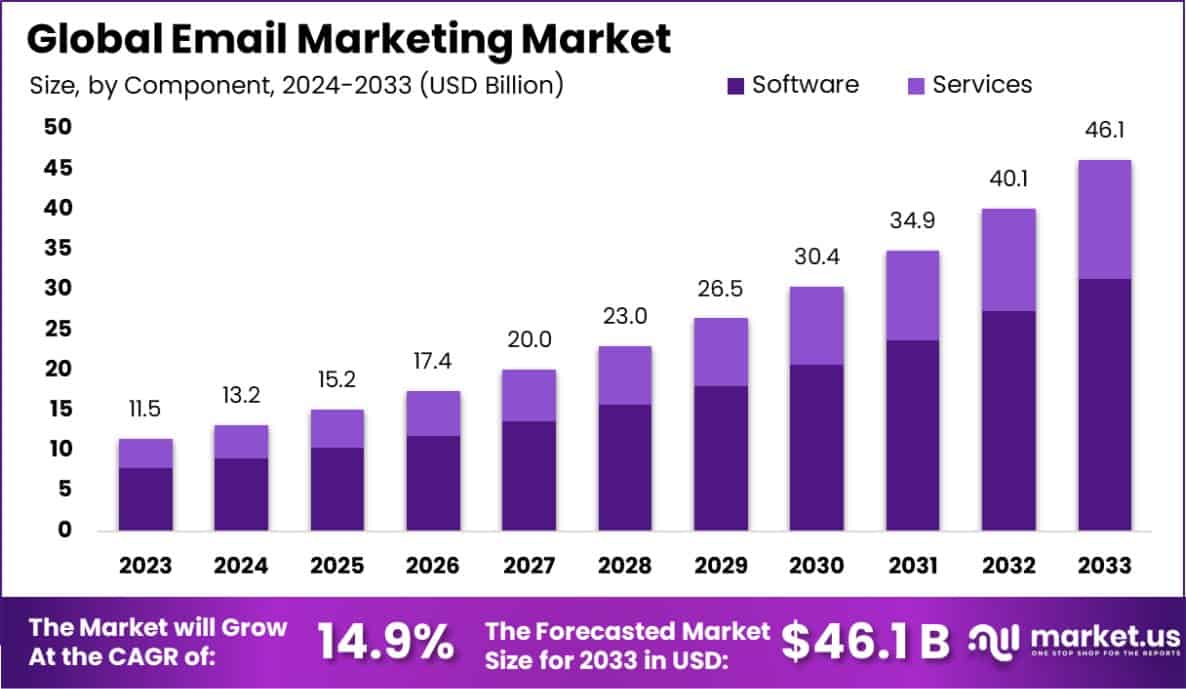
The Global Email Marketing Market size is expected to be worth around USD 46.1 Billion By 2033, from USD 11.5 Billion in 2023, growing at a CAGR of 14.9% during the forecast period from 2024 to 2033.
Email marketing is a digital marketing strategy that involves sending emails to prospects and customers. Effective email marketing converts prospects into customers and turns one-time buyers into loyal, raving fans. This method of marketing helps businesses promote their products and services, maintain customer engagement, distribute content, and achieve a variety of other business goals. Email marketing is advantageous because it is direct, flexible, cost-effective, and measurable. Businesses can tailor their messages based on user behavior, ensuring relevant and personalized engagement.
The email marketing market has expanded significantly over the past decade, driven by the increasing digitalization of business practices and the growing recognition of email marketing’s cost-efficiency and high return on investment (ROI). As of recent data, the global email marketing market size is projected to continue its growth trajectory due to several key factors including technological advancements in artificial intelligence (AI) and automation, the surge in mobile email access, and the escalating demand for personalized communication solutions.
The Email Marketing Market is poised for significant growth, driven by several key factors and market opportunities. The proliferation of digital transformation initiatives across industries has elevated the role of email as a critical tool for communication, marketing, and customer retention. Businesses are increasingly leveraging email marketing technologies to reach customers with personalized content, which enhances engagement rates and drives conversions.
Furthermore, the integration of artificial intelligence and machine learning in email marketing platforms allows for smarter segmentation and targeting, optimizing the timing and content of emails to maximize open rates and click-through rates. Market opportunities in the Email Marketing sector are abundant due to the rising demand for automated and data-driven marketing solutions that can deliver measurable results in real-time.
As privacy regulations tighten globally, there is a growing demand for compliant email marketing solutions that respect user privacy while effectively engaging customers. Additionally, the increasing use of mobile devices has opened new avenues for mobile-optimized email campaigns, tapping into a continuously connected user base. The integration of email marketing with other channels, such as social media and web analytics, offers a holistic view of customer behaviors and preferences, enabling more refined strategies that could significantly boost the effectiveness of marketing campaigns.
Specifically, email marketing yields an average of $42 for every $1 spent, underscoring its high profitability and effectiveness as a marketing tool. This robust ROI is supported by an average open rate of 21.33% for email campaigns, complemented by a click-through rate of 2.62%, indicating a strong recipient engagement compared to other direct marketing methods.
Personalization and segmentation are key drivers of success in email marketing. Personalized email messages have been shown to boost click-through rates by an average of 14% and enhance conversions by 10%, demonstrating the importance of tailored content in driving engagement and sales.
Furthermore, segmented and targeted emails are responsible for generating 58% of all revenue, highlighting the critical role of precise audience targeting in maximizing email marketing effectiveness. The inclusion of social sharing buttons can also significantly enhance engagement, evidenced by a 158% increase in click-through rates.
The strategic use of calls-to-action in emails has resulted in a dramatic increase in user engagement, with a 371% rise in clicks and a remarkable 1617% boost in sales. Additionally, abandoned cart emails, which are pivotal in recapturing potentially lost sales, boast an impressive average open rate of 45% and a click-through rate of 21%.
Key Takeaways
- The Global Email Marketing Market size is expected to be worth around USD 46.1 Billion By 2033, from USD 11.5 Billion in 2023, growing at a CAGR of 14.9% during the forecast period from 2024 to 2033.
- In 2023, Software held a dominant market position in the Component segment of the Email Marketing Market, capturing more than a 68.1% share.
- In 2023, Cloud-Based held a dominant market position in the Deployment Mode segment of the Email Marketing Market, capturing more than a 70.5% share.
- In 2023, Large Enterprises held a dominant market position in the Organization Size segment of the Email Marketing Market, capturing more than a 64.0% share.
- In 2023, Retail and E-commerce held a dominant market position in the Industry Vertical segment of the Email Marketing Market, capturing more than a 21.9% share.
- North America will dominate a 36.3% market share in 2023 and hold USD 4.17 Billion in revenue from the Email Marketing Market.
Component Analysis
In 2023, Software held a dominant market position in the Component segment of the Email Marketing Market, capturing more than a 68.1% share. This segment significantly outperformed Services, which accounted for the remaining 31.9%.
The prominence of Software in this market can be attributed to its crucial role in enabling automated, scalable, and personalized email campaigns essential for contemporary marketing strategies. Innovations in AI and machine learning have further augmented the capabilities of email marketing software, enhancing segmentation, personalization, and overall campaign effectiveness.
Services, while smaller in market share, continue to be vital by providing expertise in strategy formulation, campaign management, and analytics services. This segment is expected to grow as organizations increasingly seek specialized skills to leverage sophisticated software solutions effectively.
The synergy between Software and Services is essential, fostering a more integrated approach that enhances the efficacy of email marketing strategies. As businesses increasingly recognize the value of targeted and data-driven marketing campaigns, the demand for both advanced software solutions and expert services is projected to increase, driving further growth in the Email Marketing Market.
Deployment Mode Analysis
In 2023, Cloud-Based solutions held a dominant market position in the Deployment Mode segment of the Email Marketing Market, capturing more than a 70.5% share. In contrast, On-Premise solutions accounted for a 29.5% market share.
The significant preference for Cloud-Based deployment can be attributed to its scalability, cost-effectiveness, and ease of integration with existing marketing technologies. Organizations are increasingly opting for cloud solutions to leverage the benefits of real-time data access, higher flexibility, and reduced IT overhead.
On-Premise deployment, while smaller in market share, remains relevant for organizations prioritizing data control, security, and compliance with stringent regulatory requirements. This deployment mode is particularly prevalent in industries such as finance and healthcare, where data privacy is paramount.
The market’s inclination toward Cloud-Based solutions is expected to continue as the need for more agile and collaborative marketing tools increases. Meanwhile, advancements in security and hybrid cloud solutions may potentially increase the attractiveness of On-Premise solutions in scenarios where data sensitivity is critical. The ongoing evolution in deployment strategies underscores the dynamic nature of the Email Marketing Market, reflecting shifting organizational priorities and technological advancements.

Organization Size Analysis
In 2023, Large Enterprises held a dominant market position in the Organization Size segment of the Email Marketing Market, capturing more than a 64.0% share. Conversely, Small and Medium-Sized Enterprises (SMEs) accounted for the remaining 36.0%.
This predominance of Large Enterprises is largely driven by their substantial marketing budgets and the capacity to leverage sophisticated email marketing platforms that offer advanced analytics, segmentation, and automation features. These capabilities are crucial for executing large-scale campaigns that can reach a global audience effectively.
On the other hand, SMEs, while having a smaller share, are increasingly adopting email marketing solutions tailored to their specific needs and budgets. The scalability of email marketing tools allows these smaller companies to achieve significant ROI, driving gradual market penetration.
The future may see a rebalancing of market shares as email marketing platforms become more accessible and affordable, enabling SMEs to harness advanced marketing technologies traditionally reserved for larger corporations. Furthermore, the growing recognition of personalized customer engagement as a key to competitive advantage is likely to drive increased adoption among SMEs, potentially shifting the market dynamics in the Email Marketing Market.
Industry Vertical Analysis
In 2023, Retail and E-commerce held a dominant market position in the Industry Vertical segment of the Email Marketing Market, capturing more than a 21.9% share.
This was followed by IT and Telecommunications, BFSI (Banking, Financial Services, and Insurance), Travel and Hospitality, Media and Entertainment, Education, and Other Industry Verticals. The significant share held by Retail and E-commerce is attributed to the industry’s reliance on direct customer communications to drive sales, promote new products, and enhance customer loyalty through personalized offers and targeted marketing campaigns.
The Retail and E-commerce sector’s utilization of email marketing is driven by the need to manage vast customer databases and execute segmented marketing strategies that require robust and scalable email marketing solutions. Additionally, the integration of analytics and machine learning development technologies has enabled retailers to optimize their email marketing tactics, improving customer engagement and conversion rates.
Despite the strong position of Retail and E-commerce, other sectors like IT and Telecommunications and BFSI are also integrating email marketing strategies to enhance customer communication and retention. As digital transformation continues to influence various industries, the reliance on effective email marketing solutions across all verticals is expected to grow, further diversifying the market landscape in the coming years.
Key Market Segments
Component
- Software
- Services
Deployment Mode
- Cloud-Based
- On-Premise
Organization Size
- Small and Medium-Sized Enterprises
- Large Enterprises
Industry Vertical
- IT and Telecommunications
- BFSI
- Retail and E-commerce
- Travel and Hospitality
- Media and Entertainment
- Education
- Other Industry Verticals
Drivers
Email Marketing Market Drivers
Email marketing continues to be a pivotal strategy in digital marketing due to its cost-effectiveness and wide reach. This method is driven primarily by the increasing digitization of businesses, as companies of all sizes are leveraging email campaigns to maintain engagement with their customer base.
The adaptability of email marketing allows for personalized communication, which can significantly enhance customer response rates and engagement. Additionally, advancements in marketing automation technology have streamlined the process of creating, sending, and tracking emails, which enhances the efficiency of marketing campaigns.
The integration of analytics tools also allows businesses to measure the success of their campaigns in real time, providing insights that help in optimizing strategies and improving return on investment (ROI). As consumers continue to prefer email as a primary form of communication, the relevance and impact of email marketing remain strong.
Restraint
Challenges Limiting Email Marketing Impact
One of the main restraints facing the email marketing market is the growing concern over privacy and data security. As regulations such as the General Data Protection Regulation (GDPR) and similar laws worldwide tighten, businesses must navigate complex legal requirements to avoid penalties.
This regulatory environment compels companies to be more cautious about how they collect, store, and use customer data, potentially limiting the scope and effectiveness of email campaigns. Additionally, the high volume of emails that consumers receive daily can lead to email fatigue, reducing engagement rates.
This saturation makes it challenging for companies to stand out in crowded inboxes, further hindering the impact of email marketing efforts. As a result, businesses must innovate continuously and tailor their strategies to maintain customer interest and compliance with evolving regulations.
Opportunities
Expanding Opportunities in Email Marketing
The email marketing market presents significant opportunities, particularly through the integration of artificial intelligence (AI) and machine learning (ML). These technologies can enhance personalization and targeting, allowing marketers to send content that is highly relevant to each recipient, thus improving engagement rates.
Additionally, the rise of mobile internet usage offers a vast potential for optimizing emails for mobile devices, ensuring that marketing messages are effective and accessible on the go. There is also a growing trend towards integrating email marketing with other digital channels, such as social media and websites, creating a cohesive and seamless customer experience.
This multi-channel approach can help businesses reach a broader audience and engage customers at various points in their purchasing journey. Leveraging these technological advancements and strategies can greatly enhance the effectiveness and reach of email marketing campaigns.
Challenges
Navigating Email Marketing’s Complex Landscape
The email marketing sector faces several challenges that could hinder its effectiveness and growth. One significant issue is the increasing sophistication of spam filters, which can mistakenly block legitimate marketing emails, reducing their reach.
This challenge is compounded by the evolving algorithms of email platforms aiming to enhance user experience by prioritizing personal over promotional content. Additionally, the need for continuous content innovation is a hurdle for marketers as they strive to capture the attention of an audience inundated with digital messages.
The growing consumer sensitivity towards privacy and the preference for less intrusive forms of communication further complicate the effectiveness of traditional email strategies. To remain competitive, marketers must adapt by developing more engaging, value-driven content and respecting user preferences and privacy to maintain trust and compliance.
Growth Factors
- Integration with Other Platforms: Email marketing tools that offer seamless integration with other software such as AI in CRM systems, social media platforms, and analytics tools enhance campaign effectiveness and efficiency, making them more attractive to businesses.
- Advancements in AI Technology: The incorporation of artificial intelligence in email marketing allows for more personalized content, predictive analytics, and automated responses, thereby improving engagement rates and campaign performance.
- Increasing Smartphone Penetration: With more consumers accessing emails via mobile devices, marketers are optimizing emails for mobile viewing, leading to higher engagement and conversion rates. This trend underscores the need for mobile-responsive email design.
- Regulatory Compliance: Changes in privacy laws and regulations like GDPR have made email marketing a more trusted channel, as marketers must adhere to stricter standards, thereby enhancing consumer trust and engagement.
- Rise in E-commerce: As e-commerce continues to grow, so does the use of email marketing by retailers to drive sales, retain customers, and personalize shopping experiences, which further supports market expansion.
- Data-Driven Strategies: The growing availability of data and advanced analytics tools allows marketers to make informed decisions about when to send emails, whom to target, and what content drives conversion, enhancing the overall ROI of email campaigns.
Emerging Trends
- AI-Driven Personalization: Artificial intelligence is revolutionizing email marketing by enabling hyper-personalized content and recommendations, increasing engagement and conversion rates by delivering tailored messages to individual users.
- Interactive Emails: Marketers are incorporating interactive elements like sliders, polls, and buttons directly into emails. This engagement encourages more active participation from recipients, leading to higher click-through rates.
- Integration with Omnichannel Marketing: Email is increasingly integrated with other marketing channels, such as social media and websites. This holistic approach ensures a consistent message across all platforms, enhancing the overall customer journey.
- Privacy-Focused Campaigns: In response to stricter data privacy laws, marketers are adopting transparent practices in email campaigns, prioritizing user consent and clear communication about data usage, thereby building trust.
- Mobile Optimization: With the majority of emails now opened on mobile devices, there’s a greater emphasis on designing emails that are mobile-friendly, with responsive layouts and easily clickable calls-to-action.
- Predictive Analytics: Using predictive analytics, marketers can forecast the optimal timing and content for their emails, improving open rates and engagements by reaching audiences when they are most likely to engage.
Regional Analysis
The global landscape of the email marketing market is distinctly segmented, with North America maintaining a dominant position, accounting for 36.3% of the market share, valued at USD 4.17 billion. This region’s dominance is attributed to the high adoption of advanced marketing technologies, significant investments in AI in digital marketing, and the presence of major industry players.
In Europe, stringent data protection regulations such as GDPR have shaped email marketing strategies, leading to innovative privacy-compliant solutions that enhance consumer trust and engagement. This regulatory environment, coupled with a mature digital infrastructure, supports steady market growth.
The Asia Pacific region is witnessing the fastest growth due to increasing internet penetration and smartphone usage. Emerging economies like India and China are experiencing a surge in small and medium-sized enterprises that are leveraging email marketing for cost-effective customer outreach and engagement.
In contrast, the Middle East & Africa, and Latin America are gradually adopting email marketing solutions. These regions show potential for growth driven by digital transformation initiatives and an expanding online retail sector, which utilize email marketing to tap into a growing base of tech-savvy consumers.

Key Regions and Countries
- North America
- US
- Canada
- Europe
- Germany
- France
- The UK
- Spain
- Italy
- Russia
- Netherlands
- Rest of Europe
- Asia Pacific
- China
- Japan
- South Korea
- India
- Australia
- Singapore
- Thailand
- Vietnam
- Rest of APAC
- Latin America
- Brazil
- Mexico
- Rest of Latin America
- Middle East & Africa
- South Africa
- Saudi Arabia
- UAE
- Rest of MEA
Key Players Analysis
In the global email marketing market of 2023, key players such as Mailchimp, HubSpot, Inc., and Klaviyo have exhibited strategic positioning and innovation that significantly influence market dynamics.
Mailchimp has long been a frontrunner in the email marketing sphere, renowned for its user-friendly interface and robust feature set that caters to small and medium-sized enterprises. In 2023, Mailchimp’s commitment to integrating AI-driven analytics and automation tools has further solidified its market position. The platform’s ability to offer personalized, data-driven marketing solutions enables businesses to execute highly effective campaigns with improved ROI.
HubSpot, Inc. continues to excel as a comprehensive inbound marketing platform, where email marketing is a key component of its broader suite of tools. HubSpot’s strength lies in its seamless integration capabilities, allowing users to synchronize their email marketing efforts with other sales and marketing activities. This integration fosters a more cohesive user experience and enhances the effectiveness of multi-channel marketing strategies.
Klaviyo specializes in leveraging data for creating highly targeted email campaigns, particularly for e-commerce businesses. Its platform offers advanced segmentation and personalization capabilities, making it possible for retailers to engage customers with customized content based on their behaviors and preferences. Klaviyo’s focus on e-commerce integration, particularly with major platforms like Shopify, provides a significant competitive edge by optimizing the customer journey from email to purchase.
Collectively, these companies are pivotal in shaping the trajectory of the email marketing industry. Their innovations and adaptations to changing market conditions and consumer expectations dictate not only their success but also the broader trends in the market, underscoring the importance of technological advancement and customer-centric approaches in today’s digital marketing landscape.
Top Key Players in the Market
- Mailchimp
- HubSpot, Inc.
- Klaviyo
- Salesforce, Inc.
- Adobe Inc.
- Zoho Corporation
- ActiveCampaign
- Constant Contact, Inc.
- AWeber
- GetResponse
- Other Key Players
Recent Developments
- In July 2023, Zoho introduced a new set of analytics features within its Zoho Campaigns product, focusing on providing deeper insights into campaign performance metrics to enhance decision-making for marketers.
- In March 2023, Salesforce launched AI enhancements to its Marketing Cloud, helping businesses personalize customer interactions more effectively, thus aiming to increase user engagement and satisfaction.
- In January 2023, Adobe acquired a smaller technology firm specializing in email marketing optimization, aiming to integrate new AI capabilities into its Adobe Experience Cloud to streamline customer data analysis and campaign management.









