


Report Overview
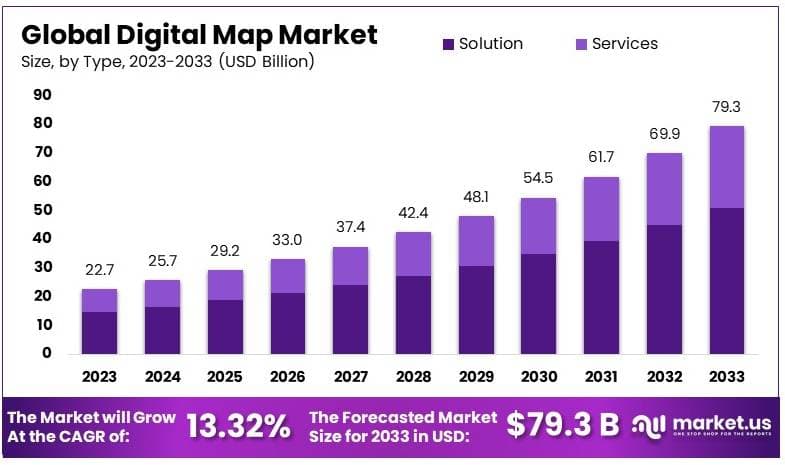
The Global Digital Map Market size is expected to be worth around USD 79.3 Billion by 2033, from USD 22.7 Billion in 2023, growing at a CAGR of 13.32% during the forecast period from 2024 to 2033.
The Digital Map market refers to the creation and use of digital representations of geographical areas, which are used for navigation, location-based services, and spatial analysis. These maps are essential tools in various industries, including transportation, logistics, urban planning, and retail.
Digital maps provide real-time information on routes, traffic conditions, and points of interest. They are used in GPS devices, smartphone apps, and autonomous vehicles to help users navigate from one location to another efficiently. In addition to navigation, digital maps are used for analyzing demographic trends, planning infrastructure projects, and optimizing delivery routes.
The market is driven by the increasing demand for accurate and up-to-date geographical data. With the rise of smart cities, connected vehicles, and location-based services, the need for advanced digital mapping solutions is growing.
The digital map market is crucial in today’s data-driven economy, providing foundational support for industries ranging from logistics and transportation to urban planning and emergency management. This sector is particularly influential in enhancing operational efficiencies through advanced Geographic Information Systems (GIS) and real-time navigation capabilities.
In 2023, the U.S. manufacturing sector installed over 44,303 new industrial robots, primarily in the automotive and electronics industries. This surge in automation relies significantly on cloud GIS and digital mapping technologies to streamline processes.
For instance, digital maps facilitate intelligent traffic management system, route optimization, and traffic pattern forecasting, directly contributing to operational efficiencies. Companies leveraging GIS platforms for route optimization have reported reductions in fuel consumption by 10-15%, thanks to efficient route planning aided by real-time traffic updates.
The role of digital maps extends into the logistics sector, where the integration of AI with professional service robots has dramatically transformed warehouse operations. Between 2021 and 2022, sales of these robots grew by 44%, illustrating their increasing adoption for tasks such as picking, packing, and autonomous transportation. This shift not only enhances efficiency but also reduces the reliance on human labor for repetitive and physically demanding tasks.
On the consumer front, navigation platforms like Google Maps and Moovit are at the forefront of the digital mapping space. Google Maps, with its 1.8 billion monthly active users, remains a dominant player in global navigation, offering extensive data that aids countless users in daily commuting and travel planning.
Similarly, Moovit, with 1.5 billion daily users, specializes in public transit navigation, providing tailored solutions that improve urban mobility and access to public transportation systems.
The digital map market is poised for continuous growth, driven by the expanding use of GIS in industrial automation and the increasing prevalence of AI in logistics. As businesses and consumers alike depend more on precise and efficient navigation solutions, the demand for advanced digital mapping technologies is expected to escalate, offering ample opportunities for innovation and market expansion in the coming years.
Key Takeaways
- The Digital Map Market was valued at USD 22.7 billion in 2023 and is expected to reach USD 79.3 billion by 2033, with a CAGR of 13.32%.
- In 2023, Solution dominated the type segment with 64% due to the growing need for comprehensive digital mapping tools.
- In 2023, Outdoor led the mapping type segment with 83.5%, driven by the high demand for external navigation services.
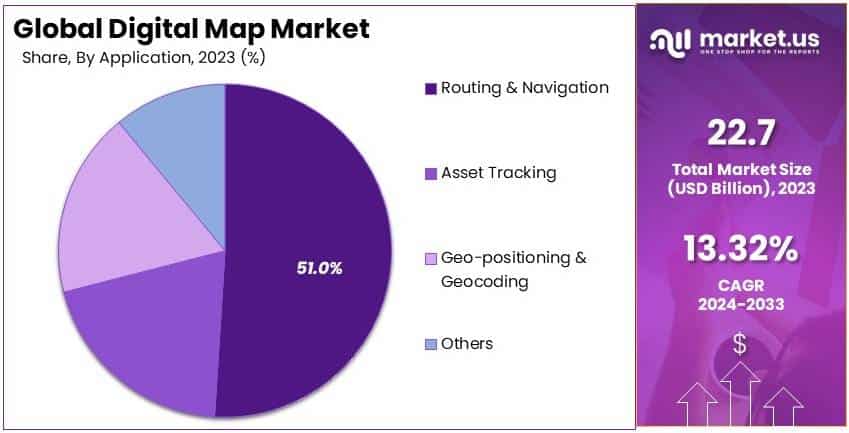
- In 2023, Routing and Navigation was the leading application segment with 51%, highlighting its importance in transportation and logistics.
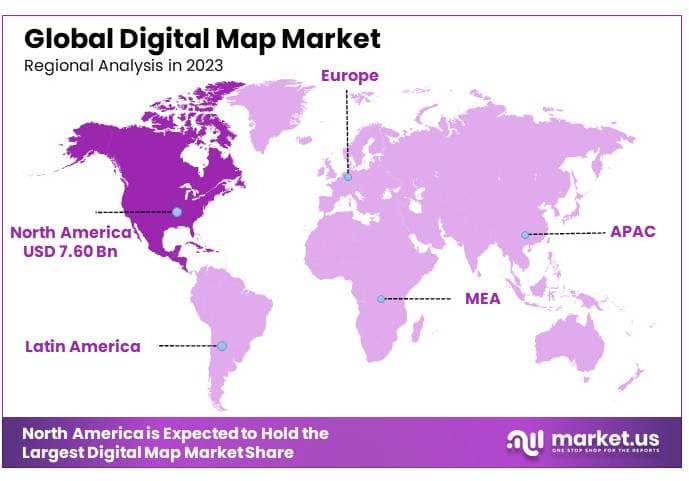
- In 2023, North America dominated the market with 33.5% market share, reflecting its strong infrastructure for digital mapping technologies.
Type Analysis
Solution dominates with 64% due to its comprehensive role in providing accurate and interactive map data.
In the digital map market, the Solution segment holds a dominant share of 64%. This segment’s leadership is primarily driven by the increasing demand for accurate and detailed digital maps across various applications, from navigation systems in vehicles to planning tools in urban development.
Solutions in digital mapping include software and platforms that provide and manage digital map data, ensuring users receive precise and current geographical information.
These digital map solutions are integral to countless applications that depend on reliable and precise geographical data to function effectively. They serve as the foundation upon which companies build applications for routing, asset tracking, and spatial analysis, among others.
While Solutions lead the market, Services also play a crucial role by offering support, maintenance, and customization of digital map solutions. Services ensure that the digital map data integrates seamlessly with client systems and meets specific needs, which might vary greatly across different industries and use cases.
The interdependence of Solutions and Services highlights a dynamic market where both segments support and drive growth. As technology advances and the demand for innovative mapping solutions increases, both segments will likely see sustained growth, reflecting their critical roles in the broader digital landscape.
Mapping Type Analysis
Outdoor mapping dominates with 83.5% due to its critical importance in global navigation and geographic analysis.
Outdoor mapping commands the largest share in the mapping type segment, at 83.5%. This significant figure underscores the essential nature of outdoor digital maps in a wide range of applications, from personal navigation on smartphones to complex geographic information systems used by governments and businesses.
The dominance of outdoor mapping is linked to its fundamental role in everyday activities such as driving, logistics, and travel, where accurate geographical data is necessary for routing and navigation. Furthermore, outdoor maps are crucial for emergency response, urban planning, and environmental monitoring, providing essential data that helps in decision-making and operational efficiency.
Indoor mapping, though a smaller segment, is growing as businesses recognize its value in areas such as AI in event management, in-building navigation, and facility management. The Metaverse is an emerging area that promises to expand further as virtual and augmented realities become more prevalent in entertainment and real estate.
The continued growth of outdoor mapping solidifies its position as a cornerstone of digital mapping, while the potential expansion in indoor and Metaverse mapping indicates a broadening scope of applications, enriching the digital map market’s diversity and utility.
Application Analysis
Routing and Navigation lead with 51% due to their widespread use in consumer and commercial transportation.
Routing and Navigation constitute the largest application segment within the digital map market, holding a 51% share. This dominance reflects the widespread reliance on digital maps for everyday and commercial transportation needs. Digital maps are essential for efficient route planning, providing real-time traffic updates, and suggesting optimal paths in dynamic conditions.
This application’s prevalence is due to the increasing use of GPS tracking devices in personal devices, automotive navigation systems, and mobile applications, all of which require up-to-date and accurate map data to function effectively. Routing and Navigation services are also critical for logistics and delivery services, which depend on precise timing and route optimization to reduce costs and improve service quality.
Other applications, such as Asset Tracking, Geo-positioning and Geocoding, and others like Real-time Location Data Management, also play significant roles in the digital map market. Each provides unique capabilities that support various business processes and consumer services, further driving the adoption and development of digital mapping technologies.
The prominence of Routing and Navigation underscores its fundamental role in modern transportation and logistics, while the growth in other applications highlights the expanding scope of digital maps in supporting diverse technological and commercial activities.
End-Use Analysis
Automotive leads with 38% due to the critical integration of digital maps in vehicle navigation and autonomous driving systems.
The Automotive sector is the leading end-use industry in the digital map market, with a 38% share. This substantial figure is primarily due to the essential role that digital maps play in vehicle navigation systems and the burgeoning field of autonomous driving. Modern vehicles increasingly rely on digital maps for not only basic navigation but also advanced features like predictive routing, hazard recognition, and adaptive cruise control, which enhance driver safety and convenience.
The integration of digital maps in the automotive industry is crucial for the development of autonomous vehicles, which use detailed map data to navigate roads without human input. The accuracy and detail of digital maps directly influence the effectiveness and safety of these systems.
Other industries such as Government & Defense, Logistics, Travel and Transportation, and others also significantly utilize digital maps. Each of these sectors depends on precise and up-to-date geographical data to optimize operations, plan infrastructure, manage logistics, or enhance customer experiences, contributing to the overall growth and innovation in the digital map market.
The dominance of the Automotive industry highlights the critical importance of digital maps in modern transportation solutions, while the diverse applications across other industries underscore the broad utility and potential for future growth in the digital map market.
Key Market Segments
By Type
- Solution
- Services
By Mapping Type
- Indoor
- Outdoor
- Metaverse
By Application
- Asset Tracking
- Geo-positioning and Geocoding
- Routing and Navigation
- Others (Reverse Geocoding, Real-time Location Data Management, Catchment Analysis)
By End-Use
- Automotive
- Government & Defense
- Logistics, Travel, and Transportation
- Infrastructure Development and Construction
- Retail
- Others (Oil & Gas, Finance, Agriculture)
Driver
Increasing Urbanization and Advancements in Navigation Technology Drive Market Growth
The growth of the Digital Map Market is driven by the increasing rate of urbanization, advancements in navigation technology, and the rising adoption of location-based services. As cities expand and become more complex, the demand for accurate and up-to-date digital maps has surged, providing essential tools for urban planning, transportation, and infrastructure development.
Moreover, technological advancements in navigation systems, including GPS and satellite imaging, have significantly enhanced the accuracy and functionality of digital maps. These innovations allow for more precise mapping and real-time updates, making digital maps indispensable for applications such as autonomous vehicles, logistics, and emergency services.
Additionally, the growing reliance on location-based services in industries like retail, travel, and tourism is further propelling the demand for digital maps. Businesses are increasingly utilizing digital maps to improve customer experiences by offering personalized services and targeted marketing based on geographic data.
Restraint
High Costs and Data Accuracy Restraints Market Growth
High costs, data accuracy issues, privacy concerns, and technological limitations collectively restrain the growth of the Digital Map market. High costs are a significant barrier, as developing, updating, and maintaining digital maps require substantial investment in technology, data collection, and skilled personnel.
Data accuracy is another critical issue. Digital maps must be precise and regularly updated to remain useful. However, inaccuracies in mapping data can lead to errors in navigation or decision-making, reducing trust in digital map solutions and slowing their adoption.
Privacy concerns also play a role in restraining market growth. Digital maps often rely on location-based data, raising concerns about the collection, storage, and use of personal information. These privacy issues can make users and regulatory bodies wary of fully embracing digital mapping technologies.
Technological limitations further impact the market. Digital maps require advanced technology for accurate data collection and processing, but these technologies may not be available or reliable in all regions. This limitation can lead to gaps in coverage and hinder the global adoption of digital maps.
Opportunity
Expanding Applications and Integration Capabilities Provide Opportunities
The expanding applications of digital maps across various industries present significant opportunities for players in the Digital Map Market. As sectors like transportation, retail, and real estate increasingly rely on geospatial analytics, there is growing demand for advanced mapping solutions that can be integrated with other technologies.
Moreover, the opportunity to integrate digital maps with emerging technologies such as IoT and AI is another area ripe for growth. By offering solutions that combine digital mapping with real-time data analytics and smart devices, companies can provide innovative services that optimize operations and improve decision-making processes.
Additionally, the rise of smart cities offers further opportunities. As urban areas become more connected, there is a growing need for digital maps that support smart infrastructure, traffic management, and public safety. Companies that can deliver accurate, real-time mapping solutions will be well-positioned to capitalize on this demand.
Furthermore, the increasing use of digital maps in environmental monitoring and disaster management highlights the potential for market expansion. By developing maps that support sustainability efforts and emergency response, companies can tap into new markets and contribute to global initiatives.
Challenge
Technological Complexity and Integration Challenges Market Growth
Technological complexity, integration difficulties, limited accessibility, and data security challenges collectively impact the growth of the Digital Map market. The technological complexity involved in creating and maintaining digital maps is significant.
Integration difficulties also pose a challenge. Digital maps need to be seamlessly integrated with various applications and systems, such as navigation tools, Geographic Information Systems (GIS), and autonomous vehicles. This integration can be complex, requiring significant technical expertise and resources, which can slow down the adoption of digital mapping solutions.
Limited accessibility is another key challenge. In some regions, the infrastructure required to support accurate and up-to-date digital maps is lacking. This limitation restricts the usability of digital maps in certain areas, reducing their global impact and market reach.
Data security challenges further complicate the market. As digital maps increasingly rely on user-generated and location-based data, ensuring the security and privacy of this information becomes critical. Breaches or misuse of data can lead to a loss of trust and hinder the widespread adoption of digital map technologies.
Growth Factors
- Increasing Demand for Real-Time Navigation: The growing need for real-time navigation in transportation and logistics is driving the adoption of AI in digital maps, enabling more accurate, up-to-date routing and traffic information for users.
- Advancements in AI and Machine Learning: Improvements in AI and machine learning algorithms are enhancing the precision and capabilities of digital maps, allowing for more detailed and accurate representations of geographic areas.
- Rise of Autonomous Vehicles: The development and deployment of autonomous vehicles are fueling demand for AI-powered digital maps that can provide detailed, real-time data on road conditions, obstacles, and routes, which are critical for safe navigation.
- Growth in Smart Cities and IoT: The expansion of smart cities and the Internet of Things (IoT) is driving the need for AI-integrated digital maps that can manage and analyze large amounts of geospatial data, improving urban planning and infrastructure management.
- Increased Use of Location-Based Services: The proliferation of location-based services in mobile apps, e-commerce, and social media is increasing the demand for AI-enhanced digital maps that can offer personalized, context-aware location information to users.
- Demand for Environmental Monitoring: The growing focus on environmental monitoring and management is driving the adoption of AI in digital maps, enabling real-time tracking of environmental changes, such as deforestation, pollution, and climate-related events.
Emerging Trends
- AI-Powered Predictive Mapping: AI is being used to develop predictive mapping technologies that can forecast traffic patterns, weather conditions, and other dynamic factors, providing users with more reliable and proactive navigation options.
- Integration with Augmented Reality (AR): The integration of digital maps with AR technologies is creating immersive navigation experiences, where users can overlay digital information onto the physical world, enhancing location-based services and tourism.
- AI in Disaster Management and Response: AI-powered digital maps are being used in disaster management, offering real-time data on affected areas, optimizing evacuation routes, and coordinating emergency response efforts, improving safety and efficiency during crises.
- Expansion of Indoor Mapping Solutions: The development of AI-driven indoor mapping solutions is expanding, enabling detailed navigation within complex buildings like airports, malls, and hospitals, which enhances user experience and operational efficiency.
- Enhanced Mapping for Agriculture: AI is enabling more precise mapping in agriculture, allowing farmers to monitor crop health, optimize irrigation, and manage land more effectively, leading to increased productivity and sustainability.
- AI-Driven Geospatial Analytics: The combination of artificial intelligence with digital maps is opening up new opportunities in geospatial analytics, where businesses and governments can analyze location data to gain insights into consumer behavior, market trends, and urban development.
Regional Analysis
North America Dominates with 33.5% Market Share in the Digital Map Market
North America’s dominance in the digital map market, with a 33.5% share and revenues of USD 7.60 billion, is driven by its robust technological infrastructure and the prevalence of tech giants who prioritize geographic data solutions. The region’s focus on enhancing location-based services and autonomous vehicle technologies are key contributors to its high market share.
The digital map market in North America is characterized by high demand for real-time navigation, urban planning, and business intelligence. The adoption of these technologies across various sectors, including automotive, logistics, and real estate, underpins the region’s leadership in this field.
The future of North America’s digital map market looks strong, with ongoing innovations in AI and IoT likely to drive further growth. The expansion of autonomous driving and increased mobile usage are expected to significantly influence the region’s market presence and leadership globally.
Regional Mentions for Other Areas:
- Europe: Europe’s digital map market is driven by stringent data protection laws and a focus on sustainable urban planning. The region is advancing in smart city projects, which rely heavily on accurate and up-to-date digital maps.
- Asia Pacific: This region is rapidly expanding in the digital map market due to the surge in smartphone penetration and improvements in digital infrastructure. Asia Pacific’s growing tech industry makes it a key player in the global market.
- Middle East & Africa: The Middle East and Africa are embracing digital maps to enhance connectivity and support large-scale infrastructure projects. The integration of digital mapping in various sectors is beginning to take shape, offering substantial growth potential.
- Latin America: Latin America is increasingly adopting digital maps for disaster management and agricultural planning. The region’s focus on improving connectivity and transportation systems presents opportunities for market growth in digital mapping.
Key Regions and Countries covered іn thе rероrt
- North America
- US
- Canada
- Mexico
- Europe
- Germany
- UK
- France
- Italy
- Russia
- Spain
- Rest of Europe
- Asia Pacific
- China
- Japan
- South Korea
- India
- Rest of Asia-Pacific
- South America
- Brazil
- Argentina
- Rest of South America
- Middle East & Africa
- GCC
- South Africa
- Israel
- Rest of MEA
Key Players Analysis
The Digital Map market is dominated by a few key players who lead in technology, data accuracy, and market influence. Google, HERE Technologies, and Apple are the top companies driving this market forward.
Google is a major force in the Digital Map market with its Google Maps platform. Google’s extensive mapping data, combined with powerful AI and machine learning, allows for highly accurate and real-time navigation. Google Maps is widely used by businesses and consumers, making it a leader in the digital mapping space. Their continuous innovation and integration with other services like Google Search and Android strengthen their market position.
HERE Technologies specializes in high-precision mapping and location data services. Their focus on automotive, transportation, and logistics industries gives them a strong presence in the market. HERE’s advanced mapping solutions are used in autonomous vehicles and smart city projects, positioning them as a key player in the digital mapping ecosystem.
Apple is a significant player with its Apple Maps platform, which is integrated across all Apple devices. Apple has invested heavily in improving the accuracy and features of Apple Maps, making it a strong competitor in the market. Their focus on privacy and seamless integration with iOS and other Apple services enhances their strategic positioning.
These companies lead the Digital Map market with their advanced technologies, vast data resources, and strategic partnerships. Their influence is transforming how people navigate and interact with the world, making digital maps an essential tool for modern life.
Top Key Players in the Market
- ESRI
- Apple
- TomTom
- NearMap
- HERE Technologies
- INRIX
- Caliper
- MapQuest
- Maxar Technologies
- Other Key Players
Recent Developments
- 2023: Schneider Electric introduced AI-enhanced IoT solutions for energy management in smart buildings. These tools use real-time data to optimize energy consumption, predict maintenance needs, and reduce costs.
- April 2023: Siemens launched AI-driven IoT solutions for smart cities, focusing on transportation, energy management, and public safety. The company’s tools enable cities to optimize traffic flow, reduce emissions, and enhance urban safety through real-time data and AI analytics.
- 2023: IBM unveiled Watson IoT for Manufacturing, an AI-driven platform that enhances operational efficiency by predicting equipment failures and optimizing production lines. Watson IoT integrates with existing factory systems to provide real-time insights, helping manufacturers reduce costs and improve productivity.









