


Report Overview
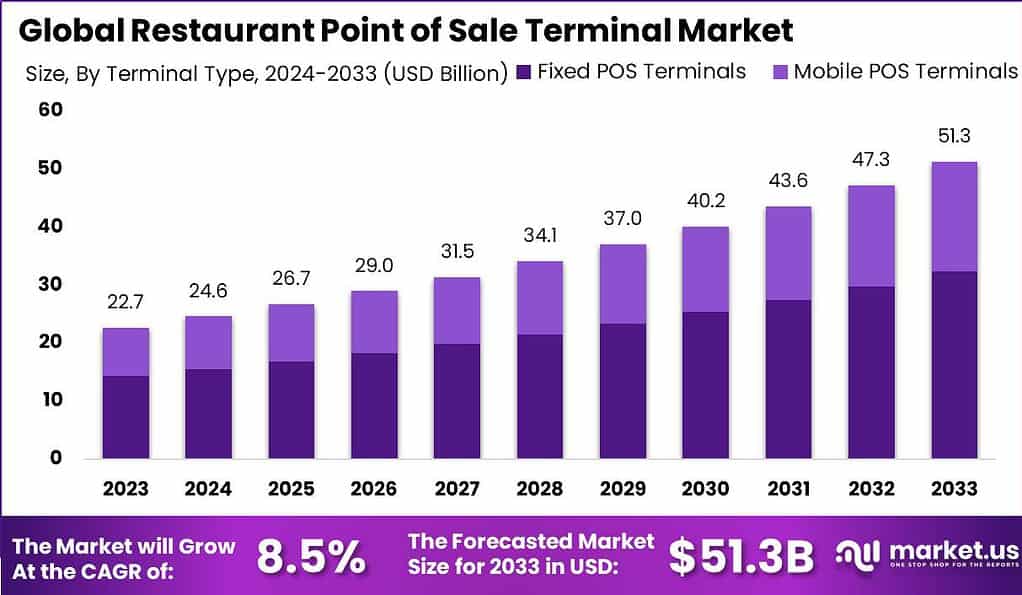
The Global Restaurant Point of Sale Terminal Market size is expected to be worth around USD 51.3 Billion By 2033, from USD 22.7 Billion in 2023, growing at a CAGR of 8.5% during the forecast period from 2024 to 2033.
A Restaurant Point of Sale (POS) Terminal is a system used in the hospitality industry to manage orders, payments, and other business transactions. This system integrates hardware and software components to streamline the operation of restaurants, cafes, and bars. The hardware typically includes a touchscreen display, cash drawer, receipt printer, and often supports peripherals like barcode scanners and card readers. The software is designed to handle tasks such as order tracking, inventory management, customer management, and sales reporting.
The demand for Restaurant POS Terminals has been steadily increasing, driven by the need for efficient, streamlined operations within the food service industry. As restaurants strive to enhance customer service and operational efficiency, the adoption of sophisticated POS systems has become crucial. The growing preference for digital and contactless payments, particularly accelerated by the pandemic, has further spurred this demand, making POS systems essential for day-to-day operations.
The Restaurant Point of Sale (POS) Terminal Market is witnessing significant growth, driven by several key factors. The increasing demand for enhanced customer experience, coupled with the need for operational efficiency in restaurants, is a primary growth driver. As more restaurants adopt digital ordering and payment systems, the integration of POS terminals becomes crucial in streamlining operations and reducing errors. Additionally, the rise of cloud-based POS systems, which offer real-time data analytics and remote management, presents substantial growth opportunities for market players.
Another crucial factor is the growing trend of contactless payments, accelerated by the COVID-19 pandemic. Restaurants are increasingly adopting POS systems that support mobile wallets and NFC (Near Field Communication) payments, catering to the evolving consumer preferences for quick and secure transactions. Moreover, the expansion of the food delivery and takeout industry has further bolstered the demand for versatile POS systems that can efficiently manage online orders, track deliveries, and integrate with third-party delivery platforms.
For instance, In June 2024, Square unveiled its latest mPOS reader featuring a built-in display. This new device allows merchants to show customers the transaction amount, accept signatures, and provide digital receipts directly on the reader, streamlining the checkout process. The reader is compatible with Square’s ecosystem of mPOS software and integrates with popular business tools.
The market also presents opportunities in the form of technological advancements such as AI-driven POS systems that provide personalized customer experiences and data-driven insights for restaurant owners. As restaurants continue to embrace digital transformation, the POS terminal market is poised for robust growth, with significant potential in emerging markets where the foodservice industry is rapidly expanding.
As per market.us experts, The Restaurant Digitalization Market is projected to grow significantly, with its size expected to reach around USD 37.0 billion by 2033, up from USD 7.9 billion in 2023. This represents a robust CAGR of 16.7% during the forecast period from 2024 to 2033. This growth is driven by the increasing adoption of digital tools and platforms by restaurants to enhance customer experiences, streamline operations, and improve overall efficiency.
Similarly, The POS Software Market, in particular, is estimated to be worth USD 21.1 billion in 2023 and is projected to surge to USD 74.7 billion by 2032, registering a CAGR of 15.1%. Despite the availability of advanced POS technologies, many retailers are still utilizing outdated systems.
According to Fit Small Business, only 21% of retailers have adopted POS software within the past two years, while 40% of POS software and hardware are over five years old. This indicates a substantial opportunity for the modernization of POS systems, as businesses seek to enhance their operations with more sophisticated and integrated solutions.
In the competitive landscape, companies like Square, Toast, Lightspeed, First Data (now Fiserv), and Clover are leading the charge in the POS systems market. Notably, Square holds a significant share of over 27% of the market, followed closely by Toast at 24%. These companies are likely to continue driving innovation and capturing market share as the demand for digital solutions in the restaurant industry grows.
Mobile payments are also becoming increasingly prominent in the restaurant and retail sectors. In 2024, the average mobile transaction value in the US is anticipated to reach nearly $11,000, with the number of mobile payment users expected to exceed 101 million by 2028.
As of December 2023, Apple Pay was the most commonly used mobile payment brand in the US, with 60% of respondents using it in restaurants and retail shops. This was followed by CashApp and PayPal, with 59% and 58% of respondents, respectively, highlighting the growing preference for mobile payment options among consumers.
Key Takeaways
- The Global Restaurant Point of Sale Terminal Market is projected to reach a valuation of USD 51.3 Billion by 2033, up from USD 22.7 Billion in 2023, reflecting a robust CAGR of 8.5% during the forecast period from 2024 to 2033.
- In 2023, the Fixed POS Terminals segment asserted a dominant position within the market, accounting for more than 63.1% of the total market share.
- The Front End segment also dominated the market in 2023, capturing over 70.5% of the Restaurant Point of Sale Terminal Market.
- The Full-Service Restaurants (FSR) segment held a significant market share in 2023, commanding more than 43.9% of the total market.
- Geographically, North America led the market in 2023, representing more than 36.0% of the market share, with revenues approximating USD 8.1 Billion.
- The self-service kiosk subsegment is projected to experience the most rapid growth within the POS market, with an anticipated CAGR of 9.5% from 2023 to 2030.
- Currently, only 21% of retailers have adopted new POS software in the last two years. The adoption rate for POS hardware is slightly higher at 29%.
- Over 40% of POS software and a nearly equivalent percentage of POS hardware have been in use for over five years.
- A significant 43% of restaurants have prioritized the identification and acquisition of an efficient mobile POS system for use in 2023.
- Additionally, 46% of restaurants are seeking to upgrade their POS systems to enhance omnichannel experiences for their customers.
- Restaurants typically invest just over $9,000 in upfront costs for POS systems.
- Remarkably, nearly 90% of restaurants utilize data from their POS systems to support various business operations.
Terminal Type Analysis
In 2023, the Fixed POS Terminals segment held a dominant market position, capturing more than a 63.1% share of the Restaurant Point of Sale Terminal Market. This segment’s leadership is largely attributed to its robust functionality and reliability, which are critical in high-volume food service environments such as restaurants and cafes.
Fixed POS terminals offer powerful processing capabilities, extensive connectivity options for peripherals, and enhanced security features that are essential for managing large transactions and complex orders. Additionally, these terminals often integrate seamlessly with other back-end systems like inventory management and customer relationship management, providing restaurateurs with a comprehensive toolkit to streamline operations and enhance customer service.
Moreover, the preference for fixed POS terminals can be linked to their durability and ease of use. In bustling restaurant settings, equipment needs to withstand constant use and occasional mishaps. Fixed terminals are built to endure such conditions, offering a longer lifespan compared to more portable alternatives.
They also tend to have larger screens and more intuitive interfaces, which can improve order accuracy and speed up training times for new staff. This combination of dependability, comprehensive features, and user-friendliness makes fixed POS terminals a preferred choice for many restaurant operators, ensuring their continued dominance in the market.
Application Analysis
In 2023, the Front End segment held a dominant market position in the Restaurant Point of Sale Terminal Market, capturing more than a 70.5% share. This segment’s prominence is primarily due to the critical role that front-end systems play in customer interactions within restaurants. These systems, which include the interfaces where orders are entered and payments are processed, are pivotal in ensuring efficient customer service and streamlining the dining experience.
They enable quick order processing, facilitate accurate billing, and support various payment methods, which enhances customer satisfaction and helps in managing peak dining times effectively. Additionally, the front-end POS systems are increasingly being integrated with digital menus and ordering platforms that further optimize customer engagement and operational efficiency.
The ability to directly input orders into the kitchen in real-time reduces errors and speeds up service, a vital factor in enhancing customer turnover rates. Innovations in POS technology, such as touch screen interfaces and mobile compatibility, have also made these systems more user-friendly and versatile, broadening their application in various types of dining establishments from quick service restaurants to fine dining.
The ongoing advancements in technology and the growing expectation for seamless, fast service in the food service industry continue to drive the adoption of sophisticated front-end POS systems. With the increasing focus on improving customer experience and operational efficiency, the front-end segment is expected to maintain its lead in the market, underpinned by both technological innovations and the essential nature of customer-facing operations in restaurants.

End-User Analysis
In 2023, the Full-Service Restaurants (FSR) segment held a dominant market position in the Restaurant Point of Sale Terminal Market, capturing more than a 43.9% share. This leadership is largely attributed to the complex operational demands of full-service restaurants, which require robust and multifunctional POS systems to manage everything from reservations and customer orders to billing and inventory.
FSRs typically offer a more extensive dining experience, including dine-in services, alcohol sales, and multiple course meals, all of which necessitate a higher level of coordination and management that advanced POS systems provide. Furthermore, full-service restaurants emphasize customer service and dining experience, making efficient, reliable POS systems crucial for handling high volumes of transactions and intricate order customizations.
The ability of these systems to integrate seamlessly with other service management tools, like customer relationship management (CRM) systems and loyalty programs, adds to their indispensability in full-service settings. These integrations help in maintaining customer data, preferences, and dining history, which are vital for delivering personalized service and promoting customer loyalty.
As full-service restaurants continue to evolve with trends such as digital menu cards, mobile ordering, and contactless payments, the need for versatile and innovative POS solutions grows. This ongoing technological integration supports operational efficiency and enhances the overall customer experience, keeping the FSR segment at the forefront of the POS terminal market. With the increasing complexity of restaurant operations and heightened consumer expectations, full-service restaurants will likely continue to lead in the adoption and utilization of advanced POS systems.
Key Market Segments
Terminal Type
- Fixed POS Terminals
- Mobile POS Terminals
Application
- Front End
- Back End
End-User
- Full-Service Restaurants (FSR)
- Quick Service Restaurants (QSR)
- Other End-Users
Driver
Technological Advancements
The restaurant POS terminal market is significantly driven by ongoing technological advancements, which enhance transaction efficiency, optimize order management, and improve customer experience. Innovations like mobile POS systems, which facilitate seamless cash register functions and electronic POS terminal operations wirelessly, are increasingly being adopted.
These systems help in managing large customer volumes efficiently, improving service levels and reducing operational costs. The proliferation of mobile and wireless technologies supports this growth by enabling more dynamic and efficient customer service solutions.
Restraint
High Cost of Implementation
One major restraint in the restaurant POS terminal market is the high cost associated with implementing and upgrading POS systems. These costs can be particularly prohibitive for small and independent restaurants.
Initial expenses not only include the purchase of hardware and software but also encompass installation, integration with existing systems, and ongoing maintenance. Additionally, the requirement for periodic software upgrades to keep the systems secure and efficient adds to the financial burden, potentially deterring smaller establishments from adopting the latest technology.
Opportunity
Integration with Cloud-Based Solutions
The shift towards cloud-based POS systems presents a substantial opportunity within the restaurant POS terminal market. Cloud-based solutions offer advantages such as real-time data access, scalability, and reduced upfront costs.
These systems allow for the efficient management of data across multiple locations and provide enhanced security and uptime compared to traditional systems. The trend towards software-as-a-service (SaaS) models and subscription-based services is expected to grow, driven by the need for more flexible and cost-effective solutions that can adapt to varying business demands.
Challenge
Data Security Concerns
Data security emerges as a significant challenge in the adoption of POS systems within the restaurant industry. As POS systems handle sensitive customer information and transaction data, ensuring the security of this data is paramount. The integration of various digital payment methods increases the complexity of maintaining robust security protocols.
Restaurants face the ongoing challenge of protecting against data breaches, which can lead to financial loss and damage to reputation. The need for compliance with ever-evolving data protection regulations further complicates this aspect, requiring continuous updates and monitoring of security measures.
Emerging Trends
- Cloud-Based Solutions: The shift towards cloud-based POS systems is significant, with these platforms offering scalability, enhanced security, and cost-effectiveness. They allow for seamless updates and integration with other digital services, catering to the dynamic needs of modern restaurants.
- Integration with Mobile and Online Ordering: Restaurants are increasingly integrating their POS systems with mobile and online ordering platforms. This trend is driven by the growth in consumer demand for convenient and quick service options, enhancing operational efficiency and customer satisfaction.
- Adoption of Self-Service Kiosks: There is a rising trend in the deployment of self-service kiosks within the restaurant industry. These kiosks help streamline the ordering process, reduce wait times, and allow businesses to handle higher customer volumes more efficiently.
- Advanced Payment Solutions: The integration of advanced payment technologies, including contactless and mobile payment options, is becoming commonplace. These technologies offer quicker transactions and enhance the customer experience by reducing the time spent at checkout.
- Use of AI and Analytics: Restaurants are starting to leverage artificial intelligence (AI) and analytics within their POS systems to gain insights into customer behavior, optimize inventory management, and personalize customer interactions. This helps in making data-driven decisions to boost profitability and service quality.
Top Use Cases
- Enhanced Customer Management: POS systems help restaurants manage reservations, customer preferences, and order history, which enhances the dining experience and boosts customer loyalty.
- Efficient Order Management and Delivery: These systems are crucial for managing in-house and online orders seamlessly, ensuring that the food is prepared and delivered timely, which is particularly beneficial for quick-service restaurants.
- Inventory and Stock Management: By integrating POS systems with inventory management software, restaurants can track ingredient usage and stock levels in real time, reducing waste and ensuring that the menu items are always available.
- Financial Transactions and Reporting: POS systems streamline financial operations by handling transactions, processing payments, and generating detailed financial reports that help in financial planning and audit compliance.
- Operational Efficiency: With POS systems, restaurants can streamline various operations, from order taking to billing to kitchen management, all synchronized through a single platform. This integration helps reduce human errors and improves overall operational efficiency.
Regional Analysis
In 2023, North America held a dominant market position in the Restaurant Point of Sale (POS) Terminal Market, capturing more than a 36.0% share with revenues reaching approximately USD 8.1 billion. This leading position can be attributed to several key factors. Firstly, the region boasts a highly developed restaurant industry, characterized by a large number of both fast-food and fine-dining establishments continuously adopting advanced technologies for better customer service and operational efficiency.
Moreover, the presence of major POS terminal manufacturers and software developers in North America, particularly in the United States and Canada, has facilitated the rapid adoption of innovative solutions in this sector. These companies are pioneers in integrating cloud-based technologies and mobile POS systems, which have become increasingly popular among restaurant operators seeking flexible and scalable solutions.
The market’s growth in this region is also driven by stringent regulatory requirements regarding payment security. North American restaurants are increasingly adopting POS systems that comply with PCI DSS standards to safeguard customer payment information, a move that has further boosted the regional market’s growth.
Additionally, the increasing trend of digitalization and automation in the food service industry in North America has propelled the demand for integrated POS terminals that offer more than just payment processing. These systems are now central to operations, capable of managing inventory, reservations, and customer relationship management, thereby enriching the overall efficiency of restaurant management. This trend is expected to continue, ensuring sustained growth and innovation in the North American POS terminal market.

Key Regions and Countries covered іn thе rероrt:
- North America
- US
- Canada
- Mexico
- Europe
- Germany
- UK
- France
- Italy
- Russia
- Spain
- Rest of Europe
- Asia Pacific
- China
- Japan
- South Korea
- India
- Rest of Asia-Pacific
- South America
- Brazil
- Argentina
- Rest of South America
- Middle East & Africa
- GCC
- South Africa
- Israel
- Rest of MEA
Key Players Analysis
In the Restaurant Point of Sale (POS) Terminal Market, several leading companies are driving innovation and competition. Among them, Panasonic Corporation, Oracle Corporation, and VeriFone, Inc. stand out for their strategic initiatives.
Panasonic Corporation has been proactive in enhancing its POS solutions through strategic acquisitions aimed at expanding its technology stack and market reach. In 2023, Panasonic acquired a smaller software company that specializes in integrating AI capabilities into retail and hospitality systems, aiming to bolster its POS offerings with advanced analytical tools.
Oracle Corporation, a major player in enterprise software solutions, launched a new suite of cloud-based POS systems in 2024 designed specifically for small to medium-sized restaurants. This launch is part of Oracle’s broader strategy to dominate the cloud services market by providing more tailored and scalable solutions that can adapt to the dynamic needs of the hospitality industry.
Toast, Inc., primarily focused on POS solutions for the restaurant industry, has recently merged with a leading online ordering and delivery platform. This merger, completed in early 2024, aims to provide an integrated approach to restaurant management, combining in-house sales and online orders in one seamless system, thereby enhancing operational efficiency and customer satisfaction.
Top Key Players in the Market
- Panasonic Corporation
- Oracle Corporation
- VeriFone, Inc.
- Block, Inc.
- Toast, Inc.
- NCR Corporation
- Lightspeed
- PAX Global Technology Limited
- Revel Systems
- TouchBistro Inc.
- Other Key Players
Recent Developments
- In March 2024, Panasonic unveiled its new Stingray® JS9900 Kiosk Series and JS988 Point-of-Sale (POS) Terminals, designed to enhance operational efficiency and the customer experience in fast casual and quick-serve restaurant settings. These solutions will be showcased at MURTEC 2024, highlighting their modular and versatile designs suitable for a variety of retail environments.
- In January 2024, ParTech, Inc. launched the PAR Wave, a state-of-the-art All-In-One touch panel tailored for the hospitality industry. This advanced hardware solution is engineered to address the evolving demands of the restaurant sector by integrating performance, security, functionality, and a modern design into a single platform. The PAR Wave stands out as a pivotal component for restaurant POS systems, designed to enhance operational efficiency and customer service.
- PAX launched the A920, a smart mobile POS terminal, which combines the functionality of an Android tablet with a powerful payment terminal. This device is designed to meet the needs of dynamic retail and hospitality environments. In June 2024, PAX also introduced kitchen displays and bump bars as part of its product lineup, enhancing its offering for restaurant environments.









