


Report Overview
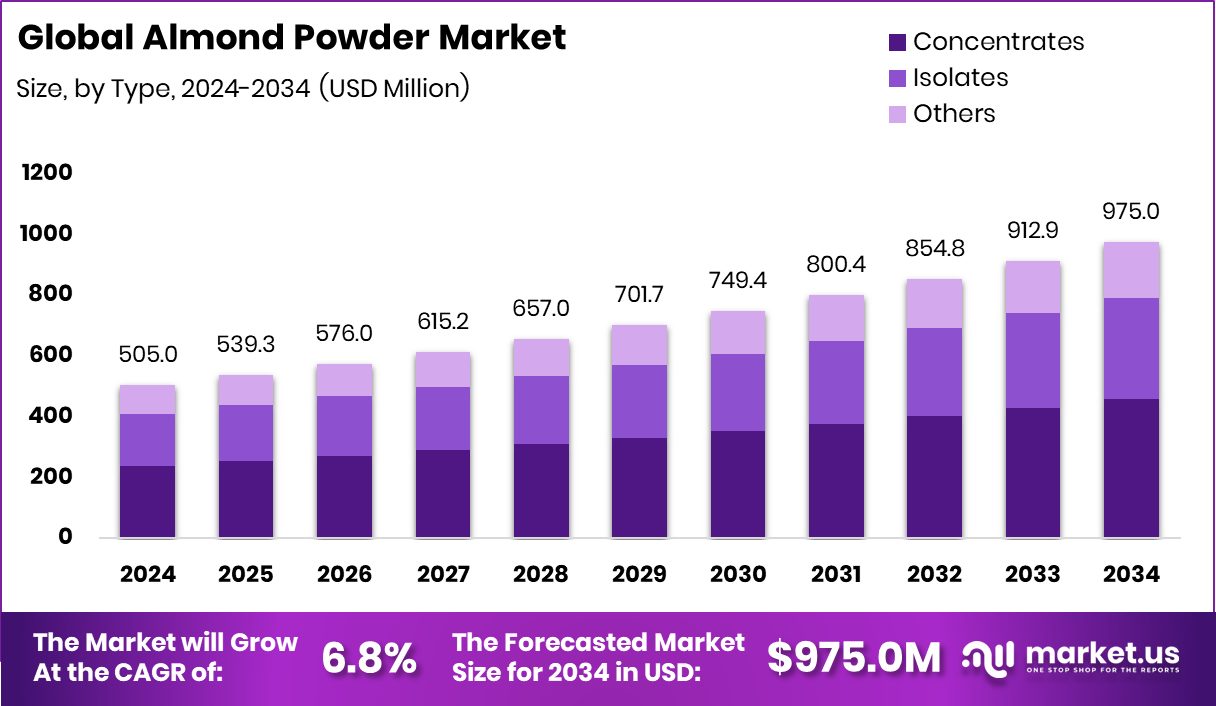
The Global Almond Powder Market is expected to be worth around USD 975.0 million by 2034, up from USD 505.0 million in 2024, and is projected to grow at a CAGR of 6.8% from 2025 to 2034. Strong consumer preference for plant-based diets supported North America’s 41.3% market dominance.
Almond powder is a finely ground product made from blanched or unblanched almonds, often used in baking, confectionery, dairy alternatives, and nutritional products. It is valued for its natural protein, healthy fats, and gluten-free properties, making it a staple in health-conscious diets. With rising interest in plant-based and functional foods, almond powder has become a versatile ingredient across the food and beverage industries.
One of the main growth factors for almond powder is the increasing preference for healthy, plant-based diets. Consumers are shifting toward natural protein and fiber sources, and almond powder offers both in an easily usable form. To further strengthen this ecosystem, the Almond Board has invested $4.8 million in research focused on water sustainability, honey bee health, and coproduct utilization, ensuring responsible and innovative growth in almond farming.
In terms of demand, almond powder is witnessing strong uptake from bakery, confectionery, and dairy-free beverage producers. Its ability to act as a natural thickener and flavor enhancer makes it highly desirable. Supporting this demand, the “Stretching the Grower’s Dollar” program has secured an additional $6 million in RAPP funding, giving farmers tools to sustain production while meeting rising consumption trends.
Looking at opportunities, almond powder aligns with technological and financial innovation in the broader almond ecosystem. Companies like Almond AI, which secured ₹16 Cr in seed funding, are driving AI-led solutions for agriculture, while Almond FinTech, with $7 million in funding, is transforming financial transactions globally. Such innovations indirectly benefit the almond powder market by strengthening supply chains and improving efficiency. Additionally, Almond Finance completing its $2 million seed round demonstrates the growing ecosystem that supports the almond value chain from production to consumer markets.
Key Takeaways
- The Global Almond Powder Market is expected to be worth around USD 975.0 million by 2034, up from USD 505.0 million in 2024, and is projected to grow at a CAGR of 6.8% from 2025 to 2034.
- The almond powder market by type is dominated by concentrates, holding a strong 47.2% share globally.
- Conventional sources lead the almond powder market significantly, contributing around 78.1% to overall production and supply.
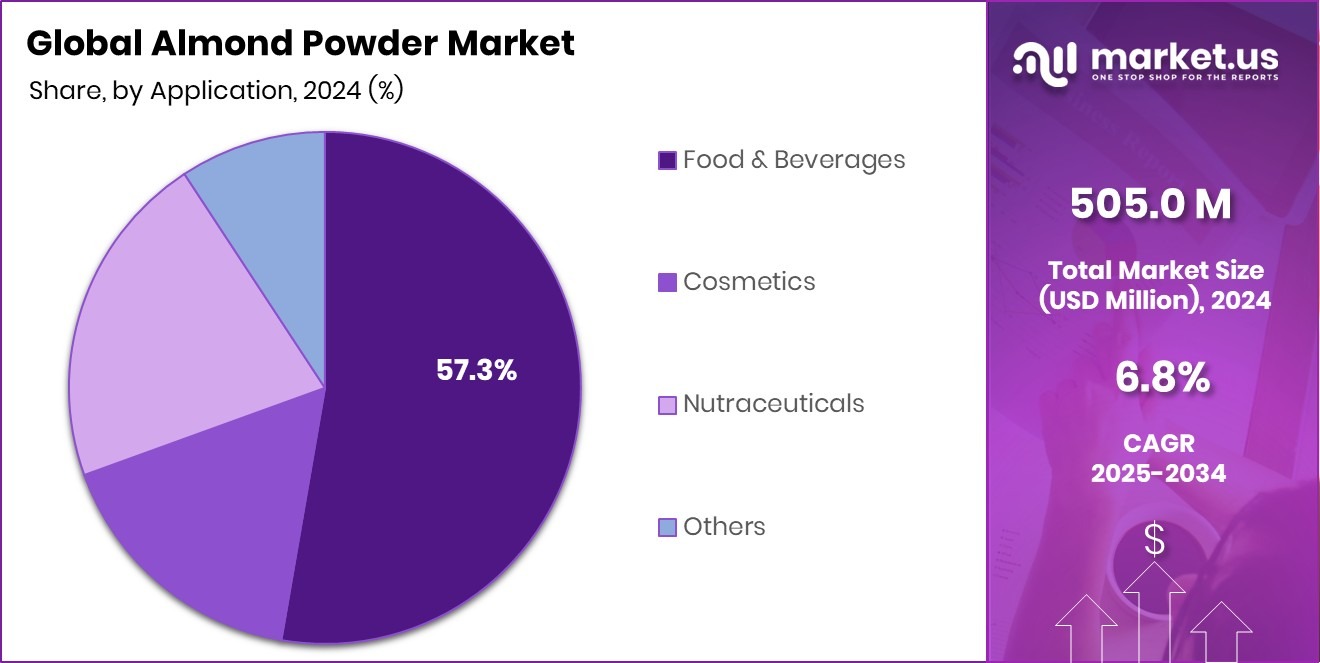
- Food and beverage applications account for 57.3% of the almond powder market, driving consumer-oriented demand growth.
- Offline distribution channels capture 71.5% of the almond powder market, highlighting traditional retail dominance worldwide.
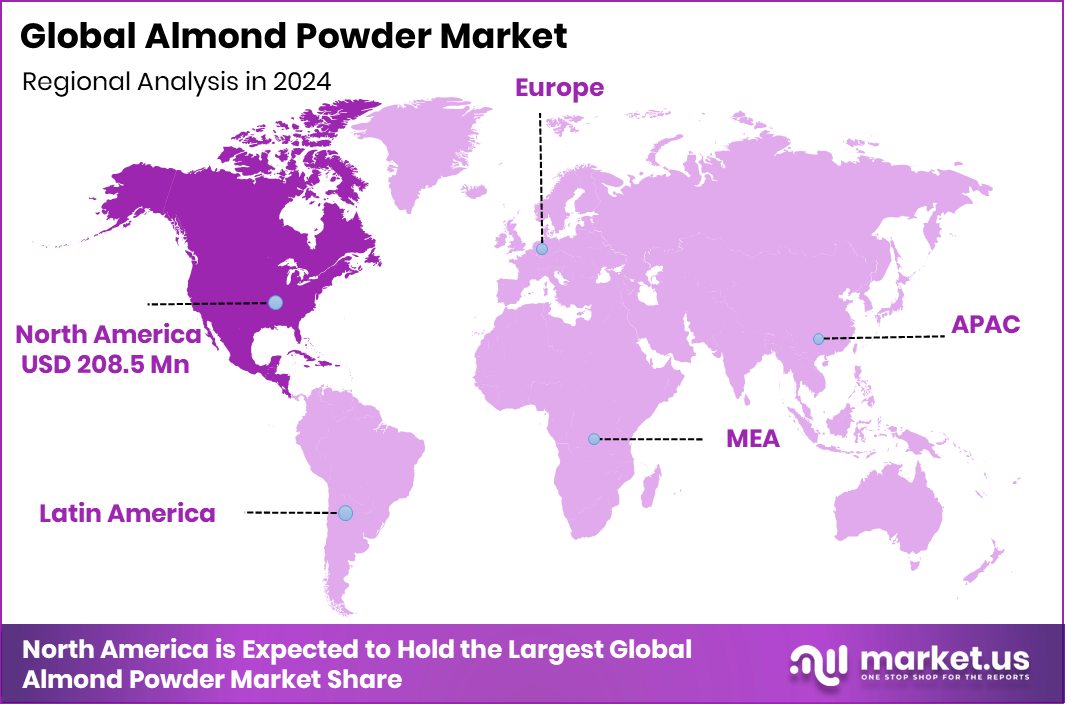
- North America recorded a market value worth USD 208.5 million.
By Type Analysis
The almond powder market by type shows concentrates leading with a 47.2% share.
In 2024, Concentrates held a dominant market position in the By Type segment of the Almond Powder Market, with a 47.2% share. This leadership reflects the growing utilization of concentrated almond powder in bakery, confectionery, and beverage applications, where its rich flavor and nutrient density provide functional and clean-label advantages. The high share also indicates strong demand from manufacturers seeking versatile, plant-based ingredients that align with consumer preferences for natural protein and fiber.
Concentrates are further supported by industry-backed initiatives and funding that encourage sustainable production and innovative utilization of almond-based products, ensuring their continued dominance within the segment and strengthening their role as a core driver of market expansion.
By Source Analysis
Conventional sources dominate the almond powder market, accounting for 78.1% of the market.
In 2024, Conventional held a dominant market position in the By Source segment of the Almond Powder Market, with a 78.1% share. This dominance highlights the widespread reliance on conventional farming and processing practices, which ensure consistent supply volumes and cost efficiency for large-scale food and beverage manufacturers.
Conventional almond powder is extensively preferred due to its accessibility and suitability for mass-market applications in bakery, confectionery, and nutritional products. The significant share also reflects established consumer trust in conventional sourcing methods, supported by robust distribution networks. With its strong market presence, the conventional segment continues to anchor the almond powder industry, meeting rising demand while maintaining competitive pricing structures across global markets.
By Application Analysis
Food and beverage applications drive the almond powder market with a 57.3% contribution.
In 2024, food and beverages held a dominant market position in the by-application segment of the almond powder market, with a 57.3% share. This reflects the strong integration of almond powder into bakery, confectionery, dairy alternatives, and beverage formulations, where its natural protein, fiber, and rich flavor profile enhance both nutrition and taste. The segment’s high share underscores consumer preference for plant-based and clean-label ingredients, making almond powder a key component in health-driven food innovations.
Its versatility in product development, combined with growing demand for functional and gluten-free options, has reinforced the prominence of the food and beverages category, establishing it as the primary driver of market consumption and growth in 2024.
By Distribution Challenge Analysis
Offline distribution channels capture 71.5% of the almond powder market.
In 2024, Offline held a dominant market position in the By Distribution Channel segment of the Almond Powder Market, with a 71.5% share. This dominance is driven by the strong presence of supermarkets, hypermarkets, and specialty stores that provide consumers with direct access to a wide variety of almond powder products. The offline channel benefits from consumer preference for in-person purchasing, where they can evaluate quality, packaging, and authenticity before buying.
Its significant share also reflects the trust and convenience associated with established retail formats, which continue to play a central role in distribution. The offline segment thus remains the primary contributor to market sales, reinforcing its leadership in the almond powder industry.
Key Market Segments
By Type
- Concentrates
- Isolates
- Others
By Source
- Conventional
- Organic
By Application
- Food and Beverages
- Cosmetics
- Nutraceuticals
- Others
By Distribution Challenge
- Online
- Offline
Driving Factors
Rising Demand for Natural and Healthy Ingredients
One of the biggest driving factors for the almond powder market is the growing consumer shift toward natural and healthy ingredients. Almond powder is rich in protein, fiber, and vitamins, making it a popular choice for people who prefer plant-based and gluten-free options. It is widely used in bakeries, beverages, and dietary supplements, supporting the rising demand for nutritious and versatile ingredients.
The beauty and personal care industry is also boosting the demand for almond-based products, as consumers look for clean and safe formulations. Supporting this trend, beauty brand Renee Cosmetics raised $25 million in Series B funding and earlier secured $1.5 million in pre-Series A funding, highlighting the broader appeal of natural and almond-based solutions.
Restraining Factors
High Production Costs and Supply Limitations
A key restraining factor for the almond powder market is the high production costs and supply limitations linked to almond cultivation. Growing almonds requires significant amounts of water, suitable climatic conditions, and careful farming practices, which makes production expensive and sensitive to environmental changes.
Any fluctuation in weather, such as droughts or reduced rainfall, can impact yields and drive up costs. These challenges often result in price volatility, making almond powder less accessible to cost-sensitive markets. Additionally, the processing of almonds into powder involves advanced technology and quality control, adding further expense. Together, these factors create supply and pricing pressures that can slow down wider adoption of almond powder in global markets.
Growth Opportunity
Expanding Plant-Based Food and Beverage Innovations
A major growth opportunity for the almond powder market lies in the expansion of plant-based food and beverage innovations. With more consumers choosing dairy-free, gluten-free, and protein-rich diets, almond powder is becoming a preferred ingredient in smoothies, bakery products, nutrition bars, and dairy alternatives. Its versatility allows manufacturers to create healthier options that appeal to both mainstream and health-focused audiences.
Supporting this opportunity, GoodSam Foods raised $9 million to enhance its range of sustainable, plant-based products. Additionally, the Almond Board of California has been granted an extra $6 million from the U.S. Department of Agriculture through the Regional Agricultural Promotion Program (RAPP), strengthening industry capacity and opening new global market possibilities.
Latest Trends
Growing Use of Almond Powder in Skincare
One of the latest trends in the almond powder market is its increasing use in skincare and personal care products. Almond powder is valued for its natural exfoliating, moisturizing, and skin-brightening properties, making it a popular ingredient in face packs, scrubs, and masks.
As consumers move toward clean-label beauty and natural formulations, brands are adding almond-based ingredients to meet this demand. This trend also aligns with the rising interest in multifunctional products that provide both nourishment and sustainability.
Beyond food applications, the beauty and wellness sector is creating new opportunities for almond powder, highlighting its versatility. This growing crossover between food and skincare is shaping the market in innovative and consumer-focused directions.
Regional Analysis
In 2024, North America captured a 41.3% share of the Almond Powder Market.
The Almond Powder Market demonstrates varied regional performances across North America, Europe, Asia Pacific, the Middle East & Africa, and Latin America. In 2024, North America emerged as the dominant region, accounting for 41.3% of the market share with a value of USD 208.5 million. This leadership reflects the region’s strong demand for plant-based, gluten-free, and functional food ingredients, particularly in bakery and beverage applications.
Europe follows with steady adoption driven by consumer preference for natural and protein-rich products, supported by the region’s established health and wellness trends. In the Asia Pacific, the market is expanding as rising disposable incomes and urbanization accelerate the demand for convenient and nutritious foods, positioning the region as a future growth hub.
Meanwhile, the Middle East & Africa present emerging opportunities due to increasing awareness of plant-based nutrition, though growth remains gradual compared to developed regions. Latin America also contributes to the market with a growing base of health-conscious consumers adopting almond-based products.
Key Regions and Countries
- North America
- US
- Canada
- Europe
- Germany
- France
- The UK
- Spain
- Italy
- Rest of Europe
- Asia Pacific
- China
- Japan
- South Korea
- India
- Australia
- Rest of APAC
- Latin America
- Brazil
- Mexico
- Rest of Latin America
- Middle East & Africa
- GCC
- South Africa
- Rest of MEA
Key Players Analysis
Royal Nut Company has built its reputation through a focus on high-quality nut products, including almond powder that caters to both household and foodservice needs. Their emphasis on purity and premium standards helps them meet the rising demand for natural and health-oriented ingredients, making them a trusted choice in specialty markets.
ADM plays a pivotal role as a large-scale agribusiness and processing company, with almond powder forming part of its extensive portfolio of value-added products. By integrating advanced processing technologies and sustainable sourcing practices, ADM supports large-scale food and beverage manufacturers, aligning with the global shift toward plant-based and functional foods. Its operational scale ensures a consistent supply, which is critical in a market sensitive to raw material costs and availability.
Treehouse Almonds brings strength through specialization in almond-based products, supplying bulk and tailored solutions for manufacturers. With a dedicated focus on almonds, the company enhances product innovation and ensures versatility in applications such as bakery, confectionery, and beverages.
Top Key Players in the Market
- Royal Nut Company
- ADM
- TREEHOUSE ALMONDS
- Olam International
- Blue Diamond Growers
- Russell Stover Chocolates, LLC
- Bob’s Red Mill Natural Foods.
- Rolling Hills Nut Company
- Jonny Almond Nut Company
- Noosh Brands
Recent Developments
- In October 2024, Treehouse California Almonds partnered with Sitos Group to launch a $9 million slow-pyrolysis biochar facility in Delano, California. This facility will convert almond shells (a byproduct of hulling and shelling) into biochar, supporting regenerative agriculture and sustainability goals.
- In December 2023, ADM announced it would acquire Revela Foods, a company that develops and manufactures dairy flavor ingredients and systems, to expand its flavor portfolio and capabilities.









