


Report Overview
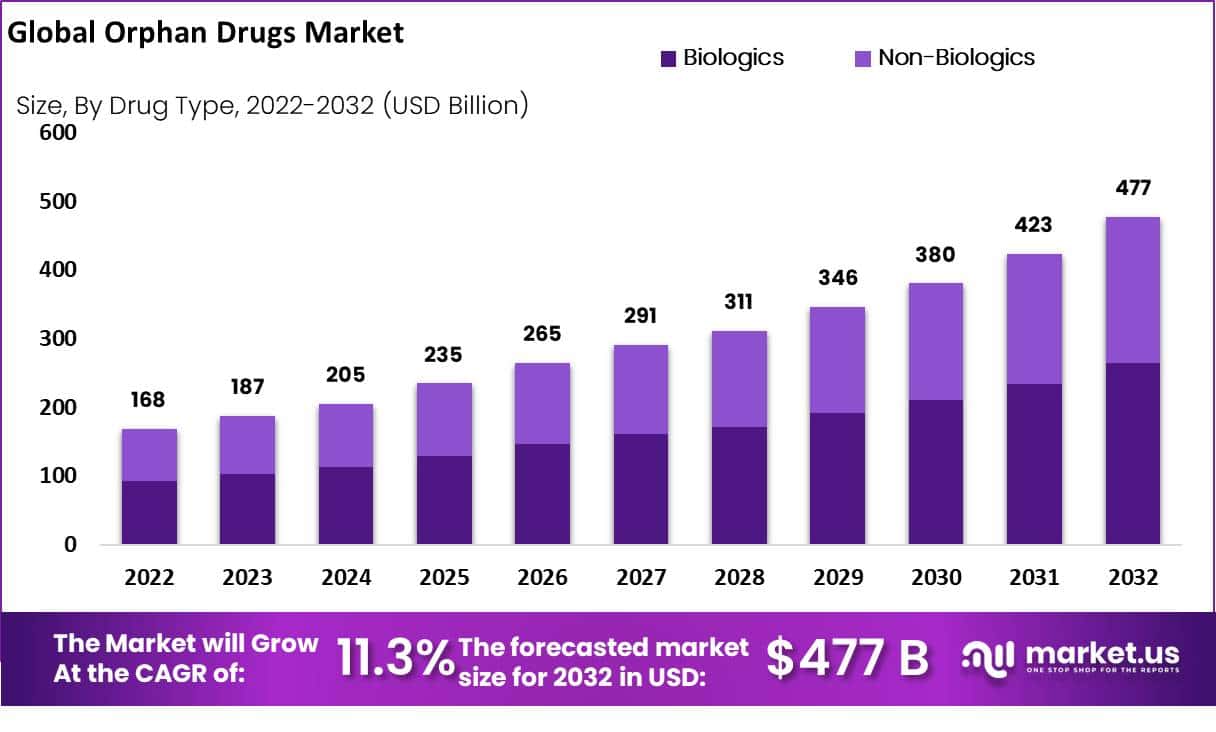
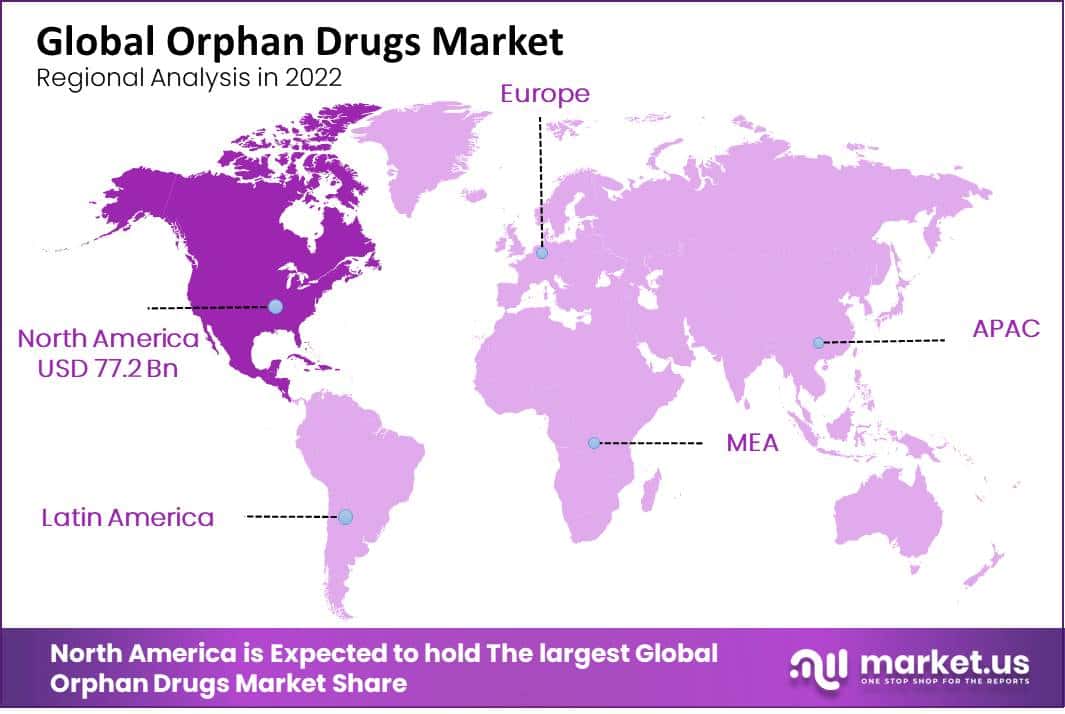
The Orphan Drugs Market size is expected to be worth around USD 477 Billion by 2032 from USD 168 Billion in 2022, growing at a CAGR of 11.3% during the forecast period from 2023 to 2032. North America held a dominant market position, capturing more than a 45.9% share and holds US$ 77.2 Billion market value for the year.
Pharmaceutical products used to diagnose, prevent, and treat rare medical conditions are referred to as orphan drugs. Due to the fact that they are produced for a selective group of patients, these medications typically have a limited market because they are made to meet a specific public health requirement. It is anticipated that this market’s expansion will also be aided by an increase in healthcare spending and the prevalence of rare diseases. Orphan drug market expansion is also anticipated to be driven by favorable government regulations and reimbursement rules.
Key Takeaways
- Market Growth: The orphan drugs market to reach USD 477 Bn by 2032, growing at 11.3% CAGR from 2023.
- Therapy Dominance: Oncology leads in revenue share due to the rising demand for cancer treatments.
- Biologics Lead: Biological orphan drugs are the market leaders, driven by effectiveness and fewer side effects.
- Distribution Channels: Hospital pharmacies hold the majority due to intravenous medication administration. Online pharmacies and retail are growing.
- Market Drivers: Growth fueled by rare disease prevalence, demand for immunomodulators, and favorable regulations.
- Market Restraints: High treatment costs, strict regulations, and a lack of awareness pose challenges.
- Opportunities: Increasing rare disease cases creates growth opportunities, aided by FDA incentives and funding.
- Regional Analysis: North America held a dominant market position, capturing more than a 45.9% share and holds US$ 77.2 Billion market value for the year.
Therapy Analysis
The oncology segment is accounted to hold a significant revenue share and dominate the orphan drugs market
Based on therapy, the global orphan drugs market outlook is segmented into oncology, neurology, endocrinology, hematology, cardiovascular, immunotherapy, respiratory, and other Therapies. Among these therapies, the oncology segment is predicted to hold the largest revenue share.
Interest in the sector is expected to rise as more leisure activities become available. The drug division that deals with oncology treats an increasing number of cancer patients with various diseases each year. In the field of drug development, there is a growing demand and interest in powerful medications to combat the situation. As a consequence of this, it is anticipated that the global market for orphan drugs will experience development opportunities in the coming years.
The development of effective medications to treat or maintain control of chronic conditions is necessary due to the rising geriatric rate of the elderly population. Interest in the industry has increased as a result of significant growth in the global orphan drug market over the forecast period.
Drug Type
The biologics segment is the most lucrative and holds the largest share of this market
Based on the drug, the global orphan drug market is divided into biologics and non-biologicals. The biological orphan drugs segment holds the largest share of the market and is anticipated to expand at a faster rate during the forecast period.
The current trend of biological orphan drug approval for a variety of applications has led to expansion and has inspired both existing and new market players to arrive in this sector. Rare diseases have long been treated with biological medicines. Despite its higher prevalence in developed nations, cancer, a most targeted orphan disease, has been successfully treated by biological therapies with less side effects.
Distribution Channel
Hospital Pharmacies dominate the market and are expected to remain dominant over the forecast period
Based on distribution channel, the global orphan drugs market is divided into hospital pharmacy, retail pharmacy, and online pharmacy. It is anticipated that hospital pharmacies will hold the majority of the market. This is because skilled healthcare providers in hospitals are required to administer a significant amount of medications intravenously. The Retail pharmacy segment is anticipated to expand at a moderate CAGR over the anticipated time frame, and this will largely contribute to the orphan drugs market growth.
In the coming years, online pharmacy will complement the shifting of market dynamics. This growth can be attributed to the ease of use of the platform by customers when purchasing medications. Additionally, the online pharmacy industry has grown significantly as a result of the growing number of COVID-19-infected customers turning to online pharmacies to purchase medications.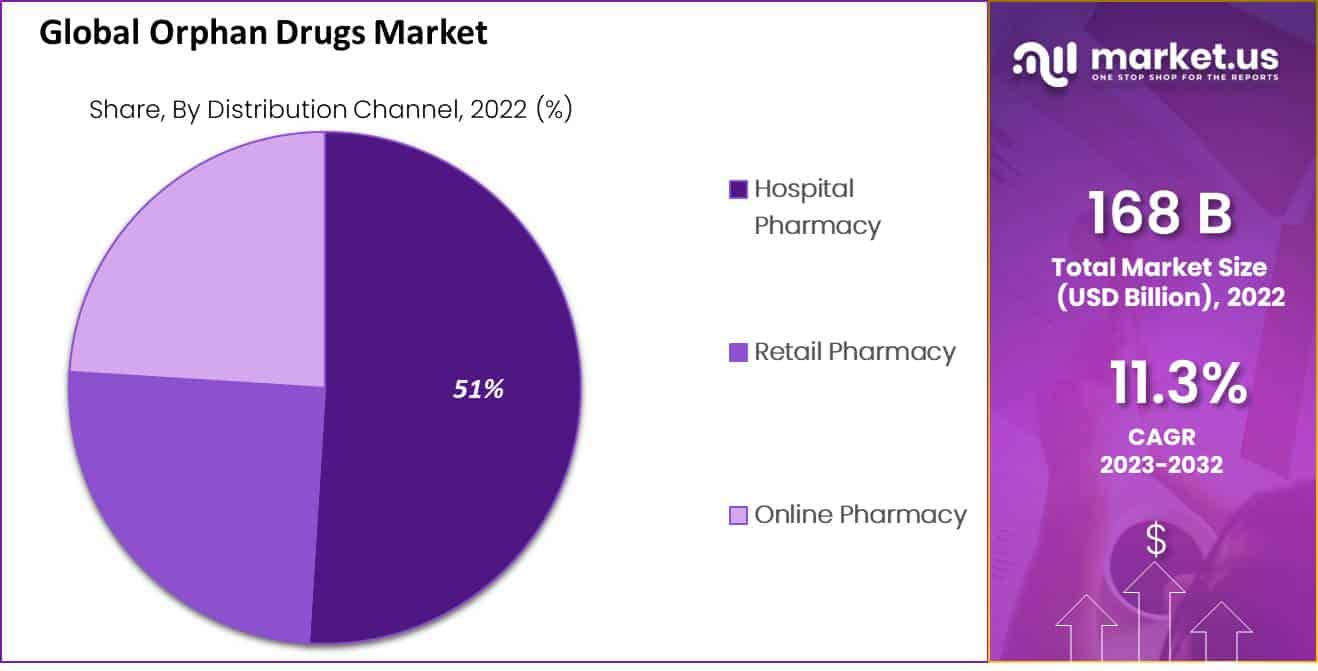
Key Market Segments
By Therapy
- Oncology
- Neurology
- Endocrinology
- Hematology
- Cardiovascular
- Immunotherapy
- Respiratory
- Other Therapies
By Drug Type
- Biologics
- Non-Biologics
By Distribution Channel
- Hospital Pharmacy
- Retail Pharmacy
- Online Pharmacy
Drivers
Rising cases of rare diseases are projected to the expansion of the orphan drugs market
Treatments for rare diseases frequently require a cold chain, which is a temperature-controlled supply chain that is not readily accessible in all nations. Rare or orphan diseases only affect 7 out of every 10,000 people. However, rare diseases’ global prevalence has been rising in recent years. In January 2022, there will be approximately 54,500 new cases of oropharyngeal or oral cancer in the United States, according to an article that was shared by the American Cancer Society. 11,250 people are affected by oral (oropharyngeal) cancer.
These cancers can strike at any age, but the average age at diagnosis is 60-65. One in five of all cases involves patients under the age of 55 or slightly more than 20%. As a result, the market for orphan drugs is expanding in response to the rising incidence of diseases.
Increasing demand for immunomodulators and favorable government regulations are subject to boost the market growth
Market expansion will be driven by rising demand for immunomodulators, which regulate or enhance the immune system. The orphan drug market is expected to grow during the forecast period as a result of the rising incidence of infectious diseases in developed and developing nations as well as rising drug costs.
Favorable government regulations are driving growth in the market for orphan pharmaceuticals. The industry’s growth is also aided by the possibility of orphan medication manufacturers holding exclusive commercial rights.
Restraints
Higher Costs of Treatment and strict regulations are restraining the market growth
High per-patient treatment costs and regulatory restrictions on profitability may also pose a challenge to the market’s growth during the forecast period, as well as a lack of awareness among patients and physicians regarding the treatment of orphan diseases and the high costs associated with these drug developments.
Opportunity
An increase in the prevalence of rare diseases generates higher opportunities in the market
Around 300 million people worldwide are anticipated to be affected by recurrent, rare, and chronic illnesses, as well as increased demand for significant amounts of orphan drug production.
Medicines for rare diseases like yellow fever, Waardenburg syndrome, von Willebrand disease, abetalipoproteinemia, diabetic macular edema, yellow nail syndrome, autism spectrum disorder (ASD), and von Hippel-Lindau syndrome, among others, are in high demand, which helps expand the market.
In addition, the FDA provides free exemptions, favorable reimbursement policies, public R&D grants, and premium pricing to help businesses expand.
Regional Analysis
North America held a dominant market position, capturing more than a 45.9% share and holds US$ 77.2 Billion market value for the year.
Based on region, the global orphan drugs market is divided into North America, Europe, Asia Pacific, Latin America, and Middle East & Africa. North America accounted for dominating the market with the largest revenue share. The promotion of laws that enable the rapid approval of such drugs, drug status exclusivity for such drugs, and a robust health system all contribute to the industry’s expansion.
Regional development is being sped up by key players, a well-established healthcare network, and a growing number of patients. Additionally, regional development is being aided by favorable government funding and policies. In the United States, orphan drugs receive tax breaks and a user fee waiver in addition to 7 years of marketing exclusiveness following FDA approval for a specific use.
The European market is anticipated to expand quickly due to the region’s large patient population and wide-ranging acceptance of cutting-edge treatments for rare diseases. North America dominates the market because of this and the favorable reimbursement policies in the United States.
Due to increasing healthcare costs and heightened awareness of rare diseases, the Asia-Pacific market is anticipated to expand at the fastest rate. The Asia-Pacific orphan drugs market is expected to expand as the prevalence of rare diseases rises, and people become more aware of them.
Additionally, Asia-Pacific clinical trial expansion is anticipated to be more rapid than that in Europe and the United States, driving regional expansion. Orphan drug availability should rise in developing regions as a result of government initiatives to expand community health and oncology centers.
Key Regions
- North America
- The US
- Canada
- Western Europe
- Germany
- France
- The UK
- Spain
- Italy
- Portugal
- Ireland
- Austria
- Switzerland
- Benelux
- Nordic
- Rest of Western Europe
- Eastern Europe
- Russia
- Poland
- The Czech Republic
- Greece
- Rest of Eastern Europe
- APAC
- China
- Japan
- South Korea
- India
- Australia & New Zealand
- Indonesia
- Malaysia
- Philippines
- Singapore
- Thailand
- Vietnam
- Rest of APAC
- Latin America
- Brazil
- Colombia
- Chile
- Argentina
- Mexico
- Costa Rica
- Rest of Latin America
- Middle East & Africa
- Algeria
- Egypt
- Israel
- Kuwait
- Nigeria
- Saudi Arabia
- South Africa
- Turkey
- United Arab Emirates
- Rest of MEA
Key Players Analysis
The market for orphan drugs is somewhat competitive. The market is currently dominated by a small number of major players in terms of orphan disease market share. A few smaller players are entering the market and now hold a significant share due to the rising number of diseases and cases each year.
Moreover, they are involved in partnerships, acquisitions, collaborations, mergers, and new product launches. This forms the competitive landscape among the key market players
Market Key Players
Listed below are some of the prominent orphan drugs market companies that form a competitive landscape in the global orphan drug market.
- Hoffmann-La Roche Ltd. (Switzerland)
- Novartis AG (Switzerland)
- Johnson & Johnson Services Inc. (U.S.)
- Merck KGaA (Germany)
- Bristol-Myers Squibb Company (U.S.)
- Pfizer Inc. (U.S.)
- Eli Lilly and Company (U.S.)
- Novo Nordisk A/S (Denmark)
- Takeda Pharmaceutical Company Limited (Japan)
- Alexion Pharmaceuticals, Inc. (U.S.)
- Kyowa Kirin Co., Ltd. (Japan)
- GlaxoSmithKline Plc
- AbbVie Inc.
- Sanofi S.A
- Amgen Inc. (U.S.)
- Biogen Inc. (U.S.)
- Celldex Therapeutics (U.S.)
- GSK plc. (U.K.)
- Eisai Co., Ltd. (Japan)
- Vertex Pharmaceuticals Incorporated (U.S.)
- Alexion Pharmaceutical Inc.
- ALX Oncology Holdings Inc.
- BioMarin Pharmaceutical Inc.
- Agios Pharmaceuticals Inc.
- DAIICHI SANKYO Company Ltd.
- Other Key Players
Recent Development
- In March 2022, CER-001, which was developed by ABIONYX Pharma, was granted FDA approval for Orphan Drugs Designation (ODD) for the diagnosis of LCAT deficiency that manifests as kidney dysfunction or ophthalmologic illness. Both partial LCAT insufficiency, which causes Fisheye Disease, and comprehensive LCAT deficiency, which causes renal symptoms and corneal opacities, are referred to by this term. The progression of LCAT deficiency, for which there is no treatment, can eventually result in kidney disease that calls for kidney transplantation or dialysis and/or corneal opacification that calls for a transplant.
- In April 2022, Shanghai Henlius Biotech revealed in a press release that the Food and Drug Administration has granted serplulimab, also known as Hansizhuang, orphan drug status for the treatment of SCLC, or small cell lung cancer.
- In February 2022, The European Commission granted AZP-3601 Orphan Drug Designation (ODD) for the treatment of hypoparathyroidism, according to Amolyt Pharma, a multinational corporation that focuses on developing therapeutic peptides for rare endocrine and associated conditions. ODD grants sponsors access to centralized marketing authorization, funding for the proposed, reduced regulatory costs, and ten years of market exclusiveness if granted.









