


Report Overview
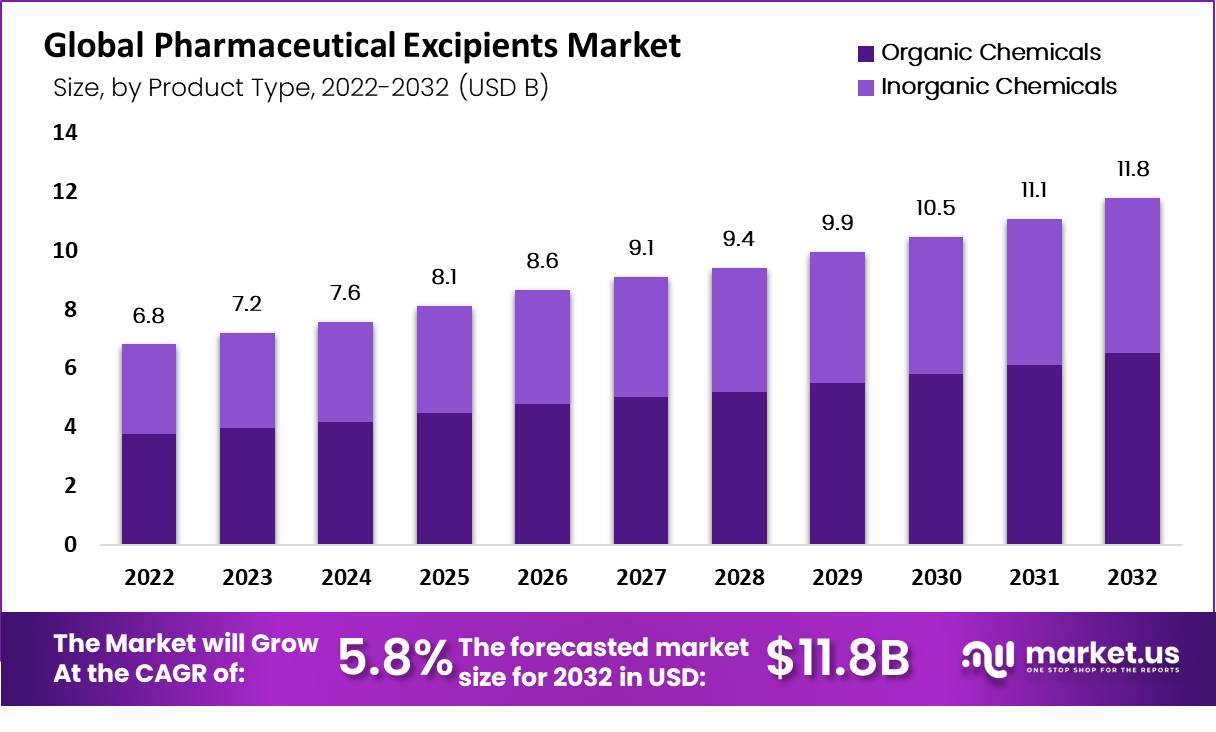
The Global Pharmaceutical Excipients Market Size is expected to be worth around USD 11.8 bn by 2032 from USD 6.8 bn in 2022, growing at a CAGR of 5.8% during the forecast period from 2022 to 2032.
Pharmaceutical excipients are included in a dosage form, not for direct curative action but to help manufacture, support, protect, and enhance stability or bioavailability.
The inactive substances in pharmaceuticals, called excipients, are important product components that ease the process to promote solubility, drug delivery, pharmaceutical ingredients into the form of usable dosage, and betterment of taste.
Oral drugs’ popularity has been heavily increasing in recent years because the patient wants no pain, and it has a comparatively straightforward method, so end-users prefer this solution.
Due to the patient-oriented industry, hard-to-take, hard-solid tablets are replaced by innovative drugs such as ODG, chewable tablets, lozenges, and effervescent tablets.
Key Takeaway
- The global pharmaceutical excipients market is expected to reach approximately USD 11.8 billion by 2032.
- In 2022, the market had reached USD 6.8 billion, suggesting an immense potential of expansion.
- This expansion should be propelled by an estimated compound annual growth rate (CAGR) from 2022-2032 of 5.8%.
- By product type, in 2022, the Pharmaceutical Excipients market was dominated by the organic chemicals segment due to their non-toxic nature and efficiency.
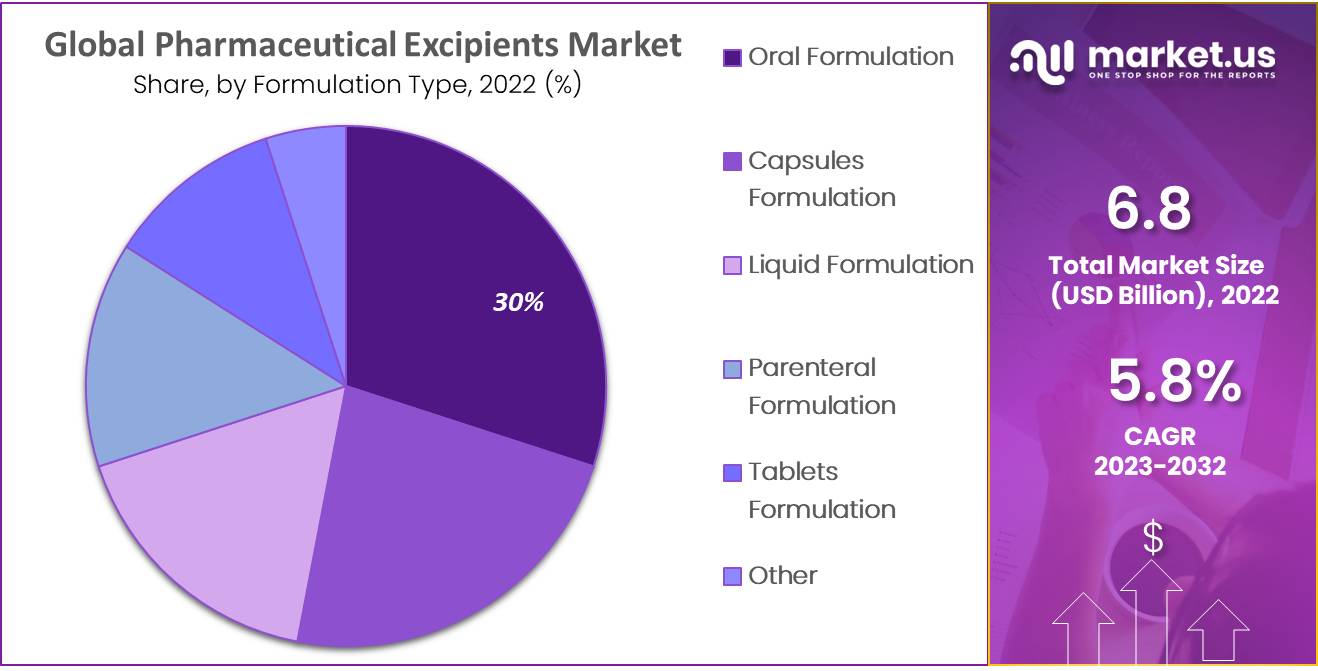
- By formulation type, the oral formulations segment dominated the market share due to its enormous advantages and efficiency in dominating diseases.
- By functionality type, the fillers and diluents hold the largest market share owing to their use in the formulation of tablets and capsules
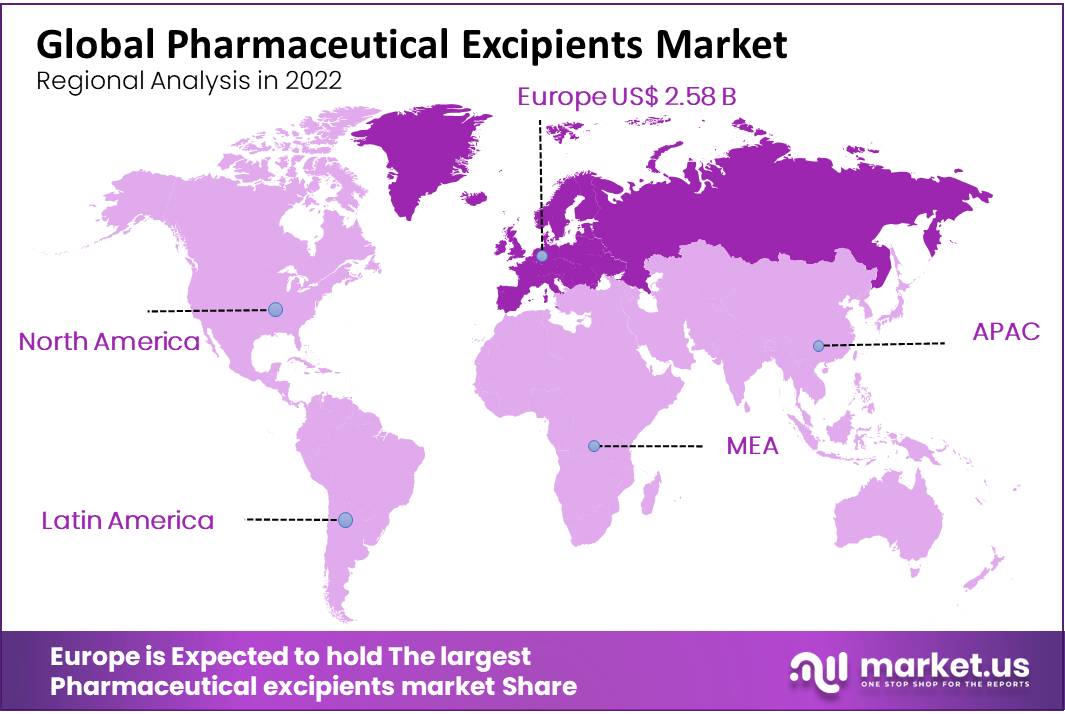
- In 2022, Europe dominated the market with the highest revenue share of over 38%.
- APAC is expected to grow at a higher pace among all the regions covered in the report.
Product Type Analysis
The Organic Chemicals Segment Dominated Largest Market Share in Product Type Owing To Their Non-Toxic Nature And Efficiency
The pharmaceutical excipients market is segmented on product types into inorganic and organic chemicals. Among these products, organic chemicals have the largest market share in pharmaceutical excipients. Organic chemicals are divided into further segments such as Proteins, carbohydrates, petrochemicals, oleo chemicals, and others.
Because organic chemicals will boost chemical use in a large portion of pharmaceutical formulations, which will help grow overall market sales. Drug manufacturers prefer organic chemicals due to their non-toxic nature and efficiency.
Formulation Type Analysis
The Oral Formulations Segment Dominated the Largest Market Share in Formulation Type Owing To Their Enormous Advantages And Efficiency In Dominating Diseases.
Based on formulation types, the pharmaceutical excipients market is segmented into capsules, tablets, liquid, topical, parenteral, oral, and other formulations.
Among these formulations, the oral formulations segment has the largest share in the pharmaceutical excipients market due to its enormous advantages and efficiency in dominating diseases. In COVID-19, healthcare experts claimed that antiviral drugs are essential.
Hence, these drugs were in high demand during the pandemic. Tablet forms are developed for an oral dosage to increase efficiency against diseases like pneumonia. Tablet formulations for oral use are becoming more famous due to less intrusive consumption, which increases overall market growth.
Functionality Type Analysis
The Fillers And Diluents Segment Accounted for the Largest Market Share in Functionality Type Owing To Their Major Application In the Formulation Of Medicines.
Based on functionality types, the pharmaceutical excipients market is segmented into fillers & diluents, suspending and viscosity agents, binders, flavoring agents and sweeteners, preservatives, coating agents, disintegrates, colorants, emulsifying agents, lubricants & glidants, disintegrates and, others functionality.
Among these functionalities, the largest market share was occupied by fillers and diluents. Because these are used in the formulation of tablets and capsules.
Key Market Segments
By Product Type
- Inorganic Chemical
- Organic Chemicals
By Formulation Type
- Capsules Formulation
- Tablets Formulation
- Liquid Formulation
- Parenteral Formulation
- Oral Formulation
- Other Formulations
By Functionality Type
- Fillers & Diluents
- Suspending and Viscosity Agent
- Binders
- Flavoring Agents and Sweeteners
- Preservatives
- Coating Agents
- Other Functionality Types
Drivers
Expanding the Market of Generics
Generic drugs have the same effect as branded drugs; additionally, the safety guarantee provided by the brand can help increase customers’ trust in the brand. Pharmaceutical excipients market growth is increasing due to less price of generics.
The US healthcare system has saved up to 1.7 trillion by using generic drugs in the last ten years. Due to such advantages, countries provide and promote generic medicines.
The report of the Association for Accessible Medicines has shown that 90% of US prescriptions are generic drugs. From 2019 to 2022, many players, such as Eli Lilly, Bristol Myers Squibb, Novartis, and Merck, lose patents for 47 types of drugs.
The sheer volume of cheaper generic drugs will complete ongoing market demand at low cost, which is advantageous for generic drugs. Late-stage development problems can incur high charges, increase development costs, and affect overall profit margins.
As safety regulations increase, pharmaceutical companies must upgrade their current manufacturing with increasing production costs.
Restraints
High Cost and Time-Consuming Drug Development
By CBRA, the new drug manufacturing process took 10 to 12 years of hard work to convert the drug from the research lab to the patient. It takes 5-6 years for toxicology studies only for a particular drug by an industry expert; out of 10,000 drugs, only 10 drugs will go for pre-clinical tests. Of these, only 2 will go for human testing to get the drug’s approval.
There has been high development of biologic production in some previous years, and as such high initial investments are getting during the forecast period.
Opportunity
Multiple Functions Provided Tablets
Developments with high cost are helping excipient manufacturers to be capable of multiple functional excipients to compete with the ongoing pharmaceutical industry market.
Various functions of drugs can improve the manufacturing process with advantages such as reduced cost, decreased production time, increased efficiency, ODT formation, and developed chemical formation.
Market players can improve into a new version of present excipients by targeting specific application-based development and optimization, such as controlled release tablets.
Challenges
Regulating Quality and Standards
Even if there is an increased demand for pharmaceuticals, issues such as regulating the quality and basic standards demanded from users, patients, and makers can be detrimental to the overall performance increase in the company. With each supplier’s variation in excipients, there is an impact on the overall market growth.
Outsourcing Reducing Quality and Transparency in Supply Chain
Large manufacturing of excipients is outsourced to other manufacturers for underdeveloped countries. Hence, less control over the process indirectly reduces quality and transparency in the supply chain of underdeveloped countries.
Regional Analysis
Europe Has Dominated the Global Pharmaceutical Excipients Market Share Owing To Growing Healthcare Industry In the Region
Europe dominated the pharmaceutical excipients market with a 38% market share in 2022. Government schemes are used to decrease drug prices, increase investments in biologics discoveries, and develop dosage forms.
As demand for excipients that are newly formed increases, then the contribution to the overall growth of pharmaceuticals increases in the Europe market healthcare industry.
The Asia-Pacific region will increase its market share at a high rate in the forecast period as growth factors such as the low price of raw materials and the presence of a low-cost workforce in the region can help to grow the pharmaceutical excipients market. Countries such as India and China present massive market growth opportunities in the forecast period.
Key Regions and Countries
- North America
- The US
- Canada
- Mexico
- Western Europe
- Germany
- France
- The UK
- Spain
- Italy
- Portugal
- Ireland
- Austria
- Switzerland
- Benelux
- Nordic
- Rest of Western Europe
- Eastern Europe
- Russia
- Poland
- The Czech Republic
- Greece
- Rest of Eastern Europe
- APAC
- China
- Japan
- South Korea
- India
- Australia & New Zealand
- Indonesia
- Malaysia
- Philippines
- Singapore
- Thailand
- Vietnam
- Rest of APAC
- Latin America
- Brazil
- Colombia
- Chile
- Argentina
- Costa Rica
- Rest of Latin America
- Middle East & Africa
- Algeria
- Egypt
- Israel
- Kuwait
- Nigeria
- Saudi Arabia
- South Africa
- Turkey
- United Arab Emirates
- Rest of MEA
Market Players Analysis
Significant key players have market presence in major countries such as the United States (Ashland Global Holdings, Inc., International Flavors & Fragrances, Inc., FMC corporation), Germany (BASF SE, Evonik Industries AG), France (Roquette Freres), etc., are responsible for the majority of market share.
Market Key Players
- Ashland Global Holdings
- BASF SE
- DuPont
- Roquette Feres
- Evonik Industries AG
- Associated British Foods
- Archer Daniels Midland Company
- Lubrizol Corporation
- Kerry Group
- Croda International PLC
- Roquette Frères
- FMC Corporation
- Other Key Players
Recent Market Developments
- September 2024: Evonik initiated operations at a new spray drying facility dedicated to pharmaceutical oral excipients in Darmstadt, Germany. This multi-million euro investment is designed to meet rising demand for functional excipients essential for oral drug delivery. The facility enhances supply security and shortens delivery times, and is built to integrate seamlessly with existing production networks, operating with green electricity and steam from local waste, reducing over 1,000 CO2 equivalents annually.
- In July 2024: Lubrizol signed a Memorandum of Understanding to acquire a 120-acre plot in Aurangabad, India. This move aims to construct a new manufacturing facility, representing an investment of approximately $200 million. The plant is slated to be the company’s largest in India, supporting the growing regional demands and aligning with their strategy for local supply chains.
- In November 2023: BASF Pharma Solutions and IFF Pharma Solutions established a collaboration to enhance BASF’s digital Virtual Pharma Assistant platform, ZoomLab™. This collaboration integrates IFF’s leading excipient products into ZoomLab™, a digital tool designed to optimize pharmaceutical formulation by predicting the best excipients needed for new pharmaceutical products. This partnership aims to enhance formulation capabilities for clients globally, reflecting a significant stride in digitalizing formulation processes.
- In October 2023: Ashland introduced its new bioresorbable polymers technology platform at significant industry events including CPHI in Barcelona and AAPS PharmSci 360 in Orlando. This technology supports various applications like long-acting injectables for chronic diseases and advanced drug delivery systems for improved mRNA delivery. During these events, Ashland also showcased innovative products like Viatel Ultrapure high-purity bioresorbable polymers and Klucel Fusion HPC, an immediate release tablet binder designed for melt granulation, which offers enhanced tablet binding performance at lower processing temperatures.









