


Report Overview
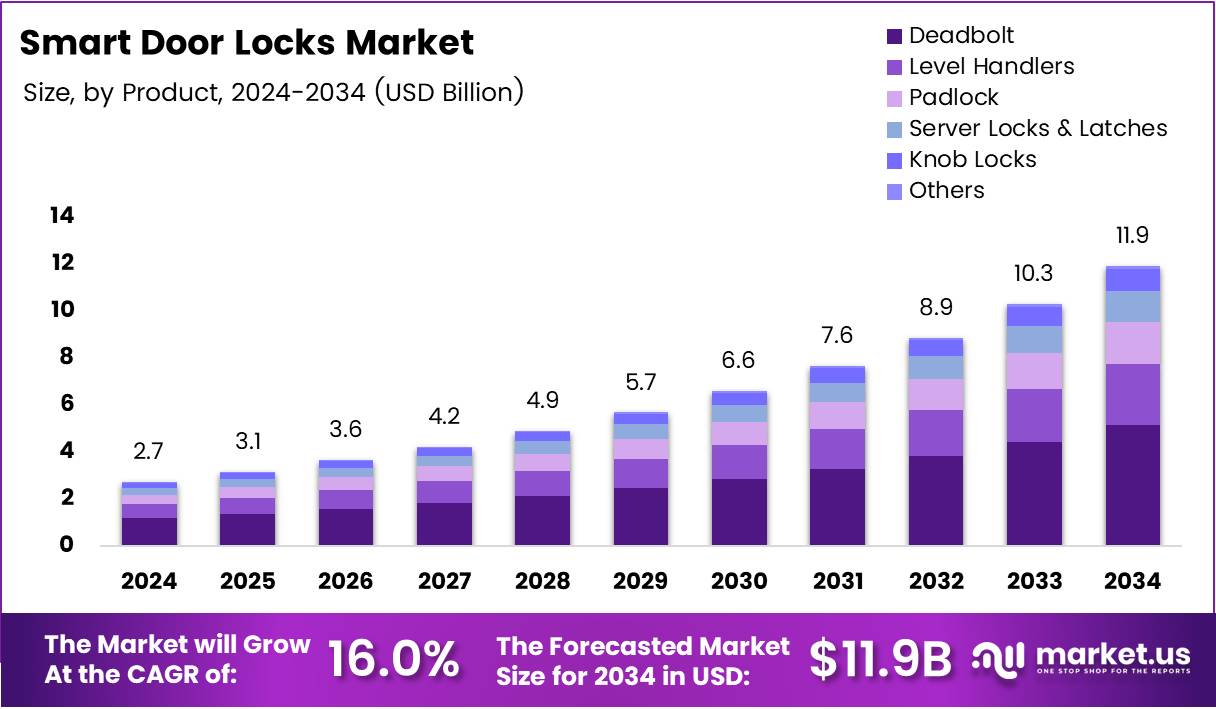
The Global Smart Door Lock Market size is expected to be worth around USD 11.9 Billion by 2034, from USD 2.7 Billion in 2024, growing at a CAGR of 16.0% during the forecast period from 2025 to 2034.
A smart door lock is an advanced locking device that allows users to lock and unlock doors using electronic methods instead of traditional keys. These locks can be controlled through mobile apps, Bluetooth, or even voice commands. Smart door locks offer enhanced security features such as keyless entry, remote access, and integration with smart home systems.
The smart door lock market refers to the global industry that designs, manufactures, and sells electronic door locks with smart functionalities. It is growing due to increasing awareness of home security, the rise of smart homes, and advancements in technology. Consumers are seeking convenience, safety, and control, which drives demand for smart locking systems.
The increasing adoption of smart door locks is largely driven by rising concerns about home security. While the U.S. burglary rate dropped to 255 incidents per 100,000 people in 2021, burglary remains a significant issue, with 1.6 burglaries occurring every minute on average. These security concerns, along with advancements in smart home technology, are driving demand for smart door locks among both homeowners and renters.
The growth of the smart door lock market is fueled by the increasing adoption of smart home technology, rising concerns about smart home security, and the demand for convenience in daily life. Innovations such as biometric authentication and integration with home automation systems are attracting consumers. Additionally, rising urbanization and disposable incomes, particularly in developing regions, are contributing to market growth.
A key driver is the growing focus on home security. In 2023, states like New Mexico and Washington recorded burglary rates of 604 and 563 incidents per 100,000 residents, respectively. This highlights the need for better home protection solutions, and smart door locks are emerging as a preferred choice for securing homes.
Additionally, the broader adoption of smart home technology is supporting the growth of the smart door lock industry. According to a survey by the National Association of Realtors, 81% of homebuyers consider smart home technology important. Furthermore, 49% of U.S. broadband households have adopted smart speakers, demonstrating the integration of voice-controlled devices in everyday life. This trend is expected to continue as consumers seek more convenient and connected home solutions.
With features such as integration with virtual assistants like Alexa, Google Assistant, and Siri, smart door locks provide users with the ability to manage home access remotely, monitor entry activity, and improve overall home security. As of 2024, 40% of U.S. households using smart home devices have integrated voice-controlled systems, highlighting the growing popularity of smart locks.
There are significant opportunities in the smart door lock industry, particularly in emerging markets where smart home adoption is increasing. Manufacturers that focus on offering more affordable options can tap into a broader consumer base. Innovations in security, such as biometric technology and real-time monitoring, provide further growth potential.
Key Takeaways
- Smart Door Lock Market was valued at USD 2.3 Billion in 2023, and is expected to reach USD 10.9 Billion by 2033, with a CAGR of 16.8%.
- In 2023, Deadbolt locks dominate with 27%, preferred for their high security in both residential and commercial use.
- In 2023, Biometric door locks lead with 35%, driven by rising demand for advanced security solutions.
- In 2023, Wi-Fi technology dominates due to its widespread integration with smart home systems.
- In 2023, North America leads with 45% market share, attributed to high adoption of smart home technologies.
By Product Analysis
Deadbolt dominates with 43.8% due to its widespread adoption for enhanced residential and commercial security.
In 2024, Deadbolt held a dominant market position in the By Product Analysis segment of the Smart Door Locks Market, with a 43.8% share. Deadbolts are widely used because of their high durability, simple installation, and superior resistance to forced entry. Their integration with smart home systems enhances both convenience and safety, driving consistent market preference.
Lever Handles are gaining traction owing to their ergonomic design and ease of use. These locks are particularly popular in offices and hospitality spaces, offering quick access control and compatibility with multiple authentication technologies. Growing demand for user-friendly, aesthetic locking systems fuels their adoption across various urban infrastructures.
Padlocks are preferred for portable security needs, providing flexible solutions for outdoor and temporary access control. Smart padlocks are increasingly integrated with Bluetooth or fingerprint authentication, enabling keyless convenience for users while ensuring reliable protection for storage units, gates, and lockers.
Server Locks & Latches address the growing need for data center and IT infrastructure protection. These smart locks ensure controlled access to sensitive hardware, reducing unauthorized entry risks. Demand continues to rise with digitalization and the expansion of secure enterprise environments worldwide.
Knob Locks are commonly used in residential applications for interior doors. Their affordability and compatibility with smart upgrades make them suitable for homeowners seeking partial automation. Although less secure than deadbolts, they remain a staple for basic smart home setups due to their practicality.
Others include rim locks, cam locks, and electronic latch systems catering to niche applications. These products provide customized security solutions for specific environments, such as hospitality or healthcare, where traditional locking systems require digital enhancements for better control and monitoring.
By Protocol Analysis
Bluetooth dominates with 31.2% due to its seamless smartphone connectivity and low power consumption.
In 2024, Bluetooth held a dominant market position in the By Protocol Analysis segment of the Smart Door Locks Market, with a 31.2% share. Bluetooth smart locks offer quick pairing with mobile devices, eliminating the need for Wi-Fi connectivity. Their cost-effectiveness and energy efficiency make them highly popular among residential users.
Wi-Fi smart locks provide remote access control, allowing homeowners to monitor and operate doors via apps. They are ideal for smart home ecosystems where continuous internet connectivity enhances automation. Their strong integration capabilities with virtual assistants boost adoption across modern households.
Z-Wave technology supports interoperability within home automation networks. These smart locks ensure secure, encrypted communication and are widely used in comprehensive security systems. Their stable network range and reliability make them favored for professional smart home installations.
Zigbee smart locks are valued for their fast communication speed and scalability. They are commonly used in smart buildings and commercial settings where numerous connected devices function simultaneously. The technology ensures efficient performance with minimal energy consumption.
Others include proprietary or hybrid communication protocols used in specific security systems. These variants cater to specialized environments like industrial plants or high-security facilities, offering tailored data transmission and compatibility for mission-critical applications.
By Authentication Analysis
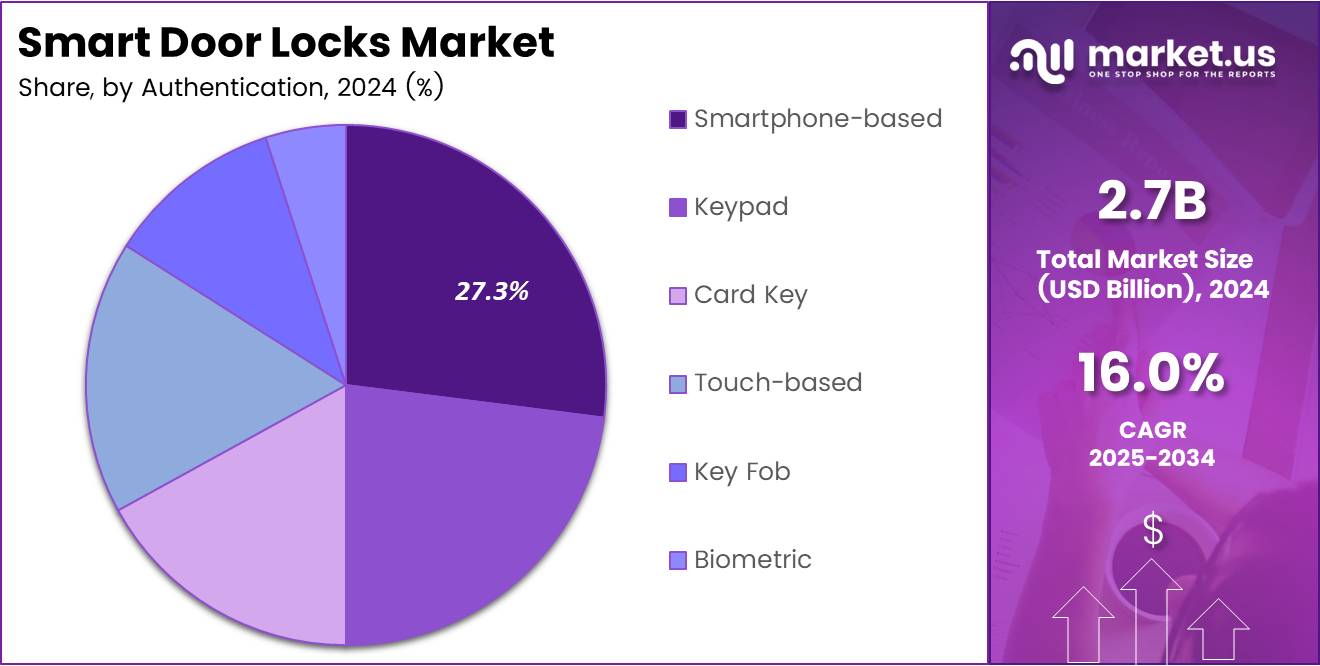
Smartphone-based authentication dominates with 27.3% due to rising mobile integration and convenience in access management.
In 2024, Smartphone-based authentication held a dominant market position in the By Authentication Analysis segment of the Smart Door Locks Market, with a 27.3% share. These locks enable users to control access remotely via mobile apps, providing enhanced security and flexibility. Their user-centric features align with the expanding smart home ecosystem.
Keypad smart locks remain popular for their simplicity and reliability. Users can set personalized PINs, ensuring secure yet quick access. They are ideal for commercial and hospitality environments where multiple users require controlled entry without depending on physical keys.
Card Key authentication is widely utilized in hotels and corporate offices. It ensures efficient visitor management through reprogrammable access cards, minimizing unauthorized entries. These systems combine convenience and cost-effectiveness for large-scale operations.
Touch-based locks, featuring capacitive sensors, provide easy access with a single touch. Their sleek design and enhanced responsiveness make them attractive for premium residential settings. Adoption is rising as consumers prefer minimalist interfaces with modern aesthetics.
Key Fob authentication allows proximity-based unlocking, offering a hands-free experience. These are particularly useful in commercial and automotive environments, where rapid and secure access is essential. The convenience of key fobs continues to attract users prioritizing mobility and efficiency.
Biometric smart locks utilize fingerprint or facial recognition, offering personalized security. They eliminate password dependency and provide high accuracy in identity verification. Adoption is growing in smart apartments and offices where advanced access control is crucial.
By Application Analysis
Residential segment dominates with 61.8% due to increasing smart home adoption and growing urban housing developments.
In 2024, Residential applications held a dominant market position in the By Application Analysis segment of the Smart Door Locks Market, with a 61.8% share. Homeowners are increasingly adopting smart locks for convenience, security, and integration with home automation systems. Rising smart home investments are significantly fueling this segment’s growth.
Commercial applications, including offices, retail, and hospitality sectors, utilize smart locks for access management and employee tracking. These systems provide real-time entry logs and remote authorization, supporting operational efficiency. Demand continues to grow with the digital transformation of business environments.
Industrial facilities are adopting smart locks to enhance physical security and streamline access control. These locks protect restricted areas, warehouses, and equipment zones, reducing unauthorized access. As industrial automation expands, smart locking solutions are becoming vital for safeguarding critical infrastructure.
Key Market Segments
By Product
- Deadbolt
- Level Handlers
- Padlock
- Server Locks & Latches
- Knob Locks
- Others
By Protocol
- Bluetooth
- Wi-Fi
- Z-Wave
- Zigbee
- Others
By Authentication
- Smartphone-based
- Keypad
- Card Key
- Touch-based
- Key Fob
- Biometric
By Application
- Residential
- Individual Household
- Commonhold
- Commercial
- Hospitality
- Healthcare
- BFSI
- Enterprise
- Critical Infrastructure
- Educational Institution
- Industrial
- Manufacturing
- Energy & Utilities
- Oil & Gas
- Others
Driver
Increasing Security Concerns Drives Market Growth
The Smart Door Lock Market is driven by several key factors, with increasing security concerns being a major contributor. As crime rates and burglary incidents rise, consumers are actively seeking advanced security solutions, with smart door locks offering enhanced safety and convenience.
The rise in urbanization and growing middle-class populations also contribute to market expansion, as more households invest in smart home technologies, including smart locks, to improve their quality of life.
In addition, the integration of smart locks with existing home automation systems is another driving factor. Consumers are drawn to the seamless connectivity and ease of managing multiple smart devices through a single platform. The increased adoption of smartphones further boosts this market, as mobile apps allow users to control and monitor smart locks remotely.
Restraint
High Initial Cost and Cybersecurity Concerns Restraints Market Growth
Despite its potential, the Smart Door Lock Market faces several restraining factors. The high initial cost of smart door locks is a significant barrier for price-sensitive consumers. Many potential buyers may find traditional locks more affordable, thus slowing market penetration.
Additionally, cybersecurity concerns play a crucial role in restraining growth, as consumers are worried about hacking and unauthorized access to their smart locks.
Another challenge is the complexity of installation and setup, which can deter less tech-savvy consumers from adopting these solutions. Compatibility issues with other smart home devices also create barriers, as users seek products that integrate effortlessly with their existing systems. These restraining factors limit the market’s expansion, particularly in regions with lower technological penetration.
Opportunity
Rising Demand for Smart Homes Provides Opportunities
The Smart Door Lock Market holds significant growth opportunities, especially with the rising demand for smart homes. As more consumers embrace smart home technologies, there is an increasing need for integrated security solutions such as smart door locks. This trend is particularly evident in developed markets, where smart home adoption is accelerating.
Moreover, the increasing use of IoT (Internet of Things) offers opportunities for companies to develop more innovative and connected solutions. Partnerships with smart home automation platforms and security companies can help smart lock providers tap into new customer bases. Emerging markets also offer growth potential, as rising disposable incomes and growing urbanization lead to greater adoption of smart home technologies.
Additionally, commercial sectors such as hotels, office buildings, and co-working spaces are adopting smart locks for improved access control and management, providing a significant opportunity for market expansion. These growth opportunities allow companies to enhance their product offerings and capture new revenue streams.
Challenge
Complex Integration and User Adaptation Challenges Market Growth
The Smart Door Lock Market faces various challenges, including complex integration with other smart home devices. Users often experience difficulties when attempting to connect their smart door locks with existing home automation systems, leading to frustrations and reduced adoption rates.
Another challenge is user adaptation. Some consumers, especially older generations, may resist the adoption of smart technologies, preferring traditional locks due to concerns over reliability and ease of use. Additionally, maintaining product quality while ensuring long-term durability and energy efficiency is a challenge for manufacturers.
Lastly, the risk of product obsolescence due to rapid technological advancements is a concern. Companies must innovate continuously to remain competitive, which adds to operational costs. These challenges create obstacles that slow market growth, making it essential for businesses to address these issues effectively.
Growth Factors
IoT Connectivity and Urbanization Are Growth Factors
IoT connectivity and urbanization are among the key growth factors driving the Smart Door Lock Market. The increasing penetration of IoT devices in households and businesses enables seamless integration of smart locks with other connected devices, such as cameras and alarms, offering enhanced security.
Rapid urbanization, especially in developing countries, is driving the demand for smart locks as more consumers move into urban residential complexes and smart cities. These developments often incorporate advanced security systems, including smart locks, to improve resident safety and convenience.
The rise in working professionals and renters also contributes to the market’s growth, as these demographics seek flexible and tech-driven security solutions for their homes. Furthermore, ongoing advancements in artificial intelligence (AI) and machine learning enable the development of smarter, more efficient door lock systems, supporting long-term market expansion.
Emerging Trends
Voice Integration and Mobile Control Are Latest Trending Factor
Voice integration and mobile control have emerged as significant trends in the Smart Door Lock Market. Consumers are increasingly seeking voice-activated smart door locks that integrate with popular virtual assistants such as Amazon Alexa, Google Assistant, and Apple Siri. This trend enhances the user experience by offering hands-free control and greater convenience.
Additionally, mobile control via smartphone apps is becoming a key trend, allowing users to lock, unlock, and monitor their doors remotely. The ability to grant temporary access to visitors through mobile apps further adds to the appeal of smart locks, especially in the rental and hospitality sectors.
Another notable trend is the growing focus on eco-friendly smart locks, which are designed to reduce energy consumption while maintaining robust security features. Moreover, the incorporation of biometric authentication, such as fingerprint recognition, is gaining traction, providing enhanced security options.
Regional Analysis
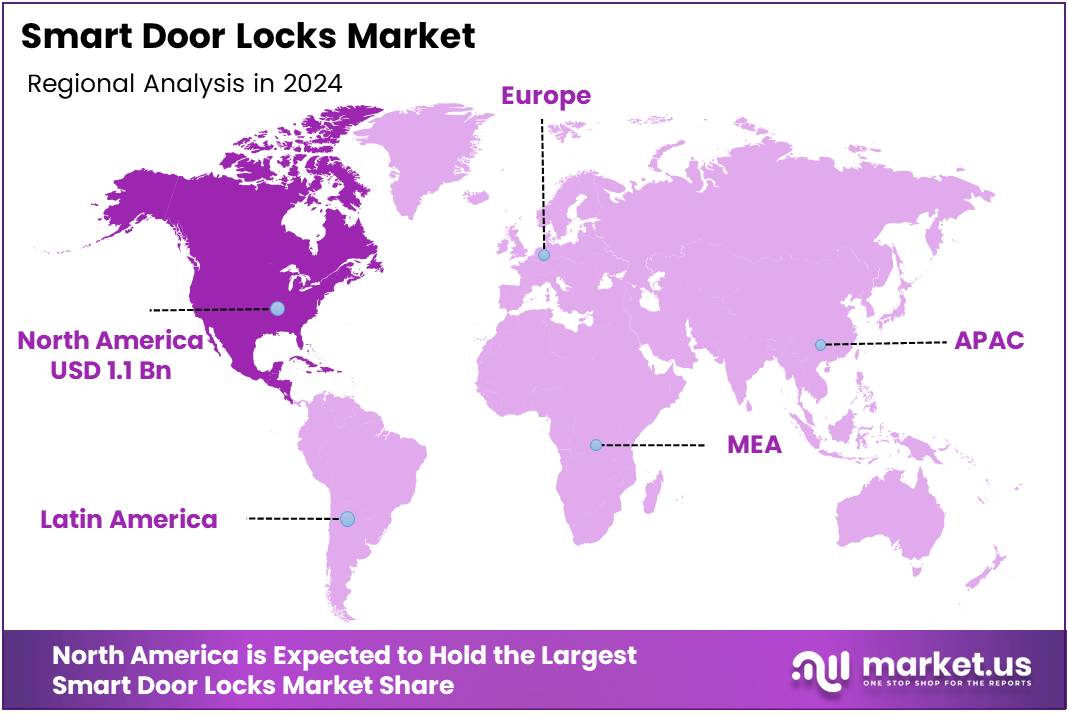
North America Dominates the Smart Door Locks Market with a Market Share of 42.9%, Valued at USD 1.1 Billion
In 2024, North America emerged as the leading region in the global Smart Door Locks Market, accounting for a substantial 42.9% share, valued at approximately USD 1.1 billion. The region’s dominance is driven by high adoption of smart home technologies, increasing emphasis on residential security, and widespread integration of IoT-enabled devices. Rising consumer preference for advanced access control systems, coupled with supportive government initiatives for smart infrastructure, continues to strengthen market penetration across the U.S. and Canada.
Europe Smart Door Locks Market Trends
Europe holds a significant position in the global market, supported by strong demand for connected home solutions and advanced building automation systems. Countries such as Germany, the UK, and France are witnessing a surge in adoption due to rising awareness of smart security and sustainability goals. The growth is also propelled by stringent safety regulations and consumer interest in energy-efficient smart devices.
Asia Pacific Smart Door Locks Market Trends
The Asia Pacific region is experiencing rapid market expansion, fueled by growing urbanization and rising disposable incomes. Smart city projects in China, Japan, and South Korea are promoting the use of intelligent locking systems in both residential and commercial buildings. Furthermore, increasing digitalization and the proliferation of mobile applications for remote security management are boosting adoption across emerging economies.
Middle East and Africa Smart Door Locks Market Trends
The Middle East and Africa are showing steady growth as smart home adoption gains traction across luxury residential and hospitality sectors. Rapid urban development and government-led initiatives for smart infrastructure are contributing to demand. The UAE and Saudi Arabia, in particular, are integrating advanced security systems into modern building projects, signaling strong potential for future growth.
Latin America Smart Door Locks Market Trends
Latin America’s market for smart door locks is gradually expanding, led by increasing awareness of home security and the rise of digital ecosystems. Countries such as Brazil and Mexico are investing in connected living solutions, driving consumer acceptance. Economic recovery and technological penetration in urban centers are expected to further encourage the adoption of smart access solutions in the coming years.
Key Regions and Countries covered іn thе rероrt
- North America
- US
- Canada
- Europe
- Germany
- France
- The UK
- Spain
- Italy
- Rest of Europe
- Asia Pacific
- China
- Japan
- South Korea
- India
- Australia
- Rest of APAC
- Latin America
- Brazil
- Mexico
- Rest of Latin America
- Middle East & Africa
- South Africa
- Saudi Arabia
- UAE
- Rest of MEA
Key Players Analysis
Avent Security is well-positioned in 2024 as a value-driven supplier, leaning on cost-efficient manufacturing and incremental feature upgrades (biometric variants, longer battery life) to win price-sensitive residential and SME contracts. Its channel strategy—distributors and e-commerce bundles—helps compress deployment costs, while partnerships with local installers accelerate retrofit cycles in emerging markets, supporting steady unit growth despite tightening margins.
Cansec Systems Ltd. remains a specialist with credibility in access control for commercial and institutional settings. In 2024, its smart lock portfolio benefits from tighter software–hardware integration, enabling centralized credential management and audit trails that resonate with facility managers. Expect Cansec to prioritize interoperability with existing controllers and badges, defending niche share where reliability, compliance, and lifecycle service trump headline features.
Danalock continues to capitalize on retrofit elegance and multi-protocol flexibility, targeting connected-home enthusiasts and premium residential installers. In 2024, the company’s emphasis on app experience, secure onboarding, and modular cylinders sustains differentiation against lower-cost clones. The growth vector is upselling—from core smart cylinders to add-on keypads and gateways—expanding ARPU while maintaining a lightweight logistics footprint across European and North American channels.
dormakaba International Holding AG leverages its global brand, enterprise relationships, and deep portfolio to straddle hospitality, multifamily, and commercial verticals. In 2024, its strategy centers on end-to-end platforms—locks, readers, and cloud management—reducing vendor sprawl for large accounts. Scale advantages in certification, service networks, and procurement underpin resilience, while expanding software subscriptions and analytics shift the revenue mix toward recurring, higher-margin streams and multi-year client stickiness.
Top Key Players in the Market
- Avent Security
- Cansec Systems Ltd.
- Danalock
- dormakaba International Holding AG
- FRIDAY Home
- Gate Labs
- HavenLock, Inc.
- Honeywell International Inc.
- RemoteLock
- Nuki Home Solutions GmbH
- Salto Systems, S.L.
- SentriLock, LLC
- SMARTLOCK
- UniKey Technologies, Inc.
- Zigbang Co., Ltd.
Recent Developments
- MyGate: September 2024 – MyGate launched a new line of smart, keyless door locks, marking its entry into the consumer electronics market. The locks are available in three variants—Lock SE, Lock Plus, and Lock Pro—offering features like remote unlocking, keyless entry, and real-time notifications for enhanced home security. Prices range from ₹9,950 to ₹23,990, with free installation and a three-year warranty.
- Home Depot: 2024 – Home Depot introduced a smart door with dynamic glass, which adjusts its opacity based on external conditions, enhancing privacy and light control. Priced from $800, the door represents a growing trend in integrating smart technology into home construction.
- Xiaomi: August 2024 – Xiaomi released the Smart Door Lock 2 Pro, featuring 3D facial recognition and a large screen for enhanced security and convenience. The lock offers advanced keyless entry options and integrates seamlessly with smart home ecosystems.









