


Report Overview
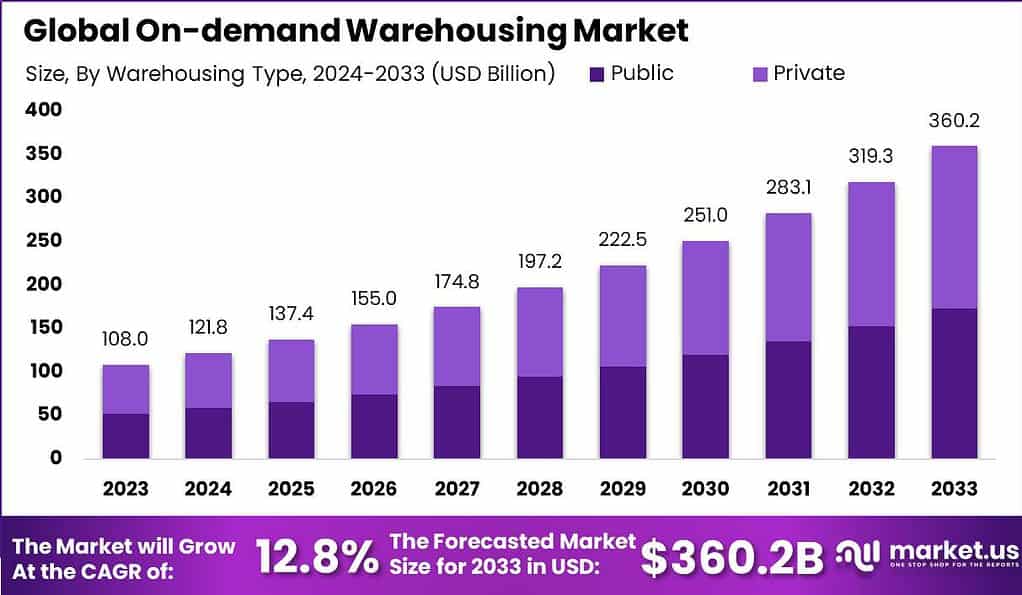
The Global On-demand Warehousing Market size is expected to be worth around USD 360.2 Billion By 2033, from USD 108 Billion in 2023, growing at a CAGR of 12.8% during the forecast period from 2024 to 2033. In 2023, Asia-pacific held a dominant market position, capturing more than a 41% share, holding USD 44.28 Billion revenue.
On-demand warehousing is a modern logistics solution that caters to the fluctuating storage needs of businesses, particularly useful for managing seasonal demand, overflow, and returns. This flexible warehousing model allows companies to rent space in a warehouse on a temporary basis, avoiding long-term leases and reducing overhead costs.
The on-demand warehousing market is experiencing rapid growth, driven by the increasing demand from e-commerce sectors and the need for scalable, flexible storage solutions. As companies continue to seek efficiency in logistics and distribution, the on-demand model offers a cost-effective alternative to traditional warehousing by eliminating the need for long-term leases and reducing overhead costs associated with unused space.
The market is further fueled by advancements in technology, such as warehouse management systems (WMS) and logistics software, which enhance the operational efficiency of on-demand services The demand for on-demand warehousing is growing steadily as businesses seek flexible storage solutions that can adjust to fluctuating inventory levels.
This model is particularly appealing to e-commerce businesses, which often experience seasonal spikes in demand that require additional storage space. On-demand warehousing eliminates the need for long-term leasing commitments, offering a cost-effective alternative that aligns with dynamic business needs.
On-demand warehousing has gained popularity due to its scalability and efficiency. Companies can access warehouse space and related logistics services on a pay-per-use basis, which is more adaptable than traditional warehousing methods. This flexibility is highly valued in industries where inventory management is critical to business success, such as retail, manufacturing, and distribution.
The popularity of this market is also driven by the rise in online shopping, which demands more versatile and responsive logistics solutions. The expansion of the on-demand warehousing market is facilitated by technological advancements and the integration of digital platforms that connect warehouse owners with businesses in need of temporary storage.
This market is expanding globally, with significant growth observed in North America, Europe, and Asia-Pacific. These regions are seeing increased investment in warehouse automation and digital supply chain solutions, further boosting the market’s growth potential.
There are substantial opportunities in the on-demand warehousing market to cater to the surge in online shopping and the diversification of supply chains. Opportunities also exist in offering enhanced, technology-driven services such as real-time inventory tracking and analytics-driven space allocation. As businesses increasingly value flexibility and scalability, providers who innovate and adapt their offerings to meet these needs will find considerable growth potential in the market.
Key Takeaways
- The Global On-demand Warehousing Market is projected to expand significantly, with its market size expected to reach USD 360.2 billion by 2033, up from USD 108 billion in 2023, representing a CAGR of 12.8% over the forecast period from 2024 to 2033. The market is primarily driven by the growing need for flexible and scalable warehousing solutions across various industries.
- In 2023, the Public segment dominated the market, accounting for more than 48% of the total share. This segment’s dominance reflects the rising adoption of public warehousing services due to their cost efficiency and flexible storage solutions.
- Additionally, the Large Enterprise segment led the market, capturing over 61% share in 2023. Large organizations continue to favor on-demand warehousing to handle the growing complexities of supply chain management and meet seasonal storage demands.
- The E-commerce/Retail sector also held a significant position, controlling more than 36% of the market in 2023. This is attributed to the surge in online shopping, which drives the demand for flexible warehousing options.
- Regionally, Asia-Pacific emerged as the dominant player, holding more than 41% of the market share, with revenues reaching approximately USD 44.28 billion in 2023. The region’s leadership is driven by rapid industrialization, growing e-commerce activity, and advancements in supply chain infrastructure.
On-demand Warehousing Statistics
- The on-demand warehousing and logistics sector is experiencing substantial growth, with an annual increase of 20%. This expansion is primarily attributed to its ability to expedite shipping, bolster supply chain resilience, and ensure consistent fulfillment processes.
- The Smart Warehousing Market is projected to reach approximately USD 78.6 Billion by 2033, up from USD 20.3 Billion in 2023, growing at a compound annual growth rate (CAGR) of 14.5% from 2024 to 2033.
- The Global AI in Warehousing Market is set to expand significantly, with an expected valuation of around USD 88.4 Billion by 2033, starting from USD 8.7 Billion in 2023. This market is forecasted to grow at a CAGR of 26.1% over the same period. As of 2023, North America leads this market, holding a 38% share with revenues amounting to USD 3.3 billion.
- The Warehouse Automation Market size is anticipated to reach about USD 91.0 Billion by 2033, up from USD 20.8 Billion in 2023, with a CAGR of 15.9% during the forecast period.
- The Warehouse Robotics Market is expected to grow to USD 19.20 Billion by 2032 from USD 5.5 Billion in 2022, at a CAGR of 13.30%.
- The Global IoT in Warehouse Management Market is forecasted to be valued at around USD 57.2 Billion by 2033, up from USD 14.8 Billion in 2023, with a growth rate of 14.5% over the forecast period.
- The European E-commerce 2023 report notes that over 99% of consumers have modified their online shopping behaviors, increasingly seeking the best deals and engaging in extensive product research.
- A significant proportion of consumers, 37%, now expect delivery within 1-2 days, while 29% anticipate same-day delivery. These expectations are driving businesses towards on-demand warehousing solutions to enhance fulfillment efficiency.
- Approximately 60% of businesses are considering or have already implemented on-demand warehousing to optimize their logistics operations.
- The adoption of Automated Storage and Retrieval Systems (ASRS) within on-demand warehousing has reportedly increased operational speed by up to 50%, thereby significantly boosting throughput and minimizing human errors in inventory management.
Warehousing Type Analysis
In 2023, the Public segment held a dominant market position within the On-demand Warehousing Market, capturing more than a 48% share. This leadership can be primarily attributed to the versatility and economic advantages that public warehousing offers to various industries, including retail, e-commerce, and manufacturing.
Public warehouses provide flexible storage solutions without long-term commitments, which is highly attractive for businesses seeking scalability and cost efficiency in managing inventory fluctuations. Furthermore, these facilities often come equipped with value-added services such as inventory management, order fulfillment, and transportation services, enhancing their appeal to companies that require comprehensive logistics solutions.
The growth of the Public segment is also propelled by the increasing integration of technology in warehousing operations. Modern public warehouses are leveraging automation and advanced data analytics to improve operational efficiency and accuracy in order fulfillment. This technology-driven approach not only reduces errors but also speeds up the processing time, meeting the fast-paced demand of today’s market.
Additionally, the rise of e-commerce has significantly boosted the demand for public warehousing as businesses seek rapid scalability to handle seasonal peaks without investing in permanent infrastructure. Another factor contributing to the predominance of the Public segment is the strategic location of these facilities.
Typically situated in close proximity to major transport hubs, public warehouses offer logistical advantages that are crucial for just-in-time inventory management, which is vital for industries such as automotive and retail. The accessibility of these warehouses enables companies to reduce transportation costs and lead times, further enhancing supply chain efficiency.
Overall, the Public segment’s lead in the On-demand Warehousing Market is sustained by its ability to provide flexible, technologically advanced, and strategically located warehousing solutions that cater to the dynamic needs of diverse industries. As businesses continue to prioritize agility and cost-effectiveness in their supply chain operations, the demand for public warehousing is expected to remain robust, underpinning its continued market dominance.
Organization Size Analysis
In 2023, the Large Enterprise segment held a dominant market position in the On-demand Warehousing Market, capturing more than a 61% share. This segment’s leadership is largely due to the extensive logistical needs and complex supply chain operations of large enterprises, which require robust warehousing solutions that can efficiently manage large volumes of goods.
On-demand warehousing offers the flexibility and scalability that large enterprises need to optimize their supply chain operations, adjust to market demands, and manage inventory without the constraints of long-term leases. Large enterprises often operate on a global scale, necessitating a warehousing solution that can be rapidly scaled up or down based on regional demands and seasonal fluctuations.
On-demand warehousing enables these organizations to access additional space during peak seasons or scale back during off-peak times, thus avoiding the financial burden of unused space. Additionally, these enterprises benefit from the advanced technologies integrated into on-demand warehousing, such as real-time inventory tracking and automated warehousing systems, which significantly enhance operational efficiency and accuracy.
Furthermore, the financial capability of large enterprises to invest in innovative logistics solutions also contributes to their dominance in this segment. They are better positioned to leverage the full suite of services offered by on-demand warehousing providers, including advanced security, specialized storage facilities, and customized logistics services. This capacity not only ensures a more controlled and efficient distribution process but also enhances the overall responsiveness of the supply chain to customer needs.
In summary, the Large Enterprise segment’s commanding share in the On-demand Warehousing Market is underpinned by its complex supply chain requirements, global operational scale, and the ability to invest in and benefit from advanced warehousing technologies. These factors collectively ensure that large enterprises not only optimize their logistical operations but also maintain flexibility and competitiveness in a dynamic market environment.

Industry Vertical Analysis
In 2023, the E-commerce/Retail segment held a dominant market position within the on-demand warehousing market, capturing more than a 36% share. This segment’s prominence is primarily due to the exponential growth of online shopping, which has necessitated more flexible and scalable warehousing solutions to manage fluctuating inventory levels effectively.
E-commerce and retail businesses typically experience significant variability in inventory demand due to seasonal peaks, promotional campaigns, and evolving consumer trends. On-demand warehousing provides these businesses with the ability to quickly adjust their storage space and logistics operations without the constraints and high costs associated with traditional, fixed warehousing contracts.
This flexibility is crucial for maintaining service levels and optimizing supply chain efficiency, factors that directly impact customer satisfaction and business profitability. Furthermore, the rapid shift towards online shopping platforms has increased the need for e-commerce and retail businesses to distribute their products across broader geographical areas.
On-demand warehousing facilitates this requirement by offering strategically located storage facilities that can serve as distribution hubs, reducing delivery times and shipping costs. This geographic flexibility is particularly advantageous for online retailers looking to maintain competitive delivery promises to their customers.
Advancements in technology also play a critical role in why the E-commerce/Retail segment leads in on-demand warehousing. Integrated warehouse management systems (WMS) and automated sorting and packing technologies have become increasingly sophisticated, allowing for faster processing times and more accurate order fulfillment. These technological enhancements support the scalability and efficiency needs of e-commerce businesses, further cementing the segment’s leading position in the on-demand warehousing market.
Key Market Segments
By Warehousing Type
- Public
- Private
By Organization Size
- SMEs
- Large Enterprises
By Industry Vertical
- E-commerce/Retail
- Food and Beverage
- Consumer Electronics
- Pharmaceuticals
- Automotive
- Others
Driver
E-Commerce Expansion
One significant driver of the on-demand warehousing market is the rapid expansion of e-commerce. As online shopping continues to grow globally, there is a corresponding increase in demand for warehousing solutions that are flexible and scalable to handle fluctuating inventory needs. This surge is particularly noticeable in regions with high internet penetration and a robust digital infrastructure, where consumers expect quick delivery times.
The adoption of on-demand warehousing allows e-commerce businesses to efficiently manage inventory without investing in permanent warehouse space, thus aligning with the just-in-time inventory management practices favored in today’s fast-paced market environment.
Restraint
High Initial Investment
A primary restraint in the on-demand warehousing market is the high initial investment required for setting up technologically equipped warehouse facilities. While on-demand warehousing reduces long-term fixed costs, the upfront expenditure for sophisticated warehouse management systems (WMS) and automation technologies can be significant.
This initial cost barrier can deter small to medium-sized enterprises (SMEs) from adopting on-demand warehousing solutions, despite the flexibility they offer. This is particularly challenging in less developed markets where access to capital and advanced technology is limited.
Opportunity
Technological Advancements
Technological advancements present a major opportunity in the on-demand warehousing market. The integration of AI, IoT, and automation technologies in warehouse operations can significantly enhance efficiency and accuracy in inventory management and order fulfillment.
These technologies enable real-time inventory tracking, optimized storage solutions, and faster processing times, catering to the needs of dynamic and complex supply chains. As these technologies become more accessible and cost-effective, even smaller players in the market can leverage these advanced tools to compete effectively on a larger scale.
Challenge
Complex Logistics and Supply Chain Integration
A notable challenge in the on-demand warehousing market is the complexity of integrating these flexible solutions into existing logistics and supply chains. As businesses aim to streamline operations and reduce costs, the integration of on-demand warehousing must be seamless to ensure real-time data flow and maintain supply chain continuity.
This requires sophisticated software systems and skilled personnel to manage the integration, posing difficulties particularly in regions with less developed technological infrastructure or where there is a skill gap in the workforce.
Emerging Trends
Emerging trends in the on-demand warehousing market are predominantly shaped by technological advancements, sustainability efforts, and the evolving demands of e-commerce. Here’s a breakdown of these key trends:
- Technological Integration: The on-demand warehousing sector is seeing significant incorporation of advanced technologies such as the Internet of Things (IoT), which facilitates real-time data monitoring and enhances inventory tracking. The deployment of IoT devices, cloud computing, and artificial intelligence are optimizing operations by enabling more agile and accurate management of resources.
- Automation and Robotics: There is a pronounced trend towards using automation and robotics within warehousing operations. These technologies streamline processes by handling repetitive tasks, improving efficiency, and reducing human error. Automation extends from robotic process automation (RPA) handling administrative tasks to autonomous robots performing physical activities like moving inventory.
- Sustainable Practices: Sustainability is increasingly becoming a priority in warehousing operations. Efforts are being made to minimize environmental impacts through the adoption of green technologies such as solar panels, electric forklifts, and LED lighting. These initiatives not only help reduce the carbon footprint but also align with the broader corporate responsibility goals towards environmental sustainability.
- Enhanced Supply Chain Visibility: Enhanced tracking and data analytics are crucial in improving supply chain transparency. This visibility allows companies to manage inventory more effectively, predict demand accurately, and enhance customer satisfaction by ensuring timely deliveries. Technologies like RFID and advanced inventory management systems are pivotal in achieving these outcomes.
- Cold Storage Expansion: The demand for cold storage is surging, driven by the growth in sectors like pharmaceuticals and perishable food items. This trend is catalyzing the development of more sophisticated cold storage solutions that can maintain the integrity of temperature-sensitive products throughout the supply chain.
Top 5 Business Benefits
- Faster Shipping On-demand warehousing helps position your inventory closer to your customers, significantly reducing shipping times. This logistical advantage ensures that businesses can meet customer expectations for fast delivery, with many consumers now expecting 1–2 day delivery, and some even anticipating same-day service. This proximity to customers not only improves service levels but also enhances customer satisfaction by delivering orders more quickly and reliably.
- Supply Chain Resilience The flexibility offered by on-demand warehousing significantly enhances the resilience of your supply chain. This model allows businesses to quickly adapt to unexpected changes or disruptions, such as seasonal fluctuations or sudden spikes in demand. Having the capability to scale storage resources up or down as needed ensures that businesses can continue operations smoothly without excess costs or logistical nightmares during crises.
- Better Fulfillment Rates & SLAs Using on-demand warehousing can improve your order fulfillment rates and adherence to service level agreements (SLAs). Providers like Ware2Go offer guarantees such as 99% on-time fulfillment and delivery, including provisions for same-day fulfillment if orders are received before a specified cut-off time. This reliability can be a significant competitive advantage, ensuring customer commitments are met consistently.
- A Team of Supply Chain Experts Working with You When you opt for on-demand warehousing, you gain access to a wealth of logistics and supply chain management expertise. On-demand warehousing providers typically offer support from seasoned professionals who help optimize your supply chain operations from end to end. This partnership allows your business to benefit from continuous improvements and expert insights, making your logistics operations more efficient and responsive to market demands.
- Bandwidth to Focus on Business Drivers Outsourcing warehousing and fulfillment operations to on-demand services frees up your internal resources, allowing you to concentrate on core business activities such as product development, sales, and marketing. This shift can help streamline operations and allocate more focus and capital towards growth and expansion strategies, ultimately driving higher profitability and market reach.
Regional Analysis
In 2023, Asia-Pacific held a dominant market position in the on-demand warehousing market, capturing more than a 41% share with revenues amounting to approximately USD 44.28 billion. This region leads primarily due to the rapid expansion of e-commerce platforms and the increasing need for scalable warehousing solutions that can adapt quickly to fluctuating inventory levels.
The growth of major e-commerce giants in countries like China, India, and Japan has fueled the demand for warehousing services that offer flexibility and scalability, aligning perfectly with the on-demand model. Furthermore, the push towards digital transformation in the supply chain sector across Asia-Pacific nations has significantly contributed to the growth of on-demand warehousing.
Innovations in technology, including the integration of Internet of Things (IoT) devices, advanced robotics, and AI-driven systems in warehousing operations, have streamlined processes and increased efficiency. These technological advancements enable on-demand warehouses to offer enhanced services that traditional warehouses might struggle to provide, making them more attractive to businesses looking to optimize their supply chains.
Additionally, the governmental support for infrastructure development in this region has improved logistics and transportation networks, reducing lead times and lowering transportation costs. This has encouraged more companies, particularly small and medium-sized enterprises (SMEs), to adopt on-demand warehousing solutions.
These SMEs, which often cannot afford to invest heavily in their own warehousing and distribution centers, benefit from the flexible pricing models that on-demand services offer, thereby driving further growth in the region’s market.

Key Regions and Countries
- North America
- US
- Canada
- Europe
- Germany
- France
- The UK
- Spain
- Italy
- Rest of Europe
- Asia Pacific
- China
- Japan
- South Korea
- India
- Australia
- Singapore
- Rest of Asia Pacific
- Latin America
- Brazil
- Mexico
- Rest of Latin America
- Middle East & Africa
- South Africa
- Saudi Arabia
- UAE
- Rest of MEA
Key Player Analysis
The on-demand warehousing market is thriving, bolstered by innovative companies that are revolutionizing logistics and storage solutions. Among the notable key players, Stord Inc., Flowspace, and Flexe stand out due to their dynamic service offerings and strategic expansions. These companies, along with others like ShipBob, Inc., Ware2Go, and Cubework, are addressing the fluctuating demands of businesses by providing flexible warehousing solutions.
Stord Inc. has been particularly aggressive in its growth strategies, marked by its recent acquisition of a smaller logistics firm to expand its distribution network across North America. This move aims to provide more comprehensive solutions to Stord’s expanding customer base, enhancing their ability to offer end-to-end supply chain services effectively.
Flowspace has recently launched a new software tool designed to optimize warehousing operations and improve inventory visibility. This product release aligns with Flowspace’s commitment to integrating cutting-edge technology to streamline warehousing and logistics operations, further solidifying its position as a leader in the on-demand warehousing space.
Flexe has entered into a strategic merger with a European logistics provider to broaden its market reach and enhance its service offerings. This merger is part of Flexe’s strategy to establish a more significant global footprint and to offer its clients a seamless and scalable warehousing solution across multiple continents.
Top Key Players in the Market
- Stord Inc.
- Flowspace
- Flexe
- ShipBob, Inc.
- Ware2Go
- Cubework
- Extensiv
- Waredock Estonia LLC
- Wareflex
- ZhenHub Technologies Ltd.
- Other Key Players
Recent Developments
- In August 2024, Warehowz, an innovative online platform for on-demand warehousing, entered into a strategic partnership with Nexterus, a leader in supply chain management and 3PL services. This alliance enables Nexterus to utilize Warehowz’s vast database of over 2500 warehouse properties, streamlining the process of securing appropriate warehouse space tailored to clients’ specific requirements. This partnership enhances operational efficiency by providing quick access to flexible warehousing solutions.
- In June 2024, Kinaxia Logistics responded to the increasing demand for adaptable storage options by introducing a new on-demand warehousing service, specifically designed for businesses needing seasonal storage flexibility. This service appeals particularly to retailers, manufacturers, wholesalers, and importers, offering them the ability to manage inventory more effectively without the constraints of long-term contracts, thereby optimizing their supply chain strategies.
- Ware2Go (a UPS subsidiary) expanded its footprint in February 2023 through a partnership with the e-commerce platform Whitebox. This collaboration added new warehouses in Baltimore, Las Vegas, and Memphis, providing fulfillment services specifically for Amazon sellers. This expansion allows Ware2Go to enhance its services, including Fulfillment by Amazon (FBA) prep solution.









