


Report Overview
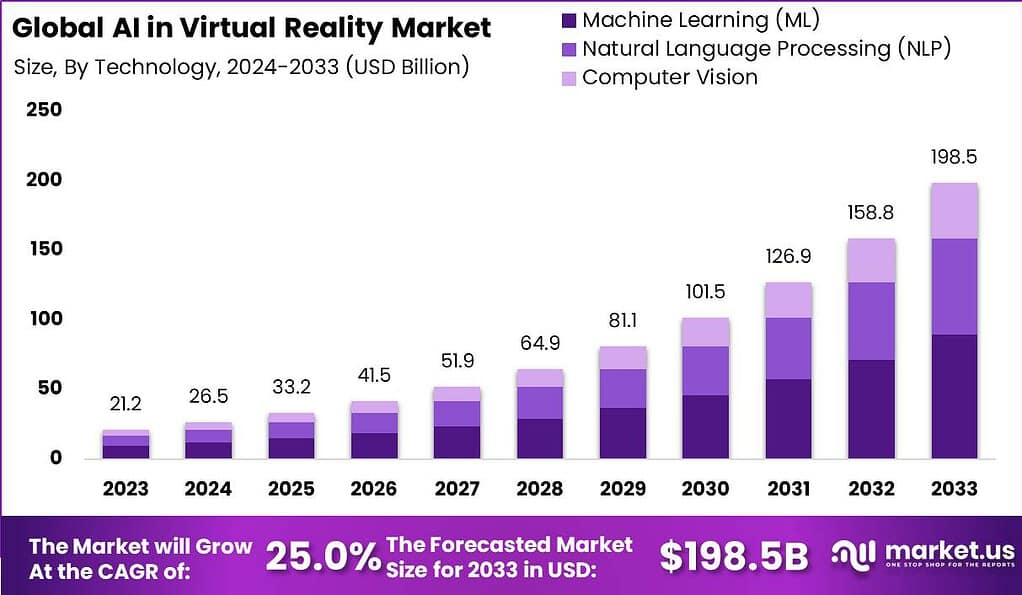
The Global AI in Virtual Reality Market size is expected to be worth around USD 198.5 Billion By 2033, from USD 21.2 Billion in 2023, growing at a CAGR of 25.0% during the forecast period from 2024 to 2033. In 2023, North America held a dominant market position, capturing more than a 38% share, holding USD 8.2 Billion revenue.
Artificial Intelligence (AI) in Virtual Reality (VR) integrates AI algorithms and methodologies into VR systems to create more immersive and interactive virtual environments. This integration enables VR systems to understand and predict user intentions, enhance interaction through natural language processing, and improve the personalization of the virtual experience.
The AI in Virtual Reality market is experiencing significant growth, driven by the increasing demand for enhanced user experiences and the broadening application of VR technologies in various sectors. As industries such as healthcare, education, and real estate embrace VR for training, simulations, and virtual showings, the integration of AI is becoming essential to provide more immersive and effective solutions.
The major driving factors of the AI in Virtual Reality market include the technological advancements in machine learning and neural networks, which significantly enhance the interaction capabilities of VR systems. Additionally, the increasing availability of high-speed internet and powerful computing capabilities at lower costs enable more sophisticated AI integrations. There’s also a growing interest in enhancing user engagement in virtual environments, driving the demand for AI capabilities that can create deeply immersive and personalized experiences.
The demand for AI-enhanced VR solutions is growing rapidly, driven by consumer interest in more immersive entertainment and effective educational and training tools. There is also significant demand in the healthcare sector for VR applications that offer realistic simulations for medical training and therapeutic interventions. This demand is supported by the increasing availability of affordable VR headsets and platforms that are capable of supporting AI functionalities, making advanced VR more accessible to a wider audience.
The popularity of AI in VR is soaring as users recognize the benefits of enhanced virtual experiences that offer greater interaction and personalization. This popularity is evident in the gaming industry, where players seek deeper immersion and adaptive gaming environments. Furthermore, in educational and professional training, the ability to simulate complex scenarios with intelligent responses is highly valued, enhancing the learning and preparation processes.
The market for AI in Virtual Reality is expanding, with its applications extending beyond entertainment into fields such as telemedicine, remote education, and real estate, where immersive VR tours can be enhanced with AI to provide interactive and personalized user experiences. The expansion is further supported by investments from major tech companies in both AI and VR technologies, aiming to explore new applications and improve existing ones.
Key Takeaways
- The Global AI in Virtual Reality Market is projected to reach a value of USD 198.5 billion by 2033, up from USD 21.2 billion in 2023, reflecting a robust compound annual growth rate (CAGR) of 25.0% over the forecast period from 2024 to 2033. This growth is driven by the increasing integration of AI technologies into virtual reality applications, enhancing user experiences across various industries.
- In 2023, North America emerged as the leading region, holding a dominant market share of 38%, translating to revenues of approximately USD 8.2 billion. The region’s leadership is attributed to its advanced technological infrastructure and the growing adoption of AI-powered VR solutions in entertainment, gaming, and enterprise sectors.
- The Machine Learning (ML) segment played a pivotal role within the AI in Virtual Reality market, securing more than 45% of the total market share in 2023. This dominance highlights the critical role of ML in enhancing VR systems’ intelligence, adaptability, and real-time interaction capabilities.
- The Gaming and Entertainment segment also demonstrated significant dominance, capturing over 40% of the market share in 2023. The immersive nature of AI-powered VR solutions continues to transform the gaming industry, offering more engaging and interactive experiences to users, which further accelerates market growth in this sector.
AI in Virtual Reality Statistics
- According to G2, the number of individuals utilizing VR technology worldwide stands at 171 million. The penetration rate of VR users is projected to rise from 52.8% in 2024 to 55.9% by 2028. This suggests a steady increase in the adoption of VR technologies across various sectors. By 2028, the number of AR & VR market users worldwide is anticipated to escalate to approximately 3,674.0 million.
- The Artificial Intelligence (AI) market is projected to experience robust growth, with its value expected to surge from USD 250.1 billion in 2023 to approximately USD 3,527.8 billion by 2033, reflecting a compound annual growth rate (CAGR) of 30.3%. In 2023, North America emerged as the dominant region in the AI market, with revenue contributions estimated at around USD 97.25 billion.
- The AR & VR Market is also expected to experience notable growth, with a projected market size of USD 106.2 billion by 2033, up from USD 34.8 billion in 2023, reflecting a CAGR of 11.8% during the forecast period.
- Specifically, the Virtual Reality Headset Market is anticipated to surge, with its market size forecasted to grow from USD 13 billion in 2023 to USD 121.9 billion by 2032, expanding at an impressive CAGR of 29.1%.
- In the United States, VR technology is becoming increasingly mainstream, with 1 in 5 adults having experienced VR, according to a VirtualSpeech report. Gaming remains the primary driver for 64% of VR users, while 52% of users cite TV and movies as their main usage, 42% mention sports, and 38% find value in social media experiences.
- Despite the immersive experiences VR offers, only 28% of VR headset owners use their devices daily. The majority, 39%, engage with VR on a weekly basis, while 19% use their devices monthly. Notably, only 6% of users engage with VR on an annual basis.
- A remarkable 75% of Forbes’ World’s Most Valuable Brands have already invested in AR/VR technologies, underscoring the strategic importance and future potential of these experiences in global brand development.
Technology Analysis
In 2023, the Machine Learning (ML) segment held a dominant market position within the AI in Virtual Reality market, capturing more than a 45% share. This significant market share can primarily be attributed to the versatility and robustness of ML algorithms, which are crucial in enhancing immersive experiences in virtual environments.
Machine Learning enables more sophisticated and responsive VR applications by improving the ability to interpret and respond to human behavior and environmental data in real-time. Machine Learning technologies have proven to be integral in advancing virtual reality systems. They facilitate improved interaction models and more personalized content delivery, which are key differentiators in the competitive landscape.
For instance, ML algorithms can analyze user behavior to tailor virtual scenarios or predict movements, enhancing the user’s sense of presence and immersion. This capability not only improves user satisfaction but also broadens the applications of VR across various sectors including gaming, training simulations, and educational content.
Moreover, the growth of the ML segment is supported by continuous advancements in neural networks, deep learning techniques, and reinforcement learning, which have substantially improved the efficiency and effectiveness of VR applications. The ability to process large datasets and learn from user interactions without explicit programming enables ML-driven VR systems to offer dynamic and adaptive experiences.
These experiences are highly valued in industries where customization and user engagement are critical, thereby driving the segment’s growth. Additionally, the integration of ML in VR is being accelerated by the increasing availability of high-quality data and the development of more sophisticated sensors and input devices.
These advancements enable more accurate tracking and rendering of complex user interactions, which are essential for creating realistic and engaging virtual environments. As businesses continue to recognize the value added by these technologies, investment in ML-driven VR solutions is expected to grow, further cementing Machine Learning’s leading position in the market.
Application Analysis
In 2023, the Gaming and Entertainment segment held a dominant market position in the AI in Virtual Reality landscape, capturing more than a 40% share. This segment’s leadership is largely due to the immersive and interactive experiences that AI-enhanced VR technology brings to gaming and entertainment, transforming how users engage with content.
AI algorithms are adept at creating realistic and dynamic environments that can respond in real-time to user actions, thereby offering a deeply engaging and personalized experience that is highly sought after in the entertainment sector. The appeal of AI-driven VR in gaming and entertainment extends beyond just the enhancement of visual experiences. AI facilitates more complex storylines, adaptable gameplay, and innovative interaction techniques that mimic real-life reactions and emotions.
These capabilities make virtual experiences more compelling and satisfying for users, leading to increased consumer spending in this segment. The integration of AI helps developers to craft experiences that are not only visually impressive but also contextually rich, offering gamers levels of depth previously unachievable without this technology.
Furthermore, the rising popularity of e-sports and interactive media has fueled demand for VR solutions that incorporate AI. These technologies enable a range of new content forms, such as virtual concerts, sports, and live events, which have begun to draw substantial audiences. AI enhances these experiences by optimizing performance, reducing latency, and improving the overall user interface, making VR a preferred platform for both developers and consumers in the entertainment domain.
Investments in AI and VR technologies are also increasing as companies recognize their potential to revolutionize entertainment experiences. This trend is supported by advancements in hardware and VR devices, which are becoming more accessible and affordable, further stimulating the growth of the Gaming and Entertainment segment. With continued technological advancements and growing consumer demand, this sector is poised to maintain its lead and expand its influence in the coming years.

Key Market Segments
By Technology
- Machine Learning (ML)
- Natural Language Processing (NLP)
- Computer Vision
By Application
- Gaming and Entertainment
- Healthcare
- Education and Training
- Retail and E-commerce
- Industrial
- Real Estate
- Defense and Aerospace
Driver
Integration of AI in Virtual Reality
The integration of Artificial Intelligence (AI) in Virtual Reality (VR) is propelling significant market growth, particularly through its enhancement of user experience and system efficiencies. AI’s capability to process vast amounts of data in real time allows VR environments to become more interactive and immersive.
For instance, AI algorithms can adjust virtual scenarios in real-time based on user behavior, significantly enhancing personalized experiences in gaming, training, and educational applications. This adaptability is crucial for developing sectors such as healthcare for surgical training and retail for customer experience simulations.
Restraint
Health Concerns Associated with VR Usage
A major restraint in the VR market is the health risks associated with prolonged use of VR technology. Users report various physical symptoms such as eye strain, headaches, and in extreme cases, neurological impacts, which could deter potential long-term use.
The physical discomfort, dubbed ‘VR fatigue’, stems from extended exposure to virtual environments that can disorient users’ perception and balance. This issue is compounded by concerns over mental health impacts, particularly in developing children and adolescents whose cognitive functions might be affected by early VR adoption.
Opportunity
Expanding Commercial Applications
The expansion of VR into commercial applications presents substantial opportunities. The technology’s application beyond entertainment into fields like real estate, where users can take virtual tours of properties, and retail, where customers can try products virtually before purchasing, is becoming increasingly feasible.
This expansion is supported by improvements in VR content realism facilitated by AI, making these experiences more valuable to users. Additionally, sectors such as military training and education are increasingly adopting VR to provide risk-free, real-world scenario training which can be tailored to individual needs by AI enhancements.
Challenge
Consumer Adoption and Skepticism
Despite advancements, a significant challenge facing the AI-enhanced VR market is consumer skepticism and the rate of adoption. The initial high cost of VR setups and the fear of obsolescence as technology advances rapidly can deter potential users.
Moreover, the public’s apprehension about data privacy and the ethical use of AI in immersive environments that can manipulate real-time interactions and behaviors poses a substantial barrier to widespread adoption. Overcoming these challenges requires continuous innovation and addressing privacy concerns transparently to build user trust.
Emerging Trends
Emerging trends in AI in Virtual Reality (VR) are increasingly focused on creating more social, immersive, and multifaceted experiences. One notable trend is the rise of social VR, where platforms are evolving into spaces for virtual meetups, events, and collaborative workspaces, fostering social interactions in a manner akin to physical presence.
This has particularly enhanced the appeal of VR in business settings, where such technology is used for team collaborations and meetings without the geographical constraints. Additionally, the integration of AI is making VR experiences more personalized and interactive, tailoring content dynamically to user preferences and behaviors, thereby enhancing user engagement and satisfaction.
Business Benefits
On the business side, VR offers significant benefits. It is proving instrumental in enhancing customer engagement and operational efficiencies. For instance, immersive VR experiences are being used in sectors like retail and real estate to offer virtual tours and try-before-you-buy options, which not only enrich the customer experience but also boost sales conversions.
In enterprise settings, VR’s ability to simulate real-world scenarios for training and development purposes is reducing costs and improving training outcomes. Moreover, AI-driven VR applications are enabling companies to create highly engaging marketing content and innovative product demonstrations, setting new standards in customer interaction and product visualization.
Regional Analysis
In 2023, North America held a dominant market position in the AI in Virtual Reality sector, capturing more than a 38% share with revenues amounting to USD 8.2 billion. This leadership is attributed to several factors, including advanced technological infrastructure and substantial investments in AI and VR technologies by leading tech companies in the region. North America is home to major technology firms and startups that are pioneers in developing VR hardware and software solutions integrated with AI, driving innovation and market growth.
Moreover, the region’s strong economic environment and the presence of a tech-savvy consumer base have fueled the adoption of VR technologies in various applications such as gaming, training simulations, and educational tools. These applications are increasingly becoming sophisticated with the integration of AI, enhancing user experiences by making them more interactive and immersive.
Government support and favorable policies related to technological advancements also play a crucial role in this region’s market dominance. Initiatives aimed at boosting the digital economy through investments in AI and VR technologies have facilitated growth, making North America an attractive market for new players and investors looking to explore and expand in the AI-driven VR space.

Key Regions and Countries
- North America
- US
- Canada
- Europe
- Germany
- France
- The UK
- Spain
- Italy
- Rest of Europe
- Asia Pacific
- China
- Japan
- South Korea
- India
- Australia
- Singapore
- Rest of Asia Pacific
- Latin America
- Brazil
- Mexico
- Rest of Latin America
- Middle East & Africa
- South Africa
- Saudi Arabia
- UAE
- Rest of MEA
Key Player Analysis
The AI in Virtual Reality market is witnessing significant contributions from major companies that are driving innovation through acquisitions, new product launches, and strategic partnerships. These actions are crucial as companies seek to enhance their product offerings and expand their market footprint.
Meta, formerly known as Facebook, stands out as a dominant player in the AI in VR landscape. The company has made significant strides through acquisitions such as the purchase of Oculus, which has been pivotal in integrating VR with social media platforms. Meta continues to innovate, with recent product launches focusing on improving the VR experience through enhanced AI integration that enables more realistic interactions within virtual environments.
Sony is renowned for its prowess in gaming and entertainment technologies, which it has effectively leveraged into the VR space. The company’s PlayStation VR headset is a testament to its innovative capabilities. Sony has also been active in forming partnerships to enhance its VR offerings, including collaborations with various game developers to create AI-enhanced VR games that offer immersive gaming experiences.
HTC has carved out a strong position in the market with its Vive VR headset. The company focuses on expanding its VR capabilities through both hardware advancements and software innovations. HTC has launched various new products that incorporate advanced AI to deliver improved user tracking and interaction within VR environments. Their approach includes strategic mergers and collaborations with tech startups to broaden their technological capabilities in AI.
Top Key Players in the Market
- Meta
- Sony
- HTC
- Microsoft Corporation
- Nvidia Corporation
- Unity Technologies
- Apple
- Qualcomm Technologies
- Samsung
- Other Key Players
Recent Developments
- Sony: Sony introduced a new spatial content creation system in January 2024, featuring a high-quality XR head-mounted display equipped with Qualcomm’s Snapdragon XR2+ Gen 2 platform. This setup enhances the image quality and user experience in virtual environments, designed especially for creators working in 3D and mixed reality spaces.
- Apple: Apple introduced its Vision Pro headset in June 2023. Recently, the company integrated AI-driven medical applications like Veyond Metaverse and Osso VR, allowing healthcare professionals to use VR for remote surgery assistance and training. These developments highlight Apple’s strategy of using AI to enhance the capabilities of its VR and AR devices.
- Qualcomm: Qualcomm announced the Snapdragon XR2+ Gen 2 platform in 2023, which powers VR and AR devices. This chipset enhances AI processing and graphic capabilities, significantly improving the user experience in virtual environments. Qualcomm is collaborating with Samsung and Google to integrate this new chip into future devices, helping them compete with Meta and Apple in the VR space.









