


Report Overview
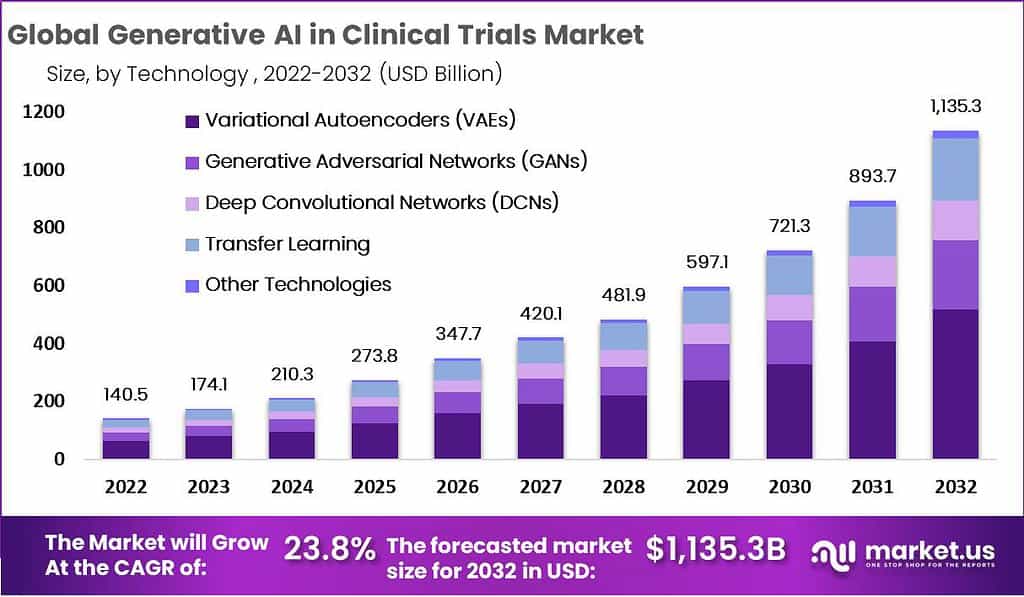
The Global Generative AI in Clinical Trials Market Size is projected to reach USD 1,135.3 Billion by 2032 from USD 140.5 Billion in 2022 with an impressive compound annual growth rate of 23.8%.
Artificial intelligence (AI) has the potential to greatly streamline and accelerate clinical trials through automation of repetitive tasks, advanced data analytics and predictive modeling. Clinical trials are an essential part of the drug development process, allowing researchers to test the safety and efficacy of new treatments on human participants.
However, clinical trials are extremely complex, lengthy and expensive undertakings. The average cost to develop a new drug and bring it to market is estimated to be over $2.5 billion, with clinical trials accounting for the largest proportion of these costs.
The clinical trial process typically takes several years to complete and involves extensive paperwork, complex logistical coordination, participant recruitment challenges and massive amounts of data collection and analysis. This results in delayed access to potentially life-saving treatments for patients.
Generative AI has emerged as a pivotal technology in the realm of clinical trials, offering transformative benefits in patient recruitment, data analysis, trial design, and drug development. Leveraging sophisticated deep learning and machine learning techniques, generative AI optimizes these critical processes, leading to heightened efficiency, reduced timeframes, and cost savings in the conduct of clinical trials.
Key Takeaways
- The Generative AI in Clinical Trials Market is projected to grow from USD 140.5 Billion in 2022 to USD 1135.3 Billion by 2032, with a CAGR of 23.8%.
- Generative AI is set to transform patient recruitment, trial design, data analysis, and drug development, enhancing clinical trial efficiency and reducing costs.
- The market’s expansion is driven by the increased efficiency and productivity of generative AI algorithms in clinical trials.
- Regulatory uncertainties and challenges in data access and privacy are major hurdles to the widespread adoption of generative AI in clinical trials.
- Clinical trial design and outcome prediction are promising areas for generative AI, improving trial adaptability, sample size accuracy, and outcome precision.
- Variational Autoencoders (49% market share) and Generative Adversarial Networks are pivotal in generating realistic patient data for optimizing trials.
- North America leads the market with its strong healthcare infrastructure and regulatory support, while Asia Pacific is poised for rapid growth due to rising healthcare investments.
Promising Applications
Within the various applications of generative AI in clinical trials, the segments related to clinical trial design and outcome prediction are expected to witness significant growth. Generative AI’s capabilities in enabling adaptive trial designs, precise sample size estimations, and accurate outcome predictions have positioned these segments for substantial advancements in the forecast period.
Dominant Technologies
Among the technologies driving the market, Variational Autoencoders (VAEs) and Generative Adversarial Networks (GANs) have emerged as dominant forces, with VAEs holding a significant market share of 49%. These technologies enable the synthesis of precise patient data and the generation of realistic, high-fidelity data, which are critical in optimizing and enhancing various clinical trial procedures.
Key Market Segments
Based on Application
- Data generation
- Clinical trial design
- Outcome prediction
- Adverse event detection
- Data imputation and Denoising
- Other Applications
Based on Technology
- Variational Autoencoders (VAEs)
- Generative Adversarial Networks (GANs)
- Deep Convolutional Networks (DCNs)
- Transfer Learning
- Other Technologies
Based on End-Use
- Researchers and Scientists
- Healthcare Professionals
- Clinical Trial Sponsors and CROs
- Data Analysts and Biostatisticians
- Other End Uses
Drivers
Efficiency Enhancements
Generative AI algorithms are significantly enhancing efficiency and productivity within clinical trial operations. These advanced algorithms aid in streamlining processes and improving outcomes, making clinical trials more efficient. This technological progress is a key factor in the growing adoption of generative AI tools across various stages of clinical research. By optimizing trial design and data management, these tools help in reducing time and costs associated with drug development.
Personalized Therapy and Technological Advances
The use of generative AI extends beyond operational improvements, as it also supports the personalization of therapies tailored to patient-specific characteristics. This capability of customizing treatment enhances the effectiveness of clinical trials, leading to more successful therapeutic outcomes. Ongoing advancements in AI technology continue to push the boundaries, facilitating the discovery and development of new medications. This ongoing innovation is crucial in transforming how clinical trials are conducted and therapies are developed.
Restraints
Evolving Regulatory Environment
The integration of generative AI into clinical trials offers numerous potential advantages. However, this market faces significant challenges, particularly due to the evolving regulatory environment. These regulations aim to address the security, reliability, and ethical implementation of AI algorithms. As these guidelines continue to develop, they introduce a level of uncertainty that can complicate the adoption of such technologies in clinical settings.
Data Privacy and Quality Concerns
Additional challenges include issues related to the availability and quality of clinical trial data. There are also heightened concerns regarding data privacy. These factors collectively pose barriers to the effective and widespread use of generative AI in clinical trials. Addressing these concerns is crucial for harnessing the full potential of AI technologies in improving clinical research outcomes.
Opportunity
Enhancing Clinical Trials with Generative AI
Generative AI significantly enhances the efficiency of clinical trials by producing synthetic data that mirrors real patient data. This innovation supports the development and assessment of new treatment plans, optimizes dosages, and aids in early detection of adverse effects. The technology also streamlines the process of identifying and enlisting suitable participants for clinical trials. By leveraging data from electronic health records, social media, and patient forums, generative AI expedites recruitment and boosts participation rates.
Optimizing Trial Protocols
Further, generative AI offers substantial improvements in clinical trial protocols. By analyzing historical data from past trials, AI algorithms can uncover patterns and recommend optimal control groups and sample sizes. This leads to more efficient, cost-effective trials that enhance statistical power, ultimately speeding up the time to market for new therapies.
Latest Trends
Innovations in Synthetic Control Arms
A recent innovation within clinical trial methodologies is the utilization of generative AI to create synthetic control arms. This technique harnesses historical data to simulate control groups, thereby eliminating the need for traditional control arms. The benefit of this approach is the acceleration of the evaluation process for new treatments. By adopting synthetic control arms, researchers can overcome the typical delays associated with conventional trial methods, facilitating quicker advancements in medical treatments.
Generative AI in Medical Imaging
Another progressive trend in medical research involves the use of generative adversarial networks (GANs) and other generative AI technologies to produce realistic medical images and pathology slides. These synthetic images serve multiple purposes: they enhance training and testing processes, augment limited datasets, and enable the simulation of various disease states. Utilizing these synthetic resources addresses major hurdles such as data accessibility and privacy concerns, ultimately supporting more extensive research and the development of robust algorithms.
Regional Analysis
North America currently dominates the market, attributed to its strong healthcare infrastructure, advanced technology, and favorable regulatory environment. This leadership is supported by the region’s commitment to incorporating cutting-edge solutions within the healthcare sector. The well-established infrastructure and a proactive regulatory landscape facilitate the smooth integration of innovative technologies, making it a prime market for new advancements in clinical trials.
In contrast, the Asia Pacific region is emerging as the fastest-growing market, driven by rapid developments in its healthcare sector and increasing R&D investments. The diverse genetic makeup and significant disease prevalence in this region amplify its growth potential. As investments continue to rise, the Asia Pacific is set to become a critical market for the integration of generative AI in clinical trials, leveraging its vast resources and growing capabilities.
Key Regions and Countries
- North America
- US
- Canada
- Europe
- Germany
- France
- The UK
- Spain
- Italy
- Russia
- Netherland
- Rest of Europe
- Asia Pacific
- China
- Japan
- South Korea
- India
- New Zealand
- Singapore
- Thailand
- Vietnam
- Rest of APAC
- Latin America
- Brazil
- Mexico
- Rest of Latin America
- Middle East & Africa
- South Africa
- Saudi Arabia
- UAE
- Rest of MEA
Key Players Analysis
The Generative AI in Clinical Trials Market is experiencing significant contributions from leading technology corporations that are enhancing the use of AI in this sector. IBM Watson, Microsoft Corporation, Google LLC, Tencent Holdings Ltd., and Neuralink Corporation stand out with their advanced solutions. These companies are focusing on improving aspects of clinical trials such as data analysis, patient recruitment, and trial design optimization. Their technologies also support clinical decision-making processes, which are crucial for the efficiency and success of clinical trials.
In the specialized area of deep genomics, the integration of artificial intelligence and genetics is proving transformative. Utilizing deep learning algorithms, these key players are able to identify new therapeutic targets and refine clinical trial designs. This innovative approach not only speeds up the development of effective treatments but also enhances the precision of genetic research in clinical settings. The efforts of these companies are pivotal in propelling forward the growth and advancement of the Generative AI in Clinical Trials Market.
Market Key Players
- IBM Watson
- Microsoft Corporation
- Google LLC
- Tencent Holdings Ltd.
- Neuralink Corporation
- Johnson & Johnson
- Other Key Players
Recent Developments
- April 2024: Partnership with Cognizant: Microsoft announced a strategic partnership with Cognizant, investing $1 billion over the next three years to expand the use of generative AI in enterprise operations. This partnership is set to enhance business operations and employee experiences across various industries, including healthcare. Cognizant will utilize Microsoft’s Copilot capabilities, integrated within Microsoft 365 and GitHub, to drive AI adoption and innovation, potentially impacting millions of users across its network.
- March 2024: Google introduced a new series of healthcare-focused generative AI models called MedLM for specific applications like Chest X-rays. This development aims to enhance the capacity of AI to integrate diverse healthcare data forms, aiding in more comprehensive health assessments.
- October 2023: Tencent Holdings Ltd. was part of a significant investment round where Baichuan, a Chinese AI startup, raised $300 million. This funding round, which also saw contributions from Alibaba Group Holding Ltd. and Xiaomi Corp., propelled Baichuan to a valuation of over $1 billion. Baichuan is known for its development of generative AI services and aims to compete with major industry players like Microsoft Corp. and OpenAI.









