


Report Overview
The Global Bionic Eye Market size is expected to be worth around USD 524 Million by 2032, from USD 175 Million in 2022, growing at a CAGR of 11.9% during the forecast period from 2024 to 2033.
A bionic eye is an electrical prosthetic device implanted surgically into the human eye to let light transduction, i.e., change of light from the environment into impulses; the brain can process in individuals who sustained severe damage to the retina. The bionic eye contains an exterior camera and transmitter and an internal microchip. The camera is fitted on a pair of eyeglasses, where it forms the visual stimuli of the environment before radio waves emission.
Rising product approvals, rising prevalence of vision loss, and intensive research and development focused on product innovation to make bionic eye market demand. Furthermore, product adoption among individuals suffering from incurable eye diseases and permanent vision loss is accelerated by positive clinical outcomes.

Key Takeaways
- Market Growth: Global Bionic Eye Market is set to triple from USD 175 million in 2022 to USD 524 million by 2032, at a remarkable CAGR of 11.9%.
- Eye Type Dominance: External eye segment holds a substantial 57.4% revenue share, with a focus on improving patient outcomes through technological advancements.
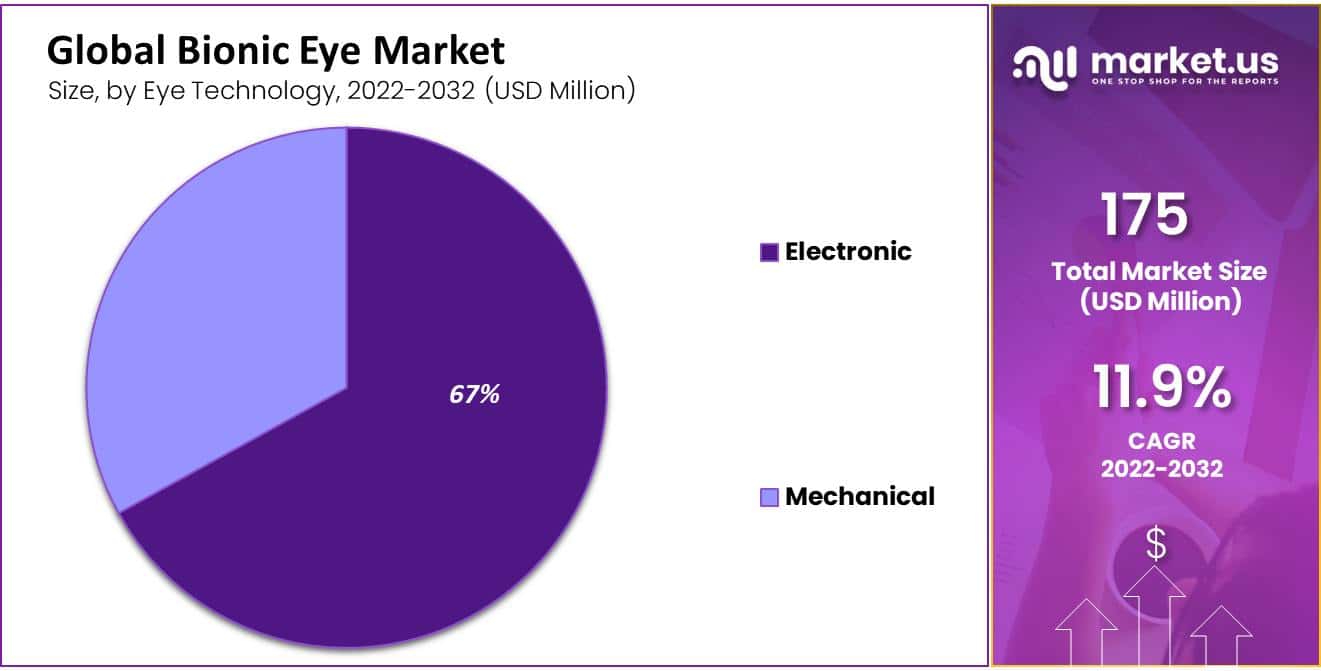
- Technology Preference: Electronic eye technology leads with 67% market share, driven by clinical trials and high adoption rates.
- Hospital Dominance: Hospitals account for 62.2% of the bionic eye market, backed by expert ophthalmologists and successful collaborations.
- Drivers: Rising prevalence of vision loss and eye disorders are key growth drivers.
- Restraints: High treatment costs hinder market expansion; availability is limited to regions like the U.S.
- Opportunities: Significant research investments and government initiatives drive growth and innovation.
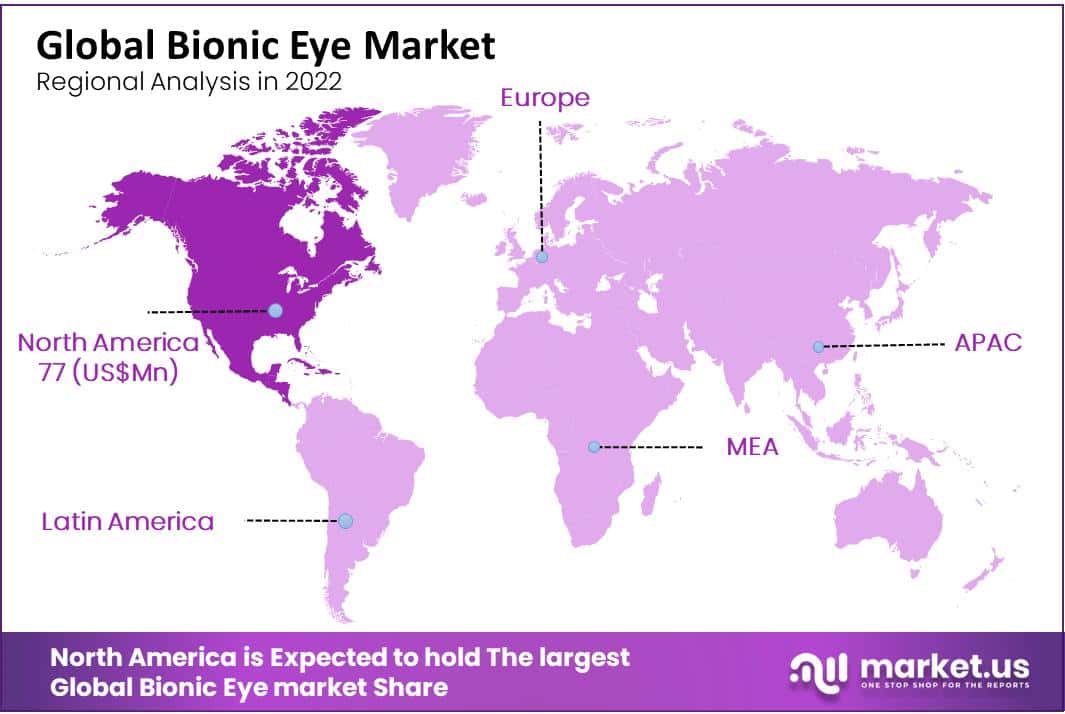
- Regional Dominance: North America holds a dominant market share (44%) due to advanced healthcare services and research. Asia Pacific is the second-largest growing region, driven by the launch of novel bionic eye implants.
Eye Type Analysis
Based on eye type, the bionic market segment is segmented into the external eye and implanted eye. The external eye segment dominates the bionic eye market with a revenue share of almost 57.4%. A significant area of focus is technological advancements to give better patient outcomes. For instance, an Orion bionic eye with upgraded external hardware that includes an updated video processing unit featuring a face detection system and 3D vision with stereo cameras fitted on eyewear was introduced by second sight.
The latest version has properties of obstacle detection and navigational capabilities for patients. In addition, the rising prevalence of age-associated vision loss caused by macular degeneration which results in blurred vision can surge bionic eye adoption.
Eye Technology Analysis
Based on eye technology, the bionic eye market is segmented into electronic and mechanical. The electronic segment dominated the market for bionic eyes with a revenue share of almost 67% during the forecast period. The segment’s growth is due to factors like an increasing number of clinical trials and high adoption rates.
These are neural stimulation devices implanted in the patient’s eyes. A video camera gives video signals decoded by a battery-powered device worn by the patient, which is then transformed into electrical stimulation data. The data is then forwarded to implanted stimulation device.
On the other hand, the mechanical eye implant segment is witnessed to be fast-growing during the forecast period. These implants treat end-stage age-related macular degeneration. These devices are implanted in the eye’s posterior chamber, which helps in increasing the size of the visual projection onto the retina.
End-User Analysis
Based on end-users, the market for bionic eyes is segmented into hospitals, ophthalmic clinics, and other end-users. The hospital segment dominates the market for bionic eyes with a revenue share of almost 62.2%. Hospitals present the first line of care to patients and are well-organized with expert ophthalmologists and the latest equipment that provide efficient patient care.
High medical coverage for the patient population and positive outcome of surgeries is expected to increase surgical procedures, hence boosting the market growth. In addition, the hospital’s and product developers’ collaborations for initiating clinical trials have led to market growth.
Key Market Segments
By Eye Type
- External Eye
- Implanted Eye
By Eye Technology
- Electronic
- Mechanical
By End-User
- Hospitals
- Ophthalmic Clinics
- Other End-Users
Drivers
Rise in Prevalence of Vision Loss
The increase in vision loss is a key market driver for the bionic eye market—the rise in population results in a rise in the number of infants born with vision problems. In addition, there are many individuals with moderate or severe blindness. Hence, the need to effectively treat the problem fuels the bionic eye market demand.
Severe as well as moderate eye problems can be cured by bionic eye. Furthermore, several individuals with vision problems have the condition of uncorrected presbyopia, and these complications are treated with a bionic eye.
Rise in the prevalence of eye disorders.
The prevalence of eye disorders is another key factor driving market growth. Eye diseases in infants are increasing in many regions. There are many infants born with eye disorders that need to be addressed.
Thus, the rise in eye disorders leads to more adoption of bionic eyes. Also, the geriatric population is another factor with many eye conditions. In developing nations, there is a need to treat these diseases. All these factors have a positive impact on the bionic eye market.
Restraints
The high cost associated with this treatment renders market growth. A bionic eye transplant is a sophisticated procedure involving the brain’s function to rectify correct vision. Advanced processes and technologies are used in bionic eye high end- products.
The overall cost of the treatment is increased due to the 3D cameras and modern equipment used to carry out this procedure. Bionic eye systems are available only in the U.S. There are many regions where proper procedures are still unavailable. Thus, the cost factor hampers the market growth.
Opportunity
There are tremendous funds for research of bionic eye surgeries. These investments can bring exceptional growth opportunities in the bionic eye market. Government initiatives to raise funds for the eye market are increasing.
This helps in the restoration of vision for many individuals. Advanced implants will be available with R & D. Various bionic eye implants will be exceptional. With the increased funds, the devices used to implant bionic eyes will improve. In the coming years, these developments can treat rare eye conditions also. There is a rise in age-related eye macular degeneration.
However, preventing these problems with research is possible. High investments can result in the remarkable market growth of the bionic eye. Hospitals have expert ophthalmologists as these experts can carry out successful eye implants; hospitals’ demand for a bionic eye is expected to be immense. Also, efficient eye treatment is possible in hospitals. Future development of bionic eyes will be due to increased eye surgeries. All these factors will fuel market growth.
Trends
Cumulative growth analysis
The increase in vision loss calls for more eye treatments, and vision loss for the geriatric population is creating awareness for the bionic eye. Thus, the prevalence of eye disease is another demand driver. In addition, there are rare eye diseases that require advanced eye treatment. The cost of treatment is a challenging factor. A lack of awareness can have a negative impact on the market.
Regional Analysis
North America dominates the market for bionic eyes, with a revenue share of 44% during the forecast period. North America has access to healthcare services, innovative infrastructure, and intensive research activities.
Therefore, the technology significantly impacts the market, beating the challenge of printing electronics on curved surfaces. To develop a solar-powered retina to cure blindness due to degenerative retinal disease- retinitis pigmentosa. Asia Pacific is the second largest growing region because of the accelerated launch of novel bionic eye implants.
Key Regions
- North America
- The US
- Canada
- Mexico
- Western Europe
- Germany
- France
- The UK
- Spain
- Italy
- Portugal
- Ireland
- Austria
- Switzerland
- Benelux
- Nordic
- Rest of Western Europe
- Eastern Europe
- Russia
- Poland
- The Czech Republic
- Greece
- Rest of Eastern Europe
- APAC
- China
- Japan
- South Korea
- India
- Australia & New Zealand
- Indonesia
- Malaysia
- Philippines
- Singapore
- Thailand
- Vietnam
- Rest of APAC
- Latin America
- Brazil
- Colombia
- Chile
- Argentina
- Costa Rica
- Rest of Latin America
- Middle East & Africa
- Algeria
- Egypt
- Israel
- Kuwait
- Nigeria
- Saudi Arabia
- South Africa
- Turkey
- United Arab Emirates
- Rest of MEA
Key Players Analysis
Emerging key players are focused on various strategic policies to develop their respective businesses in foreign markets. For instance, several bionic eye market companies are concentrating on expanding their existing operations and R&D facilities.
Furthermore, businesses in the bionic eye market are developing new products and portfolio expansion strategies through investments, mergers, and acquisitions. In addition, several key players are now focusing on different marketing strategies, such as spreading awareness about natural ingredients and boosting the target products’ growth.
With several local and regional players, the market for companion diagnostics is fragmented. Market players are subject to intense competition from top players, particularly those with strong brand recognition and high distribution networks. As a result, companies have gained various expansion strategies, such as partnerships and product launches, to stay on top of the market.
Market Key Players
- Second Sight Medical Products LLC
- Nidek Co. Ltd.
- Nano Retina Ltd.
- MetaModal LLC
- Biomedical Technologies S.L.
- Bionic Vision Technologies
- Pixium Vision
- Monash Vision Group
- Other Key Players
Recent Developments
- In June 2024: Bionic Vision Technologies announced the successful long-term results of its ‘second generation’ bionic eye clinical trial. Over two and a half years, four patients with retinitis pigmentosa experienced substantial improvements in functional vision, daily activities, and quality of life. This trial, involving multiple Australian institutions, confirmed the implant’s stability and functionality, with 97% of electrodes still operational after 2.7 years.
- In September 2022: The merger between Second Sight Medical Products Inc. and Nano Precision Medical was completed, resulting in the formation of Vivani Medical, Inc. This merger incorporated NPM’s technology for subdermal drug implants into Second Sight’s portfolio. Post-merger, Second Sight, now Vivani Medical, reported having about $55 million in cash to advance the development of their combined technologies, which include the NPM-119 and Second Sight’s visual prosthetic devices.









