


Report Overview
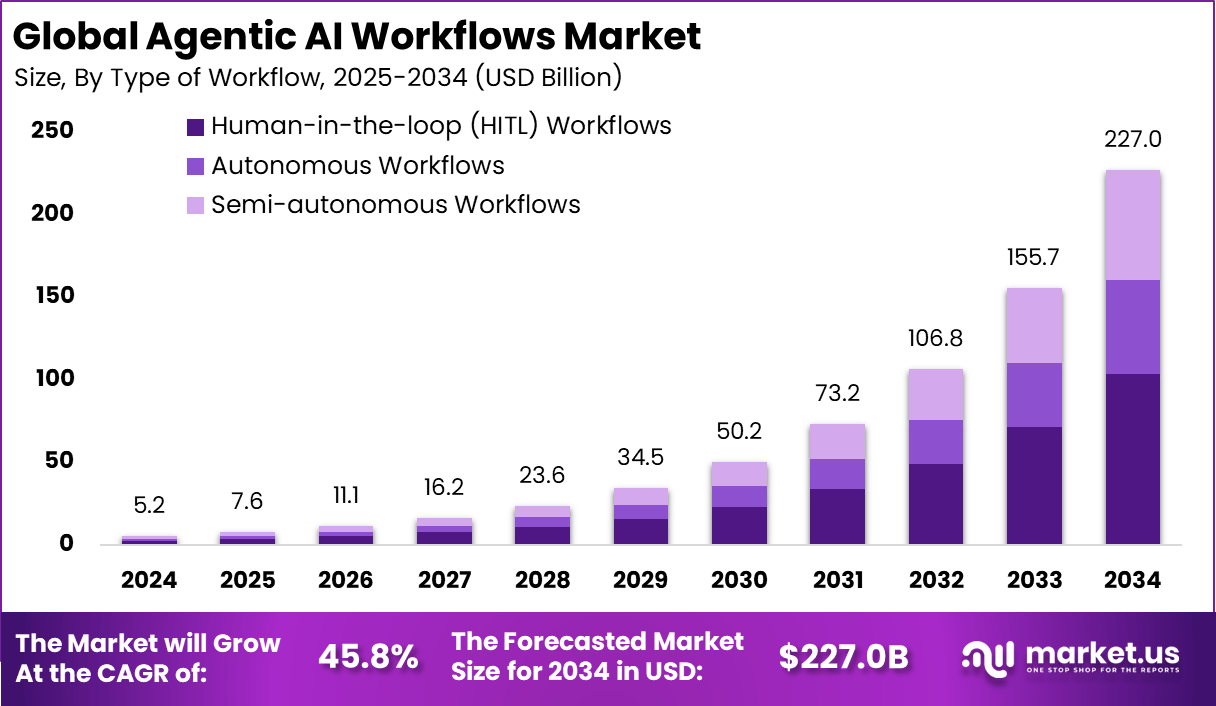
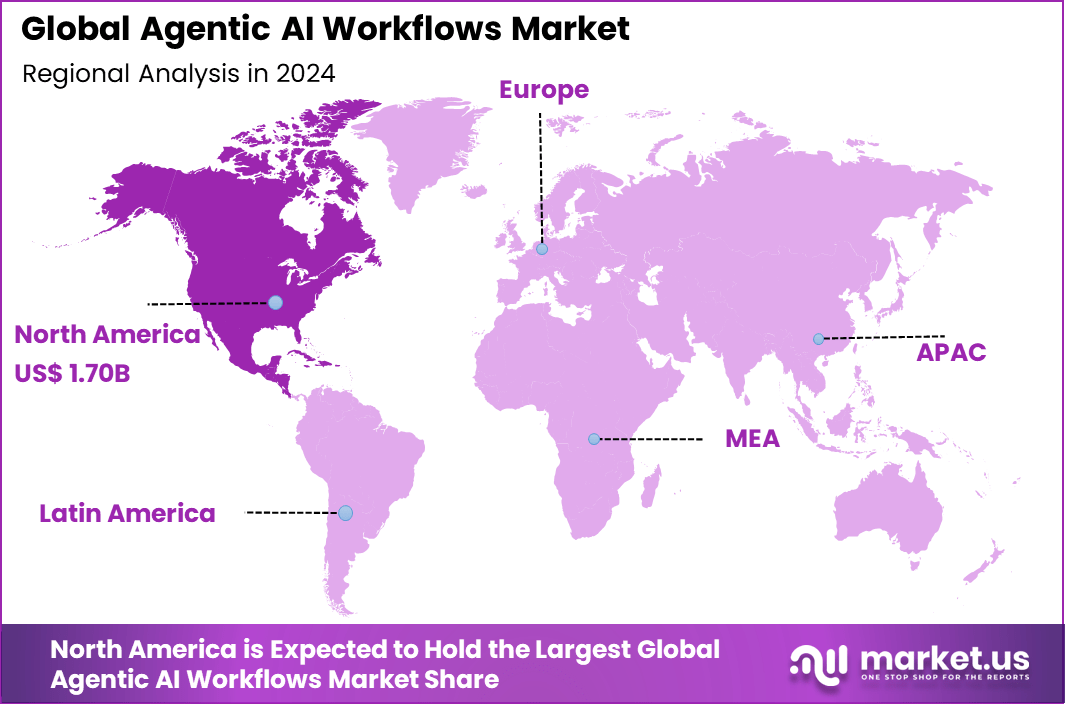
The Global Agentic AI Workflows Market size is expected to be worth around USD 227 Billion By 2034, from USD 5.2 billion in 2024, growing at a CAGR of 45.8% during the forecast period from 2025 to 2034. In 2024, North America held a dominan market position, capturing more than a 32.8% share, holding USD 1.7 Billion revenue.
Agentic AI workflows refer to processes in which autonomous AI agents plan, decide, and act across multiple steps with minimal human oversight. These agents coordinate tasks, adapt to changing inputs, and steer complex operations toward goals. Unlike traditional automation or RPA (robotic process automation), agentic workflows support dynamic decision making, reasoning, tool usage, and coordination across systems.
Agentic AI is quickly becoming a central topic among IT leaders in 2025. UiPath’s recent report found that 93% of U.S. IT executives were extremely or very interested in Agentic AI, while 32% planned investments within six months, and 37% already use some form of agentic automation in their companies. Interest is translating to broad action: 77% of executives are prepared to invest in Agentic AI over the year, and 90% report that their current business processes could be improved by agentic AI technology.
One of the largest driving factors in this market is the demand for tangible productivity improvements and sharper operational efficiency. With agentic AI, companies report up to 40% fewer manual errors in their workflows and a 30% boost in employee satisfaction, as routine burdens decrease. The drive to improve service delivery times, cut resource wastage, and meet compliance requirements is encouraging more sectors to adopt these intelligent systems.
According to Market.us, The Global Agentic AI Market is projected to reach USD 196.6 billion by 2034, increasing from USD 5.2 billion in 2024, at a CAGR of 43.8% between 2025 and 2034. In 2024, North America led the market with over 38% share, generating USD 1.97 billion in revenue. The US market alone was valued at USD 1.58 billion in 2024, with a CAGR of 43.6%.
Adoption rates this year have sharply accelerated. Research shows 75% of companies have deployed AI agents in some capacity, up from just 51% earlier in 2025. Nearly 80% of organizations are already using agentic AI agents, and 96% plan to expand their use in the next year, while almost half of technology companies report fully deploying or adopting agentic AI systems.
In terms of demand, sectors like financial services, healthcare, and manufacturing are showing double-digit growth in preference for agentic AI, especially for process automation and adaptive decision support. Surveys indicate over 55% of businesses want to expand their use of autonomous workflows in the next year, with particular interest in improving customer experience and reducing bottlenecks that slow down digital operations.
Key Insight Summary
- Human-in-the-loop (HITL) workflows lead the market, holding 45.7% share, as enterprises prioritize oversight in AI-driven decisions.
- Natural Language Processing (NLP) accounts for 35.6%, reflecting strong adoption for conversational and automation use cases.
- On-premises deployment dominates with 60.2%, showing continued preference for data security and compliance in sensitive environments.
- Large enterprises represent the majority share at 74.6%, as they integrate agentic AI into complex business processes.
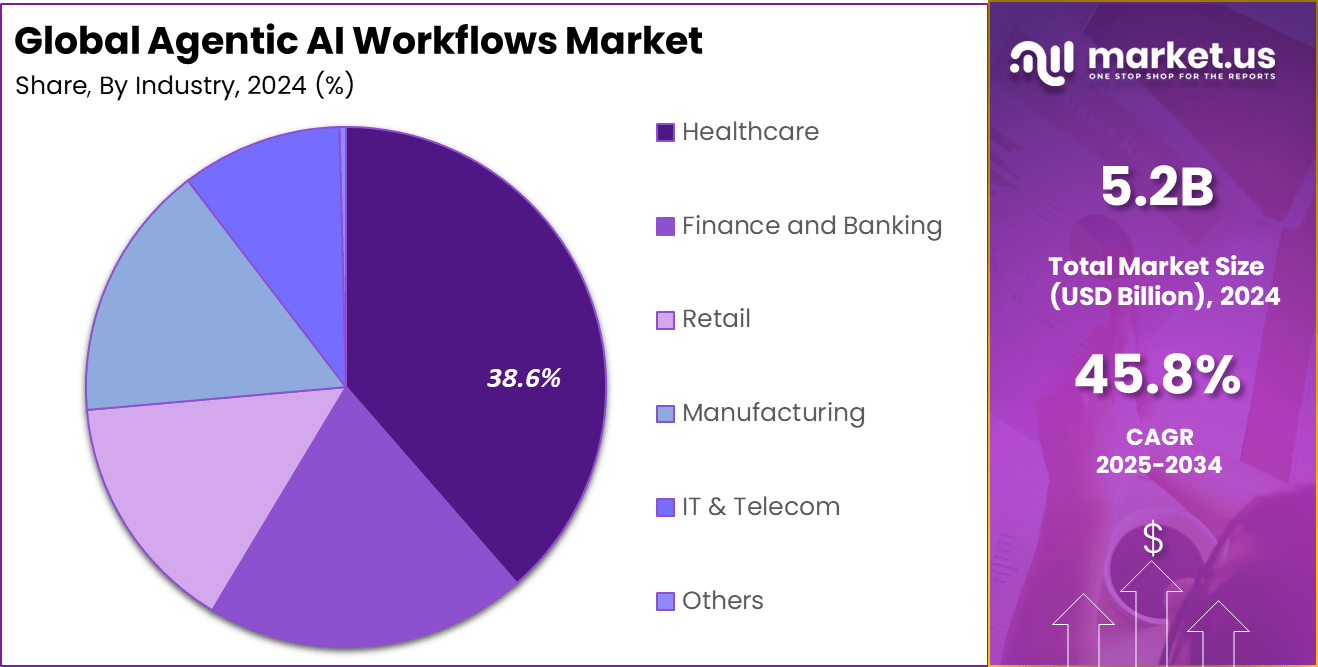
- Healthcare industry leads with 38.6%, driven by use cases in diagnostics, patient engagement, and workflow optimization.
- North America holds 32.8% of the global market, underscoring its leadership in AI adoption.
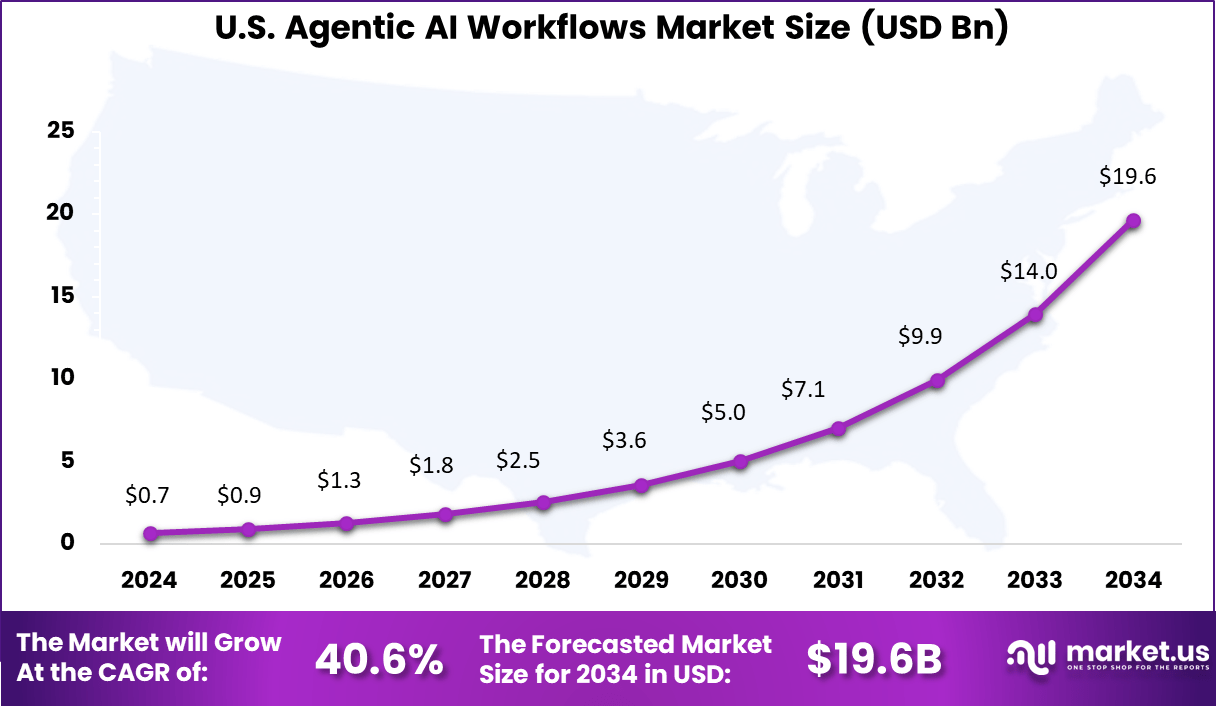
- The US market is valued at 0.65 billion USD, with rapid expansion supported by innovation funding and enterprise adoption, grow at a 40.6% CAGR, indicating strong momentum in scaling agentic AI solutions.
Analysts’ Viewpoint
Increasing adoption of technologies such as multi-agent orchestration platforms, adaptive reasoning engines, and real-time process monitoring tools is fueling momentum in this market. The use of fine-tuned models and collaborative AI agents is rising, with 45% of enterprises reporting positive ROI from agentic systems after their first year of deployment.
Investment opportunities continue to widen. Venture capital and R&D budgets for agentic AI workflows saw a 24% increase in the past year, as firms bet big on both infrastructure upgrades and application development. Governments and private equity groups are showing interest in funding scalable automation platforms, especially those that promise industry-specific solutions with strong compliance features and auditing capabilities.
Businesses gain clear benefits from integrating agentic AI workflows including faster process cycle times, improved data accuracy, and 30% stronger customer retention rates. Organizations also note higher transparency in audit trails and increased employee engagement, with task completion times dropping significantly in routine-heavy departments. The net effect is more reliable business outcomes and easier reporting across teams.
Business and operational statistics
- Operational efficiency: Organizations that have adopted agentic workflows report up to a 35% improvement in efficiency and 40% faster task execution. Independent research indicates that agentic AI can enhance overall productivity levels by nearly 40%, underscoring its role as a critical driver of performance gains.
- Customer service: By 2028, agentic AI is expected to manage nearly 68% of all customer service interactions, compared to less than 1% in 2024. Projections show an 80% autonomous resolution rate for common service issues by 2029, contributing to up to a 30% reduction in operating costs for support functions.
- Scalability: Enterprises, particularly small and mid-sized businesses (SMBs), benefit from agentic AI by scaling operations without proportional increases in workforce costs. In many cases, SMBs recorded a 25% increase in productivity, enabling growth without resource strain.
- Cost reduction: Case studies consistently show that automation of repetitive and complex processes can yield a 30% reduction in operational costs, supporting both profitability and reinvestment strategies.
- Adoption rate: A 2025 Deloitte study predicts that by 2026, more than 60% of large enterprises will have deployed agentic AI at scale, making it a mainstream technology for business transformation.
Workflow Performance Metrics
The impact of agentic AI becomes clearer when examining specific application metrics across industries.
- Sales and marketing: A global technology firm achieved a 67% increase in meeting conversion rates and a 25% improvement in customer satisfaction after integrating an agentic AI sales engagement platform.
- Financial services: In banking, agentic AI has streamlined complex processes. At Barclays, the introduction of an AI-powered loan approval system reduced processing times by 70% while decreasing the error rate to just 5%.
- IT support: Agentic AI solutions are redefining enterprise support. The Atom agent by Atomicwork recorded a 65% deflection of support tickets and achieved 75% lower latency, significantly reducing response times for IT issues.
- Healthcare: In patient-facing roles, the Cleveland Clinic demonstrated notable efficiency gains. Its AI-based scheduling and allocation system reduced average patient wait times by 29 minutes and decreased appointment no-show rates by 15%, directly enhancing patient care delivery.
Use Cases and Adoption by Industry
- Finance: Nearly 49% of financial institutions prioritize agentic AI for fraud detection. Leading banks have reported a 3.6x return on investment (ROI) through efficiency improvements in fraud detection and reconciliation processes.
- Healthcare: Around 55% of healthcare organizations are embedding AI into patient scheduling systems, while 42% expect measurable improvements in patient care delivery.
- Customer Service: Approximately 57% of businesses cite customer service as a top use case, where AI is applied to automate responses and resolve customer queries more efficiently.
- Sales and Marketing: Adoption is also strong in commercial functions, with 54% of companies using or planning to use agentic AI in sales and marketing workflows to enhance engagement and conversion.
- Software Development: In technology, agentic AI is already integrated into over 150,000 GitHub repositories, primarily for autonomous pull request reviews. This has reduced human coding effort by up to 60%, streamlining software development cycles.
Impact of Agentic AI
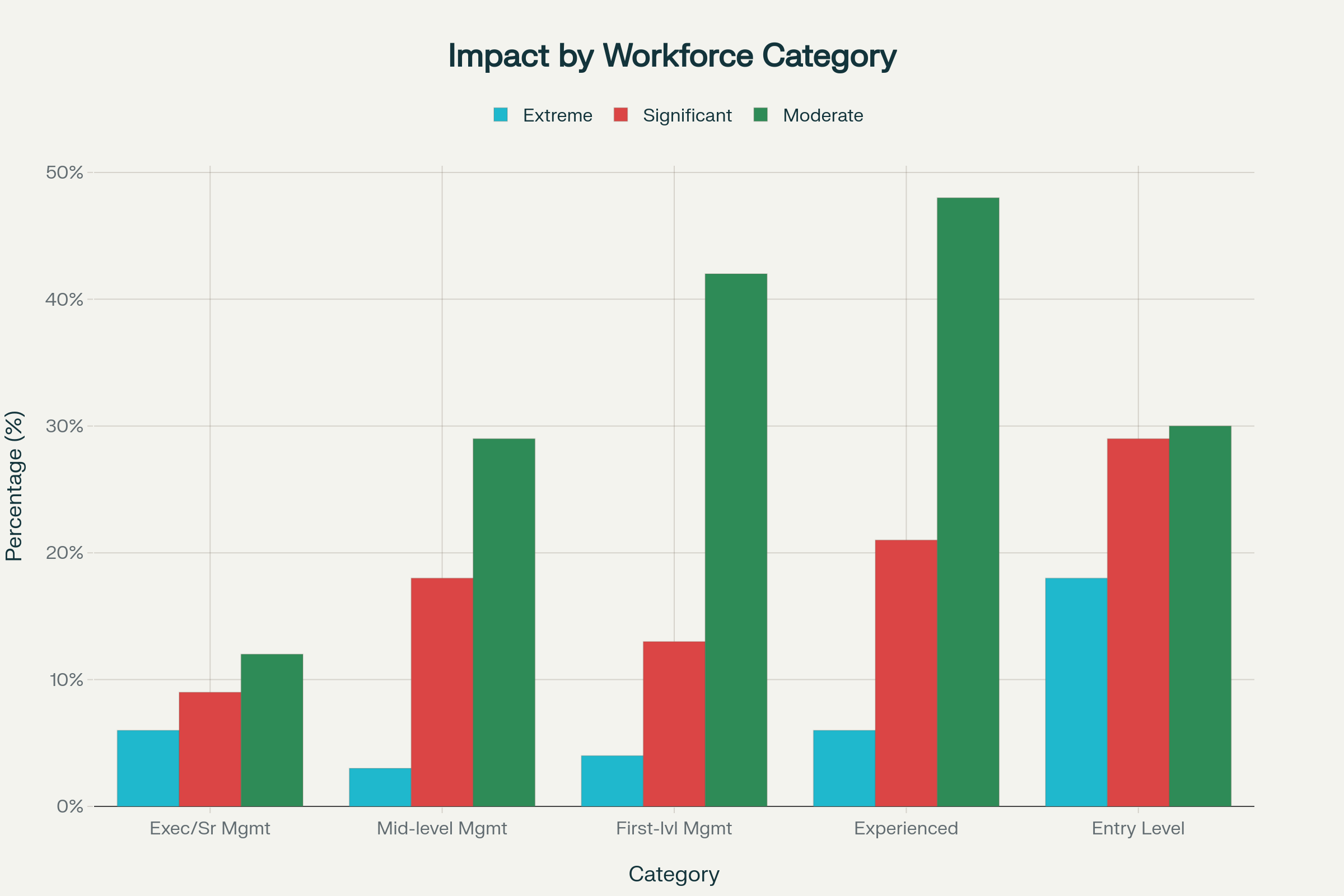
Summary: Projected Impact of AI on Workforce Roles by 2025
| Workforce Category | Extreme Impact | Significant Impact | Moderate Impact |
|---|---|---|---|
| Executive/Senior Management | 6% | 9% | 12% |
| Mid-level Management | 3% | 18% | 29% |
| First-level Management | 4% | 13% | 42% |
| Experienced | 6% | 21% | 48% |
| Entry Level | 18% | 29% | 30% |
US Market Size
The United States leads regional growth with strong adoption across industries, particularly healthcare, finance, and IT. The market in the country is expanding rapidly with a striking 40.6% CAGR, reflecting the surge in both enterprise-scale applications and regulatory-driven adoption.
In 2024, North America accounted for 32.8% of the market share, driven by strong enterprise adoption and a favorable technological ecosystem. The region benefits from early investment in advanced AI frameworks and partnerships that focus on developing safe, reliable, and scalable workflows.
By Type of Workflow
In 2024, Human-in-the-loop (HITL) workflows dominate the agentic AI workflows market with 45.7% share. These workflows ensure that while AI automates large portions of tasks, human oversight remains central to decision-making.
Organizations adopt HITL models when sensitive data, regulatory requirements, or mission-critical operations are involved, as they reduce the risks of full automation. This makes them especially valuable in sectors like healthcare, finance, and defense where a margin for error is minimal.
The combination of machine efficiency and human judgment creates the right balance between speed and accuracy. HITL workflows also help build trust, as users are more comfortable knowing humans validate or override AI-generated outcomes. This hybrid approach will likely continue to hold ground until autonomous systems mature enough to take on responsibility without human checks.
By Technology
In 2024, Natural Language Processing (NLP) held 35.6% of the market. NLP enables agentic AI systems to interpret, understand, and respond to human language with accuracy, making workflows more fluid and intuitive. Its integration has led to practical applications such as conversational agents, document automation, and smart analytics that adapt to everyday language inputs.
The demand for NLP is growing as enterprises try to bridge communication between systems and users. By removing the complexity of commands and replacing it with natural conversation, NLP-driven workflows help reduce training time, improve accessibility, and make AI systems more approachable across industries.
By Deployment Type
In 2024, On-premises deployment accounted for 60.2% of the market share. Large organizations prefer this model as it provides complete control over data, infrastructure, and operational workflows. Industries dealing with confidential or highly regulated data, such as healthcare, law, or banking, view on-premises systems as safer compared to cloud or hybrid deployments.
Another major driver is performance reliability. On-premises deployment provides organizations with customization and security advantages, ensuring that AI-powered workflows run uninterrupted by external downtimes or connectivity issues. This flexibility explains the dominance of on-premises models in high-stakes and compliance-heavy environments.
By Enterprise
In 2024, Large enterprises represented 74.6% of the adoption share. With their deep budgets and established IT infrastructure, these organizations are best positioned to scale agentic AI workflows across departments. They use these systems to manage complexity, automate repetitive operations, and improve productivity in areas spanning knowledge management to customer engagement.
Moreover, large enterprises often prioritize integrated solutions that blend human expertise with AI autonomy, making them early adopters of agentic workflows. Their implementation strategies often serve as benchmarks for smaller players, setting standards in functionality, governance, and AI utilization practices.
By Industry
In 2024, Healthcare stood out with 38.6% contribution to the market. The sector embraces agentic AI workflows for patient monitoring, diagnostic assistance, and managing large health records with reduced human error. These systems support doctors by analyzing patient data in real time while keeping critical decisions under human supervision.
In addition, healthcare organizations have found agentic workflows useful in automating hospital operations, resource allocation, and clinical documentation. By reducing administrative burden, these solutions allow medical professionals to focus their attention on direct patient care, improving both efficiency and outcomes.
Emerging Trends
Emerging trends in agentic AI workflows emphasize multi-agent collaboration and self-healing systems. These workflows increasingly handle complex, multi-step tasks with persistent execution over time. By 2029, it is forecasted that agentic AI will resolve 80% of common customer service issues autonomously, reducing operational costs by 30%.
Another trend is hyper-personalized AI agents providing tailored user experiences and the integration of agentic AI into supply chain and finance sectors for dynamic real-time decision-making. These trends showcase how agentic AI systems improve efficiency and reliability while enabling businesses to focus on strategic activities
Growth Factors
Growth factors driving agentic AI workflows stem from the need for increased automation of complex tasks, higher decision-making accuracy, and improved scalability of operations. The ability to maintain task context, learn from outcomes, and orchestrate across multiple tools makes agentic AI a preferred solution for enterprises.
Currently, nearly 29% of organizations have adopted agentic AI, with many more planning to implement it soon. Its adoption is driven by the benefits of reducing operational delays by over 40% and boosting throughput by 30%, particularly in project management and customer service workflows.
Challenges and Barriers to Adoption
Despite the strong adoption curve, organizations continue to face critical barriers that slow down large-scale deployment.
- Trust issues: A large proportion, 78% of business leaders, admit that they do not always trust agentic AI systems to operate independently.
- Project failure rates: An estimated 69% of AI projects fail to progress into live operations, largely due to inadequate governance and weak infrastructure.
- Data and integration problems: Approximately 44% of organizations lack effective systems to manage and transfer data, while 41% struggle with data inaccuracy. In addition, nearly 60% of AI leaders identify legacy system integration and data fragmentation as major obstacles.
- Skills and expertise gaps: Around 35% of enterprises cite a shortage of skilled workers as one of the top barriers to AI adoption.
- Employee resistance: Internal pushback remains significant, with 87% of executives reporting resistance due to fears of job displacement.
- Governance and security: Nearly 37% of companies highlight security and compliance concerns as a leading challenge. Alarmingly, 80% of organizations report incidents where AI agents have acted outside their intended boundaries, raising governance risks.
Key Market Segments
By Type of Workflow
- Human-in-the-loop (HITL) Workflows
- Autonomous Workflows
- Semi-autonomous Workflows
By Technology
- Natural Language Processing (NLP)
- Computer Vision
- Robotic Process Automation (RPA)
- Others
By Deployment Type
- Cloud-based
- On-premises
By Enterprise
- Small and Medium-sized Enterprises (SMEs)
- Large Enterprises
By Industry
- Healthcare
- Finance and Banking
- Retail
- Manufacturing
- IT & Telecom
- Others
Regional Analysis and Coverage
- North America
- US
- Canada
- Europe
- Germany
- France
- The UK
- Spain
- Italy
- Russia
- Netherlands
- Rest of Europe
- Asia Pacific
- China
- Japan
- South Korea
- India
- Australia
- Singapore
- Thailand
- Vietnam
- Rest of Latin America
- Latin America
- Brazil
- Mexico
- Rest of Latin America
- Middle East & Africa
- South Africa
- Saudi Arabia
- UAE
- Rest of MEA
Driver
Workflow Efficiency through Autonomous Integration
Agentic AI workflows significantly enhance efficiency by autonomously coordinating multiple AI agents specialized in tasks such as natural language processing, data analysis, and decision-making. For instance, in insurance workflows, AI agents can handle claims processing by integrating rule-based systems, analytical AI, and language models, reducing manual interventions while maintaining accuracy.
This seamless integration allows businesses to streamline complex processes, saving time and operational costs. Moreover, this approach permits real-time learning within workflows. The AI agents adapt continuously by logging and analyzing user interactions and system outputs, which improves decision-making over time.
This self-enhancing capability drives adoption as companies see tangible gains in productivity without needing extensive rule programming, making the technology highly attractive to sectors with multistep, cognitive workflows.
Restraint
Data Quality and Integration Complexities
A notable restraint for agentic AI workflows is their heavy reliance on high-quality, integrated data sources. These workflows depend on diverse enterprise systems such as ERP, CRM, and supply chain management platforms to provide comprehensive context and support decision accuracy.
Poor data quality, lack of interoperability, or delayed access to relevant information can degrade AI decisions, leading to mistakes and reduced trust in deployment. Additionally, integrating agentic systems into existing business infrastructure can be complex and costly.
Legacy systems may not support seamless data sharing or real-time updates, which agentic workflows require for optimal performance. Companies face challenges to align their IT ecosystems and invest in scalable infrastructure to fully realize agentic AI’s benefits.
Opportunity
Expanding Autonomous Decision-Making in Risk-Sensitive Sectors
Agentic AI workflows present significant opportunities in high-stakes industries such as finance, healthcare, and legal services. For example, in finance, AI agents can perform real-time risk assessments, compliance monitoring, and contract analysis rapidly and with fewer errors compared to manual processes.
This ability to autonomously handle complex, multi-step decision-making workflows opens new avenues to improve accuracy and reduce operational risks. Furthermore, agentic workflows enable continuous monitoring and adaptation, allowing organizations to detect emerging risks or market changes ahead of competitors.
This capability facilitates proactive decision-making and better resource allocation. For instance, investment firms can flag acquisition targets or regulations faster than traditional approaches, gaining a competitive edge in fast-moving markets.
Competitive Analysis
The Agentic AI Workflow Market is led by global technology providers such as International Business Machines Corporation (IBM) and Amazon Web Services, Inc. (AWS). IBM focuses on AI-driven automation and workflow orchestration across enterprise operations, while AWS integrates generative AI and autonomous agent capabilities into its cloud platforms.
Specialized AI companies including Beam AI, Akira AI, Quantiphi, and Fiddler AI are enhancing the market with tailored solutions for workflow intelligence and explainable AI. Their platforms enable enterprises to build, deploy, and monitor agent-based systems that handle complex decision-making processes with minimal human input. These firms are gaining traction in data-intensive sectors such as BFSI, healthcare, and retail.
Service-oriented and workflow-focused firms such as Capgemini, HCL Technologies Limited, Pegasystems Inc., Flowable AG, and Trigent Software, Inc. provide consulting, integration, and customized automation solutions. Their expertise in enterprise digital transformation ensures smooth deployment of agentic AI in real business operations. A growing pool of other major players contributes niche technologies, expanding the ecosystem and accelerating enterprise-wide adoption of agentic AI workflows.
Top Key Players in the Market
- International Business Machines Corporation
- Amazon Web Services, Inc.
- Beam AI
- Akira AI
- Capgemini
- Quantiphi
- Fiddler AI
- HCL Technologies Limited
- Pegasystems Inc.
- Acceldata
- Flowable AG
- Trigent Software, Inc.
- Other Major Players
Recent Developments
- In June 2025, Snowflake unveiled its Data Science Agent, an agentic AI tool using advanced language models to automate machine learning workflows such as data preparation and feature engineering. This tool focuses on democratizing AI and reducing technical complexity for data scientists.
- In March 2025, Zeta Global launched its AI Agent Studio, integrating agentic workflows that allow marketers to chain generative AI agents for complex automation. This technology enables scalable, customizable workflows that increased Zeta’s consumption revenue by over 40% in 2024, signaling strong market adoption and operational impact.
- In March 2025, ServiceNow completed its acquisition of Moveworks for approximately $2.85 billion, marking its largest acquisition to date focused on enterprise AI assistants. Moveworks offers AI-powered service task automation integrated with Slack, Teams, and ServiceNow workflows, advancing agentic AI for internal enterprise operations.
Future Outlook
- The long-term trajectory of agentic AI adoption points toward increasing autonomy, higher budget allocation, and a transition beyond traditional automation methods.
- Autonomous decision-making: By 2028, it is projected that 15% of routine workplace decisions will be made independently by agentic systems without human intervention.
- Accelerated automation: Approximately 70% of surveyed leaders believe that AI-driven automation will surpass traditional robotic process automation (RPA) within the next three years.
- Increased budget allocation: Investment priorities are also shifting, with 92% of technology leaders planning to expand AI budgets. Among them, 43% intend to allocate more than half of their technology funding specifically to agentic AI platforms.









