


Report Overview
The Global AI in CPG Market size is expected to be worth around USD 86.7 Billion by 2033, from USD 2.46 Billion in 2023, growing at a CAGR of 42.80% during the forecast period from 2024 to 2033. In 2023, North America held a dominant market position, capturing more than a 39.7% share, holding USD 0.97 Billion revenue.
Artificial Intelligence (AI) is transforming the consumer packaged goods (CPG) industry in various exciting ways. AI technologies are used to analyze customer data and predict trends, which helps companies develop products that better meet consumer needs. AI also improves supply chain efficiency by predicting inventory needs and optimizing delivery routes.
The market for AI in CPG is growing rapidly as companies recognize the benefits of integrating AI into their operations. This integration leads to smarter business decisions and increased efficiency in managing vast amounts of data. As AI technology continues to advance, more CPG companies are investing in AI to stay competitive in a market that demands innovation and agility. This adoption is reflected in the increased allocation of budgets towards AI research and implementation in the CPG sector.
Several factors are driving the growth of AI in the CPG market. There is a growing need for businesses to understand consumer behavior more deeply and accurately. AI provides powerful tools for data analysis and consumer insight, which are essential for product development and targeted marketing. Additionally, as competition increases, companies are looking to AI for a competitive edge in operational efficiency and cost reduction.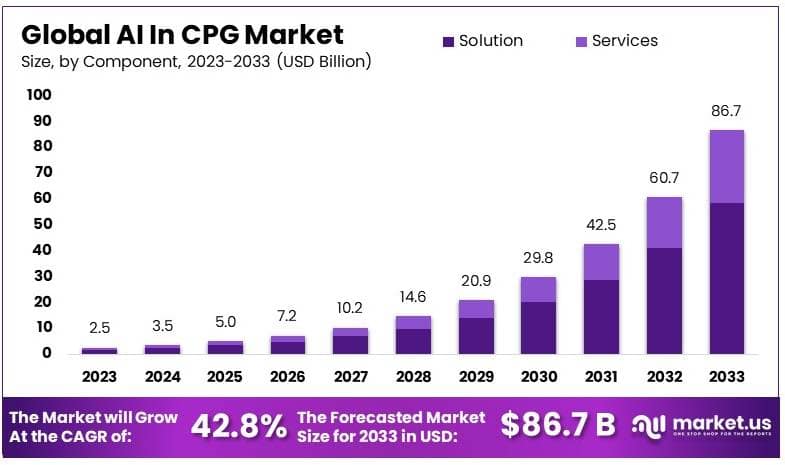
Demand for AI solutions in the CPG industry is on the rise as companies seek to enhance decision-making processes and customer experiences. AI-driven predictive analytics are in high demand for forecasting consumer buying patterns and inventory requirements. This technology enables CPG companies to optimize their stock levels, reducing waste and ensuring product availability.
The integration of AI presents numerous opportunities for the CPG market. For instance, AI can significantly enhance online shopping experiences through personalized recommendations and virtual assistants that understand user preferences. There is also potential for AI in improving product quality and safety by monitoring production processes and predicting possible issues before they affect the product.
The AI in CPG market is set to expand as technology becomes more accessible and affordable. Small and medium-sized enterprises are beginning to adopt AI tools, which were previously only available to large corporations. This expansion is further supported by the development of industry-specific AI solutions that cater to the unique needs of CPG businesses, making it easier for these companies to adopt and benefit from AI technologies.
The Global Artificial Intelligence Market is projected to grow significantly, reaching USD 3,527.8 billion by 2033, up from USD 250.1 billion in 2023. This growth represents a CAGR of 30.3% from 2024 to 2033, according to Market.us data. AI adoption continues to rise across industries, with the Consumer Packaged Goods (CPG) sector standing out for its increasing reliance on AI technologies.
According to recent insights from Starmind, the CPG industry is expected to grow at a CAGR of 3.5% through 2032. To surpass this industry average, AI-powered tools are becoming essential. Survey data shows that 69% of CPG and retail firms have already seen an AI-driven boost in their annual revenue.
Furthermore, 71% of CPG leaders in a 2024 survey confirmed adopting AI in at least one business function, a sharp rise from 42% in 2023. This trend is further supported by 56% of firms regularly using generative AI (gen AI). AI and automation are proving to be cost-effective for the CPG industry, particularly in research and development.
By fully embracing generative AI, CPG and retail companies could add between $400 billion and $660 billion to global revenue. Additionally, the potential impact of generative AI could boost traditional AI’s economic contribution by 15% to 40%, unlocking an extra $160 billion to $270 billion annually in profits for CPG companies worldwide.
Key Takeaways
- The AI in CPG Market was valued at USD 2.46 billion in 2023 and is projected to grow significantly, reaching USD 86.7 billion by 2033. This represents an impressive CAGR of 42.80% during the forecast period.
- In 2023, the Solutions segment dominated the market, accounting for 67.5% of the component segment. This growth is driven by the rising need for AI-driven solutions in the Consumer Packaged Goods (CPG) industry, particularly to enhance operational efficiency and decision-making processes.
- The Supply Chain Optimization application segment led the market in 2023, capturing 35.1% of the share. This highlights the increasing focus on streamlining supply chain operations to improve delivery times, reduce costs, and enhance overall efficiency in the CPG sector.
- North America emerged as the leading region, holding 39.7% of the market in 2023, reflecting the strong adoption of AI technologies across the consumer goods sector. This growth is further supported by significant investments and advancements in AI infrastructure across the region.
AI in CPG Statistics
According to recent findings by Worldmetrics, AI adoption is having a significant impact on the Consumer Packaged Goods (CPG) industry, driving efficiencies and enhancing decision-making processes.
- Supply Chain Efficiency: AI is projected to reduce supply chain forecasting errors by up to 50% in the CPG sector. This improvement in forecasting accuracy helps optimize inventory levels and reduce waste.
- Revenue Growth through Personalization: By implementing AI-driven personalization strategies, CPG companies can potentially boost their revenues by 6-10%. Personalization allows brands to cater more effectively to customer preferences, leading to higher sales.
- Operational Cost Reduction: AI adoption can lead to a 10% reduction in operational costs for CPG companies. Streamlined processes, better resource allocation, and automation are key drivers behind this cost-saving potential.
- Executive Confidence in AI: A significant 70% of CPG executives believe that AI will have a major impact on growth within the industry over the next two years. This indicates widespread confidence in AI’s potential to transform business operations.
- Demand Forecasting Accuracy: AI-enabled demand forecasting can improve forecast accuracy by up to 20% in the consumer goods sector, helping companies better anticipate customer demand and plan accordingly.
- Investment in AI: CPG companies are expected to invest over $2.5 billion in AI and machine learning technologies by 2023, reflecting a growing commitment to leveraging these advanced tools to stay competitive.
- Profitability through AI-Driven Pricing: AI-driven pricing strategies have shown the potential to increase profitability by 2-5% for CPG companies. By analyzing market trends and customer behavior, AI can optimize pricing in real-time.
- Supply Chain Management: 66% of CPG executives believe that AI will play a critical role in transforming supply chain management, improving efficiency and responsiveness.
- Sales Growth with AI-Powered Assortments: Dynamic AI-powered assortments can result in a 2-3% increase in sales for consumer goods companies by ensuring the right products are available in the right locations.
- Value Creation: By 2025, AI is expected to generate $500 billion in value for the global CPG industry. This value comes from enhanced decision-making, efficiency improvements, and better customer engagement.
- Customer Engagement: AI-driven marketing campaigns can lead to a 20% increase in customer engagement for CPG brands, thanks to more targeted and personalized communication strategies.
- AI in Procurement: 55% of CPG companies are already utilizing AI-based tools for procurement and sourcing, helping streamline operations and reduce costs.
AI In CPG Market In North America
In 2023, North America held a dominant market position in the AI in Consumer Packaged Goods (CPG) market, capturing more than a 39.7% share and generating revenue of USD 0.97 billion. This leading position can be attributed to several key factors.
The region’s advanced technological infrastructure plays a critical role, enabling businesses to adopt AI solutions swiftly. Major CPG companies in the U.S. and Canada are heavily investing in AI-driven technologies to optimize supply chains, enhance customer engagement, and personalize marketing strategies, further driving the demand for AI in the CPG sector.
The United States, as the primary contributor to this growth, is home to several technology giants and AI startups, providing the necessary ecosystem for AI-driven solutions in CPG. This includes AI applications in demand forecasting, personalized marketing, supply chain optimization, and consumer insights, which are highly sought after by retailers and manufacturers to maintain competitive advantages.
Moreover, North America’s robust ecosystem of AI startups and well-established tech giants, such as Google and IBM, has accelerated the adoption of AI tools across various CPG segments. These companies are leveraging AI to enhance operational efficiency, predict consumer trends, and improve product recommendations, all of which have proven highly beneficial in a competitive market.
The region’s focus on AI-driven data analytics and predictive modeling helps businesses gain deeper insights into consumer behavior, positioning North America as a market leader. Furthermore, favorable regulatory policies and high levels of digital literacy among consumers contribute to the region’s dominance.
Companies are encouraged to innovate and deploy AI in various aspects, from inventory management to personalized consumer experiences. Additionally, North America’s strong e-commerce growth, coupled with the increasing use of AI in automating customer interactions, has further solidified its leading position in the AI in CPG market.

Component Analysis
In 2023, the Solution segment held a dominant market position within the AI in CPG market, capturing more than a 67.5% share. This significant dominance can largely be attributed to the essential role these AI solutions play in automating complex decision-making processes and enhancing operational efficiencies across various facets of the CPG industry.
AI solutions are pivotal in transforming vast data sets into actionable insights that drive critical business decisions, from supply chain optimizations to personalized marketing strategies. As companies increasingly aim to connect with consumers on a personal level while managing expansive product lines, AI-powered analytics and consumer behavior prediction models become indispensable. These solutions allow brands to forecast demand more accurately, tailor marketing efforts to individual preferences, and optimize product distribution and inventory management.
Moreover, the growing emphasis on real-time data processing and the need for agile responses in market strategies further propel the demand for robust AI solutions. These technologies not only facilitate quicker adaptations to market changes but also enhance the overall responsiveness of supply chains to fluctuations in consumer demand. As the CPG industry continues to face dynamic market conditions, the ability to rapidly interpret and act on data insights represents a crucial competitive edge.
Additionally, the integration of AI solutions in CPG has been spurred by their scalability and the increasing accessibility of advanced AI technologies, including machine learning models and cognitive computing. These tools offer scalable solutions that can be customized to meet the specific needs of businesses, from small enterprises to global giants, thus broadening their applicability across the sector and cementing their lead in the market.
Application Analysis
In 2023, the Supply Chain Optimization segment held a dominant market position in the AI in CPG market, capturing more than a 35.1% share. This leadership stems from the critical need for CPG companies to enhance efficiency and accuracy in their supply chain operations, which are complex and often spread across global networks.
AI-driven supply chain optimization solutions are instrumental in managing and streamlining logistics, inventory management, and distribution processes. By integrating AI, companies can predict potential disruptions, automate routine tasks, and optimize routes and inventory levels. This not only reduces operational costs but also improves service delivery, ensuring products are available where and when they are needed, thereby enhancing customer satisfaction.
Furthermore, as consumer demand for faster and more reliable services grows, CPG companies are increasingly reliant on AI to provide the agility needed to respond to market changes swiftly. AI enables real-time data analysis, which is crucial for adapting to trends and managing resources efficiently. This capability is particularly valuable in a sector where timing and product availability can significantly influence purchasing decisions.
The Supply Chain Optimization segment’s prominence is also boosted by the increasing integration of IoT devices in logistics, which generates massive data points that AI systems can utilize to further refine supply chain processes. This synergy between IoT and AI leads to smarter, more connected supply chains that significantly reduce waste and downtime while maximizing productivity and profitability.

Top AI Tools For CPG Industry
Here are ten prominent AI tools that are making significant impacts:
- AdCreative.ai – This tool leverages AI to generate ad creatives tailored to specific audience segments, helping brands optimize their advertising efforts throughout the ecommerce customer journey.
- Aidaptive – As an AI-powered personalization platform, Aidaptive enhances ecommerce performance by predicting customer preferences and intentions, allowing for real-time delivery of personalized content.
- Neurons – Utilizing insights from cognitive neuroscience and machine learning, Neurons helps businesses optimize their marketing strategies and product designs by understanding customer behaviors and emotions.
- Spectrm – This conversational marketing automation platform uses AI to engage customers in real-time on platforms like Facebook Messenger and WhatsApp, delivering personalized messages that drive sales and loyalty.
- CommentGuard – An AI-driven social media moderation tool that protects brands by automatically removing harmful or spam comments from posts and ads on platforms like Facebook and Instagram.
- Spatial.ai – A location intelligence platform that uses AI to analyze geosocial data, helping businesses make informed decisions about where to target customers and place products.
- Patterned – This tool generates unique, royalty-free patterns for product packaging, supporting brands in creating distinctive and appealing visual presentations.
- Voc – A voice of customer platform that uses NLP and machine learning to analyze customer feedback, providing valuable insights that can enhance customer satisfaction and drive business growth.
- Basis AI – A tool that enables real-time decision-making in the CPG industry by processing large volumes of data to provide actionable insights, particularly useful in managing dynamic environments.
- Jasper AI – Known for its content creation capabilities, Jasper AI assists in generating marketing copy and product descriptions, facilitating consistent and engaging brand messaging across various channels.
Key Market Segments
By Component
- Solution
- Services
By Application
- Supply Chain Optimization
- Demand Forecasting
- Product Development
- Marketing & Advertising
- Other Applications
Key Regions and Countries
- North America
- US
- Canada
- Europe
- Germany
- France
- The UK
- Spain
- Italy
- Rest of Europe
- Asia Pacific
- China
- Japan
- South Korea
- India
- Australia
- Singapore
- Rest of Asia Pacific
- Latin America
- Brazil
- Mexico
- Rest of Latin America
- Middle East & Africa
- South Africa
- Saudi Arabia
- UAE
- Rest of MEA
Driver
Consumer Insights, Supply Chain Optimization, and Personalization Drive Market Growth
The AI in CPG (Consumer Packaged Goods) Market is driven by the need for deeper consumer insights, AI in supply chain, and the demand for personalized products and experiences. The increasing importance of consumer insights is a key factor, as companies aim to better understand customer preferences and behaviors.
Supply chain optimization is another critical driver. The complexity of global supply chains requires advanced tools to enhance efficiency and reduce costs. AI can streamline operations by predicting demand, optimizing inventory levels, and improving logistics management. These improvements not only cut costs but also ensure faster delivery times and better resource allocation, contributing to the growth of AI in the CPG sector.
Additionally, the growing demand for personalized products and experiences is fueling the adoption of AI. Consumers are increasingly looking for products that cater to their individual needs and preferences. AI allows CPG companies to offer customized recommendations, tailor product offerings, and create personalized marketing campaigns. This personalization enhances customer loyalty and boosts sales, further expanding the AI in CPG Market.
Restraint
High Implementation Costs, Data Privacy Concerns, and Workforce Resistance Restrain Market Growth
The AI in CPG (Consumer Packaged Goods) Market is restrained by high implementation costs, data privacy concerns, and workforce resistance. The significant costs involved in adopting AI technologies pose a major challenge, especially for small and medium-sized enterprises. These costs can include not only the technology itself but also the necessary infrastructure and training, which slows down the adoption of AI in the CPG sector.
Data privacy concerns further restrain market growth. As AI systems process vast amounts of consumer data to drive insights and personalization, there is a growing concern over how this data is collected, stored, and used. These concerns can lead to regulatory scrutiny and consumer distrust, limiting the extent to which companies can leverage AI-driven strategies.
Additionally, resistance from the workforce is another critical factor. Employees may fear job displacement or may be hesitant to adopt new technologies due to a lack of understanding or training. This resistance can hinder the effective implementation of AI solutions, reducing their potential impact on the business.
Opportunity
AI-Driven Consumer Insights Provide Opportunities
The growing use of Artificial Intelligence (AI) in the Consumer Packaged Goods (CPG) market presents significant opportunities for industry players. AI-driven consumer insights enable companies to analyze vast amounts of data to predict consumer behavior accurately. This helps in creating personalized marketing strategies that resonate more with customers, driving sales growth.
Additionally, AI enhances supply chain efficiency by optimizing logistics, reducing waste, and ensuring timely delivery of products. These improvements can significantly cut costs and improve profit margins.
The automation of routine tasks, such as demand forecasting and inventory management, frees up resources that can be allocated to innovation and product development. This further boosts competitiveness in the market.
Moreover, AI enables real-time feedback loops, allowing companies to quickly adapt to changing market conditions and consumer preferences. This adaptability provides a significant advantage in a fast-paced market.
Challenge
Data Privacy Concerns Challenge Market Growth
Data privacy concerns present significant challenges to the growth of AI in the Consumer Packaged Goods (CPG) market. As AI systems require vast amounts of consumer data to function effectively, concerns over data security and privacy are on the rise. These concerns can lead to stricter regulations and compliance requirements, which may increase operational costs for companies.
Another challenge is the potential for bias in AI algorithms. If AI systems are trained on biased data, they may produce biased outcomes, leading to inaccurate predictions and ineffective marketing strategies. This can harm a company’s reputation and reduce consumer trust.
The high cost of implementing AI technology also poses a barrier. Small and medium-sized enterprises (SMEs) may find it difficult to invest in expensive AI systems, limiting their ability to compete with larger players. This could lead to a widening gap between large and small companies in the market.
Furthermore, the rapid pace of technological change creates an ongoing challenge. Companies need to continuously update and adapt their AI systems to stay competitive. This requires significant investment in research and development, as well as skilled personnel, which may not always be readily available
Growth Factors
- Enhanced Supply Chain Efficiency: AI optimizes supply chain management by predicting demand, managing inventory, and improving logistics. This efficiency reduces costs and ensures that products are available when and where they are needed.
- Personalized Marketing: AI enables CPG companies to create personalized marketing campaigns by analyzing consumer behavior and preferences. This targeted approach improves customer engagement and drives higher sales by offering relevant products to the right audience.
- Product Innovation: AI-driven insights help CPG companies identify emerging trends and consumer needs, leading to more innovative product development. This ability to quickly adapt to market demands gives companies a competitive edge.
- Operational Cost Reduction: AI automates various operational tasks, such as demand forecasting and quality control, leading to significant cost savings. These reductions in operational costs are a major driver for the adoption of AI in the CPG sector.
- Improved Customer Experience: AI enhances customer interactions through personalized recommendations, chatbots, and virtual assistants. This improvement in customer experience fosters loyalty and encourages repeat purchases, which are critical for growth in the CPG market.
- Data-Driven Decision-Making: AI provides CPG companies with deep insights from large datasets, enabling more informed decision-making. This data-driven approach allows companies to optimize their strategies and respond swiftly to market changes.
Emerging Trends
- AI in Demand Forecasting: AI is revolutionizing demand forecasting by analyzing past sales data, market trends, and consumer behavior. This trend is expected to grow as companies seek to optimize inventory levels and reduce waste.
- Sustainability and AI: AI is increasingly being used to support sustainability initiatives in the CPG industry, such as optimizing energy use and reducing carbon footprints. This trend will continue as companies prioritize eco-friendly practices to meet consumer and regulatory demands.
- AI-Enhanced Product Customization: AI is enabling the creation of customized products based on individual consumer preferences. This trend is likely to expand, offering consumers more personalized options and enhancing brand loyalty.
- AI in Retail Analytics: AI-powered retail analytics is becoming essential for understanding consumer behavior in real-time. This trend will grow as companies leverage these insights to optimize product placement, pricing strategies, and promotional efforts.
- AI-Driven Packaging Solutions: AI is being used to develop smarter packaging that enhances product freshness, reduces waste, and improves the consumer experience. This trend will likely continue as companies innovate to meet changing consumer expectations.
- Advancements in Natural Language Processing (NLP) for Consumer Interaction: Natural language processing technology is improving how CPG companies interact with consumers through voice assistants and chatbots. This trend will expand as these technologies become more sophisticated, providing better customer support and engagement.
Business Benefits
- Enhanced Forecasting and Demand Planning: AI technologies enable more accurate forecasting by analyzing diverse data sets, which helps in optimizing inventory levels and reducing waste.
- Operational Efficiencies: Through automation and predictive maintenance, AI can significantly enhance production line efficiencies and reduce downtime.
- Personalization at Scale: AI aids in crafting personalized marketing strategies and product offerings by analyzing consumer behavior and preferences, thereby increasing customer satisfaction and loyalty.
- Supply Chain Optimization: AI’s predictive capabilities help in anticipating demand fluctuations and potential disruptions, ensuring smoother operations and cost savings.
- Market Expansion and Consumer Insights: AI tools analyze vast amounts of market data to identify trends and consumer needs, facilitating faster and more informed decision-making processes regarding market entry and product development.
Top Use Cases
- Supply Chain Optimization: AI algorithms are utilized to forecast demand accurately, manage inventory efficiently, and identify potential disruptions, ensuring a resilient and responsive supply chain.
- Personalized Marketing and Advertising: By analyzing consumer data, AI helps in creating highly targeted marketing campaigns that resonate more personally with consumers, thereby increasing engagement and conversion rates.
- Customer Service Enhancements: AI-driven chatbots and virtual assistants provide 24/7 customer service, handling inquiries and issues promptly, which enhances overall customer satisfaction.
- Product Development: AI contributes to the ideation and design of new products by predicting consumer preferences and market trends.
- Pricing Optimization: AI models simulate numerous pricing scenarios to determine the optimal pricing strategy across different markets and customer segments, aiming to maximize profitability while staying competitive.
Key Players Analysis
The AI in Consumer Packaged Goods (CPG) market is being transformed by several key players. Among them, IBM Corporation, Microsoft Corporation, and SAP SE stand out as the top three companies driving innovation and market influence.
IBM Corporation is a leading player in the AI in CPG market, offering advanced AI solutions through its Watson platform. IBM’s tools help CPG companies optimize supply chains, predict consumer trends, and enhance product development. The company’s strong focus on AI and deep expertise in data analytics give it a significant impact on the CPG sector.
Microsoft Corporation plays a crucial role with its AI-powered solutions integrated into its Azure cloud platform. Microsoft provides CPG companies with tools to enhance customer engagement, streamline operations, and drive innovation. Its vast enterprise reach and continuous investment in AI technologies position Microsoft as a key influencer in the market.
SAP SE is another major force in the AI in CPG market, particularly through its SAP S/4HANA platform. SAP’s AI solutions enable CPG companies to automate processes, improve demand forecasting, and manage complex supply chains. SAP’s long-standing relationships with large enterprises and its focus on AI integration ensure its strong market presence.
These three companies lead the AI in CPG market by offering comprehensive solutions that drive efficiency, innovation, and growth. Their strategic positioning, advanced technologies, and market influence make them the most significant players in this evolving industry. Their ongoing contributions to AI are shaping the future of the CPG market, setting new standards for success.
Top Key Players in the Market
- IBM Corporation
- SAP SE
- Oracle Corporation
- Microsoft Corporation
- Google LLC
- Salesforce, Inc.
- Adobe Inc.
- NVIDIA Corporation
- Accenture plc
- DataRobot, Inc.
- Other Key Players
Recent Developments
- April 2024: A study by RELEX Solutions revealed that although 57% of CPG companies plan to invest in AI for demand forecasting and supply chain management over the next 3-5 years, many have yet to fully embrace these technologies.
- 2024: NVIDIA’s report on the state of AI in retail and CPG sectors shows that 64% of large retailers and CPG companies are planning to expand their AI infrastructure investments. These companies are leveraging AI for precise demand forecasting and inventory management, with a particular focus on omnichannel retail strategies.









