


Report Overview
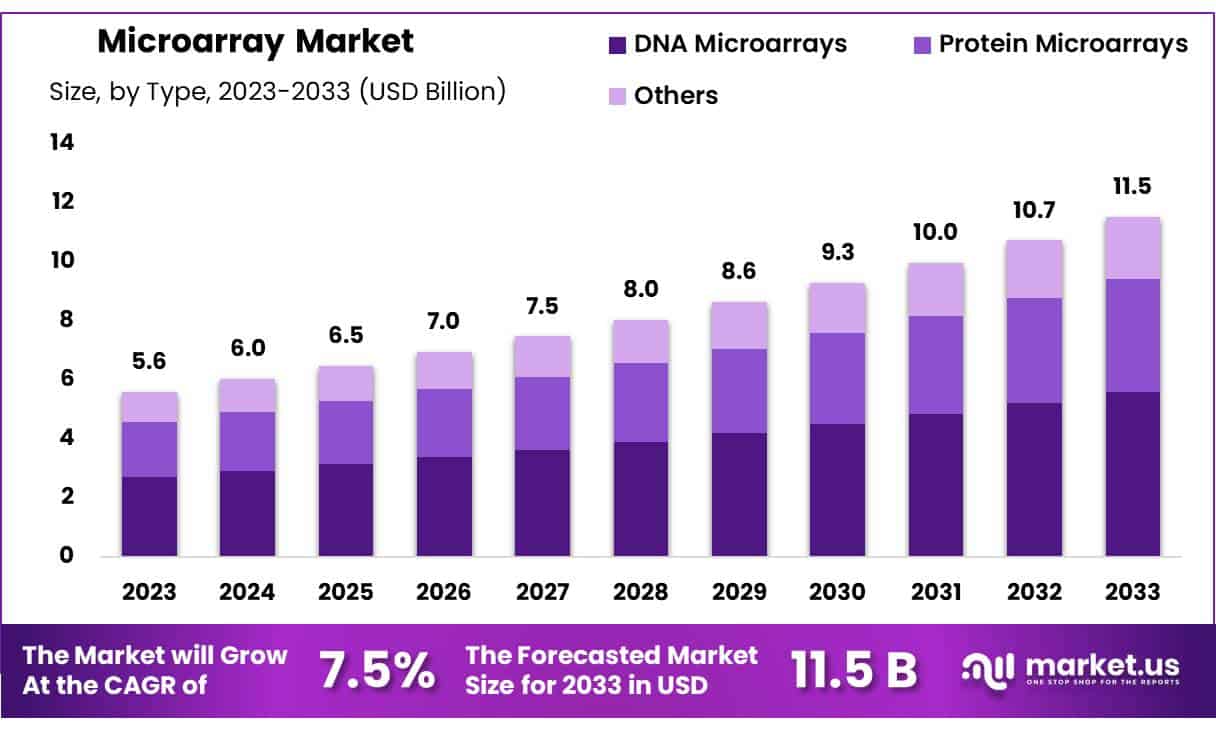
Global Microarray Market size is expected to be worth around US$ 11.5 Billion by 2033 from US$ 5.6 Billion in 2023, growing at a CAGR of 7.5% during the forecast period 2024 to 2033.
Growing demand for advanced molecular diagnostic tools is driving the expansion of the microarray market, as these technologies enable high-throughput analysis of genetic material for various applications, including disease diagnosis, drug discovery, and gene expression profiling. The increasing prevalence of cancer, such as ovarian and breast cancer, is boosting the adoption of microarrays in early detection and personalized treatment approaches.
For instance, in 2022, approximately 26,500 women in the European Union and 4,000 in the UK were projected to die from ovarian cancer, which highlights the importance of using DNA microarrays to detect mutations in genes like BRCA1 and BRCA2. In January 2024, Thermo Fisher Scientific launched the Pangenomix Array, a cutting-edge genomic tool designed to study genetic variations across diverse populations, enhancing precision in genetic research.
Opportunities for growth in the microarray market also include the development of personalized medicine, advancements in cancer research, and innovations in agriculture and environmental studies. Emerging trends, such as the integration of AI in data analysis, are poised to further advance the use of microarrays in diverse research and clinical settings.
Key Takeaways
- Market Size: Global Microarray Market size is expected to be worth around US$ 11.5 Billion by 2033 from US$ 5.6 Billion in 2023.
- Market Growth: The market growing at a CAGR of 7.5% during the forecast period 2024 to 2033.
- Type Analysis: The DNA microarrays segment led in 2023, claiming a market share of 48.5% owing to the increasing demand for genomics research and personalized medicine.
- Application Analysis: The research applications held a significant share of 41.7% due to its broad utility in genomics, proteomics, and molecular biology.
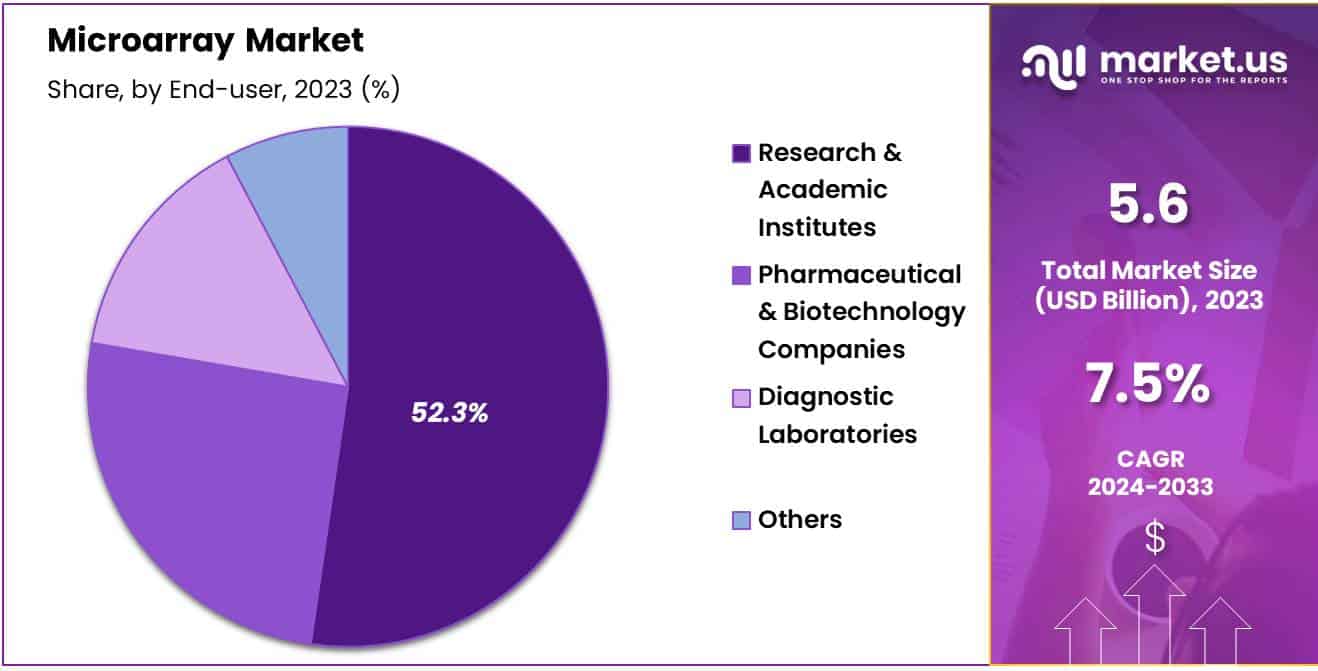
- End-Use Analysis: The research & academic institutes segment had a tremendous growth rate, with a revenue share of 52.3%
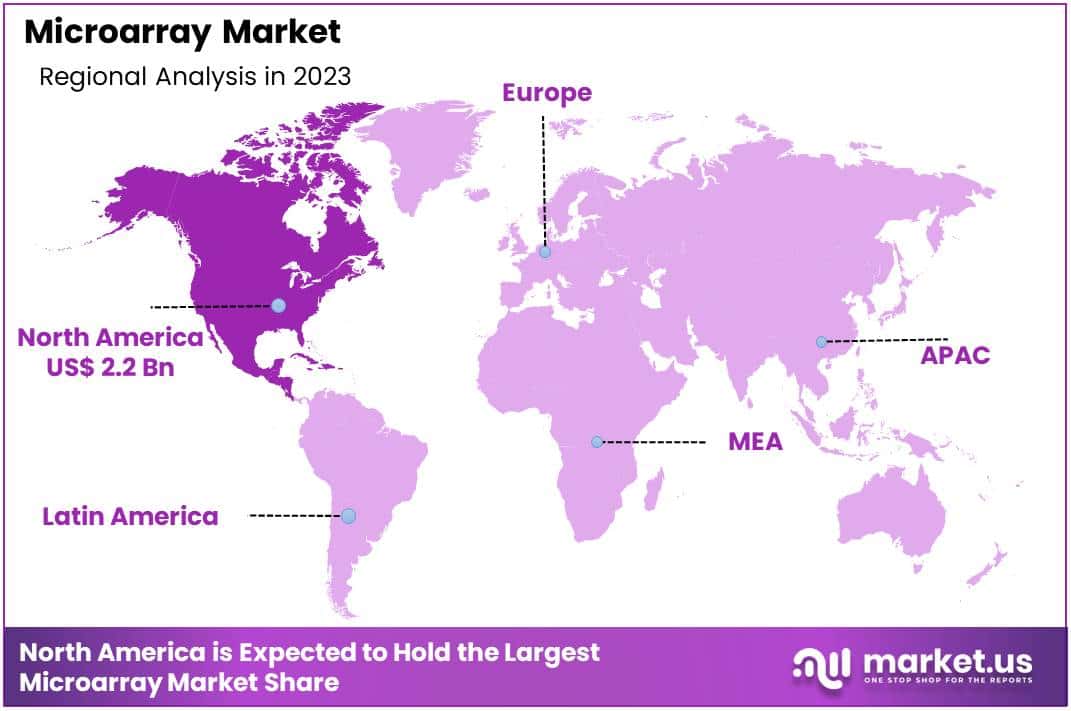
- Regional Analysis: In 2023, North America dominated the market with the highest revenue share of 39.2%.
- Technological Innovation: Continuous innovations in microarray technology are enhancing performance and applications, expanding market reach.
- Future Prospects: Emerging markets are expected to offer new growth opportunities due to rising healthcare demands and genomic research initiatives.
Type Analysis
The DNA microarrays segment led in 2023, claiming a market share of 48.5% owing to the increasing demand for genomics research and personalized medicine. Researchers are likely to use DNA microarrays extensively to study gene expression patterns, detect mutations, and identify genetic markers associated with diseases. Technological advancements, including the miniaturization of arrays and improvements in data analysis capabilities, are expected to enhance the efficiency and accuracy of these tools.
Additionally, the rising focus on cancer genomics and precision therapies is anticipated to drive demand for DNA microarrays. Their ability to analyze thousands of genes simultaneously makes them a valuable tool in understanding complex genetic diseases, which further supports the growth of this segment.
Application Analysis
The research applications held a significant share of 41.7% due to its broad utility in genomics, proteomics, and molecular biology. The increasing focus on understanding gene function, protein interactions, and cellular mechanisms in research institutions is anticipated to propel this segment. Microarrays offer a high-throughput platform for studying large datasets, which is expected to attract researchers seeking to accelerate discoveries in fields such as cancer research, neurobiology, and immunology.
Furthermore, advancements in bioinformatics tools and data analysis are likely to enhance the utility of microarrays in research. Rising funding from government and private organizations for academic research is also projected to contribute to the growth of this segment.
End-user Analysis
The research & academic institutes segment had a tremendous growth rate, with a revenue share of 52.3% owing to the increasing emphasis on advanced research in genomics and molecular biology. Academic institutions are likely to continue investing in microarray technologies to support large-scale projects involving gene expression profiling, genetic variation studies, and biomarker discovery. The availability of grants and funding from governmental bodies and research foundations is anticipated to further drive the adoption of these tools.
Additionally, collaborations between academic institutes and industry players for drug discovery and development research are expected to contribute to the growth of this segment. The demand for high-throughput, cost-effective solutions for analyzing complex biological systems also supports the growth of microarrays in this sector.
Key Market Segments
By Type
- DNA Microarrays
- Protein Microarrays
- Others
By Application
- Agriculture
- Research Applications
- Diseases Diagnostics
- Drug Discovery
- Others
By End-user
- Research & Academic Institutes
- Diagnostic Laboratories
- Pharmaceutical & Biotechnology Companies
- Others
Drivers
Rising prevalence of cancer drives the microarray market
Rising cancer prevalence is anticipated to significantly drive the growth of the microarray market. The increasing need for early diagnosis and targeted therapies has heightened the demand for advanced diagnostic tools. According to the American Cancer Society, approximately 287,850 new cases of breast cancer and 43,250 related deaths were projected in the U.S. in 2022.
As the number of cancer cases continues to rise, the adoption of microarray technologies for molecular diagnosis and drug development is expected to grow. These systems enable precise genetic analysis, contributing to the identification of cancer biomarkers and facilitating personalized treatment approaches. This surge in demand for advanced diagnostics is projected to enhance market growth over the coming years.
Restraints
High cost of microarray experiments restrains the microarray market
High costs associated with conducting microarray experiments are expected to hamper the market’s growth. The complexity of the technology and the need for specialized equipment, reagents, and highly trained personnel drive up the overall expenses. This financial burden restricts widespread adoption, particularly in smaller laboratories and research institutions with limited budgets.
Additionally, the cost of data analysis and interpretation further increases the total expenditure, making the technology less accessible to many potential users. These factors are anticipated to impede the broader implementation of microarray systems, especially in resource-constrained regions, slowing the market’s growth potential.
Opportunities
Increasing technological advancements present an opportunity for the microarray market
Growing technological advancements create significant opportunities for the microarray market. In August 2024, Illumina, Inc. introduced the NovaSeqX series, a new generation of sequencing systems designed to deliver faster and more cost-effective genomic sequencing. This innovative platform enhances scalability and performance, accelerating research in genetic studies and personalized medicine.
Such advancements enable researchers to conduct more comprehensive analyses, leading to breakthroughs in the understanding of complex diseases like cancer. The continuous evolution of microarray technologies is expected to support the development of novel therapies and diagnostics, positioning the market for robust growth as researchers and healthcare providers seek more precise and efficient solutions.
Impact of Macroeconomic / Geopolitical Factors
Macroeconomic conditions and geopolitical factors have a significant influence on the microarray industry. Rising inflation and fluctuating currency exchange rates increase production costs, leading to higher prices for end-users. Economic slowdowns can also limit research funding, reducing demand for high-cost genomic tools.
Geopolitical tensions, such as trade restrictions and sanctions, disrupt supply chains, causing delays in the availability of essential components for microarray systems. On the positive side, increased government spending on healthcare and precision medicine in developed and emerging markets drives innovation and demand for genetic research tools. As nations prioritize advanced healthcare solutions, the microarray market is expected to experience steady growth, supported by technological advancements and global collaboration.
Latest Trends
Rising Number of New Launches Driving the Microarray Market
Rising numbers of new product launches are expected to drive growth in the microarray market. In January 2023, during JP Morgan Healthcare Conference Week, Complete Genomics Inc., a division of MGI Tech Co., Ltd., introduced its complete sequencing systems at Biotech Showcase. Chief Scientific Officer Rade Drmanac announced a ‘free three-month trial’ and a ‘reagent rental leasing’ program, allowing customers to test products before committing to purchase.
This surge in product innovation and customer-centric offerings highlights the growing competition among key players to expand their market presence. Increasing advancements in genomic research and the continuous development of cutting-edge solutions are likely to further boost market growth, providing researchers with more reliable and cost-effective tools for genetic analysis.
Regional Analysis
North America is leading the Microarray Market
North America dominated the market with the highest revenue share of 39.2% owing to advancements in genomics research and the introduction of innovative technologies. A notable development occurred in August 2023 when Thermo Fisher Scientific, Inc. launched the Applied Biosystems CytoScan HD Accel array, a chromosomal microarray designed to enhance cytogenetic research productivity.
This new array, which offers an industry-leading two-day turnaround time for analyzing the human genome, has improved the efficiency and profitability of research labs across the region. Increased investment in personalized medicine and the growing demand for high-throughput genetic testing have also fueled the expansion of the market, along with the rising prevalence of chronic diseases that require genomic insights for better diagnosis and treatment.
The Asia Pacific region is expected to experience the highest CAGR during the forecast period
Asia Pacific is expected to grow with the fastest CAGR owing to the region’s increasing focus on genomic research and personalized medicine. The growing prevalence of genetic disorders and cancer is likely to spur demand for advanced diagnostic technologies, such as microarrays, across the region.
Moreover, expanding government investments in biotechnology and healthcare infrastructure are anticipated to boost research and development activities. Asia Pacific’s rising number of collaborations between academic institutions and pharmaceutical companies is expected to accelerate the adoption of genomic tools, further driving the market. Increasing awareness of precision medicine, coupled with improving healthcare access, is estimated to support the long-term growth of the microarray market in the region.
Key Regions and Countries
North America
- US
- Canada
Europe
- Germany
- France
- The UK
- Spain
- Italy
- Russia
- Netherland
- Rest of Europe
Asia Pacific
- China
- Japan
- South Korea
- India
- Australia
- New Zealand
- Singapore
- Thailand
- Vietnam
- Rest of APAC
Latin America
- Brazil
- Mexico
- Rest of Latin America
Middle East & Africa
- South Africa
- Saudi Arabia
- UAE
- Rest of MEA
Key Players Analysis
The major players in the microarray market are actively engaged in the development and introduction of innovative products, as well as implementing strategic initiatives aimed at enhancing their competitive positioning. Key players in the microarray market focus on developing advanced genomic and proteomic analysis platforms to meet the growing demand for personalized medicine and diagnostics. They collaborate with research institutions and pharmaceutical companies to enhance product innovation and accelerate technological advancements.
Expanding their product portfolios through acquisitions and strategic partnerships allows them to offer comprehensive solutions to customers. Companies invest in improving the affordability and accessibility of their technologies, targeting both academic research and clinical applications. Additionally, they explore opportunities in emerging markets to increase their global presence and capture new revenue streams.
Top Key Players
- Thermo Fisher Scientific, Inc.
- Sengenics
- SCHOTT
- PerkinElmer, Inc.
- Merck & Co., Inc.
- Illumina
- GE Healthcare
- Bio-Rad Laboratories
- Arrayit Corporation
Recent Developments
- On 8 March 2022, Sengenics announced the availability of the i-Ome Protein Array Kit for purchase. This product features over 1,600 immobilized, full-length, fully folded human proteins on slide-based, high-density protein microarrays. By making KREX™ technology more accessible, this innovation allows researchers in the fields of autoimmune disease, immuno-oncology, and neuroinflammation to use an advanced tool for autoantibody biomarker discovery, supporting the growth of the microarray market by expanding access to cutting-edge protein array technology.
- On 5 January 2022, Illumina and SomaLogic finalized a co-development agreement to deliver the SomaScan Proteomics Assay to Illumina’s current and future high-throughput Next-Generation Sequencing (NGS) platforms. This collaboration aims to advance the high-throughput proteomics market, allowing researchers to link genetic sequences (genotype) to cellular function (phenotype) more efficiently. The integration of Illumina’s NGS technology will drive growth in the microarray market by enabling faster and more scalable proteomic research.
- In September 2021, SCHOTT, a manufacturer of point-of-care microfluidic devices, announced its acquisition of Applied Microarrays, Inc. This acquisition is expected to enhance SCHOTT’s capabilities in high-density microarray printing and strengthen its ability to offer single-source contract manufacturing solutions. This development contributes to the growth of the microarray market by improving manufacturing capacity and service offerings for microarray-based technologies.









