


Report Overview
The Global AI for Earth Monitoring Market size is expected to be worth around USD 23.9 Billion by 2033, from USD 3.15 Billion in 2023, growing at a CAGR of 22.5% during the forecast period from 2024 to 2033. In 2023, North America held a dominant market position, capturing more than a 36.8% share, holding USD 1.15 Billion revenue.
AI for Earth Monitoring refers to the application of artificial intelligence (AI) technologies in monitoring and managing Earth’s environment. It encompasses the use of AI algorithms and techniques to analyze large volumes of data collected from various sources, such as satellites, sensors, and ground-based monitoring systems. The goal is to gain valuable insights into environmental processes, detect changes and anomalies, and make informed decisions for sustainable resource management.
The market for AI in Earth monitoring is experiencing significant growth. This surge is fueled by the increasing need for sustainable environmental practices and enhanced accuracy in climate monitoring. Governments and organizations worldwide are investing in AI technologies to better predict weather patterns, manage natural resources, and mitigate the impacts of climate change, thereby driving the expansion of this market.
The growth of the AI for Earth monitoring market is driven by several factors. Firstly, there is a rising awareness of environmental issues and the urgency to address them. Additionally, advancements in AI technology and increased availability of satellite and aerial data have made Earth monitoring more accessible and detailed. The push from international bodies for sustainable development goals also encourages the adoption of AI-driven solutions.
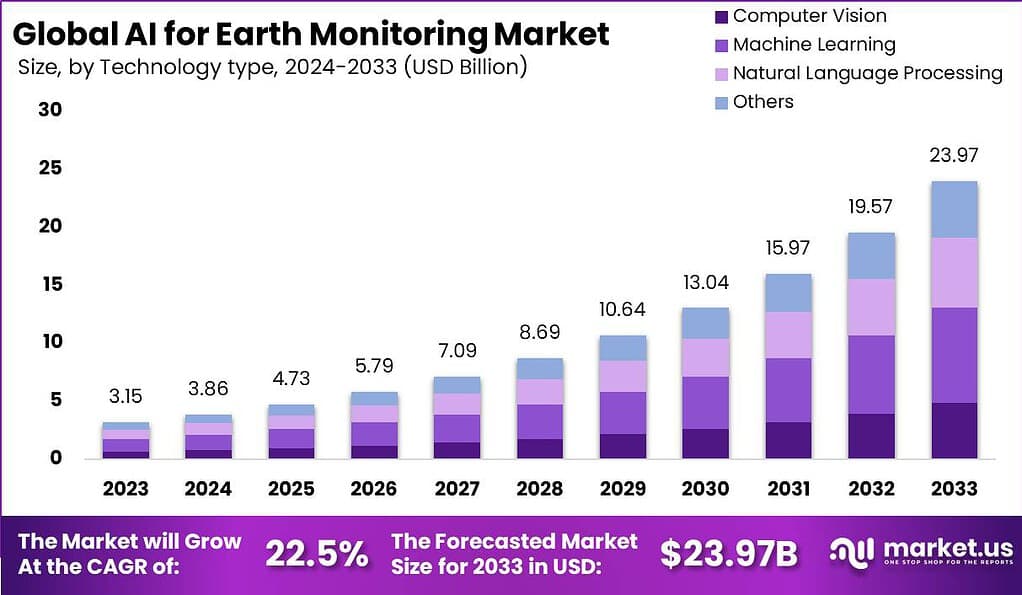
Market demand for AI in Earth monitoring is high among governmental and non-governmental organizations aiming to comply with environmental regulations and policies. There is also a growing demand in sectors like agriculture, where AI is used to optimize crop yields and manage resources more efficiently, and in disaster management, where rapid response and accurate forecasts can save lives.
The market offers numerous opportunities for expansion, particularly in developing regions that are now accessing technologies previously limited to wealthier nations. Innovations in AI that reduce costs and improve user-friendliness can open up new applications in environmental conservation and management. As awareness of the potential for AI to address critical environmental challenges grows, so does the scope for market expansion, with more startups and established companies entering the field.
For instance In a survey conducted in early 2024, approximately 50% of GEO Work Programme activities categorized their AI application levels as advanced or medium. The primary applications of AI within Earth observation are focused on image classification, change detection, and predictive modeling
Companies are increasingly focusing on developing AI-powered platforms that offer advanced analytics, predictive modeling, and automated data processing. However, this market faces challenges, including the high costs associated with implementing AI technologies and concerns over data privacy and security. Additionally, the complexity of integrating AI with existing environmental monitoring systems can pose significant hurdles.
Despite these challenges, the AI for Earth Monitoring market offers significant opportunities. The integration of AI with other emerging technologies, such as Internet of Things (IoT), big data analytics, and cloud computing, can enhance the capabilities of Earth monitoring systems. For example, IoT devices can collect real-time environmental data, which can be processed by AI algorithms for immediate insights.
Key Takeaways
- By 2033, the AI for Earth Monitoring market is projected to reach approximately USD 23.9 billion. It is expected to grow at a steady rate with a CAGR of 5% from 2024 to 2033.
- In 2023, Machine Learning technologies were the frontrunners in the AI for Earth Monitoring market, holding a significant 34.3% market share. This highlights the technology’s pivotal role in enhancing Earth monitoring capabilities.
- The Government & Public Sector emerged as the primary user of AI for Earth Monitoring in 2023, dominating the market with a substantial 68.5% share. This underscores the sector’s reliance on AI technologies for various public applications, including environmental monitoring and regulatory compliance.
- North America proved to be the leading region in the AI for Earth Monitoring market in 2023, capturing a major 36.8% share. This reflects the region’s advanced technological adoption and significant investments in environmental monitoring solutions.
Technology Analysis
In 2023, the Machine Learning segment held a dominant market position, capturing more than a 34.3% share of the AI for Earth Monitoring market. This leadership can be attributed to the robust capabilities of machine learning algorithms in processing vast amounts of environmental data, enabling accurate predictions and insights.
Machine learning’s ability to identify patterns and anomalies in climate data, monitor deforestation, and predict natural disasters with high precision has made it indispensable for earth monitoring applications. The segment’s dominance is further bolstered by continuous advancements in machine learning techniques and the increasing availability of training datasets from satellites and remote sensing technologies.
The Natural Language Processing (NLP) segment, while not as dominant as machine learning, is gaining traction due to its unique ability to analyze and interpret textual data from various sources such as research papers, reports, and social media.
NLP technologies are increasingly being used to understand public sentiment on environmental issues, extract valuable information from scientific literature, and support policy-making processes. In 2023, NLP contributed to around 21.5% of the market share, reflecting its growing importance in synthesizing qualitative data for comprehensive earth monitoring.
Computer Vision, capturing approximately 18.7% of the market share in 2023, plays a crucial role in analyzing visual data from satellite images and drone footage. This technology excels in tasks such as land use classification, vegetation cover analysis, and wildlife monitoring, providing detailed and actionable insights for environmental conservation. The rapid improvements in image recognition algorithms and the proliferation of high-resolution imaging devices are key factors driving the growth of the computer vision segment.
Application Analysis
In 2023, the Government & Public Sector segment held a dominant market position, capturing more than a 68.5% share of the AI for Earth Monitoring market. This significant share is largely due to the extensive adoption of AI technologies by government bodies and public institutions for environmental monitoring and management. Governments worldwide are increasingly leveraging AI to enhance their capabilities in climate change mitigation, natural disaster prediction and response, and resource management.
The implementation of AI-driven solutions helps in the collection and analysis of critical environmental data, enabling informed policy decisions and strategic planning. Moreover, public sector initiatives and funding are major catalysts for the growth of AI applications in this segment, underscoring the sector’s leading position. The government’s reliance on AI for Earth monitoring is also driven by the need for compliance with international environmental regulations and commitments, such as the Paris Agreement.
By utilizing AI, public agencies can monitor and report greenhouse gas emissions more accurately, track deforestation, and oversee conservation efforts, ensuring adherence to global sustainability goals. Additionally, the integration of AI in public sector projects enhances transparency and accountability in environmental governance, further promoting its widespread adoption.

Key Market Segments
By Technology type
- Machine learning
- Natural Language Processing
- Computer Vision
- Others
By Application
- Government & Public Sector
- Private Sector
Driver
The increasing need for real-time environmental monitoring and management solutions
The increasing need for real-time environmental monitoring and management solutions is a pivotal driver for the AI for Earth Monitoring market. As climate change accelerates and environmental degradation intensifies, the ability to obtain and act on timely, accurate data has become critical. Traditional methods of environmental monitoring, which often rely on periodic manual data collection and analysis, are insufficient to address the rapid pace of ecological changes and the frequency of natural disasters.
AI technologies, particularly machine learning and computer vision, offer the capability to process vast amounts of environmental data swiftly and accurately. These technologies can analyze satellite imagery, sensor data, and other remote sensing information in real-time, providing actionable insights that can inform immediate responses and long-term strategies.
For instance, AI can enhance the detection of deforestation by continuously monitoring large forested areas, alerting authorities to illegal logging activities as they happen. Similarly, AI-powered systems can predict natural disasters like floods or wildfires by analyzing weather patterns and other relevant data, enabling early warning systems that can save lives and reduce economic losses.
Restraint
High cost of implementation and maintenance of AI technologies
The high cost of implementation and maintenance of AI technologies is a significant restraint for the AI for Earth Monitoring market. Developing and deploying AI-based environmental monitoring systems require substantial financial investments in several key areas, which can be prohibitive, particularly for smaller organizations and developing countries.
The acquisition of advanced hardware and software necessary for AI applications represents a major expense. High-performance computing infrastructure, specialized AI algorithms, and proprietary software tools are essential for processing and analysing large volumes of environmental data. These technologies are often expensive and require continual updates to stay current with the latest advancements.
Obtaining high-resolution satellite imagery and other remote sensing data entails considerable costs. Licensing fees for satellite data, drone operations, and sensor deployments add to the financial burden. The storage and management of these massive datasets also demand robust and scalable data infrastructure, further escalating costs.
Opportunity
The integration of AI with Internet of Things (IoT) technologies
The integration of AI with Internet of Things (IoT) technologies presents a significant opportunity for the AI for Earth Monitoring market. This synergy leverages the strengths of both AI and IoT to enhance the capabilities of environmental monitoring systems, providing comprehensive and actionable insights that drive more effective and sustainable management practices.
IoT devices, such as environmental sensors, drones, and satellite systems, are capable of collecting vast amounts of real-time data from diverse and often remote locations. These devices can monitor various environmental parameters, including air and water quality, soil conditions, weather patterns, and wildlife movements.
However, the sheer volume and complexity of the data generated by IoT networks can be overwhelming and challenging to process using traditional methods. AI technologies, particularly machine learning and data analytics, can process and analyze this extensive data efficiently and accurately. By applying AI algorithms to IoT-generated data, it is possible to identify patterns, predict trends, and generate real-time insights that inform decision-making processes.
For instance, in agriculture, AI-powered IoT networks can monitor soil moisture levels, weather forecasts, and crop health to optimize irrigation schedules and enhance crop yields. This precision farming approach not only improves productivity but also conserves water and other resources.
Challenge
Data privacy and security concerns
Data privacy and security concerns represent a significant challenge for the AI for Earth Monitoring market. The collection, processing, and storage of vast amounts of environmental data involve sensitive information, including geographic locations, proprietary data from private enterprises, and personal information from public monitoring systems.
Ensuring the confidentiality, integrity, and availability of this data is paramount, yet several issues complicate this task. The integration of AI systems with various data sources increases the risk of cyber-attacks and data breaches. Environmental monitoring often relies on a network of IoT devices, remote sensors, and satellite systems, all of which can be vulnerable to hacking and unauthorized access.
A successful cyber-attack could lead to the manipulation or theft of sensitive data, disrupting monitoring activities and potentially causing significant harm. The use of AI in environmental monitoring raises concerns about data misuse.
The data collected can be highly valuable and might be exploited for purposes beyond its intended use, such as unauthorized surveillance or commercial exploitation. For instance, detailed geographic and environmental data could be used by businesses for competitive advantages without proper consent, infringing on privacy rights and ethical standards.
Growth Factors
- Technological Advancements: Continuous improvements in AI algorithms, machine learning models, and computer vision technologies enhance the accuracy and efficiency of environmental monitoring systems.
- Increasing Environmental Awareness: Rising global awareness and concern about climate change, biodiversity loss, and natural disasters drive the demand for advanced monitoring solutions to manage and mitigate environmental impacts.
- Government Initiatives and Regulations: Supportive policies and regulations from governments worldwide, aimed at promoting environmental sustainability and compliance with international agreements, spur the adoption of AI-based monitoring technologies.
- Availability of High-Resolution Data: Enhanced access to high-resolution satellite imagery and remote sensing data facilitates the development of more accurate and comprehensive AI-driven monitoring systems.
- Integration with IoT Technologies: The convergence of AI with IoT devices enables real-time data collection and analysis, significantly improving the scope and efficiency of environmental monitoring.
- Investment in Research and Development: Increased funding and investment in R&D activities by both public and private sectors drive innovation and the development of cutting-edge AI technologies for earth monitoring.
Latest Trends
- Enhanced Satellite Imaging: Utilization of high-resolution and multispectral satellite imagery combined with AI algorithms for detailed environmental monitoring, including land use, vegetation health, and water quality.
- AI-Driven Predictive Analytics: Increasing adoption of AI for predictive modeling to forecast environmental changes, natural disasters, and climate patterns, enabling proactive measures and risk mitigation.
- Integration with Big Data: Leveraging big data technologies to handle and analyze vast datasets from various sources, improving the accuracy and depth of environmental monitoring insights.
- Edge Computing: Deployment of edge computing in conjunction with AI to process data locally on IoT devices, reducing latency and improving real-time monitoring capabilities.
- Citizen Science and Crowdsourcing: Use of AI to analyze data collected from citizen science projects and crowdsourced environmental monitoring efforts, enhancing data diversity and coverage.
- AI for Climate Resilience: Development of AI applications focused on enhancing climate resilience, such as monitoring climate impacts on agriculture, water resources, and urban infrastructure.
- Automated Drone Surveillance: Increasing use of AI-powered drones for automated surveillance and monitoring of remote and inaccessible areas, providing real-time data on environmental conditions.
Regional Analysis
In 2023, North America held a dominant market position in the AI for Earth Monitoring Market, capturing more than a 36.8% share with revenues reaching USD 1.15 billion. This leadership is primarily due to the region’s advanced technological infrastructure and the early adoption of AI technologies across various sectors, including environmental monitoring.
Additionally, significant investments in research and development by both public and private sectors have propelled the integration of AI in sustainable practices and disaster management systems. The concentration of major tech companies in North America, which actively invest in AI and environmental initiatives, further solidifies its leading position.
These companies not only contribute to technological advancements but also collaborate with governmental and non-governmental organizations to implement large-scale projects aimed at climate change mitigation and natural resource management.
Europe follows closely, leveraging its stringent environmental policies and substantial funding for sustainability projects. The region’s commitment to reducing carbon footprints and enhancing energy efficiency drives the adoption of AI in monitoring natural resources and urban environments. Asia-Pacific is also emerging as a significant player, with countries like China and India increasing their investment in AI to address environmental concerns linked to urbanization and industrial growth.

Key Regions and Countries
- North America
- US
- Canada
- Europe
- Germany
- France
- The UK
- Spain
- Italy
- Russia
- Netherlands
- Rest of Europe
- Asia Pacific
- China
- Japan
- South Korea
- India
- Australia
- Singapore
- Thailand
- Vietnam
- Rest of APAC
- Latin America
- Brazil
- Mexico
- Rest of Latin America
- Middle East & Africa
- South Africa
- Saudi Arabia
- UAE
- Rest of MEA
Key Players Analysis
The growth of the AI for Earth monitoring market can be attributed to increasing demand for real-time geospatial insights, advancements in AI and machine learning capabilities, and expanding applications across various sectors. Key players continue to innovate by integrating AI with satellite technology to offer more accurate, timely, and scalable solutions for environmental monitoring, disaster response, and sustainable development initiatives.
As the market evolves, collaboration between AI developers, satellite operators, and end-users will likely drive further innovation and adoption of AI-driven Earth monitoring solutions globally. This collaborative approach is crucial for addressing complex challenges such as climate change resilience, natural resource management, and urbanization planning.
Top Key Players in the Market
- Microsoft
- AWS
- Descartes Labs
- FruitPunch AI
- Maxar
- LiveEO
- Planet
- HawkEye 360
- UP42
- Satellogic
- Other Key Players
Recent Developments
- In 2023, Microsoft continued its “AI for Earth” initiative, focusing on applying AI to environmental challenges such as climate change, biodiversity, and water conservation. The project includes advanced AI applications like land cover mapping and the “Farm Beats” project, which uses data-driven agriculture to guide farming practices in India and the U.S.
- In October 2023, Planet launched “Queryable California,” a project leveraging Microsoft’s AI to enhance the accessibility of satellite imagery data. This project aims to provide actionable insights for decision-making related to climate change and environmental management
- In 2023, Descartes Labs partnered with Satellogic to bring high-frequency, sub-meter satellite imagery to its platform. This partnership enables applications like land-use change detection, crop health monitoring, and global facility activity monitoring with up to four daily revisits for any location on Earth.









