


Biodefense Market Overview
The Global Biodefense Market size is expected to be worth around USD 36.8 billion by 2032, from USD 15.7 billion in 2023, growing at a CAGR of 8.9% during the forecast period from 2024 to 2033.
Biodefense is the combination of medical and military measures to restore biosecurity to a country from biological toxins or infectious agents. These agents can be used with the intent to kill, infect, or incite biological warfare. Agents that are used to inflict bioterrorism can include living organisms like bacteria, viruses, molds, and toxins.
These agents can also be used to deliberately infect and kill people to cause social and economic chaos. Market forces for biodefense include favorable U.S. government initiatives, increasing investment from private parties, increased government funding and focus on biodefense strategies, as well as growing prevalence of agents like the Zika Virus, Ebola Virus, and Flu.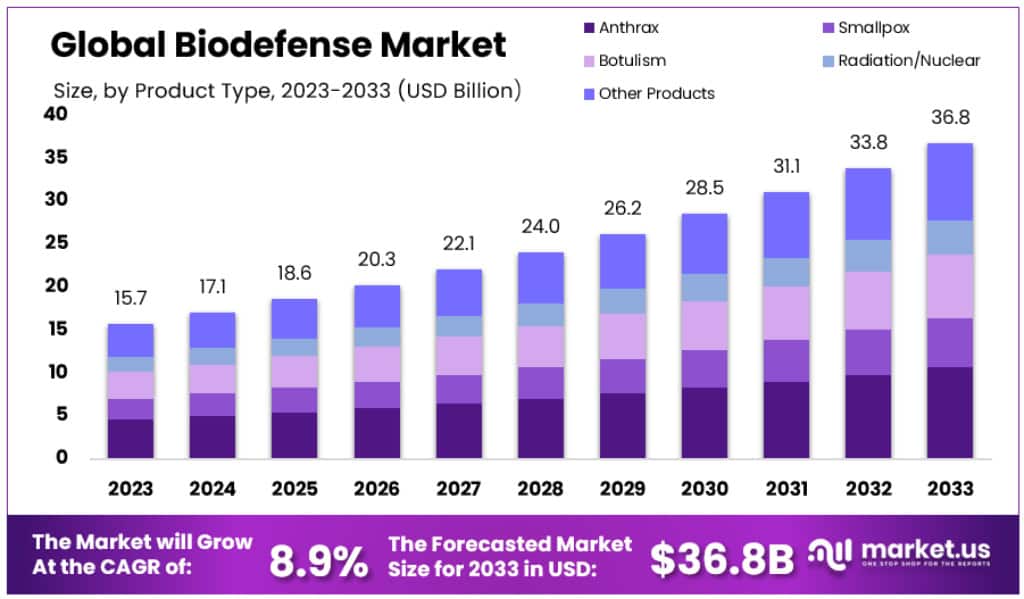
Key Takeaways
- Market Size: The Biodefense Market is valued at approximately USD 15.7 billion in the year 2023.
- Projected Market Size: It is anticipated that the Biodefense Market will reach around USD 36.8 billion by 2032.
- Compound Annual Growth Rate (CAGR): The market is expected to grow at a CAGR of 8.9% from 2023 to 2032.
- Anthrax Segment Market Share: Anthrax, as a product segment, holds the largest revenue share of 29% in the Biodefense Market in 2023.
- U.S. Department of Defense Budget: The U.S. Department of Defense allocated $718 billion for defense, including biodefense, in the fiscal year 2021.
- U.S. Government Investment in Biodefense (2023-2028): The U.S. government budgeted $88.2 billion over five years, from 2023 to 2028, for biodefense.
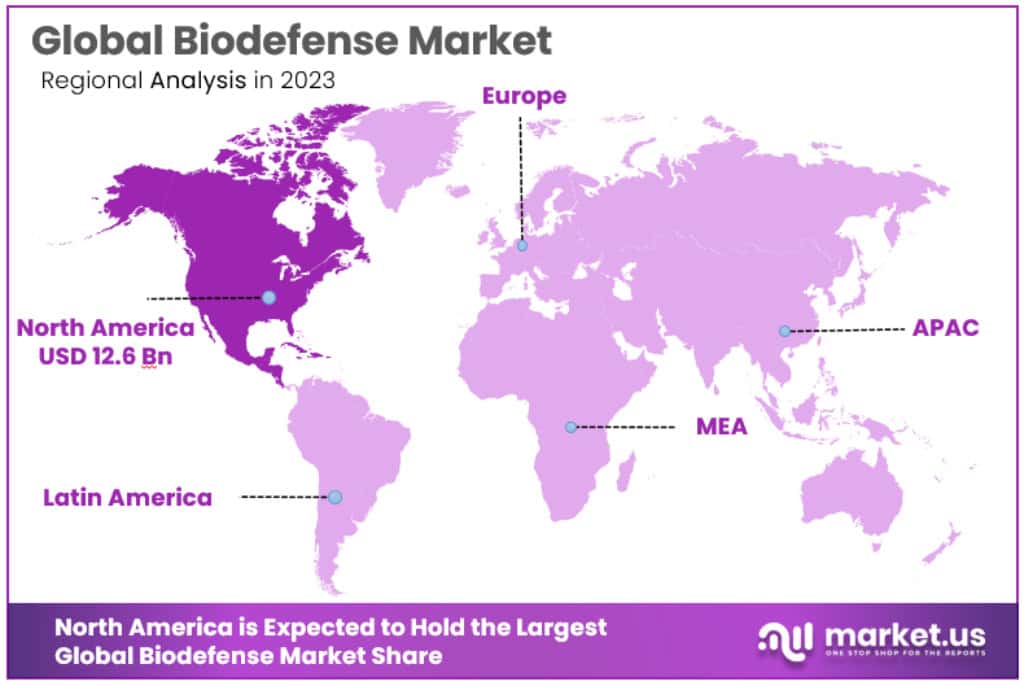
- North American Market Share: In 2023, North America, particularly the United States, dominated the market with about 80% share, valued at $12.6 million.
Product Analysis
The market for biodefense was dominated by the anthrax segment, which held the largest revenue share with 29% in 2023. It is expected that the segment will see a substantial CAGR in the future. Bacillus Anthracic is gram-positive bacteria that causes anthrax.
These spores are most commonly preferred because they can be easily released into an environment by being placed in food, water, or powder. They can survive for long periods in the environment, and they are easy to find in nature.
Anthrax bacteria, which can be easily transmitted from one person to another, is classified as a Tier-1 biological agent according to NCBI. This means that it has the potential to have major health consequences for the public. Project Bio-Shield has funded major vaccine development funds for countermeasures against anthrax. Many companies have anthrax vaccines in clinical trials.
The market for other products will have the second-highest CAGR during the forecast period. Viral hemorrhagic disease, brucellosis, cholera, and influenza are all included in the other segment.
The National Institute of Allergy and Infectious Diseases, (NIAID), has a Vaccine Research Centre. This Centre works on VHF vaccines since 2003 to protect against Ebola and Marburg. The U.S. Department of Defense has given a contract to the University of Texas at San Antonio for the development of a vaccine that will combat tularemia.
Tularemia is a highly infectious disease that can lead to death. Many countries have seen an increase in Zika and Ebola virus infections recently. Therefore, many companies are competing for vaccines.
Application Analysis
Due to terrorist organizations’ increasing biological threats to civilians, the revenue CAGR for the civilian segment will be rapid. Many terrorist organizations disrupt society.
As a majority of the population is civilians, there is a major threat or damage to the civil sector. That’s why governments are creating civilian biodefense strategies for civilians and conducting research activities to help protect the civilian population against such biological attacks.
As a result, many research institutions are engaged in civilian biodefense research. Avian influenza is a potentially lethal virus that can be introduced intentionally or naturally by terrorists. NIAID’s civilian biodefense research, for example, is part of its larger portfolio on emerging and reemerging infections.
The U.S. Department of National Institutes of Health(NIH), and Health and Human Services (HHS) placed a strong emphasis on initial advances in medical countermeasures against terrorist attacks from infectious diseases and radiation exposure. This is a significant factor that will drive segment revenue growth during the forecast period.
Key Market Segments
By Product
- Anthrax
- Botulism
- Smallpox
- Nuclear/Radiation
- Other Products
By Application
- Civilian
- Military
Drivers
- Increased Government Funding and Protective Measures: Governments globally are significantly investing in biodefense, mainly due to the growing threat of bioterrorism. For example, the US Department of Defense allocated $718 billion in FY 2021 for defense, which includes biodefense. This investment boosts the market’s growth.
- Technological Advancements: New technologies are being developed for detecting biothreats, which helps in identifying harmful bacteria and viruses. This progress is vital for the security and safety of populations, encouraging market growth.
- Rising Demand for Vaccines: With the emergence of diseases like Ebola and Zika, there’s a rush to develop effective vaccines. Governments are investing heavily in vaccine R&D, offering substantial growth opportunities for pharmaceutical companies in the biodefense sector.
Restraints
- High Costs of Advanced Biodefense Technologies: Developing countries often struggle with the financial capacity to develop strong biodefense systems. This includes the need for advanced technology, well-equipped labs, and skilled professionals, which can limit market growth in these regions.
Opportunities
- Focus on Research and Development (R&D): There’s a growing emphasis on R&D, which is crucial for developing new technologies and biodefense systems. For example, in April 2020, Emergent BioSolutions and the US government entered a partnership, with a funding of $14.5 million from BARDA, for developing COVID-19 treatments.
Challenges
- Uncertainty in Demand: The unpredictable nature of bioweapon attacks makes it hard to determine the specific demand for biodefense products. This dependence on government purchases, subject to changing priorities and threat assessments, presents market uncertainties.
Trends
- Anthrax Product Segment Growth: There’s an increasing outbreak of anthrax, driving growth in this segment. For example, in July 2022, 15 human cases of anthrax were reported in Croatia, leading to increased governmental focus and preventive measures in affected areas.
- Competition Among Market Participants: The market is highly competitive, with companies rapidly adopting advanced technologies for vaccine and drug development. Strategic partnerships with governments are key for firms to secure large orders and enhance their market position.
Regional Analysis
- North America Leading the Market: In 2023, North America, especially the United States, dominated the biodefense market, holding about 80% share, valued at $12.6 million. This is mainly because the U.S. government is heavily investing in biodefense strategies. For instance, in 2023, the U.S. budgeted $88.2 billion over five years for biodefense. This includes funding for the Department of Health and Human Services, CDC, NIH, and more. This region also has major companies working in biodefense.
- Asia Pacific’s Rapid Growth: The Asia Pacific region is expected to grow fast in the biodefense market. Countries here are putting more money into research and development (R&D) and facing more biothreats. Governments are making it easier for companies to set up vaccine and drug factories, which helps the market grow.
- Europe’s Strong Position: In 2021, Europe was second in revenue for biodefense. This is due to strict biosecurity laws in countries like Germany. For example, Germany has laws like TRBA 100, which sets high standards for handling dangerous toxins and pathogens. This focus on biosecurity is pushing the market forward in Europe.
Growth Opportunities Across Regions
- United States as a Market Leader: The U.S. remains at the forefront because of its significant federal funding and comprehensive biodefense strategies. The U.S. has a high Global Health Security (GHS) Index score of 75.9, showing its readiness for biothreats. There’s also potential to expand the biodefense market beyond the government to other customers like healthcare institutions and emergency responders.
- Europe and Asia Pacific Becoming More Important: Europe is upping its game in biodefense, especially after the COVID-19 pandemic, by increasing R&D spending. In Asia Pacific, countries like Australia and Japan, with their well-established safety norms, are becoming key players. China and India are also enhancing their R&D capabilities, making this region a significant player in the biodefense market.
Кеу Regions and Countries
- North America
- US
- Canada
- Mexico
- Europe
- Germany
- UK
- France
- Italy
- Russia
- Spain
- Rest of Europe
- APAC
- China
- Japan
- South Korea
- India
- Rest of Asia-Pacific
- South America
- Brazil
- Argentina
- Rest of South America
- MEA
- GCC
- South Africa
- Israel
- Rest of MEA
Key Players Analysis
The biodefense market is extremely competitive. Market players are competitive due to the rapid adoption and use of advanced technology for developing vaccines.
Strategic collaborations are becoming increasingly popular with key players to obtain bulk orders and increase sales volume in emerging economically viable regions. Numerous companies are joining forces to jointly develop drugs and bring their products to the market faster for biodefense.
Ichor Medical Systems Inc., which is a private biotech company, announced that it had entered into an agreement for collaboration and research with AstraZeneca. This agreement covers the development and clinical evaluation of plasmid genome constructs. Ichor will receive both annual and upfront payments under the terms. Additionally, milestones for development will be covered.
Маrkеt Кеу Рlауеrѕ
- XOMA corporation
- Altimmune Inc.
- Emergent Biosolutions Inc.
- Dynavax Technologies Corporation.
- SIGA Technologies.
- Elusys Therapeutics Inc.
- Ichor Medical Systems.
- Dynport Vaccine Company.
- Cleveland Biolabs.
- Bavarian Nordic.
- Ology Bioservices.
- Alnylam Pharmaceuticals Inc.
- Other Key Players
Recent Development
- XOMA Corporation: In May 2024, XOMA Corporation acquired a portfolio of biodefense antibodies from a leading biotech firm. This acquisition aims to enhance XOMA’s capabilities in developing countermeasures against biological threats, strengthening its position in the biodefense market.
- Altimmune Inc.: In April 2024, Altimmune Inc. launched a new intranasal anthrax vaccine candidate. This innovative product leverages Altimmune’s proprietary technology to provide rapid protection against anthrax, addressing a critical need in the biodefense sector.
- Emergent Biosolutions Inc.: In June 2024, Emergent Biosolutions Inc. merged with a prominent vaccine manufacturing company. The merger is expected to expand Emergent’s production capacity and enhance its ability to supply critical biodefense vaccines globally.
- SIGA Technologies: In March 2024, SIGA Technologies introduced a new antiviral therapeutic for smallpox. This product aims to bolster national stockpiles and improve preparedness against potential bioterrorism threats, reinforcing SIGA’s role in the biodefense market.
- Elusys Therapeutics Inc.: In April 2024, Elusys Therapeutics Inc. announced a strategic partnership with a leading pharmaceutical company to co-develop a next-generation anthrax antitoxin. This collaboration aims to advance the development and availability of effective biodefense countermeasures.
- Ichor Medical Systems: In May 2024, Ichor Medical Systems secured a government contract to develop a DNA-based vaccine platform for emerging biological threats. This contract supports Ichor’s efforts to innovate and deliver cutting-edge solutions in the biodefense arena.









