


Report Overview
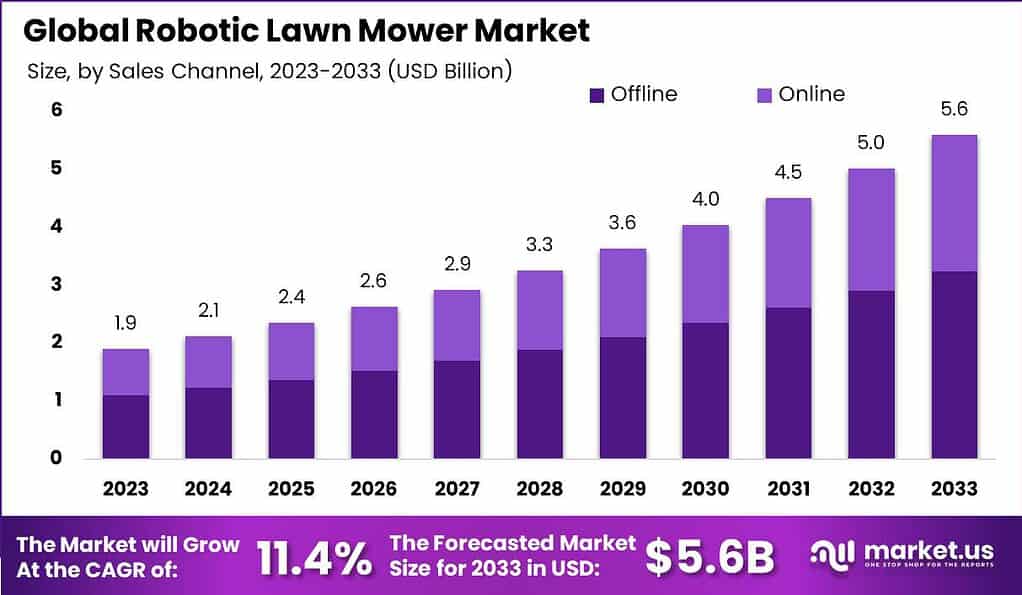
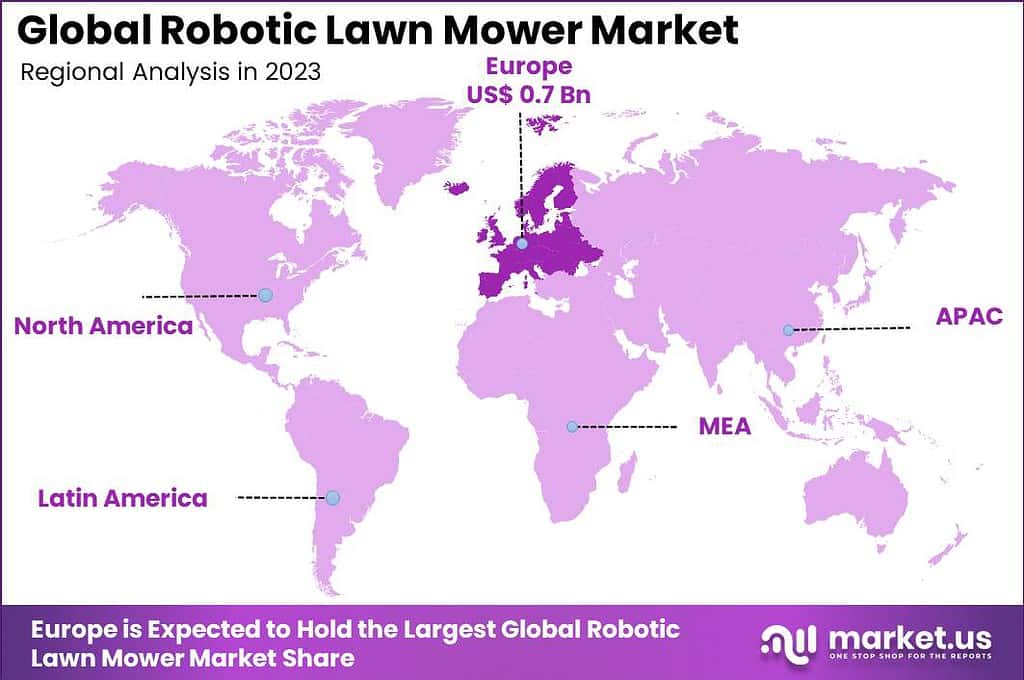
The Global Robotic Lawn Mower Market size is expected to be worth around USD 5.6 Billion By 2033, from USD 1.91 Billion in 2023, growing at a CAGR of 11.4% during the forecast period from 2024 to 2033. In 2023, Europe captured over 35% of the robotic lawn mower market share, leading the region with revenues totaling USD 0.7 billion.
A robotic lawn mower is a technologically advanced device designed to cut grass autonomously without human intervention, enhancing convenience in lawn maintenance. These mowers are equipped with sensors and GPS tracking to navigate through garden spaces, avoiding obstacles and efficiently mowing in varied patterns. Their design caters to different lawn sizes and can be controlled remotely through apps, aligning with modern smart home ecosystems.
The robotic lawn mower market refers to the industry focused on the development, manufacturing, and sales of robotic lawn mowers. This market has seen substantial growth due to increasing consumer interest in smart home gadgets and the push for new technology in home and garden care. The industry benefits from innovations in battery technology, artificial intelligence, and wireless connectivity, which have significantly improved the functionality and appeal of robotic lawn mowers.
The rise in disposable income and interest in home gardening has significantly contributed to the market demand for robotic lawn mowers. The market is also benefiting from the aging population seeking easy-to-use, physically less demanding lawn care options. Additionally, advancements in technologies such as GPS and AI have made these devices more efficient and appealing to tech-savvy consumers.
There is a notable increase in demand within the residential sector, particularly among households looking to reduce the physical exertion associated with lawn maintenance. The market opportunities are expanding with the integration of these mowers into smart home systems, providing users with seamless control and monitoring capabilities. Furthermore, manufacturers are focusing on reducing noise pollution and enhancing battery performance to meet consumer expectations for quieter, more efficient mowers.
For instance, In August 2023, Dreametech Technology unveiled its latest innovation, the Dreame Roboticmower A1. This new addition to their product lineup features a 3D lidar system, targeting the mid-to-high-end market segments. Scheduled for release in the European and North American markets in early next year, this robotic mower exemplifies Dreametech’s commitment to advancing home automation technologies.
Robotic lawn mowers have seen significant technological innovations, including the integration of LiDAR and SLAM technologies which allow for better navigation and obstacle avoidance without the need for perimeter wires. This advancement not only increases efficiency but also broadens the potential for more complex garden layouts. Companies are continually innovating to produce smarter, more connected devices that offer enhanced functionality and user experience.
Key Takeaways
- The Global Robotic lawn mower market is projected to reach USD 5.6 billion by 2033, up from USD1.91 billion in 2023. This represents a Compound Annual Growth Rate (CAGR) of 11.4% during the forecast period from 2024 to 2033.
- In 2023, the 20V to 30V segment led the robotic lawn mower market, capturing more than 62% of the market share.
- The Offline segment dominated the market in 2023, accounting for over 58% of the total market share in the robotic lawn mower industry.
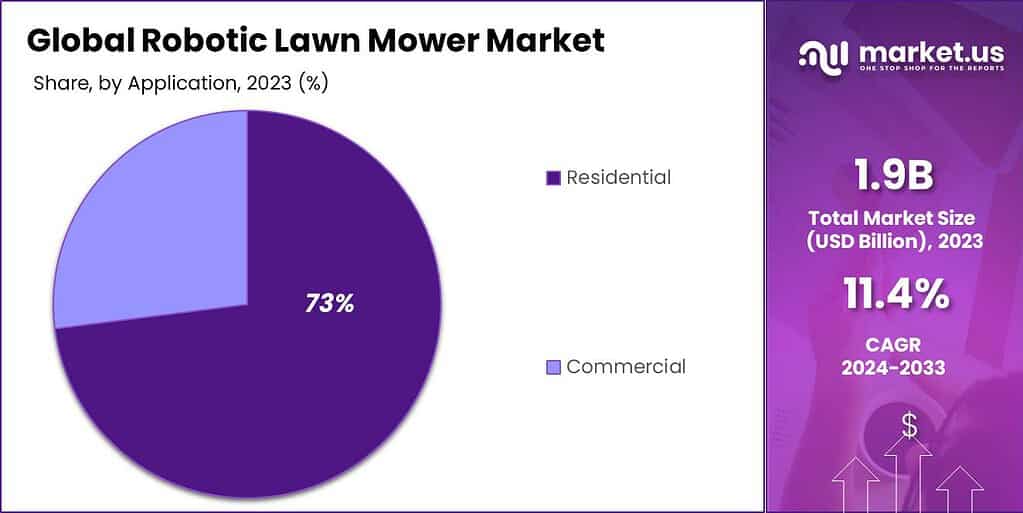
- The Residential segment held the largest share in 2023, making up more than 73% of the robotic lawn mower market.
- In 2023, Europe held the leading position in the global robotic lawn mower market, capturing more than 35% of the market share, with revenues reaching USD 0.7 billion.
Battery Capacity Analysis
In 2023, the 20V to 30V segment held a dominant market position in the robotic lawn mower market, capturing more than a 62% share. This segment’s popularity stems primarily from the perfect balance it offers between power efficiency and performance.
Mowers equipped with 20V to 30V batteries are sufficiently powerful to handle most typical residential lawn sizes without the bulk or excess energy consumption that might come with higher voltage options. This makes them particularly appealing to the average homeowner looking for a reliable, efficient lawn care solution.
These mid-range battery-powered mowers also tend to strike an ideal balance in terms of cost and functionality. They are more affordable than their more powerful counterparts while still offering advanced features like programmable schedules, obstacle detection, and precise cutting paths. This affordability, coupled with enhanced capabilities, presents a value proposition that is hard to match, thus driving the popularity of this segment.
Sales Channel Analysis
In 2023, the Offline segment held a dominant market position in the robotic lawn mower market, capturing more than a 58% share. This segment’s strength largely stems from consumer preferences for hands-on shopping experiences, where they can see, touch, and sometimes even test the product before purchasing.
The offline channel benefits from the established trust and reliability associated with traditional brick-and-mortar stores. Consumers tend to rely on physical retail outlets for after-sales services, including maintenance and repairs, which are pivotal for technologically sophisticated products such as robotic lawn mowers. This trust and the convenience of immediate customer service help sustain the segment’s leading position.
Additionally, many manufacturers have bolstered their relationships with retailers to enhance product visibility and improve consumer access in physical locations. These strategic partnerships are essential for driving sales through promotional displays and in-person demonstrations, further solidifying the offline segment’s dominance in the market.
Application Analysis
In 2023, the Residential segment held a dominant market position in the robotic lawn mower market, capturing more than a 73% share. This dominance is largely attributed to the increasing number of households adopting smart home technologies, which integrate devices like robotic lawn mowers into their everyday routines.
These mowers cater to homeowners seeking convenience and efficiency in lawn maintenance, allowing them to save time and effort with automated technology that takes care of their green spaces without needing constant oversight.
Another factor contributing to the strength of the Residential segment is the shift towards more sustainable living practices. Robotic lawn mowers are viewed as an eco-friendly alternative to traditional gas-powered mowers, as they produce no emissions and operate at a significantly lower noise level, making them ideal for residential areas.
The ongoing improvements in battery technology and artificial intelligence have also made these devices more accessible and effective for residential use. They are now capable of handling varied landscapes and can adjust their mowing patterns based on grass growth and weather conditions.
Key Market Segments
By Battery Capacity
- Up to 20V
- 20V to 30V
- More than 30V
By Sales Channel
- Offline
- Online
By Application
- Residential
- Commercial
Driver
Rising Demand for Autonomous Home Solutions
In recent years, there’s been a clear trend toward autonomous home solutions, with robotic lawn mowers at the forefront of this shift. The primary driver here is the growing preference for convenience among homeowners.
Robotic lawn mowers offer a unique benefit as they can independently mow lawns, saving time and effort for users. As people’s lives become busier, there’s a demand for technology that reduces everyday tasks, and robotic mowers deliver precisely that.
The demographic shift towards urbanization also plays a role in the growing demand for robotic lawn mowers. As more people move to urban areas with smaller yard spaces, robotic mowers are ideal solutions for managing these compact lawns. Unlike traditional mowers, which may be cumbersome, robotic mowers operate smoothly on smaller plots.
Restraint
High Initial Cost and Maintenance Expenses
Despite the advantages, one notable restraint in the robotic lawn mower market is the high upfront cost. For many consumers, these devices represent a significant financial commitment, often priced higher than traditional lawn mowers. While they offer long-term convenience, the initial cost can be a deterrent, especially for average homeowners who may not prioritize such a substantial investment for lawn care.
Maintenance and repair costs also present concerns. Robotic lawn mowers are technologically complex devices with advanced sensors, software, and battery systems. When any of these components require repair, it can be costly due to specialized parts and servicing needs. Also, in certain models, battery replacement every few years can add up, further increasing maintenance costs.
Opportunity
Technological Advancements in AI and Connectivity
The robotic lawn mower market holds a significant opportunity through advancements in artificial intelligence (AI) and connectivity. As AI technology evolves, robotic mowers can become “smarter” and more efficient in navigating lawns. For instance, AI-driven mowers can learn the specific layout of a lawn, avoid obstacles more effectively, and adapt cutting patterns based on grass growth.
Additionally, the integration of IoT and smartphone connectivity provides a new level of convenience. Many modern robotic mowers can now be controlled remotely, allowing users to schedule mowing times, monitor performance, or adjust settings from a mobile app. This remote control capability taps into the broader trend of connected devices in smart homes, creating a new selling point for these mowers.
Challenge
Limited Performance on Complex and Large Terrain
One of the biggest challenges for robotic lawn mowers is their performance on uneven, large, or complex terrains. These mowers perform well on relatively flat, small-to-medium lawns but struggle with steep slopes, thick grass, or intricate landscapes with many obstacles. Users with these kinds of lawns may find that a robotic mower doesn’t meet their expectations.
Battery life is another constraint when it comes to larger lawns. Robotic mowers often need to return to their charging station frequently, making them less efficient for expansive areas. For users with large properties, this can be inconvenient, as the mower may take significantly longer to cover the entire lawn or may need multiple recharges to finish the job.
Emerging Trends
Robotic lawn mowers are transforming how we maintain our lawns, with several key trends shaping their evolution.
A significant development is the integration of artificial intelligence and advanced sensors, enabling these mowers to navigate complex terrains and avoid obstacles like garden furniture and pets. For instance, Segway’s Navimow (i) Series utilizes AI to detect and steer clear of obstacles, ensuring efficient and safe operation.
Another notable trend is the shift towards wire-free boundary setups. Traditional robotic mowers required physical boundary wires to define their mowing area, but newer models employ GPS and vision-based systems to map lawns without the need for underground wires.
Environmental sustainability is also a driving force behind the adoption of robotic mowers. These electric-powered devices produce zero emissions, offering an eco-friendly alternative to gas-powered mowers. The smart home technology allows users to control and monitor their mowers remotely via smartphone apps which enables scheduling, status updates, and customization of mowing patterns.
Business Benefits
For landscaping businesses, incorporating robotic lawn mowers offers several advantages. One of the most significant benefits is the reduction in labor costs. Robotic mowers can operate autonomously, allowing businesses to reallocate human resources to more complex tasks that require a personal touch, thereby increasing overall productivity.
Robotic mowers provide consistent and high-quality lawn maintenance. They can be programmed to mow at optimal times and frequencies, ensuring lawns are always well-kept. This consistency enhances customer satisfaction and can lead to increased client retention.
Incorporating robotic mowers can also serve as a unique selling point, differentiating a business from competitors. Offering innovative, tech-driven solutions can attract a clientele interested in modern and efficient lawn care services. Also, the low maintenance requirements of robotic mowers translate to reduced operational costs over time. They have fewer moving parts than traditional mowers, leading to less wear and tear and lower maintenance expenses.
Regional Analysis
In 2023, Europe held a dominant market position in the robotic lawn mower market, capturing more than a 35% share with revenues amounting to USD 0.7 billion. This region leads primarily due to the high adoption rate of automation and smart home technologies among European households.
The increasing preference for garden maintenance solutions that offer convenience and efficiency has significantly driven demand in this market. European consumers show a strong inclination towards eco-friendly and energy-efficient products, which aligns well with the advancements in robotic lawn mowers.
Europe has a well-established garden culture, and the presence of expansive lawns and gardens in residential as well as commercial spaces fuels the need for automated and time-saving lawn maintenance solutions. The region’s climate, which promotes lush garden growth, further necessitates regular lawn care, pushing the demand for robotic lawn mowers.
The market is also supported by a robust presence of leading robotic lawn mower manufacturers such as Husqvarna Group, who are continuously innovating and expanding their product range to meet diverse consumer needs. These companies are deeply entrenched in the European market, benefiting from brand loyalty and established distribution channels that enhance market penetration and customer reach.
North America as well, follows Europe closely in the robotic lawn mower market, with increasing consumer interest in landscaping and smart home products driving growth. The trend towards technologically advanced home appliances that offer connectivity and ease of use has made robotic lawn mowers particularly appealing to North American consumers.
Key Regions and Countries
- North America
- US
- Canada
- Europe
- Germany
- France
- The UK
- Spain
- Italy
- Rest of Europe
- Asia Pacific
- China
- Japan
- South Korea
- India
- Australia
- Singapore
- Rest of Asia Pacific
- Latin America
- Brazil
- Mexico
- Rest of Latin America
- Middle East & Africa
- South Africa
- Saudi Arabia
- UAE
- Rest of MEA
Key Player Analysis
The robotic lawn mower market has witnessed significant growth, driven by advancements in automation and consumer interest in smarter, more efficient home gardening solutions.
Deere & Company, known widely as John Deere, has established itself as a leader in robotic lawn mower market. John Deere leverages its long-standing expertise in agricultural and turf equipment to develop high-quality robotic mowers. The company focuses on integrating advanced features such as GPS and intelligent mapping systems into its mowers, allowing precise navigation and tailored lawn care solutions.
Honda Motor Company has also become a key player in robotic lawn mowers, thanks to its innovative Miimo series. Honda’s Miimo robotic mowers are known for their reliability and smooth operation, catering particularly to residential consumers looking for user-friendly, efficient lawn care solutions.
Autmow Robotic Mowing has gained traction as a dedicated provider of robotic lawn mowing solutions, focusing specifically on the needs of residential and commercial lawn care. Unlike its competitors with broader product lines, Autmow specializes in robotic mowers, which allows it to provide tailored services, including installation and maintenance support.
Top Key Players in the Market
- Deere & Company
- Honda Motor Company
- Autmow Robotic Mowing
- Husqvarna AB
- ANDREAS STIHL AG & Co. KG
- WORX (Positec Tool Corporation)
- Ambrogio Robot
- The Toro Company
- Mammotion
- MTD Products Inc.
- Robert Bosch GmBH
- Other Key Players
Recent Developments
- In January 2024, Mammotion unveiled the Luba 2.0, an upgraded version of its best-selling robotic mower. The Luba 2.0 series includes eight models designed for various lawn sizes, ranging from 0.05 to 2.5 acres. It offers cutting height options from 1.2 to 4 inches, catering to diverse lawn care needs.
- In July 2024, Hookii introduced the Neomow X series, a groundbreaking robotic lawn mower featuring advanced LiDAR SLAM and AI-powered vision systems. This innovation eliminates the need for perimeter wires, offering precise navigation and intelligent obstacle avoidance. The Neomow X series aims to provide users with an effortless and efficient lawn care experience.
- In October 2024, Sunseeker launched the X Series of wireless robot mowers at the Equip Expo. The X Series, including models like the X7, X7 Plus, and X7 Pro, represents innovation in wire-free mowing technology. These models are designed to deliver performance and ease of use for customers, with the X7 Pro and new models exclusively available to dealers.
- In October 2024, Segway Navimow presented its upcoming Navimow X3 Series robotic mowers at the Equip Expo in Louisville, Kentucky. The new premium model mowers remove the need for boundary wires and are designed to maintain large lawns with ease, delivering efficiency and expanded mowing functions.









