


Report Overview
The Global E-Commerce Personalization Software Market size is expected to be worth around USD 2,412.3 Million By 2033, from USD 263.2 Million in 2023, growing at a CAGR of 24.8% during the forecast period from 2024 to 2033. In 2023, North America held a dominant market position, capturing more than a 36% share, holding USD 97.7 Million revenue.
E-commerce personalization software is designed to create tailored shopping experiences online by dynamically displaying content, product recommendations, and specific offers based on user behavior, preferences, and past purchases. This technology helps online retailers engage effectively with customers by delivering personalized interactions, enhancing the shopping experience to boost customer satisfaction and loyalty.
The software utilizes artificial intelligence (AI) and machine learning (ML) to analyze customer data, predict preferences, and automate personalized content delivery in real-time across various digital touchpoints. The e-commerce personalization software market is experiencing rapid growth, propelled by the demand for customized shopping experiences that cater to individual customer preferences.
This sector is expected to expand significantly, with projections suggesting a substantial increase in market size over the next decade. Key factors contributing to this growth include the integration of advanced technologies like AI and ML, which enable deeper insights into customer behavior and more accurate personalization.
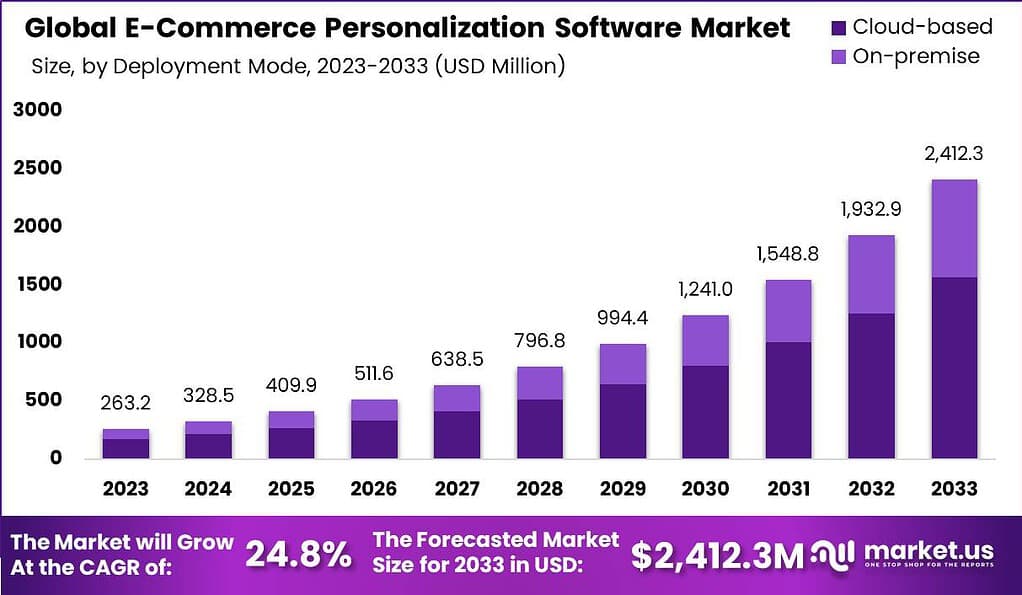
As the retail landscape becomes increasingly digital, the demand for e-commerce personalization solutions is growing. Opportunities are particularly prominent in mobile commerce, where personalization can transform standard transactions into interactive, customer-focused experiences.
Moreover, the rise of omnichannel retailing necessitates consistent personalized experiences across all platforms, from web to mobile to in-store interactions, offering further growth opportunities for the market. Technological advancements are continually shaping the e-commerce personalization software market.
The integration of machine learning models and AI technologies has allowed for more sophisticated data analysis and real-time personalization, significantly enhancing the accuracy and effectiveness of personalized marketing strategies. These technologies also facilitate the automated customization of content and offers, directly impacting conversion rates and customer loyalty in the e-commerce sector
Key Takeaways
- Market Growth Projection: The E-Commerce Personalization Software Market is projected to achieve a remarkable 24.8% Compound Annual Growth Rate (CAGR), reaching a substantial size of USD 2,412 Million by the year 2033.
- Deployment Mode Analysis: In 2023, the Cloud-Based Segment held a dominant market position in the e-commerce personalization software market, capturing more than 65% share. On the other hand, the On-Premise Segment, while smaller in market share, continued to be relevant.
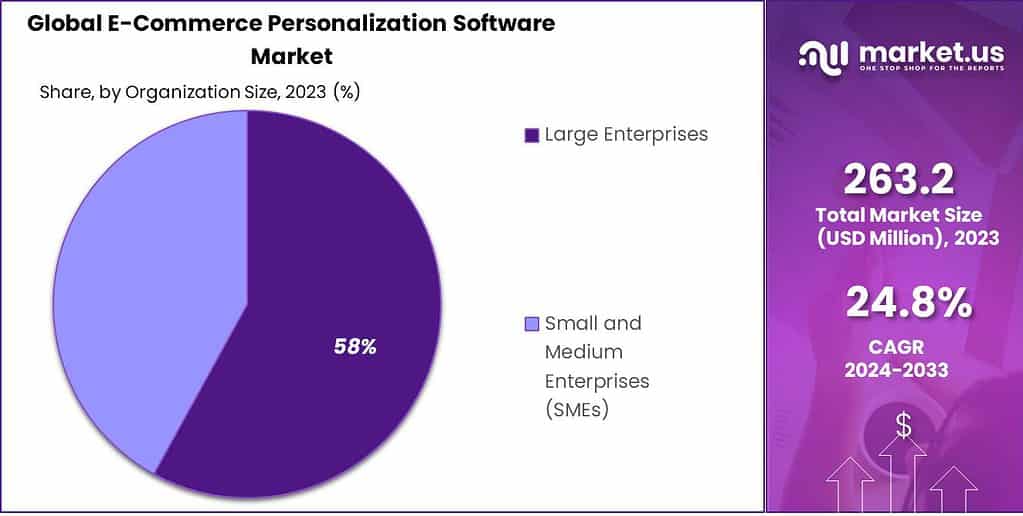
- Organization Size Analysis: In 2023, the Large Enterprises Segment held a dominant market position in the e-commerce personalization software market, capturing more than 58% share. The Small and Medium Enterprises (SMEs) segment shows promising growth potential.
- End-User Insights: In 2023, the Fashion and Apparel Segment held a dominant market position in the e-commerce personalization software market, capturing more than 37% share. Other sectors like Retail and Electronics also represent a significant portion of the market.
- Market Growth Factors: The market is driven by increasing customer demand for personalized experiences, advancements in AI and machine learning technologies, and growing competition in the e-commerce industry.
- Top Companies: Key players in the market include Adobe Inc., Salesforce.com Inc., Oracle Corporation, IBM Corporation, and others. These companies leverage AI, machine learning, and data analytics to offer personalized shopping experiences.
- Challenges: Challenges in the market include data quality and accuracy, personalization fatigue, scalability, and continuous optimization and testing.
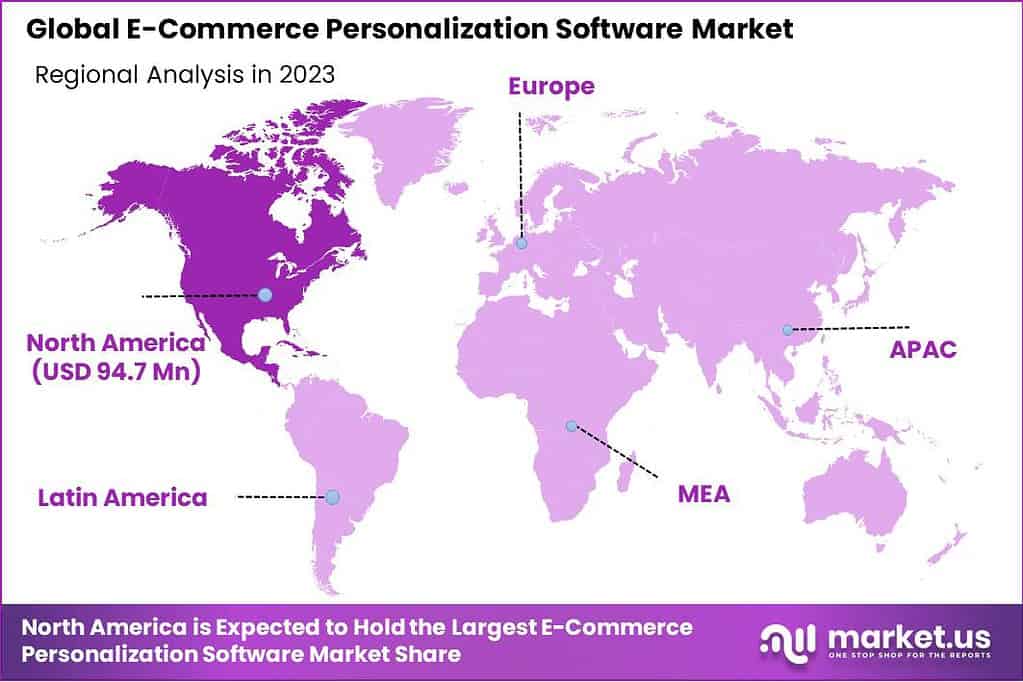
- Regional Analysis: In 2023, North America held a dominant market position in the e-commerce personalization software market, capturing more than 36% share. Europe, Asia-Pacific, Latin America, and the Middle East & Africa regions each contribute to the market’s growth.
Deployment Mode Analysis
In 2023, the Cloud-Based Segment held a dominant market position in the e-commerce personalization software market, capturing more than a 65% share. This dominance can be attributed to the increasing preference for cloud-based solutions, primarily driven by their cost-effectiveness, scalability, and ease of integration with existing e-commerce platforms.
Cloud-based personalization software offers retailers the agility to adapt to changing market trends quickly. Additionally, the cloud deployment mode benefits from regular updates and enhancements, ensuring that e-commerce businesses can leverage the latest technologies in personalization and customer experience optimization.
On the other hand, the On-Premise Segment, while smaller in market share, continued to be relevant, especially among businesses seeking greater control over their data and those with specific compliance requirements. The on-premise solutions provide enhanced security and customization, which are crucial for certain retailers, particularly in sectors handling sensitive customer information. Despite the technological advancements in cloud computing, a segment of the market remains cautious about data privacy and security, thus opting for on-premise solutions.
Organization Size Analysis
In 2023, the Large Enterprises Segment held a dominant market position in the e-commerce personalization software market, capturing more than a 58% share. This significant market share is primarily attributed to the substantial resources and capital that large enterprises possess, enabling them to invest in advanced e-commerce personalization technologies.
Large enterprises often have complex and expansive online retail operations, necessitating sophisticated personalization software to enhance customer experience and increase sales. The adoption of these technologies by large enterprises is driven by the need to maintain a competitive edge, cater to a diverse customer base, and manage vast amounts of customer data efficiently.
Conversely, the Small and Medium Enterprises (SMEs) segment, while holding a smaller portion of the market, shows promising growth potential. SMEs are increasingly recognizing the importance of personalized customer experiences as a tool to compete against larger players.
The growing availability of cost-effective, cloud-based personalization solutions is enabling SMEs to adopt these technologies without the need for substantial upfront investment. As these businesses grow in their digital transformation journeys, the demand within this segment is expected to increase, driven by the need for scalable, flexible, and user-friendly personalization tools that can cater to their dynamic market requirements.
Note: Actual Numbers Might Vary In The Final Report
End-User Outlook
In 2023, the Fashion and Apparel Segment held a dominant market position in the e-commerce personalization software market, capturing more than a 37% share. This dominance is largely due to the highly visual and trend-driven nature of the fashion industry, which necessitates a tailored online shopping experience.
E-commerce personalization software enables fashion retailers to offer customers personalized product recommendations, style advice, and size suggestions based on their browsing and purchase history. This approach not only enhances the customer experience but also significantly boosts conversion rates and customer loyalty.
The Retail Segment, while not as dominant, remains a key user of e-commerce personalization software. Retailers across various sub-segments leverage these tools to create a more engaging and relevant shopping experience for their customers. Personalization in retail extends beyond product recommendations to include personalized promotions, tailored content, and even customized shopping interfaces.
The Electronics Segment also represents a significant portion of the market. In this sector, personalization software is used to recommend products based on the customer’s technical preferences, previous purchases, and search history. Given the wide range of products and technical specifications in electronics, personalization software helps simplify the decision-making process for customers, leading to improved satisfaction and higher sales.
Other End-Users in the market include sectors like home furnishings, beauty products, and books, among others. These segments are increasingly adopting e-commerce personalization techniques to differentiate themselves in a crowded online marketplace.
Key Market Segments
Deployment Mode
- Cloud-based
- On-premise
Organization Size
- Large Enterprises
- Small and Medium Enterprises (SMEs)
End-User
- Retail
- Fashion and Apparel
- Electronics
- Other End-Users
Driving Factors
- Increasing customer demand for personalized experiences: In the realm of online shopping, customer expectations have evolved to encompass personalized website experiences, customized promotions, and tailored recommendations. E-commerce enterprises are responding to this demand by integrating personalization software, aligning with customer expectations and delivering distinctive shopping encounters.
- Advancements in AI and machine learning technologies: The landscape of e-commerce personalization software has been revolutionized by the strides made in artificial intelligence and machine learning technologies. Retailers can now delve into vast datasets, recognize complex patterns, and offer real-time recommendations, elevating the effectiveness and accuracy of personalized customer experiences.
- Growing competition in the e-commerce industry: The e-commerce market is highly competitive, with businesses constantly striving to differentiate themselves. E-commerce personalization software offers a way to stand out by delivering unique and tailored experiences, helping businesses gain a competitive edge and attract more customers.
- Increasing availability of customer data: In the era of widespread online shopping and digital interactions, e-commerce businesses find themselves immersed in a wealth of customer data. This trove, encompassing browsing behavior, purchase history, and demographics, becomes a valuable resource harnessed by personalization software. Through the strategic utilization of such data, businesses can offer highly pertinent and personalized experiences to their customers.
Restraining Factors
- Data privacy and security concerns: The functionality of personalization software relies on the meticulous collection and analysis of customer data, presenting valid concerns related to data privacy and security. To ensure compliance with regulations and fortify against potential threats, businesses are compelled to establish comprehensive security measures, protecting customer information. While crucial for data integrity, this undertaking may pose constraints for certain organizations.
- Implementation challenges and complexity: The integration and implementation of personalization software into established e-commerce platforms present a complex and challenging endeavor. Requiring technical proficiency and seamless coordination across diverse systems and organizational departments, this process can be daunting for businesses contemplating the adoption of personalization software.
- Cost considerations: The implementation of e-commerce personalization software comes with notable initial costs, covering licensing fees, infrastructure investments, and ongoing maintenance expenditures. Small and medium-sized businesses, operating under financial constraints, may find the associated expenses to be a hindrance in adopting and managing such personalized software solutions.
- Resistance to change and organizational culture: Integrating personalization software often demands a shift in organizational culture and mindset. Employees, entrenched in traditional approaches and wary of potential job displacement, may exhibit resistance. Surmounting this resistance and instilling a culture of personalization emerges as a notable challenge for organizations aspiring to embrace this innovative technology.
Growth Opportunities
- Mobile commerce and app personalization: As the prevalence of smartphones in online shopping continues to rise, there exists a substantial opportunity for personalization software to elevate mobile commerce experiences. The customization of recommendations and promotions within mobile apps stands as a pivotal strategy, fostering a seamless and personalized shopping journey that significantly enhances customer engagement and boosts conversions.
- Predictive analytics and real-time personalization: The progress in predictive analytics and real-time data processing opens avenues for dynamic and context-aware personalization. E-commerce personalization software can harness these capabilities to provide timely and pertinent recommendations and promotions, aligning with customer behavior and preferences.
- Voice commerce and smart devices: The rise of voice-enabled devices, such as smart speakers and virtual assistants, opens up new avenues for personalization in e-commerce. Personalization software can be integrated with voice commerce platforms to provide personalized product recommendations and shopping experiences through voice interactions.
- Cross-channel personalization: The realm of e-commerce provides businesses with an opportunity to consistently deliver personalized experiences across multiple channels, spanning websites, mobile apps, social media, and email marketing. By employing personalization software, businesses can seamlessly integrate customer data from these disparate channels, ensuring a cohesive and personalized journey for customers.
Challenges
- Data quality and accuracy: To bolster the effectiveness of personalization, businesses should invest in robust data quality assurance protocols. This involves implementing stringent measures to validate, clean, and standardize customer data. By enforcing rigorous standards, organizations can mitigate the impact of inaccuracies, ensuring a reliable foundation for personalization initiatives.
- Personalization fatigue and privacy concerns: While personalization can enhance the shopping experience, there is a risk of overwhelming customers with excessive or intrusive personalization. Striking the right balance between personalization and privacy, and avoiding personalization fatigue, is a challenge for businesses.
- Scalability and performance: As the volume of customer data expands, the significance of scalability and performance amplifies. Personalization software is required to adeptly manage sizable datasets, process information in real-time, and furnish personalized experiences seamlessly, devoid of delays or performance issues.
- Continuous optimization and testing: The process of personalization is a dynamic and continuous endeavor, demanding perpetual optimization and testing. Businesses must consistently scrutinize and evaluate the efficacy of their personalization initiatives, fine-tune algorithms and strategies, and engage in A/B testing to enhance performance and attain desired outcomes.
Key Market Trends
- Hyper-personalization: The momentum towards hyper-personalization signifies a paradigm where highly individualized experiences are crafted through the synergy of advanced AI algorithms and real-time data. Personalization software is undergoing a transformative evolution, enhancing its ability to furnish more detailed and context-aware recommendations and experiences, finely tuned to each customer’s preferences, behavior, and immediate needs.
- Social media personalization: The growing importance of social media platforms in e-commerce is undeniable, offering businesses avenues for customer engagement and data collection. E-commerce personalization software is now seamlessly integrating with these platforms, harnessing social data to craft personalized experiences that align with individual social interactions, interests, and connections.
- Personalization beyond product recommendations: The realm of e-commerce personalization software has expanded well beyond basic product recommendations. It now encompasses personalized pricing, customized content, targeted promotions, individualized search results, and personalized messaging, all working cohesively to provide a thorough and tailored shopping experience.
- Ethical and transparent personalization: With growing concerns about data privacy and algorithmic biases, there is a trend towards ethical and transparent personalization. Businesses are focusing on transparency in data usage, providing opt-out options, and ensuring fairness and inclusivity in personalization algorithms to build trust with customers.
Regional Analysis
In 2023, North America held a dominant market position in the e-commerce personalization software market, capturing more than a 36% share. This significant market share can be attributed to the advanced technological infrastructure and the high adoption rate of e-commerce platforms across the region.
The demand for E-Commerce Personalization Software in North America was valued at US$ 4.06 billion in 2023 and is anticipated to grow significantly in the forecast period. Furthermore, the presence of leading market players in this region contributes to the innovation and growth of personalized shopping experiences.
Europe, on the other hand, focuses heavily on customer data protection and privacy, aligning with the GDPR regulations. Despite these regulatory challenges, the European market remains robust, driven by the growing online retail sector and an increasing demand for personalized user experiences.
The Asia-Pacific (APAC) region is experiencing a surge in growth, propelled by an expanding digital consumer base and rising internet penetration. Emerging economies such as China and India are key contributors, where e-commerce personalization is becoming increasingly important for customer engagement and retention.
Latin America, though still in the developmental stages in terms of e-commerce infrastructure, is showing significant growth in the personalization software market. This region’s progress is primarily fueled by the growing adoption of mobile devices and enhanced digital literacy among consumers.
Finally, the Middle East and Africa (MEA) region, though holding a smaller portion of the market, is gradually adopting e-commerce personalization. The region’s growth is linked to increasing internet accessibility and the rising popularity of online shopping, particularly among the younger demographics.
Note: Actual Numbers Might Vary In The Final Report
Key Regions and Countries Covered in this Report:
- North America
- The US
- Canada
- Europe
- Germany
- France
- The UK
- Spain
- Italy
- Russia
- Netherland
- Rest of Europe
- APAC
- China
- Japan
- South Korea
- India
- New Zealand
- Singapore
- Thailand
- Vietnam
- Rest of Asia Pacific
- Latin America
- Brazil
- Mexico
- Rest of Latin America
- Middle East & Africa
- South Africa
- Saudi Arabia
- UAE
- Rest of MEA
Key Players Analysis
The E-Commerce Personalization Software Market is characterized by the presence of several key players, each contributing to the market’s growth through innovative solutions and strategic market approaches. These players are distinguished by their ability to offer personalized shopping experiences, leveraging advanced technologies such as artificial intelligence, machine learning, and data analytics.
Top Company Profiles
- Adobe Inc.
- Salesforce.com Inc.
- Oracle Corporation
- IBM Corporation
- Segment (Twilio Inc.)
- Optimizely (Episerver Inc.)
- Dynamic Yield
- Qubit (AB Tasty)
- RichRelevance (Manthan Software Services Pvt Ltd)
- Celebros (Bridgeline)
- Searchspring
- Glood.AI
- Shoptet
- Nudgify
- PureClarity
- Cloud.IQ
- Other Key Players
Recent Developments
- In 2023, Adobe, Focus on AI and Machine Learning: Unveiled Adobe Sensei, a powerful AI engine that powers personalization features across their Experience Cloud, including Magento.
- In 2023, Salesforce, Einstein Personalization AI Engine: Expanded capabilities of their Einstein AI engine for personalized product recommendations, dynamic content, and real-time offer triggers.
- In 2023, IBM, Watson Customer Engagement: Focused on integration of Watson AI for personalized product recommendations, chatbots, and customer journey analysis.









