


Report Overview
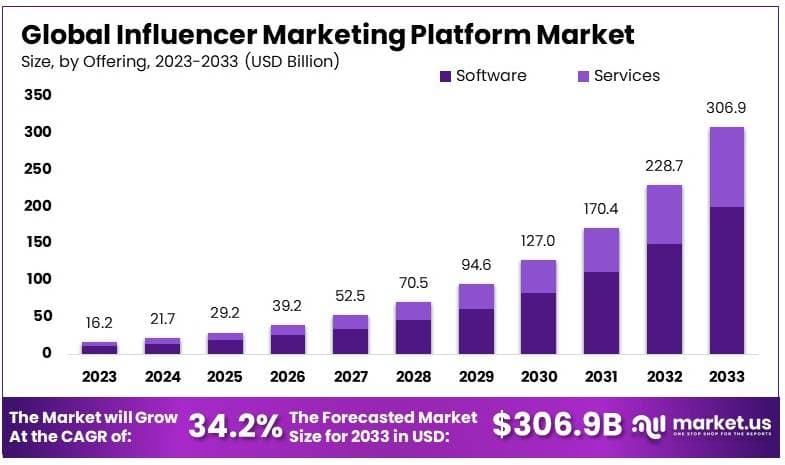
The Global Influencer Marketing Platform Market size is expected to be worth around USD 306.9 Billion by 2033, from USD 16.2 Billion in 2023, growing at a CAGR of 34.2% during the forecast period from 2024 to 2033. In 2023, North America held a dominant market position, capturing more than a 31.7% share, holding USD 5.14 Billion revenue.
An influencer marketing platform is a specialized tool designed to aid businesses in their influencer marketing efforts. These platforms provide a suite of services that streamline the process of identifying, connecting, and managing relationships with influencers. They enable brands to find influencers who align with their brand values and target audience, manage campaigns, track performance metrics, and measure the effectiveness of their influencer collaborations.
The influencer marketing platform market has seen significant growth due to the rising importance of social media marketing and the growing recognition of the impact that influencers can have on consumer behavior. Brands increasingly rely on influencer marketing platforms to enhance their marketing strategies by leveraging the credibility and reach of influencers. These platforms offer sophisticated tools for campaign management, analytics, and reporting, helping marketers optimize their campaigns for better engagement and returns.
The expansion of this market is largely driven by the increasing consumption of content across various social media platforms where influencers have a significant presence. Additionally, the shift from traditional advertising to more organic, trust-based marketing through influencers who have built loyal followings is a key driver. The growing number of social media users and their engagement with influencers makes influencer marketing a crucial part of brand strategy, prompting further development and adoption of influencer marketing platforms.
Demand in the influencer marketing platform market is driven by businesses seeking to enhance brand awareness and reach through effective influencer collaborations. The need to tap into niche audiences and generate authentic engagement through trusted voices has led many brands to invest in these platforms. Moreover, as measuring the return on investment from influencer marketing campaigns becomes increasingly important, the demand for robust analytical tools within these platforms continues to rise
The Influencer Marketing Platform market is experiencing robust growth, driven by evolving strategies and platforms that cater to increasingly targeted audience segments. A significant shift in the market is the growing reliance on micro-influencers, who now account for 46.4% of brand and agency spending.
This trend is largely attributed to their ability to engage more relevant and niche audiences, which 60% of marketers find more effective for reaching specific customer segments. Micro-influencers’ closer connections with their followers enable brands to achieve higher engagement and trust, making them an integral part of modern marketing strategies.
Instagram continues to dominate the influencer marketing landscape, with 68% of marketers utilizing it for their campaigns. The platform’s visual-centric nature is particularly effective for product discovery, as evidenced by 83% of users reporting that they discover new products on Instagram.
Influencer-generated content on Instagram significantly outperforms brand-originated posts, with an average engagement rate of 3.21%, highlighting the platform’s value in driving consumer interest and interaction.
TikTok is rapidly emerging as a key platform in influencer marketing, with 67% of marketers planning to use it for campaigns in 2023, up from 45% in the previous year. TikTok’s unique engagement dynamics, boasting an average influencer engagement rate of 15.86%, make it particularly appealing for brands targeting younger audiences.
The platform’s short-form, creative content resonates strongly with Gen Z and Millennial consumers, offering brands a powerful tool for expanding their reach and influence.
E-commerce integration with influencer marketing is also gaining traction, particularly among female consumers. Notably, 53% of women have made a purchase through a social media influencer’s post, demonstrating the direct impact of influencer-driven content on buying behavior.
Brands like Zara and Revolve have successfully leveraged social commerce, with Revolve attributing over 70% of its sales to influencer partnerships on Instagram, underscoring the financial benefits of these collaborations.
However, as the market grows, so too does the scrutiny from regulatory bodies. Currently, only 25% of Instagram influencers follow FTC regulations, but there is increasing pressure for stricter enforcement of disclosure rules. As regulatory frameworks evolve, platforms and brands will need to adapt to maintain transparency and trust with consumers.
The Influencer Marketing Platform market is poised for continued growth, driven by the effectiveness of influencer partnerships, the rise of new platforms, and the increasing integration of e-commerce platforms. As brands refine their strategies to navigate this dynamic landscape, influencer marketing will remain a vital component of their overall marketing efforts.
Key Takeaways
- The Influencer Marketing Platform Market was valued at USD 16.2 billion in 2023 and is expected to reach USD 306.9 billion by 2033, with a CAGR of 34.2%.
- In 2023, Software dominated the offering segment with 65% due to the widespread adoption of influencer marketing tools and platforms.
- In 2023, Large Enterprises led the enterprise size segment with 76%, driven by large-scale influencer campaigns requiring sophisticated tools.
- In 2023, Search & Discovery dominated the application segment with 35%, as finding the right influencers is critical for campaign success.
- In 2023, Retail & E-commerce led the industry vertical segment with 59%, driven by the significant role of influencers in driving consumer purchases.
- In 2023, North America dominated the market with 31.7%, valued at USD 5.14 billion, reflecting the region’s early adoption of influencer marketing strategies.
Top Influencer Marketing Platforms
Instagram, YouTube, and TikTok lead as the primary platforms for influencer marketing investments:
Instagram Leads
Instagram tops the charts in influencer marketing investments, with brands pouring approximately $1.95 billion into campaigns on this platform. This high level of spending underscores Instagram’s powerful role as a prime destination for influencer partnerships. Its visually rich format and broad user base make it highly attractive for companies aiming to enhance brand visibility and engagement through visually compelling content.
YouTube’s
YouTube also holds a significant place in the influencer marketing arena, with spending reaching around $986 million. Known for its extensive reach and the ability to produce in-depth content, YouTube provides a dynamic platform for influencers to connect with audiences. This investment level reflects its critical role in long-form video content, where influencers can deeply engage viewers with detailed reviews, tutorials, and storytelling.
TikTok Matches YouTube
TikTok has quickly risen to match YouTube’s influencer marketing expenditure, also at $986 million. This reflects TikTok’s explosive growth and its impact on the marketing landscape. The platform’s format of short, engaging videos appeals to a younger audience, making it a key arena for brands targeting this demographic. The equal investment in TikTok and YouTube highlights the growing importance of diverse video content strategies in reaching different audience segments.
Influencer Marketing Platform Statistics
- 80% of companies now include influencer marketing in their budgets.
- Brands gain an impressive return of $5.78 for every dollar spent on influencer marketing.
- Influencer marketing spending in the USA is poised to hit $4.6 billion, doubling the figure from five years ago.
- While most brands spend under $10,000 annually on influencer strategies, about 11% invest more than $500,000.
- Payments to creators for individual posts often range from $100 to $499, accounting for 19% of transactions.
- 61.4% of the global population engages with social platforms like Facebook, Instagram, or Twitch.
- A significant 69% of consumers place their trust in influencers’ recommendations over traditional advertising.
- 36% of marketers find that content produced by influencers performs better than content made by the brands themselves.
- Nano-influencers dominate the Instagram scene, representing 65% of influencers on the platform.
- Only 9% of baby boomers follow influencers, compared to 47% of Generation Z.
- According to the HubSpot 2024 Social Media Marketing Report, 64% of marketers have collaborated with micro-influencers, and 47% reported the most success with this group.
Offering Analysis
Software dominates with 65% due to its essential role in automating and optimizing influencer marketing efforts.
In the Influencer Marketing Platform Market, the Software segment significantly outpaces Services, holding a 65% share. This predominance is driven by the crucial functionality that software platforms offer, enabling brands to efficiently plan, execute, and measure the impact of influencer marketing campaigns.
These platforms provide tools for everything from influencer discovery and campaign management to performance analytics, making them indispensable for marketers seeking to leverage the power of influencer partnerships.
The core appeal of software in this market lies in its ability to automate complex processes and aggregate large volumes of data into actionable insights, which is critical for making informed marketing decisions. This is particularly valuable in a landscape where the effectiveness of marketing spends and the authenticity of engagement metrics are paramount.
While the Software segment leads, the Services segment also plays a vital role, offering support such as campaign design, execution assistance, and personalized consultancy. This is essential for businesses that require a more hands-on approach or lack the in-house expertise to fully utilize software solutions.
Enterprize Size Analysis
Large Enterprises dominate with 76% due to their substantial marketing budgets and broader strategic use of digital channels.
Large Enterprises constitute the largest user base for Influencer Marketing Platforms, commanding a 76% market share. This dominance is largely due to the substantial marketing budgets larger organizations possess, which allow them to invest in advanced marketing technologies and strategies. Large enterprises typically engage with influencers at scale, requiring robust platforms that can manage numerous influencer relationships and vast amounts of data efficiently.
The ability of these platforms to provide detailed analytics and reporting is particularly valued by large enterprises, as it helps them quantify the ROI of their influencer partnerships and optimize their marketing strategies accordingly.
On the other hand, Small and Medium-Sized Enterprises (SMEs) are increasingly adopting influencer marketing platforms as well, driven by the democratization of digital marketing tools and the competitive need to enhance brand visibility and consumer engagement. While their market share is smaller, SMEs are a growing segment that contributes to the overall expansion of the market, benefiting from platforms that offer scalability and user-friendly interfaces.
Application Analysis
Search & Discovery dominates with 35% due to the growing need to identify the right influencers to reach target audiences effectively.
Search & Discovery is the leading application within the Influencer Marketing Platform Market, holding a 35% share. This dominance stems from the critical importance of identifying and connecting with the most suitable influencers who can authentically align with a brand’s values and effectively reach its target audience.
As the influencer landscape becomes more crowded and diverse, the ability to quickly and accurately discover influencers with the right audience demographic and engagement metrics becomes increasingly valuable.
This application is integral to the strategic planning of influencer campaigns, providing tools that help marketers filter and select influencers based on a wide range of criteria, including reach, relevance, engagement rate, and past campaign performance.
Other applications such as Campaign Management, Influencer Relationship Management, and Analytics & Reporting also play crucial roles in the ecosystem of influencer marketing, enabling brands to manage and evaluate the effectiveness of their influencer collaborations more comprehensively.
Industry Vertical Analysis
Retail & E-commerce dominates with 59% due to the direct impact of influencer marketing on consumer purchasing decisions.
In the context of Industry Verticals, Retail & E-commerce leads the Influencer Marketing Platform Market with a 59% share. This sector’s dominance is driven by the direct correlation between influencer endorsements and consumer purchase behaviors, making influencer marketing a highly effective strategy for retail brands aiming to expand their reach and enhance their consumer engagement online.
Influencers in this vertical typically showcase products through various content formats such as posts, stories, and videos, which helps brands achieve a more organic and engaging presence on social media platforms. The visual and persuasive nature of influencer content is particularly effective in the Retail & E-commerce sector, where product visibility and brand differentiation are key.
Other verticals such as Food & Beverages, Fashion & Lifestyle, Sports & Fitness, and Health & Wellness also benefit significantly from influencer marketing. Each of these sectors utilizes influencers to cater to niche markets and create relatable content that resonates with specific consumer groups, further highlighting the versatility and broad applicability of influencer marketing across different industries.

Key Market Segments
By Offering
- Software
- Services
By Enterprise Size
- Large Enterprises
- SMEs
By Application
- Campaign Management
- Influencer Relationship Management
- Analytics & Reporting
- Search & Discovery
- Others
By Industry Vertical
- Retail & E-commerce
- Food & Beverages
- Fashion & Lifestyle
- Sports & Fitness
- Health & Wellness
- Media & Entertainment
- Travel & Hospitality
- Others
Driver
Rise of Social Media Usage and Demand for Authentic Content Drive Market Growth
The rise in social media usage and the increasing demand for authentic content are significant drivers of the influencer marketing platform market. As more consumers spend time on social media platforms, brands are turning to influencers to reach their target audiences in a more relatable and engaging way. This shift has led to a surge in the adoption of influencer marketing platforms, which facilitate connections between brands and influencers.
Moreover, the growing preference for authentic, user-generated content over traditional advertising is fueling this market. Consumers are increasingly looking for content that feels genuine, which influencers are well-positioned to provide. This trend is driving brands to invest in influencer partnerships to create more credible and impactful marketing campaigns.
Additionally, advancements in data analytics and artificial intelligence are enhancing the effectiveness of influencer marketing platforms. These technologies enable brands to identify the right influencers, measure campaign performance, and optimize their strategies in real-time. The ability to leverage data for more targeted and efficient campaigns is further accelerating the adoption of these platforms.
Restraint
High Costs and Regulatory Uncertainty Restrain Market Growth
High costs and regulatory uncertainty are key factors restraining the growth of the influencer marketing platform market. Developing and maintaining sophisticated platforms requires substantial investment in technology, infrastructure, and ongoing support. These high operational costs can be a barrier for smaller companies looking to enter the market, limiting competition and innovation.
Moreover, the constantly evolving regulatory landscape adds another layer of complexity. With increasing scrutiny on digital advertising practices, platforms must navigate a myriad of regulations related to data privacy, disclosure requirements, and advertising standards. This regulatory uncertainty can deter investment and slow market growth as companies may hesitate to expand or innovate due to potential legal risks.
Additionally, the challenge of verifying the authenticity and engagement of influencers is a significant restraint. The prevalence of fake followers and engagement metrics can undermine the effectiveness of influencer campaigns, leading to mistrust among brands and reduced spending on these platforms.
Opportunity
Growth of Niche Markets and Micro-Influencers Provide Opportunities for Market Expansion
The growth of niche markets and the rise of micro-influencers present significant opportunities for players in the influencer marketing platform market. As brands increasingly target specific audiences, there is a growing demand for niche influencers who can deliver highly relevant and targeted content. This trend is creating opportunities for platforms that can connect brands with influencers specializing in particular niches.
Additionally, micro-influencers, who typically have smaller but highly engaged followings, are becoming more valuable to brands. These influencers often have strong relationships with their audiences, leading to higher levels of trust and engagement. Companies that develop tools and features tailored to micro-influencers can capitalize on this growing segment.
Moreover, the expansion of influencer marketing into new industries, such as finance, healthcare, and B2B sectors, offers additional growth opportunities. As these industries recognize the value of influencer marketing, there is an increasing need for platforms that cater to their specific requirements.
Challenge
Data Authenticity and ROI Measurement Challenges Market Growth
Challenges related to data authenticity and measuring return on investment (ROI) are significant factors impacting the growth of the influencer marketing platform market. Ensuring the authenticity of influencers and their audience data is a critical issue. The presence of fake followers and engagement can lead to inaccurate campaign performance metrics, making it difficult for brands to trust and invest in influencer marketing.
Moreover, measuring the ROI of influencer marketing campaigns remains a complex challenge. Unlike traditional marketing channels, the impact of influencer campaigns can be harder to quantify, especially in terms of direct sales and long-term brand value. This uncertainty can lead to skepticism among businesses about the effectiveness of their marketing spend.
Additionally, the lack of standardized metrics and benchmarks across platforms adds another layer of complexity. Brands often struggle to compare the performance of different campaigns and influencers, making it difficult to optimize their strategies.
Growth Factors
- Enhanced Influencer Identification: AI algorithms can analyze vast amounts of social media data to identify the most relevant influencers for a brand based on audience demographics, engagement metrics, and content relevance. This precision improves campaign effectiveness.
- Advanced Audience Targeting: AI allows brands to target specific audience segments with greater accuracy by analyzing followers’ behavior, preferences, and engagement patterns. This targeted approach increases the likelihood of campaign success.
- Improved Content Matching: AI helps match brands with influencers whose content aligns closely with the brand’s values and messaging. This alignment ensures that influencer partnerships are authentic and resonate well with the target audience.
- Predictive Analytics for Campaign Success: AI-powered predictive analytics can forecast the potential success of influencer campaigns by analyzing past performance data and trends. This capability enables brands to make data-driven decisions and optimize their strategies.
- Automated Workflow and Management: AI streamlines the management of influencer campaigns by automating tasks such as contract management, content approval, and payment processing. This automation reduces administrative burden and allows for smoother campaign execution.
- Enhanced Measurement and ROI Tracking: AI enables more accurate measurement of campaign outcomes, including engagement rates, conversions, and return on investment (ROI). This detailed analysis helps brands understand the true impact of their influencer partnerships.
Emerging Trends
- AI-Driven Influencer Discovery: The development of AI-driven tools for discovering new influencers is a major trend. These tools use advanced algorithms to find emerging influencers who may not yet be widely known but have high potential for impact.
- Integration of Social Commerce: The integration of social commerce features into influencer marketing platforms is gaining traction. This trend allows influencers to directly sell products within social media platforms, creating a seamless shopping experience for followers.
- Data-Driven Personalization: The trend towards data-driven personalization is creating opportunities for brands to deliver more personalized content through influencers. AI can analyze follower data to tailor messages and content to specific audience segments, increasing engagement.
- Expansion of Micro-Influencers: The rise of micro-influencers, who have smaller but highly engaged audiences, is a growing trend. AI helps brands identify and work with these influencers to create more authentic and relatable campaigns.
- Video Content Domination: Video content, particularly on platforms like TikTok and Instagram Reels, is becoming increasingly dominant. AI can help brands and influencers optimize video content for maximum engagement and reach, capitalizing on this growing trend.
- Increased Focus on Transparency and Authenticity: There is a growing emphasis on transparency and authenticity in influencer marketing. AI can help track and verify influencer claims, ensuring that partnerships are genuine and that followers can trust the content.
Regional Analysis
North America Dominates with 31.7% Market Share in the Influencer Marketing Platform Market
North America’s substantial 31.7% market share with a valuation of USD 5.14 Billion in the influencer marketing platform industry is propelled by the concentration of social media usage and the commercial prominence of influencer culture. The presence of major tech and media companies further enhances this region’s capacity for influencer-driven marketing strategies.
The dynamics in North America are shaped by the extensive integration of digital marketing and e-commerce, coupled with high internet penetration and mobile device usage. These factors facilitate a fertile environment for influencer collaborations and digital advertising, driving regional market performance.
The influence of North America in the influencer marketing platform sector is anticipated to persist, fueled by ongoing innovations in social media technologies and increasing marketing budgets dedicated to influencer campaigns. This trend suggests sustained growth and evolving strategies in influencer marketing within the region.

Other Regions:
- Europe: Europe maintains a robust position in the influencer marketing platform market, supported by strong privacy regulations that drive transparency and trust in influencer campaigns, alongside a diverse cultural landscape that appeals to a broad audience.
- Asia Pacific: The Asia Pacific region is experiencing rapid growth in the influencer marketing platform market, driven by massive social media engagement and the rising popularity of local influencers across countries like China, India, and Japan.
- Middle East & Africa: In the Middle East and Africa, growth in the influencer marketing platform market is fueled by increasing internet accessibility and smartphone adoption, coupled with a young population eager to engage with digital content and influencer personalities.
- Latin America: Latin America is seeing significant expansion in the influencer marketing platform market, with businesses increasingly leveraging local influencers to reach a tech-savvy and socially engaged population, particularly in countries like Brazil and Mexico.
Key Regions and Countries covered іn thе rероrt
- North America
- US
- Canada
- Mexico
- Europe
- Germany
- UK
- France
- Italy
- Russia
- Spain
- Rest of Europe
- Asia Pacific
- China
- Japan
- South Korea
- India
- Rest of Asia-Pacific
- South America
- Brazil
- Argentina
- Rest of South America
- Middle East & Africa
- GCC
- South Africa
- Israel
- Rest of MEA
Key Players Analysis
The Influencer Marketing Platform Market is growing rapidly as brands seek effective ways to connect with audiences through social media influencers. Among the leading companies, CreatorIQ, Upfluence, and Traackr, Inc. are the top three key players driving the market.
CreatorIQ is a dominant force in the market, known for its powerful analytics and influencer relationship management tools. The platform’s ability to deliver data-driven insights helps brands optimize their influencer campaigns. CreatorIQ’s strategic partnerships with major brands and social media platforms solidify its market leadership.
Upfluence stands out for its comprehensive approach to influencer marketing. The platform allows brands to discover, engage, and manage influencers across various channels. Upfluence’s focus on providing end-to-end solutions and its strong presence in the e-commerce sector significantly enhance its market influence.
Traackr, Inc. is another key player, recognized for its advanced influencer marketing and brand advocacy tools. Traackr’s emphasis on building long-term relationships between brands and influencers sets it apart. Its global reach and ability to measure the impact of influencer campaigns make Traackr a crucial player in the market.
These companies are shaping the future of the Influencer Marketing Platform Market. Their strategic positioning, innovative technologies, and strong market influence are driving the industry forward, helping brands navigate the complex world of influencer marketing.
Top Key Players in the Market
- Launchmetrics
- Triller
- CreatorIQ
- Upfluence
- Onalytica
- Speakr
- Upfluence
- Aspire
- Meltwater
- NEOREACH
- Traackr, Inc.
- Webfluential.com
- Hypetap
- Other Key Players
Recent Developments
- August 2023: Launchmetrics, a leading marketing platform, saw a significant development in August 2023 when Lectra, a company specializing in industrial intelligence for fashion, acquired a controlling stake in Launchmetrics. This move strengthens Lectra’s position in the digital marketing space by integrating Launchmetrics’ influencer marketing tools, aiming to enhance data-driven marketing strategies.
- July 2023: Triller completed the acquisition of Julius, an established influencer marketing platform. This acquisition allows Triller to enhance its creator-centric services by providing deeper insights and more streamlined ROI analysis for brands using its platform. The move aligns with Triller’s strategy to bolster its position in the creator economy.
- October 2023: CreatorIQ, an enterprise-level influencer marketing platform, has continued its growth trajectory by integrating advanced AI features with its existing suite of tools. The platform now offers enhanced campaign management capabilities, making it easier for brands to track influencer partnerships and prove ROI through comprehensive analytics. This update further solidifies CreatorIQ’s position as a leader in the industry.









