


Report Overview
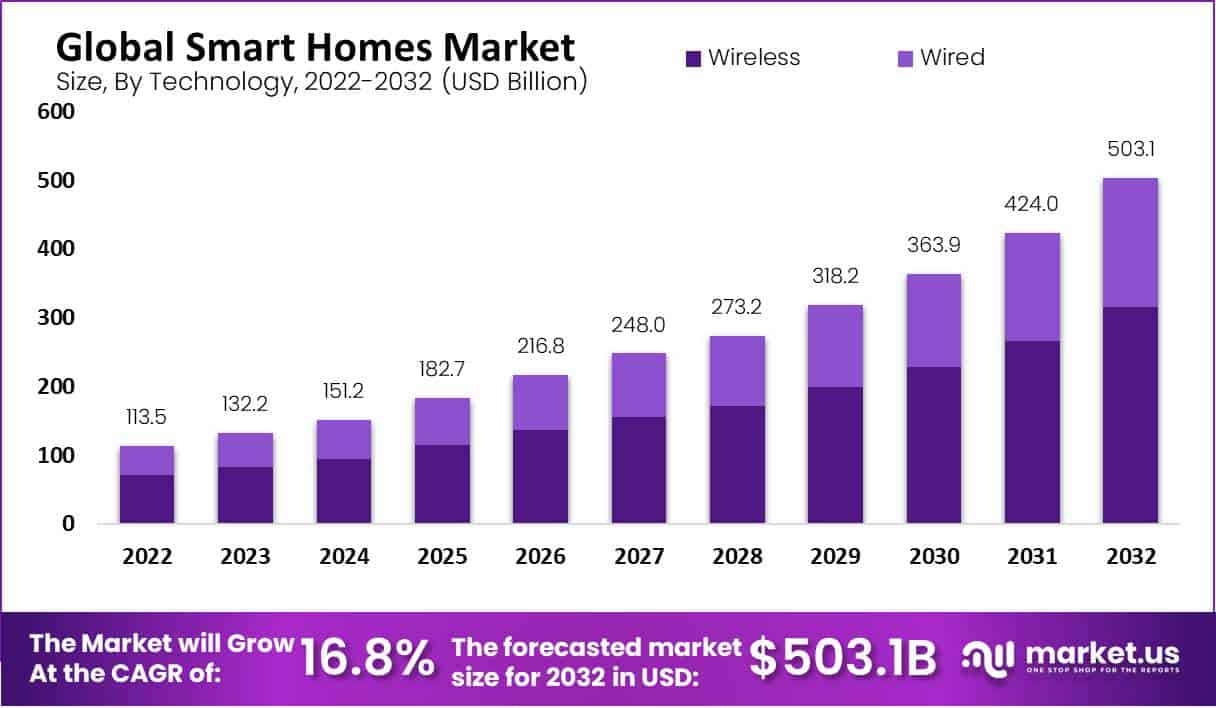
The Global Smart Homes Market size is expected to be worth around USD 503.1 Billion By 2032, from USD 132.2 Billion in 2023, growing at a CAGR of 16.8% during the forecast period from 2023 to 2032.
The Smart Homes market is experiencing rapid growth and transformation as technology continues to advance. Smart homes are residences equipped with connected devices and systems that can be controlled remotely, offering convenience, comfort, energy efficiency, and enhanced security to homeowners. This market is being driven by several factors and presents both opportunities and challenges for industry players.
One of the key growth factors for the Smart Homes market is the increasing adoption of Internet of Things (IoT) technology. IoT enables various devices and appliances within a home to communicate with each other and be controlled through a central smart hub or mobile app. This connectivity allows homeowners to remotely manage and monitor their homes, such as adjusting temperature settings, controlling lighting and appliances, and even managing home security systems.
The growing awareness and desire for a connected and automated lifestyle are fueling the demand for smart home solutions. Another driving factor is the rising focus on energy efficiency and sustainability. Smart home technologies enable homeowners to optimize energy consumption by monitoring and controlling their energy usage. For example, smart thermostats can learn household patterns and adjust temperature settings accordingly, resulting in energy savings. The ability to track and manage energy usage not only benefits homeowners in terms of cost savings but also contributes to environmental conservation.
The increasing importance of home security is also propelling the growth of the Smart Homes market. Smart home security systems offer advanced features such as real-time surveillance, motion detection, and remote monitoring. Homeowners can receive alerts and access camera feeds on their smartphones, enhancing the safety and peace of mind. The rising concern for personal safety and the need for robust security solutions are driving the demand for smart home security systems.
However, the Smart Homes market faces certain challenges as well. One major challenge is the complexity of integrating different devices and systems from various manufacturers. Interoperability and compatibility issues can arise, making it difficult for consumers to create a seamless and unified smart home experience. Standardization efforts and collaboration among industry players are vital to overcome this challenge.
Opportunities abound for both established companies and new entrants in the Smart Homes market. With the growing demand for smart home solutions, there is a need for innovative products and services. Companies can capitalize on this by developing user-friendly interfaces, expanding product offerings, and providing comprehensive customer support. Additionally, partnerships and collaborations across sectors such as technology, energy, and telecommunications can open doors for new business models and market expansion.
According to recent research conducted by MediaPost and the Consumer Technology Association (CTA), the smart homes market in the United States is experiencing significant growth and adoption. The study reveals that 69% of households in the U.S. currently own at least one smart device. Furthermore, 12% of households (equivalent to approximately 22 million homes) have multiple smart home products, indicating a growing trend towards the integration of smart technologies.
Analyzing the ownership levels of different smart home product categories, the research found that audio video products are the most prevalent, with a substantial 56% ownership rate among households. This is followed by home networking (34%), home security (33%), energy management (21%), and lighting (15%). These numbers indicate a widespread adoption of smart home technologies across various aspects of daily life.
Among the specific smart home products, the study highlights the following as the most commonly owned: smart entertainment devices (owned by 45% of households), wireless speakers without voice assistants (26%), smart speakers with voice assistants (25%), smart smoke detectors (17%), monitored security systems (17%), smart thermostats (14%), and video doorbells (12%). These findings reflect the popularity of devices that enhance entertainment experiences, improve security measures, and provide energy management capabilities within the home.
The research also indicates that the U.S. is at the forefront of smart home adoption, with other countries following suit. It is estimated that by 2023, 15% of households worldwide will have a smart home device installed, indicating a global expansion of the market.
Looking ahead, the smart homes market is poised for continued growth. Shipments of smart home devices worldwide are projected to reach 815 million this year and are expected to climb to 1.4 billion by 2025. These figures underline the robust demand for smart home technologies and the potential for further market expansion in the coming years.
Key Takeaways
- The Global Smart Homes Market size is expected to be worth around USD 503.1 Billion By 2033, from USD 132.2 Billion in 2023, growing at a CAGR of 16.8% during the forecast period from 2023 to 2032.
- The security and access control segment dominated the market by covering a major share of the market
- New construction sites are heavily adopting smart home appliances
- Asia Pacific dominates the global smart homes market by accounting for the major revenue share of 32.8%.
Product Analysis
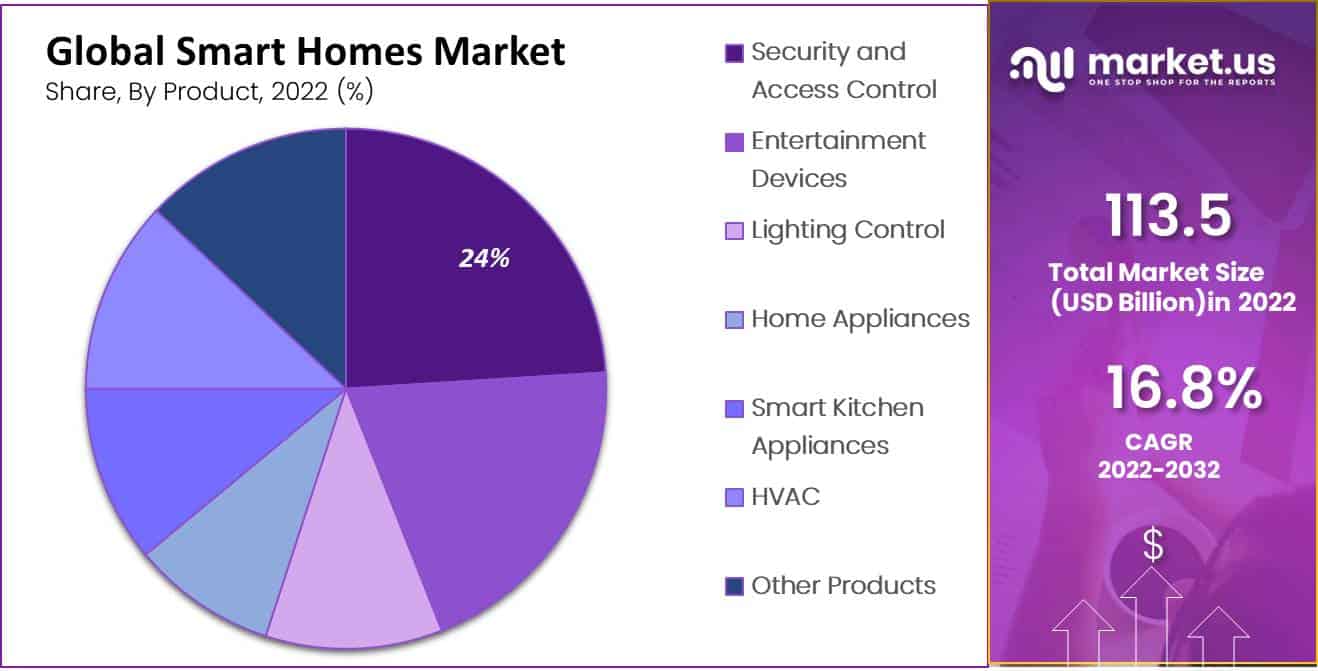
The security and access control segment dominated the market by covering a major share of the market
The smart homes market is classified on the basis of products like security and access control, entertainment devices, lighting control, HVAC, smart kitchen appliances, home appliances, and other products. Among product sub-segments, the security access control segment leads the market with the largest market share. The growth of this segment is owing to the increasing awareness about the importance of safety and security in smart home devices.
The security and access control appliances help to prohibit access to an unauthorized individual in the smart home by using products like security cameras, smart locks, video door phones, remote monitoring software and services, and other smart appliances. This protects smart homes from burglars and thieves. These factors are driving the growth of security and access control appliances through the forecast period.
Note: Actual Numbers Might Vary In The Final Report
Entertainment devices are expected to grow at a significant CAGR during the forecast period from 2023 to 2032. The growth of this segment is due to the seamless and convenient user experience for controlling the entertainment devices in the house. Technological advancements and innovations in wireless technology like voice control and AI are driving the growth of entertainment controls. These factors are boosting the growth of entertainment devices in the global smart homes market.
Application Analysis
New construction sites are heavily adopting smart home appliances
Based on application, the smart homes market is classified into new construction and retrofit. Among these applications, the new construction segment is anticipated to grow at the highest CAGR during the forecast period of 2023 to 2032. The growth of this segment is attributed to the easy installation and convenience of smart home appliances during new construction activities. The users don’t want to demolish the walls for the installation of smart home appliances.
This is propelling the growth of the new construction segment in the smart homes market. Also, the ongoing trend of urbanization, safety & security features across the world is raising the demand for smart homes in the market. Due to easy logistics in smart home appliance installation, owners of new construction sites are inclined towards the installation of many smart home appliances.
The retrofit segment is anticipated to grow at a high CAGR in the market. The growth of this segment is due to the increasing demand for smart homes in existing homes. The existing homeowners are renovating their homes by installing many smart home appliances. This is boosting the growth of the retrofit segment in the global smart homes market.
Key Market Segments
By Technology
- Wireless
- Wired
By Products
- Security and Access Control
- Smart Locks
- Security Cameras
- Video Door Phones
- Remote Monitoring Software & Services
- Others
- Lighting Control
- Relays & Switches
- Smart Lights
- Dimmers
- Occupancy Sensors
- Others
- Entertainment Devices
- Streaming Devices
- Sound bars and Speakers
- Smart Displays/TV
- HVAC
- Smart Vents
- Smart Thermostats
- Sensors
- Others
- Home Appliances
- Smart Water Heaters
- Smart Vacuum Cleaners
- Smart Washing Machines
- Smart Kitchen Appliances
- Cooktops
- Dish Washers
- Microwave/ovens
- Refrigerators
- Other Products
By Application
- New Construction
- Retrofit
Driver
Increased Consumer Adoption and Technological Advancements
The Smart Homes Market is driven by the heightened adoption of IoT and AI technologies, which are enhancing the functionality and interconnectivity of home automation systems. Consumers are increasingly embracing these technologies due to their convenience and the enhanced control they offer over home management systems. This trend is supported by a growing emphasis on energy efficiency and sustainability, which further bolsters the market’s growth. Technological advancements are making smart home devices more user-friendly and accessible, encouraging more consumers to upgrade their living spaces with smart technology.
Restraint
Privacy and Security Concerns
One major restraint in the Smart Homes Market is the growing concern over privacy and security. As smart homes rely heavily on internet connectivity, they are susceptible to cyber attacks, which can lead to the exposure of personal information. The risk of hacking and data breaches continues to be a significant barrier to adoption for many potential users. Addressing these security concerns is crucial for the continued growth of the market, and companies are actively working on developing more secure systems to protect user data.
Opportunity
Expansion in Emerging Markets
The Smart Homes Market has significant opportunities for expansion in emerging markets, particularly in regions like Asia Pacific. This area is seeing rapid urbanization and a rising middle class, which is increasingly adopting smart home technologies. There’s a strong potential for growth in countries like China and India, where technological integration into daily life is becoming more prevalent. Additionally, governments in these regions are investing in smart city projects, further driving the demand for smart home solutions.
Challenge
Technical Complexity and Integration Issues
A major challenge facing the Smart Homes Market is the technical complexity associated with integrating various smart home devices. Consumers often face difficulties in getting different devices from multiple manufacturers to work together seamlessly. This interoperability issue can deter potential customers who seek a straightforward, user-friendly system that integrates easily into their existing setup. Overcoming this challenge involves enhancing the compatibility of devices and simplifying the user experience to ensure that smart home technology can be easily adopted by a broader audience.
Growth Factors
- Technological Advancements: Continuous innovations in IoT and AI technologies enhance the functionality and efficiency of smart home devices, driving consumer adoption and market growth.
- Energy Efficiency and Sustainability: The rising demand for energy-efficient solutions is a significant growth factor. Smart homes offer optimized energy consumption, appealing to eco-conscious consumers.
- Government Initiatives and Investments: Various government initiatives promoting smart city projects contribute to the growth of the smart homes market. These projects often include the integration of smart home technologies into broader urban infrastructure plans.
- Increased Consumer Awareness and Preferences: As consumers become more aware of the benefits of home automation systems, such as increased convenience, security, and cost savings, demand grows. This is particularly pronounced in developed markets where there is a higher disposable income to invest in smart home technology.
- Expansion into Emerging Markets: The smart homes market is expanding into new geographic regions, particularly in Asia Pacific, where there is a burgeoning middle class with an increasing preference for technologically advanced and connected living solutions.
Emerging Trends
- Integration of AI and Machine Learning: Smart home devices are increasingly incorporating AI to learn from user behavior and automate tasks more efficiently, improving the user experience and device functionality.
- Voice Control and Virtual Assistants: The integration of voice-controlled assistants like Alexa, Google Assistant, and Siri into smart home ecosystems is becoming more common, making device interaction more intuitive and accessible.
- Focus on Security and Privacy: As consumers become more concerned about data privacy and security, smart home companies are focusing on enhancing security features and protocols to protect user data from potential cyber threats.
- Health Monitoring Integration: With a growing focus on health and wellness, smart home technology is increasingly being used to monitor health through devices that can track air quality, fitness levels, or even manage medical conditions.
- Eco-Friendly and Sustainable Solutions: There is a growing trend towards sustainable living, with smart homes offering features like energy monitoring and management systems that help reduce carbon footprints and promote environmental sustainability.
Regional Analysis
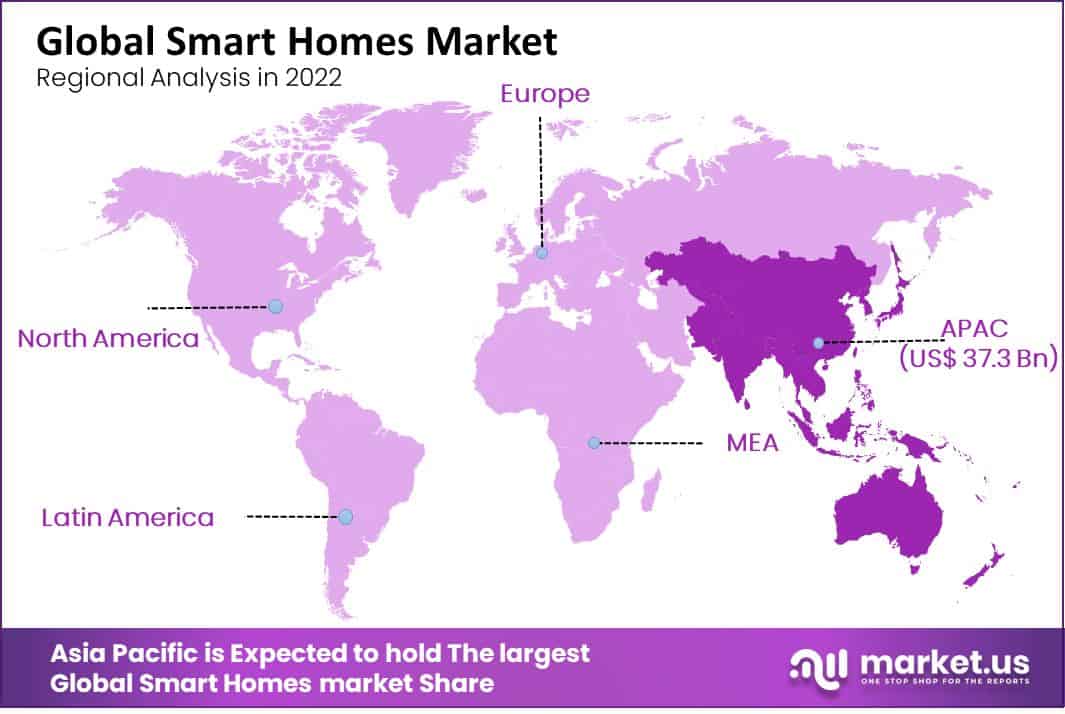
Asia Pacific dominates the market by accounting for a major share of the global smart homes market
Asia Pacific dominates the global smart homes market by accounting for the major revenue share of 32.8%. The growth of this region is due to the increasing adoption of smart home appliances to reduce energy consumption and increase energy efficiency. These factors are anticipated to drive the growth of the smart homes market in the Asia Pacific region over the forecast period.
The rising adoption of security and access control appliances in the region has helped to prohibit access to an unauthorized individual in the smart home by using products like security cameras, smart locks, video door phones, remote monitoring software and services, and other appliances. These smart home appliances are expected to boost the growth of the Asia Pacific region during the forecast period.
The Asia Pacific region is anticipated to grow at a significant CAGR during the forecast period. The growth of the Asia Pacific region is owing to the adoption of smart home appliances in major countries like China and India. Asia Pacific countries have a major population share in the global market, adopting to smart home appliances. Also, the increasing disposable income of people in the Asia Pacific region is rising the demand for smart home appliances.
Key Regions and Countries
- North America
- US
- Canada
- Europe
- Germany
- France
- The UK
- Spain
- Italy
- Russia
- Netherlands
- Rest of Europe
- Asia Pacific
- China
- Japan
- South Korea
- India
- Australia
- Singapore
- Thailand
- Vietnam
- Rest of APAC
- Latin America
- Brazil
- Mexico
- Rest of Latin America
- Middle East & Africa
- South Africa
- Saudi Arabia
- UAE
- Rest of MEA
Key Players Analysis
In the rapidly evolving Smart Homes Market, several key players are distinguishing themselves through innovation and market penetration. Samsung Electronics Co.Ltd. and LG Electronics Inc. are prominent for their wide range of interconnected home appliances and electronics that enhance user convenience and energy efficiency. Sony Corporation is well-regarded for integrating advanced audio-visual technologies into the smart home ecosystem.
Amazon.com Inc. has revolutionized the market with its Alexa-enabled devices, making voice-controlled smart homes a reality for many. Similarly, Google Nest specializes in intuitive home automation products, from thermostats to security systems, enhancing household efficiency and safety. Philips Lighting B.V. leads in smart lighting solutions, offering products that not only save energy but also adapt to users’ lifestyles.
Robert Bosch GmbH and Siemens AG are known for their robust and reliable home automation systems that integrate various household functions. Schneider Electric SE focuses on energy management and smart grid solutions that appeal to eco-conscious consumers. Honeywell International Inc. offers a comprehensive range of products that improve home comfort and security.
Top Key Players in the Smart Homes Market
- Samsung Electronics Co.Ltd.
- LG Electronics Inc.
- Sony Corporation
- Amazon.com Inc.
- Philips Lighting B.V.
- Robert Bosch GmbH
- Siemens AG
- Schneider Electric SE
- Honeywell International Inc.
- ABB Ltd
- Google Nest
- Other Key Players
Recent Developments
- Launch of LG ThinQ UP 2.0 (January 2024): LG introduced an upgraded version of its ThinQ platform, ThinQ UP 2.0, at CES 2024. This version enhances connectivity and interoperability between various smart home devices, supporting the Matter standard for a unified smart home experience.
- Matter Casting Technology (January 2024): At CES 2024, Amazon showcased its Matter Casting technology, which enhances control over smart TVs and streaming devices. This technology allows users to manage multiple devices seamlessly within the smart home ecosystem.
- Launch of Bosch Smart Home Controller II (January 2024): Bosch unveiled the second generation of its Smart Home Controller, which supports Matter and enhances the integration of various smart home devices within the Bosch ecosystem.
- Sony Smart Home Platform (March 2023): Sony launched its Smart Home Platform, focusing on integrating entertainment systems with home automation. This platform aims to provide a seamless experience for managing home entertainment and smart devices.
- Google Home Updates (April 2023): Google updated its Google Home app to enhance compatibility with the Matter standard. This update allows for better integration and control of various smart home devices through a unified platform.
- Expansion of the Hue Ecosystem (November 2023): Philips expanded its Hue smart lighting ecosystem to include outdoor lighting solutions and new smart light fixtures. These additions support Matter, ensuring compatibility with other smart home devices.

- 蓝茶市场(2026—2031)
0评论2026-09-15

- 泡沫材料市场(2026—2031)
0评论2026-09-15

- 重铬酸钠市场(2026—2031)
0评论2026-09-15

- 家族性淀粉样多发性神经病(FAP)市场(2026—2031)
0评论2026-09-15

- 次氯酸钙市场(2026—2031)
0评论2026-09-15

- 海上储能市场(2026—2031)
0评论2026-09-12

- 混凝土市场(2026—2031)
0评论2026-09-12

- 矫形器械市场(2026—2031)
0评论2026-09-12

- 木质素基树脂市场(2026—2031)
0评论2026-09-12

- 聚碳酸酯二元醇市场(2026—2031)
0评论2026-09-12