


Report Overview
The Global Generative AI In CPG Market size is expected to be worth around USD 5.4 Billion by 2033, from USD 2.3 Billion in 2023, growing at a CAGR of 9.5% during the forecast period from 2024 to 2033. In 2023, North America held a dominant market position, capturing more than a 42% share, holding USD 1.0 Billion revenue.
Generative AI is changing the game in the consumer packaged goods (CPG) industry. This technology helps companies create new product designs and improve marketing strategies by generating innovative ideas and images. It also streamlines the production process and enhances personalized customer experiences by predicting consumer preferences and behaviors.
The Generative AI market in the CPG sector is experiencing rapid growth due to the increasing demand for innovation and efficiency in product development and operations. Companies are investing in AI to stay competitive by accelerating the creation of new products tailored to consumer desires and improving operational efficiencies. This shift is driven by the need to reduce costs, speed up time to market, and enhance product customization.
The primary growth drivers for generative AI in the CPG sector include the increasing need for operational efficiency and reduced production costs. Companies are using AI to predict market trends more accurately, personalize customer interactions, and streamline product development. The push towards digital transformation by many CPG companies further accelerates the adoption of AI technologies.
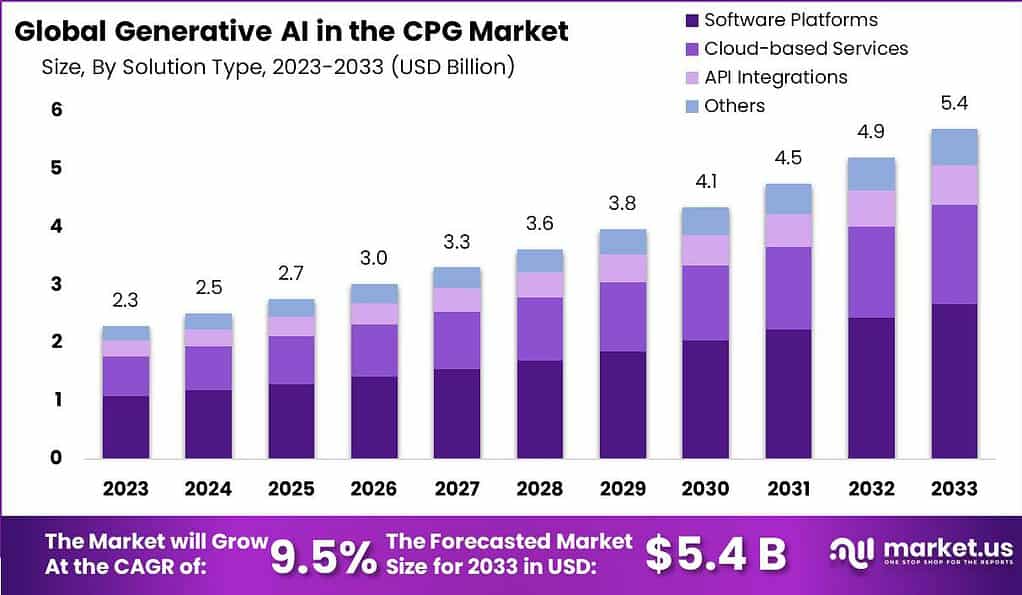
The demand for generative AI in the CPG sector is primarily driven by its ability to streamline operations and create cost efficiencies, especially in product development and marketing. Opportunities for market growth include leveraging AI for rapid product innovation, where AI can help develop new products by analyzing consumer data to identify emerging trends quickly.
Technological advancements in generative AI are continuously expanding its applications within the CPG industry. Modern AI tools are capable of handling complex data analysis, enabling real-time adjustments in marketing campaigns and product offerings. Additionally, advancements in natural language processing (NLP) and machine learning algorithms enhance the ability of AI systems to interact naturally with consumers and stakeholders, further personalizing the consumer experience and improving engagement.
The integration of Generative AI (GenAI) is transforming the consumer goods sector, as evidenced by a recent survey from EY which reveals that 40% of consumer leaders believe they are effectively utilizing GenAI. Impressively, 22% of these leaders acknowledge a significant impact on their business operations due to GenAI.
GenAI not only boosts the traditional economic impact of AI but is projected to potentially increase annual profits (measured in EBITDA) for Consumer Packaged Goods (CPG) companies globally by an astounding $160 billion to $270 billion. This enhancement represents a 15% to 40% increase over traditional AI contributions.
The economic advantages extend further, with companies adopting GenAI potentially seeing an incremental revenue uplift of 6% to 10%. Moreover, this adoption is expected to result in a 3% to 5% increase in EBITDA margins over the next three to five years.
In marketing, GenAI promises a productivity increase of 5% to 15% of total marketing expenditures. This boost comes from enhanced customer targeting and personalized communications, essential tools for today’s marketers. The ability to hyper-personalize customer experiences is particularly lucrative, driving up to 40% more revenue from personalized marketing strategies.
Research from Tredence highlights that by 2024, a projected 60% adoption rate of GenAI in marketing and advertising marks these as the predominant application areas in CPG businesses. This trend underscores the significant role of GenAI in refining marketing efforts.
Furthermore, a study by Infosys BPM notes that 62% of consumers are more likely to trust companies whose AI interactions are perceived as ethical. This trust can boost company revenues by up to 6.4%. Reflecting the growing acceptance of GenAI, 16% of businesses report full integration, while 45% have achieved partial integration of GenAI into their CPG operations.
Key Takeaways
- The Generative AI In CPG Market is estimated to reach USD 5.45 Billion by 2033, with a robust 9.5% Compound Annual Growth Rate (CAGR) projected throughout the forecast period.
- In 2023, the Software Platforms segment dominated the Generative AI in CPG market, capturing over 47% market share. This leadership is attributed to the comprehensive functionalities offered by these platforms, catering to diverse needs and enhancing product design, development, and customization capabilities.
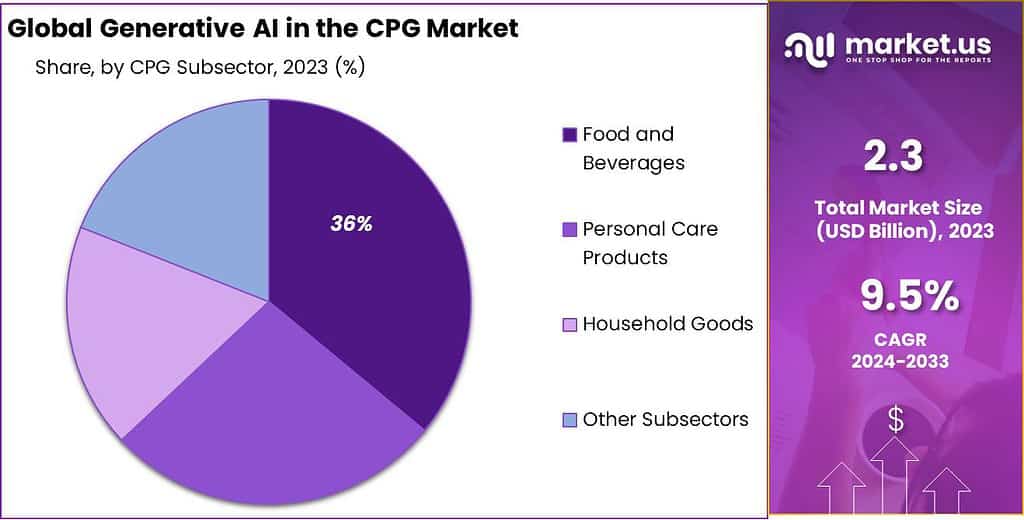
- The Food and Beverages segment held a significant market share within the Generative AI in CPG market in 2023, with over 36% share. This preference is driven by the critical role of innovation and customization in the food and beverage industry, with Generative AI facilitating the creation of novel flavor profiles, textures, and nutritional compositions to meet evolving consumer preferences.
- The Marketing and Advertising segment emerged as a dominant market player, leveraging Generative AI to create highly personalized and engaging content that resonates with individual consumer preferences at scale.
Solution Type Insights
In 2023, the Software Platforms segment held a dominant market position within the generative AI in CPG market, capturing more than a 47% share. This leadership is primarily due to the comprehensive capabilities these platforms offer to CPG companies, enabling them to innovate at a rapid pace.
Software platforms are preferred by many CPG firms because they integrate seamlessly into existing IT infrastructure, allowing businesses to leverage generative AI without the need for extensive modifications to their systems. These platforms provide tools that streamline the design process, enhance product development, and facilitate more effective marketing strategies. As a result, companies can bring products to market faster and more efficiently, meeting consumer demands in real-time and staying ahead in highly competitive markets.
Another reason for the popularity of software platforms is their ability to provide a centralized approach to data management and analytics. By using these platforms, CPG companies can harness large volumes of data from various sources, analyze this information, and generate actionable insights. This capability is crucial for understanding consumer behavior, predicting market trends, and making informed decisions that drive business growth.
Moreover, software platforms often come with built-in scalability and flexibility, which are essential for companies looking to expand their operations and explore new market territories. This scalability ensures that as the company grows, its generative AI capabilities can grow with it, without the need for significant additional investment. This aspect makes software platforms a cost-effective solution for many businesses, further contributing to their leading position in the market.
CPG Subsector Insights
In 2023, the Food and Beverages segment held a dominant market position within the generative AI in CPG market, capturing more than a 36% share. This segment’s leadership is largely attributed to the increasing complexity and competitiveness within the food and beverage industry, which drives companies to adopt advanced technologies for innovation and efficiency.
One of the primary reasons for the substantial adoption of generative AI in the Food and Beverages sector is its ability to enhance product development and customization. AI technologies enable companies to experiment with new flavors and textures, predict consumer taste preferences, and tailor products to specific demographic segments.
This capability is crucial in a sector where consumer preferences shift rapidly and the demand for personalized and health-conscious options continues to grow. Furthermore, generative AI assists companies in managing the intricate supply chains typical of the food and beverage industry. From optimizing distribution routes to forecasting inventory needs, AI platforms help minimize waste and improve operational efficiencies.
This is particularly important for managing perishable goods and ensuring that products are delivered fresh to consumers. Additionally, AI-driven data analytics play a vital role in marketing and sales strategies within the food and beverage sector.
By analyzing consumer data and market trends, generative AI helps companies craft targeted marketing campaigns and promotional strategies that are more likely to resonate with their audience, thus driving sales and enhancing brand loyalty. This strategic application of AI not only supports revenue growth but also strengthens market position, underpinning the segment’s dominance in the generative AI market.
Application Area Insights
In 2023, the Marketing and Advertising segment held a dominant market position within the generative AI in CPG market, capturing a significant share. This leading position can be attributed to the transformative impact that generative AI technologies are having on marketing strategies and consumer engagement.
One of the core reasons for the prominence of generative AI in marketing and advertising is its ability to create highly personalized content at scale. AI tools enable marketers to design bespoke marketing campaigns that resonate deeply with diverse consumer groups by analyzing behavioral data and identifying nuanced consumer preferences. This personalization is crucial in a landscape where consumers expect brands to understand their unique needs and preferences.
Additionally, generative AI enhances the efficiency and effectiveness of advertising campaigns. By automating the creation of ad content and testing different variations quickly, companies can optimize their advertisements in real-time, ensuring that they deliver the right message to the right audience at the right time. This capability not only saves time and resources but also significantly increases the ROI of marketing campaigns.
Moreover, generative AI plays a critical role in dynamic pricing and promotional strategies, allowing companies to adjust offers in real-time based on market demand and consumer behavior insights. This adaptability is particularly valuable in the highly competitive CPG sector, where timely promotions can drive substantial increases in sales volumes and improve market share.
Key Market Segments
Based on the Solution Type
- Software Platforms
- Cloud-based Services
- API Integrations
Based on the CPG Subsector
- Food and Beverages
- Personal Care Products
- Household Goods
- Other Subsectors
Based on the Application Area
- Product Development
- Marketing and Advertising
- Demand Forecasting
- Supply Chain Optimization
- Customer Insights
- Data Analytics
Driver
Enhanced Innovation and Efficiency in Product Development
One of the primary drivers for the adoption of generative AI in the consumer packaged goods (CPG) industry is its ability to enhance innovation and efficiency in product development. Generative AI facilitates rapid analysis and integration of both structured data (like sales figures and market research) and unstructured data (such as social media sentiment and weather reports), which can significantly speed up the product development process.
This technology allows for real-time feedback loops and data-driven insights, enabling CPG companies to innovate faster and meet market demands with precision. Companies leveraging generative AI can reduce the time it takes to bring new products to market, which can lead to increased market share and growth.
Restraint
High Complexity and Resource Intensity
Despite its benefits, the implementation of generative AI comes with significant challenges, particularly its complexity and the need for specialized knowledge and resources. Many companies struggle to fully understand and integrate this technology effectively.
The sophistication of generative AI systems requires substantial investment in terms of time, finances, and skilled personnel, which can be a significant barrier, especially for smaller enterprises or those with limited digital infrastructure. This complexity not only affects the adoption rates but also the scalability of generative AI applications within the CPG industry.
Opportunity
Personalization and Customer Engagement
Generative AI presents substantial opportunities in the realm of personalization and customer engagement for CPG companies. By harnessing vast amounts of data, these advanced systems can deliver highly personalized product recommendations, marketing messages, and customer interactions.
This level of personalization is becoming increasingly important as consumers demand more tailored experiences and products. Companies that effectively use generative AI to enhance personalization can see improved customer satisfaction, loyalty, and ultimately, revenue growth. This technology also enables brands to create unique customer experiences that differentiate them from competitors.
Challenge
Ethical and Privacy Concerns
As with many AI technologies, generative AI raises significant ethical and privacy concerns, particularly regarding the handling and analysis of consumer data. Mismanagement of data or breaches can lead to severe repercussions, including consumer mistrust and regulatory penalties. Companies must navigate these challenges carefully by implementing robust data governance and security measures to protect sensitive information.
Moreover, there is the ethical challenge of ensuring that AI-driven decisions and processes are transparent and fair, avoiding biases that can arise from flawed data or algorithms. Addressing these concerns is crucial for maintaining consumer trust and complying with increasing regulatory scrutiny over data practices.
Growth Factors
- Enhanced Personalization and Customer Experience: Generative AI allows for deeper personalization in the CPG sector, leading to enhanced customer experiences and increased brand loyalty. By analyzing consumer data more effectively, CPG companies can tailor their marketing strategies and product offerings with great precision, driving better customer outcomes and faster revenue growth from personalized products.
- Operational Efficiency: The integration of generative AI in CPG operations helps streamline processes, notably in manufacturing and supply chain management. By optimizing production schedules and predicting maintenance needs, companies can reduce operational costs and enhance overall efficiency.
- Rapid Product Development: Generative AI accelerates the product development cycle by enabling quick ideation, prototyping, and refinement of product concepts. This rapid innovation process helps companies meet market demands swiftly and maintain competitive advantage.
- Data-Driven Decision Making: With its ability to analyze both structured and unstructured data comprehensively, generative AI equips CPG companies with the insights needed to make informed decisions. This capability is crucial for adapting to market trends and consumer preferences effectively.
- Marketing and Advertising Innovation: Generative AI transforms marketing efforts by creating highly personalized and engaging content that resonates with consumers at scale. This technology enhances the effectiveness and ROI of marketing campaigns, making it a critical tool for customer engagement and retention.
Emerging Trends
- Adoption of AI-Driven Analytics Platforms: The significant rise in the use of AI-driven platforms for comprehensive data analytics is shaping the CPG industry. These platforms support a wide array of functions from product design to consumer insights.
- Expansion in Food and Beverages: Generative AI is increasingly used in the food and beverage sector to innovate on flavor profiles, textures, and nutritional compositions, driven by consumer demand for customization and healthier options.
- Increased Focus on Consumer Insights: Leveraging generative AI for deep consumer insights is becoming a norm. These insights help in shaping demand and optimizing product offerings to better meet consumer expectations.
- Integration with Ecosystem Partners: CPG companies are enhancing their collaboration with retailers, manufacturers, and other partners through generative AI, which facilitates more effective data exchanges and partnership strategies.
- Ethical AI and Privacy Considerations: As the use of generative AI expands, there is a growing emphasis on developing ethical AI frameworks and ensuring data privacy. This trend is critical for maintaining consumer trust and adhering to regulatory standards.
Business Benefits
- Enhanced Personalization and Customer Engagement: Companies that leverage generative AI see substantial improvements in personalization, which drives customer engagement and retention by tailoring products and experiences to individual preferences.
- Operational Efficiency: AI-driven analytics and automation streamline operations from supply chain management to manufacturing processes, reducing costs and speeding up production cycles.
- Accelerated Innovation and Time to Market: Generative AI facilitates rapid prototyping and testing of new products, significantly cutting down the development time and enabling quicker responses to market demands.
- Optimized Marketing Strategies: By analyzing extensive data sets, generative AI helps CPG companies craft effective marketing strategies and predict consumer behavior, enhancing the ROI of marketing campaigns.
- Improved Risk Management: AI tools can automate compliance and regulatory checks, minimizing risks related to product claims and safety standards, which is crucial for maintaining brand integrity and trust.
Top Use Cases
- Personalized Marketing and Advertising: Generative AI excels in creating unique customer experiences through personalized marketing campaigns, adapting content to meet the nuanced preferences of diverse consumer bases.
- Supply Chain Optimization: Leveraging AI for real-time insights into logistics, stock levels, and market conditions helps maintain efficient and responsive supply chains.
- Dynamic Product Development: From ideation to execution, AI tools help in designing products and packaging by simulating consumer reactions and optimizing product attributes like taste and nutritional content.
- Customer Insights Generation: AI algorithms analyze online consumer data to provide deeper insights into customer preferences and trends, enabling brands to make informed decisions.
- Smart Manufacturing: In manufacturing, AI is used to enhance process efficiency and automation, leading to reduced costs and improved product quality by predicting maintenance needs and optimizing production schedules.
Regional Analysis
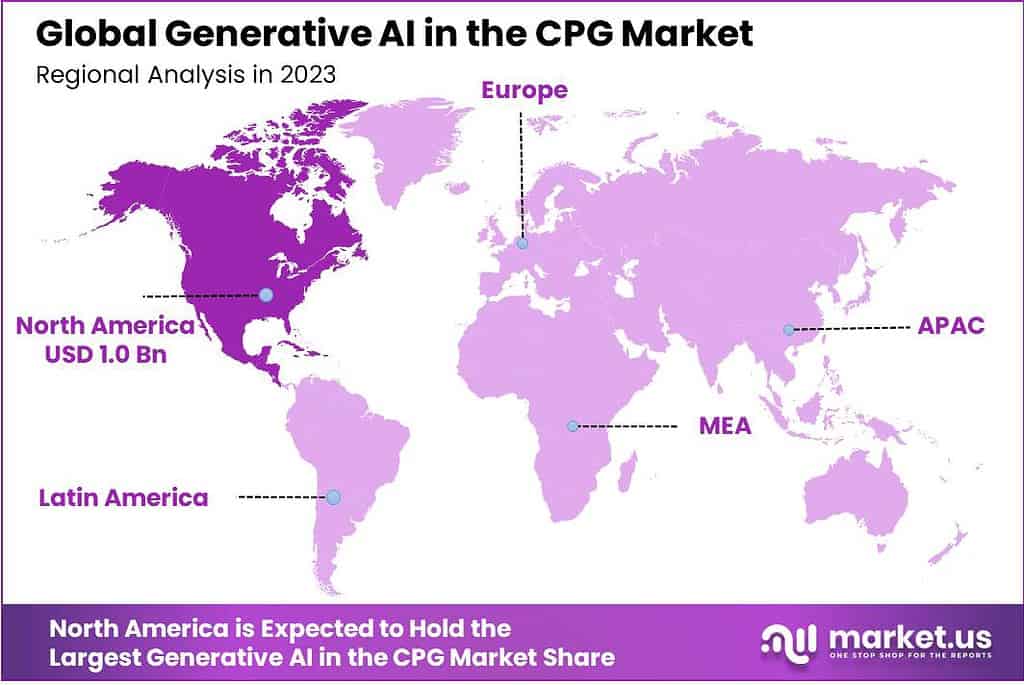
In 2023, North America held a dominant market position in the Generative AI in CPG (Consumer Packaged Goods) market, capturing more than a 42% share. This region generated revenues exceeding USD 1.0 billion, underlining its pivotal role in the development and adoption of generative AI technologies within the sector.
Several factors contribute to North America’s leading position, primary among them being the region’s robust technological infrastructure and the presence of major tech giants and startups that are continually innovating in the AI space. Furthermore, the high degree of digital literacy and quick adoption of new technologies by businesses and consumers alike boost the market.
North American companies are keen on leveraging AI to optimize supply chains, personalize customer experiences, and enhance product development, which are critical factors driving the adoption of generative AI in CPG. The regulatory environment in the U.S. and Canada, which is relatively favorable towards AI and data-driven technologies, also plays a significant role in fostering innovation and growth in this market.
Additionally, significant investments in AI research and development, supported by government funding and private investments, have propelled advancements in AI technologies in the region. The focus on integrating AI with traditional manufacturing processes to drive efficiency and reduce costs has further cemented North America’s leadership in this domain.
Key Regions and Countries
- North America
- US
- Canada
- Europe
- Germany
- France
- The UK
- Spain
- Italy
- Rest of Europe
- Asia Pacific
- China
- Japan
- South Korea
- India
- Australia
- Singapore
- Rest of Asia Pacific
- Latin America
- Brazil
- Mexico
- Rest of Latin America
- Middle East & Africa
- South Africa
- Saudi Arabia
- UAE
- Rest of MEA
Key Players Analysis
The Generative AI in CPG market is shaped significantly by initiatives and advancements made by key industry players like Google LLC, IBM Corporation, and Microsoft Corporation, each playing a pivotal role through strategic acquisitions, innovative product launches, and fruitful collaborations.
Google LLC is at the forefront, focusing heavily on integrating AI into diverse CPG applications. Google’s approach includes enhancing their existing AI models and tools, ensuring they remain at the cutting edge of generative AI capabilities. This strategy not only reinforces their market position but also sets a benchmark in technological advancement within the industry.
IBM Corporation has been instrumental in bridging technology and practicality by developing AI-driven solutions tailored for the CPG market. Recent collaborations, such as their partnership with SAP, aim to infuse generative AI into critical business processes, enhancing efficiency across supply chains and consumer interactions. IBM’s focus on expanding AI applications within the CPG sector showcases their commitment to innovation and their understanding of the evolving market needs.
Microsoft Corporation is another major player that leverages its robust AI capabilities to revolutionize the CPG landscape. A notable initiative is their collaboration with Sainsbury’s, aiming to incorporate AI to refine customer search experiences and improve operational efficiencies. Microsoft’s efforts to embed AI deeply into retail operations highlight their strategic role in transforming how CPG companies interact with technology and consumers.
Top Market Leaders
- IBM Corporation
- Google LLC
- Microsoft Corporation
- Adobe Inc.
- NVIDIA Corporation
- DataRobot Inc.
- OpenAI
- Other Key Players
Recent Developments
- IBM and Databricks formed a strategic partnership in April 2023 to accelerate the adoption of generative AI across CPG companies, providing them with more robust AI-driven platforms for customer engagement and supply chain optimization.
- Nestlé launched an AI-driven product personalization initiative in August 2023. The initiative uses generative AI to analyze customer data and create tailored product offerings, driving consumer loyalty.
- PepsiCo invested $30 million in generative AI-driven supply chain technologies in December 2023, seeking to improve operational efficiency and enhance real-time inventory management.









