


Market Overview
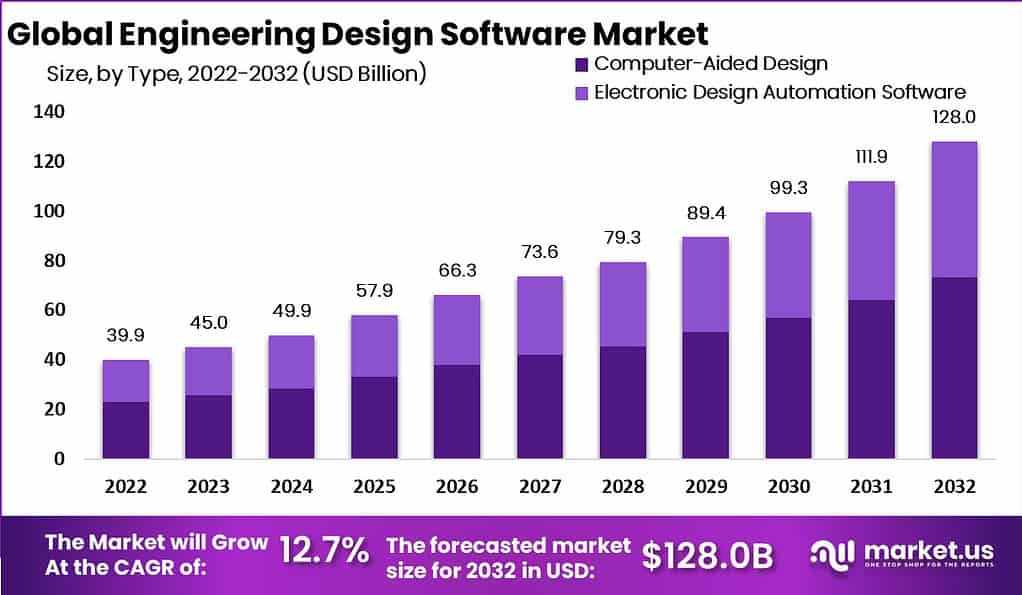
The global engineering design software market size was valued at USD 39.10 billion in 2022 and is projected to reach USD 128.0 billion by 2032, growing at a CAGR of 12.7% over the forecast period 2022-2032.
The growth of the market is being driven by a number of factors, including the increasing demand for engineering services, the rising popularity of 3D printing, and the growing adoption of cloud computing.
The engineering design software market is a rapidly growing sector in the technology industry. It refers to the software tools and solutions used by engineers and designers to create, analyze, and optimize various products and systems. This software enables engineers to design complex structures, components, and systems efficiently, saving time and resources.
The market for engineering design software has witnessed significant growth in recent years due to the increasing demand for innovative product development, rising adoption of cloud-based solutions, and advancements in 3D modeling and simulation technologies.
Engineering design software is set to play a larger role in shaping the future of multiple industries. As technological advancements continue, the software will facilitate the development of innovative products and systems, paving the way for enhanced performance, sustainability, and efficiency.
Additionally, as the global emphasis on sustainable practices grows, engineering design software will be instrumental in creating eco-friendly designs and minimizing environmental impacts.
Market Scope
Product Type Analysis
In the fast-paced world of engineering design, one technology has risen above the rest to revolutionize the way products are created and innovations are brought to life. Computer-Aided Design (CAD) stands tall as the leading segment in the engineering design software market, driving efficiency, creativity, and accuracy like never before.
CAD software empowers engineers and designers with powerful tools to create, modify, and optimize detailed 2D and 3D models of their designs. It eliminates the need for traditional hand-drawn sketches and enables seamless collaboration among teams, regardless of geographical distances. This has been a game-changer, making the design process smoother, faster, and more cost-effective.
The versatility of CAD extends across various industries, such as architecture, manufacturing, automotive, aerospace, and many more. Its widespread adoption stems from its ability to cater to a diverse range of needs, from conceptualizing new ideas to testing complex simulations before physical production even begins.
With CAD at the helm, engineers can iterate and refine their designs swiftly, fine-tuning every aspect with precision. Moreover, CAD’s intuitive user interfaces have lowered the entry barrier for aspiring designers, promoting inclusivity and diversity in the engineering field.
Application Analysis
The largest segment in the engineering design software market is the Industry Facilities segment. This category of software caters to the specific needs and requirements of various industries, such as manufacturing, architecture, automotive, aerospace, electronics, and more.
In each of these industries, engineering design plays a crucial role in developing new products, structures, and systems. The industry-specific design software provides specialized tools and features tailored to the unique challenges and intricacies faced by professionals in each sector.
For example, in the manufacturing industry, the software may focus on optimizing production processes, ensuring precise measurements, and facilitating the creation of complex geometries. In architecture, the emphasis might be on creating detailed building models, analyzing structural integrity, and integrating with building information modeling (BIM) systems.
The dominance of the industry segment reflects the diverse needs of different sectors and the recognition that a one-size-fits-all approach is not sufficient to meet the complexities of modern engineering design. As a result, companies and professionals seek software solutions that are specifically tailored to their particular field, streamlining workflows and maximizing productivity.
The growth and continued expansion of the industry segment indicate the increasing importance of engineering design software across various sectors. As industries continue to evolve and demand cutting-edge solutions, developers of engineering design software will keep innovating to cater to the specific requirements of each industry, driving further progress and advancements in the field of engineering.
Key Market Segments
By Type
- Computer-Aided Design
- Electronic Design Automation Software
By Application
- Industry Facilities
- Infrastructure
Rising Demands and Increasing Uses
The demand for engineering design software is on the rise as companies strive to stay competitive in an ever-changing global market. Businesses are increasingly realizing the importance of investing in cutting-edge technology to improve their product development cycles. The software’s ability to enable rapid prototyping, simulation, and testing accelerates the overall design process and reduces time-to-market.
Engineering design software finds uses in a wide range of industries. For instance, automotive companies use it to design and analyze vehicles for better performance and safety. Aerospace manufacturers rely on it to create sophisticated aircraft designs with optimal aerodynamics. In construction, the software helps architects and engineers visualize structures and simulate various scenarios before starting the construction phase.
Rising Popularity
The popularity of engineering design software has surged due to several factors. Firstly, the rising complexity of products and the need for precision engineering have made such software indispensable. Secondly, the availability of user-friendly interfaces and comprehensive toolsets has attracted engineers with varying levels of expertise. Moreover, the integration of advanced features like parametric modeling, real-time simulations, and virtual reality has enhanced the software’s capabilities, driving its popularity further.
Drivers
- Product Innovation and Time-to-Market: The pressure to innovate and bring products to market quickly is driving companies to invest in advanced engineering design software. It allows for rapid prototyping, iterative design, and faster development cycles.
- Increasing Complexity of Products: As products become more complex, traditional design methods become inadequate. Engineering design software offers advanced tools and simulations to handle intricate designs and ensure optimal performance.
- Globalization and Collaboration: The global nature of businesses demands efficient collaboration among teams across different locations. Engineering design software, especially cloud-based solutions, facilitates seamless collaboration and information exchange.
- Cost and Resource Optimization: By enabling virtual prototyping and simulations, engineering design software reduces the need for physical prototypes, saving costs and resources.
Restraints
- High Initial Costs: Implementing engineering design software can involve significant upfront costs, especially for small and medium-sized businesses. This can be a barrier to entry for some companies.
- Learning Curve: Mastering sophisticated design software can take time, and engineers may require training to fully utilize its capabilities effectively.
- Data Security and Intellectual Property Concerns: Storing design data on cloud servers raises concerns about data security and potential intellectual property risks.
Opportunities
- Emerging Markets: The rapid industrialization and modernization in emerging markets present lucrative opportunities for engineering design software providers.
- Customization and Specialization: Tailoring software solutions to cater to specific industries or niche markets can unlock new revenue streams.
- Sustainability and Green Design: With growing environmental concerns, there is a significant opportunity for engineering design software that emphasizes sustainability and green practices.
Challenges
- Compatibility and Interoperability: Integrating engineering design software with existing systems and ensuring interoperability with other software can be challenging.
- Competitive Landscape: The market is highly competitive, with established players and new entrants vying for market share.
- Regulatory Compliance: Adhering to industry-specific regulations and standards can be complex and time-consuming.
Regional Analysis
The largest market for engineering design software is North America, primarily dominated by the United States. The region’s substantial market share can be attributed to the presence of key players, a robust technological infrastructure, and a proactive approach to innovation. On the other hand, the Asia-Pacific region is the fastest-growing market, driven by rapid industrialization, urbanization, and the increasing adoption of advanced technologies in countries like China and India.
Key Regions and Countries
- North America
- The US
- Canada
- Mexico
- Western Europe
- Germany
- France
- The UK
- Spain
- Italy
- Portugal
- Ireland
- Austria
- Switzerland
- Benelux
- Nordic
- Rest of Western Europe
- Eastern Europe
- Russia
- Poland
- The Czech Republic
- Greece
- Rest of Eastern Europe
- APAC
- China
- Japan
- South Korea
- India
- Australia & New Zealand
- Indonesia
- Malaysia
- Philippines
- Singapore
- Thailand
- Vietnam
- Rest of APAC
- Latin America
- Brazil
- Colombia
- Chile
- Argentina
- Costa Rica
- Rest of Latin America
- Middle East & Africa
- Algeria
- Egypt
- Israel
- Kuwait
- Nigeria
- Saudi Arabia
- South Africa
- Turkey
- United Arab Emirates
- Rest of MEA
Market Players
- Autodesk
- Bentley Systems
- Dassault Systemes
- IBM
- Siemens
Recent Developments
2023:
- PTC released Creo 7.0, which includes new features for cloud collaboration, simulation, and additive manufacturing.
- Ansys released Ansys 2023, which includes new features for simulation, generative design, and artificial intelligence.
- Bentley Systems released Bentley MicroStation CONNECT Edition 10.5, which includes new features for 3D modeling, data management, and visualization.









