


Report Overview
The Global AI Audio Processing Software Market size is expected to be worth around USD 18 Billion By 2033, from USD 3.8 billion in 2023, growing at a CAGR of 16.8% during the forecast period from 2024 to 2033. In 2023, North America held a dominant market position, capturing more than a 36% share, holding USD 1.6 Billion revenue.
AI audio processing software utilizes artificial intelligence to enhance and manipulate sound data. This technology streamlines the creation, editing, and distribution of audio content. From improving voice clarity in calls to composing music, these tools are integral in various applications, providing solutions that traditional audio processing could not achieve efficiently.
The market for AI audio processing software is expanding rapidly. This growth is driven by the increasing demand across industries such as entertainment, telecommunications, and automotive, where enhanced audio quality and new sound experiences are in continuous demand. As more businesses recognize the importance of high-quality audio in providing immersive user experiences, the market scope for these AI-driven tools broadens, promising significant expansion in the upcoming years.

Several factors are propelling the AI audio processing software market forward. The proliferation of smart devices and the IoT has created a massive surge in audio content, from podcasts to virtual assistant commands. Additionally, the remote work trend has escalated the need for superior audio communication tools. As industries rely more on digital media, the demand for advanced audio processing solutions that can provide clarity and precision becomes crucial.
Market demand for AI audio processing software is witnessing a notable increase due to its capacity to automate complex processes and produce high-quality audio output. Industries such as gaming and virtual reality are particularly keen on adopting AI audio technologies to enhance user engagement through realistic and immersive soundscapes. Moreover, the film and music production sectors are also turning to AI to streamline workflows and enhance sound quality, thereby saving time and reducing costs.
Technological advancements in AI and machine learning algorithms are at the core of the evolution in audio processing software. These innovations allow for more accurate voice recognition, sound isolation, and even emotional analysis of speech. New developments in neural networks are also paving the way for software that can learn and adapt to user preferences, making audio interactions more personalized and effective.
The AI audio processing software market is ripe with opportunities, especially in developing regions that are just beginning to explore the potential of AI technologies. There is also a growing interest in applications that can benefit from real-time language translation and dialect recognition, expanding the reach of global communication. Additionally, as smart homes and cities become more prevalent, AI audio processing will play a crucial role in developing more interactive and responsive environments.
Key Takeaways
- The global AI Audio Processing Software Market is projected to experience significant growth, with its value expected to reach approximately USD 18 billion by 2033, up from USD 3.8 billion in 2023. This reflects an impressive CAGR of 16.8% over the forecast period from 2024 to 2033.
- North America emerged as a market leader, generating revenue of USD 1.6 billion, which accounted for over 36% of the global market share. The region’s dominance is driven by advanced technological adoption and the presence of key industry players.
- The Cloud-based segment held the largest share in the market, capturing more than 70% of the total market revenue. This highlights the growing preference for flexible, scalable, and cost-effective cloud solutions among businesses.
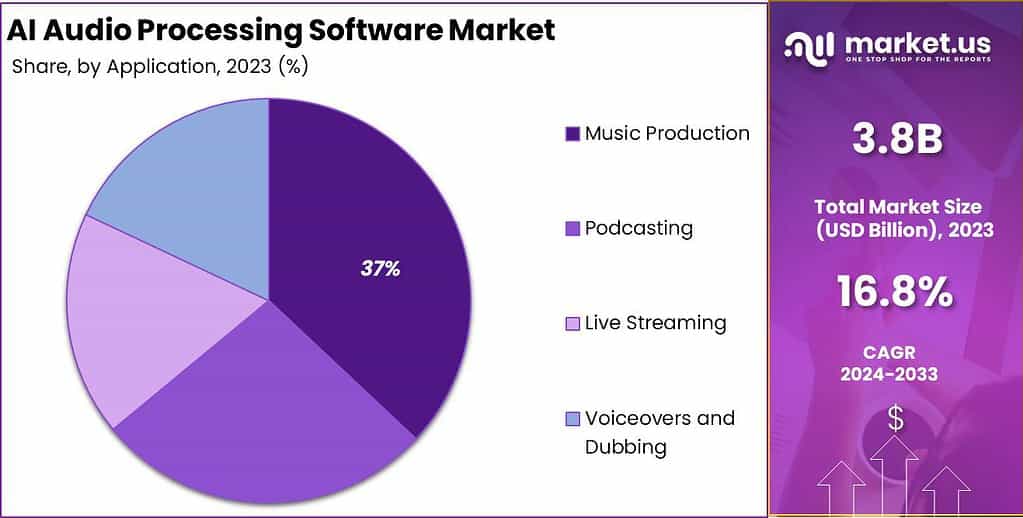
- The Music Production segment accounted for over 37% of the market share, reflecting the increasing use of AI in enhancing audio quality, automating sound editing, and supporting creative workflows.
- The Media & Entertainment sector held a substantial share of more than 40%, showcasing the growing adoption of AI tools for real-time audio enhancements, content creation, and immersive experiences.
Deployment Insights
In 2023, the Cloud-based segment held a dominant market position, capturing more than a 70% share of the AI audio processing software market. This considerable market share is largely attributed to the scalability, flexibility, and cost-efficiency that cloud-based solutions offer.
Organizations, regardless of their size, are increasingly adopting cloud-based audio processing solutions to manage large volumes of audio data without the need for substantial initial capital investment in hardware. The appeal of cloud-based AI audio processing lies in its accessibility.
Users can access powerful audio processing tools from anywhere, at any time, which is crucial in today’s mobile and interconnected world. This is particularly advantageous for industries such as media and entertainment, where collaboration across various geographies is common.
Additionally, cloud solutions are continuously updated to incorporate the latest AI advancements, ensuring users can leverage cutting-edge technologies without additional software upgrades or installations. Moreover, the cloud-based approach offers enhanced data security and backup options, which are essential for businesses handling sensitive audio content.
Data is stored in secure, redundant servers, and sophisticated encryption methods protect it during transmission and at rest. This security aspect is vital for compliance with international data protection regulations, making cloud-based solutions a preferable choice for global enterprises.
The robust growth of the cloud-based segment is also driven by the overall shift towards digital transformation. As companies adopt more cloud services across their operations, integrating cloud-based AI audio processing becomes a natural step. This trend is expected to continue, with more organizations moving towards cloud infrastructures to meet their audio processing needs efficiently and securely.
Application Insights
In 2023, the Music Production segment held a dominant market position, capturing more than a 37% share of the AI audio processing software market. This prominence is driven by the digital transformation in the music industry, where AI plays a pivotal role in streamlining production processes, enhancing sound quality, and enabling creative experimentation.
AI technologies allow for sophisticated sound editing, mixing, and mastering, which significantly reduces the time and technical expertise required to produce high-quality music tracks. AI tools in music production are not only about efficiency but also about innovation. They offer features such as automated tuning, rhythm correction, and sound layering, which empower artists and producers to experiment with complex arrangements and sounds.
This capability is crucial in an industry that thrives on innovation and uniqueness. Additionally, AI-driven software often includes predictive analytics to suggest adjustments and improvements, making it an invaluable tool for music professionals looking to refine their sound. Furthermore, the rise of independent music production due to platforms like YouTube, Spotify, and SoundCloud increases the demand for accessible, professional-quality tools that AI audio processing software provides.
Independent artists and small studios find these tools especially beneficial, as they often lack the resources for large-scale production facilities. AI software enables them to produce studio-quality music at a fraction of the cost, democratizing music production.
The ongoing development and integration of AI in music production tools are set to expand the capabilities and reach of this segment further. As AI algorithms become more sophisticated, they will continue to revolutionize how music is created, making high-quality production more accessible to a wider range of artists and producers around the world.
End-User Industry Insights
In 2023, the Media & Entertainment segment held a dominant market position in the AI audio processing software market, capturing more than a 40% share. This sector’s significant uptake of AI audio technologies is driven by the need to deliver high-quality audio content that meets the rising consumer expectations for immersive and interactive media experiences.
As viewers and listeners increasingly demand cinema-quality sound in their home entertainment, streaming services, movies, and video games, AI tools are crucial in editing and enhancing audio to professional standards efficiently. AI audio processing technologies in Media & Entertainment are used not just for improving sound quality but also for creating dynamic soundscapes that enhance storytelling.
These tools enable sound engineers to automatically adjust levels, balance multiple tracks, and apply complex effects that would otherwise require extensive manual effort. Moreover, AI-driven voice synthesis and modification are becoming essential in animations and virtual reality, offering realistic and customizable audio experiences that are vital for user engagement.
The integration of AI also extends to managing vast libraries of sound effects and tracks, where AI helps categorize and retrieve audio files efficiently, speeding up production workflows. Furthermore, AI is instrumental in developing personalized audio content, such as adaptive background scores and dialogues in video games, which adjust based on real-time user interactions and preferences.
Continued advancements in AI will further entrench its role in Media & Entertainment, as the industry seeks to innovate and provide captivating audio-visual experiences. The demand for AI audio processing in this segment is expected to grow as companies invest in technologies that not only streamline production but also enhance creative capabilities, ensuring that they remain competitive in a rapidly evolving digital landscape.
Popular AI Audio Processing Tools
The AI audio processing landscape in 2024 offers a robust array of tools, each tailored for different applications ranging from simple audio enhancements to complex production tasks. Here’s an overview of some of the most popular AI audio processing tools, characterized by their distinctive features and user suitability:
- Descript: Known for its user-friendly interface, Descript offers multifaceted capabilities including transcription, voice cloning, and audio editing. It’s highly recommended for content creators and marketers who regularly work with both audio and video, providing tools that simplify complex editing tasks.
- Murf: Praised for its diverse range of lifelike voices, Murf is suitable for creating high-quality voiceovers for various multimedia projects. It supports multiple languages and offers a robust editing toolkit, making it a go-to for global content developers.
- Listnr: This tool stands out for its vast library of over 600 voices, making it ideal for applications requiring diverse voice outputs such as podcasts and audiobooks. Listnr also offers podcast hosting and distribution services, streamlining the production process for podcast creators.
- LALAL.AI: Specializing in stem splitting, LALAL.AI excels in isolating vocals and instruments from audio tracks, which is particularly useful for music producers and remix artists looking to refine their audio inputs.
- Sonigon: Aimed at videographers and game developers, Sonigon provides AI-driven music composition tools that enable the creation of unique, royalty-free music tailored to specific moods and settings.
- Voicify: Offering ultra-realistic text-to-speech capabilities, Voicify is perfect for audiobook production and e-learning applications. It allows for deep customization of voice outputs to match specific pronunciation and emotional tones.
- Podcastle: A comprehensive platform for both audio and video podcast creation, Podcastle emphasizes ease of use with tools that support high-quality production standards, making it accessible for both amateurs and professionals.
Key Market Segments
By Deployment
- Cloud-based
- On-premises
By Application
- Music Production
- Podcasting
- Live Streaming
- Voiceovers and Dubbing
By End-User Industry
- Media & Entertainment
- Education
- Healthcare
- IT and Telecom
- Others
Driver
Rising Demand for Content Creation and Technological Advancements in AI
The market for AI audio processing software is primarily driven by the expanding needs of content creation across various platforms and the significant technological advancements in AI. With the growth of the podcast and audiobook industries, as well as a global shift towards remote work and collaboration, there is a heightened demand for tools that can provide high-quality audio processing.
This demand is further amplified by innovations that improve the efficiency and capabilities of these tools, making them more accessible and effective for users ranging from individual creators to large enterprises. These advancements not only support basic audio tasks but also enable sophisticated applications like real-time language translation and personalized audio experiences, thereby broadening the market scope and usage scenarios.
Restraint
High Costs and Complexity of Advanced AI Audio Processing Solutions
One of the significant restraints in the AI audio processing software market is the high cost associated with implementing these advanced solutions, especially for small and medium-sized enterprises (SMEs). While cloud-based models have reduced some barriers, the cost of maintenance and continuous upgrades can be prohibitive.
Additionally, the complexity of fully leveraging AI capabilities requires specialized skills and knowledge, which poses a challenge for organizations that may lack the technical resources. This complexity not only affects the adoption rates but also limits the potential market expansion to those who can afford and understand these advanced technologies.
Opportunity
Integration with Emerging Technologies and Customized Audio Experiences
The integration of AI audio processing technologies with emerging fields like virtual reality (VR) and augmented reality (AR) presents significant growth opportunities. These technologies rely on high-quality audio to create immersive and engaging experiences, positioning AI audio processing software as a critical component of development in this space.
Moreover, there’s an increasing consumer demand for personalized audio experiences, where AI can tailor content to individual preferences in real-time, offering unique and enhanced listening experiences. This trend towards personalization and integration with new tech offers substantial opportunities for market expansion and innovation.
Challenge
Keeping Pace with Rapid Technological Advancements and Diverse Market Needs
A major challenge facing the AI audio processing software market is keeping pace with the rapid rate of technological advancements. Companies must continuously innovate and update their offerings to stay competitive and meet the evolving needs of a diverse customer base. This includes not only large organizations but also individual creators and SMEs, each with unique needs and challenges.
The requirement for constant development and adaptation strains resources and necessitates ongoing investment in research and development. Additionally, the market’s global nature requires solutions to be adaptable to various regulatory and linguistic landscapes, adding another layer of complexity to the development of universally effective AI audio processing tools.
Growth Factors
The AI audio processing software market is witnessing substantial growth, driven by several key factors. Foremost among these is the increasing consumption of digital audio content, such as music, podcasts, and audiobooks, which necessitates advanced audio processing solutions. These technologies are crucial for enhancing sound quality, enabling effective noise reduction, and facilitating sophisticated audio editing processes.
Another significant growth driver is the technological advancements in artificial intelligence that enhance the capabilities of audio processing software. AI technologies enable features like real-time speech-to-text conversion, language translation, and voice recognition, which are increasingly in demand across various sectors including media, education, and customer service.
Moreover, the trend towards remote work and virtual collaborations has spurred the need for improved audio interfaces and processing tools that can handle diverse acoustic environments and ensure clear communication. This trend is particularly pronounced in corporate and educational settings, where clear and precise audio is essential for productivity and engagement.
Emerging Trends
One of the emerging trends in the AI audio processing software market is the integration with virtual and augmented reality technologies. This integration is crucial for creating immersive environments in gaming and simulations, where audio plays a pivotal role in enhancing user experience. As VR and AR technologies continue to advance and expand into new areas, the demand for sophisticated AI-driven audio processing solutions is expected to grow correspondingly.
Personalization of audio content is another significant trend. AI technologies are increasingly capable of adapting audio content to the preferences and requirements of individual users, which is becoming a compelling feature in consumer electronics, particularly in smart home devices and mobile applications.
Business Benefits
The adoption of AI audio processing software offers substantial business benefits, including increased efficiency and cost-effectiveness. Automating audio processing tasks reduces the need for manual labor and minimizes errors, which can significantly cut down production times and costs, especially in media and entertainment industries.
Additionally, AI-enhanced audio processing tools can help businesses reach a wider audience by breaking down language barriers through real-time translation and making content accessible to people with disabilities through enhanced speech clarity and audio descriptions.
Regional Analysis
In 2023, North America held a dominant market position in the AI audio processing software industry, capturing more than a 36% share and generating revenue of USD 1.6 billion. This leadership is attributed to several key factors. First, the region boasts a robust technological infrastructure, which facilitates the rapid adoption and integration of advanced technologies, including AI-driven audio processing.
Additionally, North America is home to a number of leading tech giants and innovative startups that continuously push the boundaries of AI audio processing capabilities. The market in North America is also driven by the widespread acceptance and use of digital media across various sectors, including entertainment, education, and corporate environments.
The growth of the media and entertainment industry, in particular, has spurred demand for sophisticated audio processing tools that can deliver high-quality production capabilities. Furthermore, the region’s strong focus on research and development activities, supported by significant investments from both public and private sectors, continues to drive innovations in AI and machine learning technologies applicable to audio processing.
Another contributing factor to North America’s leading position is its regulatory landscape, which generally supports technological innovations and the commercialization of new technologies. This environment encourages companies to develop and test new AI applications, including those in audio processing, thereby ensuring continuous market growth and the introduction of cutting-edge solutions.

Key Regions and Countries
- North America
- US
- Canada
- Europe
- Germany
- France
- The UK
- Spain
- Italy
- Rest of Europe
- Asia Pacific
- China
- Japan
- South Korea
- India
- Australia
- Singapore
- Rest of Asia Pacific
- Latin America
- Brazil
- Middle East & Africa
- South Africa
- Saudi Arabia
- UAE
- Rest of MEA
Key Players Analysis
The AI Audio Processing Software market is witnessing significant growth, shaped by the activities of leading companies like Super.AI, AssemblyAI, and Deepgram. These companies are key players due to their innovative solutions and strategic business activities including acquisitions, product launches, and partnerships.
Super.AI has established itself in the market with a comprehensive range of products that cater to various audio processing needs such as voice recognition and audio enhancement. The company’s recent developments suggest a focus on expanding its technological capabilities and market share through strategic initiatives and continuous improvement of its offerings.
AssemblyAI stands out with its specialized audio processing solutions, particularly in speech recognition technologies. AssemblyAI has been actively enhancing its market presence through recent updates and expansions in its product line, aiming to provide more tailored and efficient solutions to its users. The company has shown a robust financial performance and continues to innovate in the AI-driven audio market.
Deepgram is another major competitor, known for its deep learning-based approaches to audio analysis. Deepgram’s strategy includes expanding its reach and capabilities through new product launches that offer advanced features for audio transcription and analysis, helping it to secure a strong position in the competitive landscape.
Each of these companies is enhancing its market position through strategic acquisitions, innovative product launches, and mergers, indicating a dynamic and rapidly evolving sector. These efforts are not only boosting their individual growth but also driving the overall market forward by addressing the growing demand for sophisticated audio processing applications in various industries.
Top Key Players in the Market
- Google LLC
- Amazon Web Services (AWS)
- Microsoft Corporation
- Apple Inc.
- IBM Corporation
- Adobe Inc.
- iZotope Inc.
- Sonible GmbH
- Dolby Laboratories, Inc.
- Resemble AI
- Speechmatics
- Cleanfeed
- NVIDIA Corporation
- Other Key Players
Recent Developments
- In 2023, HARMAN Professional Solutions announced the acquisition of FLUX SOFTWARE ENGINEERING, a company known for its innovative audio software tools like FLUX:: SPAT Revolution and FLUX:: Analyzer. This acquisition is part of HARMAN’s strategic investment to enhance immersive audio experiences across live and recorded productions, integrating FLUX’s technology with HARMAN’s extensive portfolio of audio and visual product.
- In 2024, SoundHound AI acquired Amelia, a company specializing in conversational AI. This acquisition significantly enhances SoundHound AI’s capabilities in conversational AI, expanding its customer service solutions and creating new opportunities in voice commerce across various industries. The deal is expected to drive substantial growth and profitability expansion for SoundHound AI, with combined revenue projections exceeding $150M in 2025.









