


Report Overview
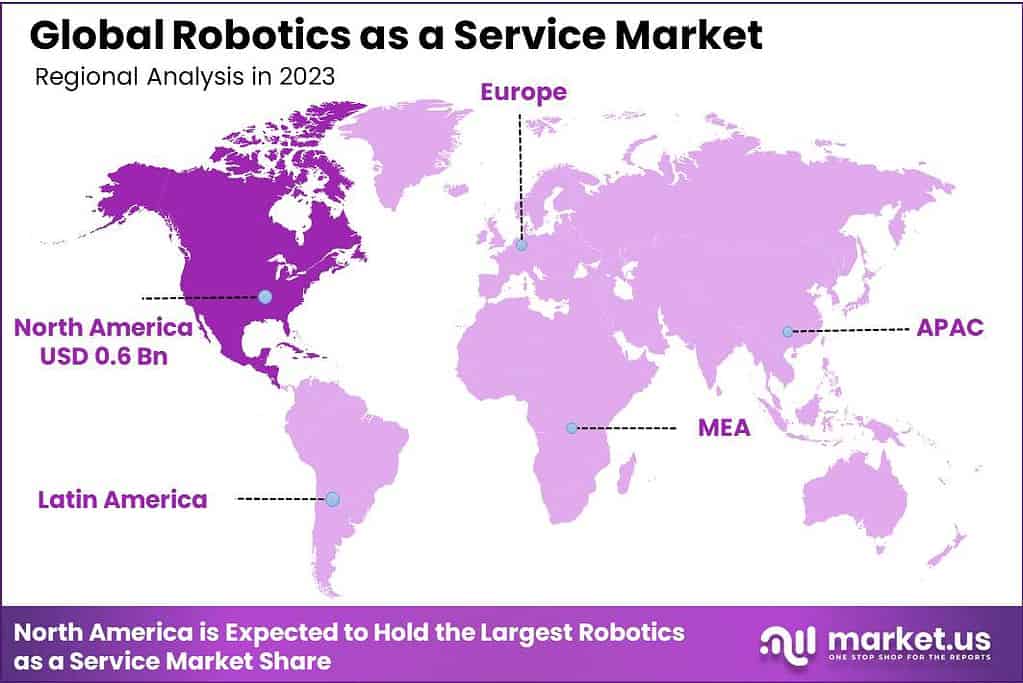
The Global Robotics as a Service Market size is expected to be worth around USD 8.3 Billion By 2033, from USD 1.6 billion in 2023, growing at a CAGR of 17.7% during the forecast period from 2024 to 2033. In 2023, North America held a dominant market position, capturing more than a 38% share, holding USD 0.6 Billion revenue.
Robotics as a Service (RaaS) is an innovative business model that allows companies to utilize robotic technology through a subscription-based or pay-as-you-go service rather than investing in the robots outright. This approach is akin to the well-known Software as a Service (SaaS) model and is designed to lower the barrier to entry for businesses to adopt advanced automation technologies.
RaaS providers typically offer their robotics systems complete with ongoing maintenance, software updates, and sometimes, operational staff to manage the automation process. The market for Robotics as a Service is experiencing robust growth, driven by the rising demand for automation across various industries including logistics, healthcare, and manufacturing. Companies are increasingly adopting RaaS solutions to address challenges such as labor shortages, high operational costs, and the need for flexibility in production processes.
The market is characterized by a range of offerings, from industrial and service robots to task-specific solutions like warehouse automation and data management services. The flexibility of the RaaS model allows businesses to experiment with advanced technology without the long-term financial commitment of purchasing equipment, which is particularly appealing in rapidly changing market environments.
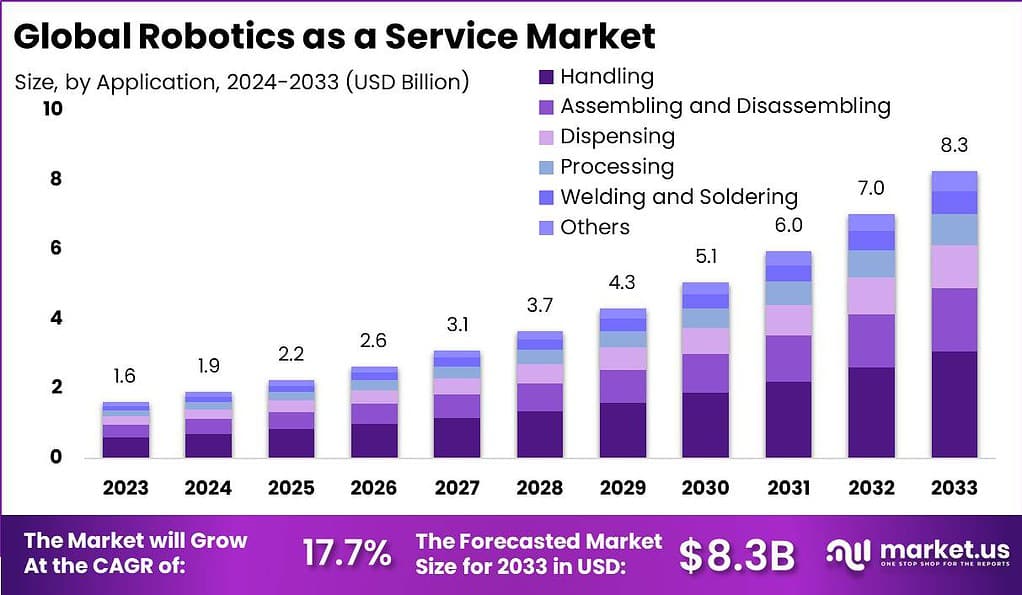
The major driving factors of the RaaS market include the increasing need for automation and efficiency in industries such as manufacturing, logistics, and healthcare. As businesses strive to improve operational efficiencies and reduce costs, the demand for robotics solutions continues to grow. Additionally, the labor shortage in various industries, exacerbated by demographic changes and the COVID-19 pandemic, has accelerated the adoption of robotic systems.
Demand for RaaS is primarily driven by the need to improve operational efficiency and productivity in the face of increasing labor costs and stringent regulatory environments. Industries such as e-commerce, which face high-volume processing and quick turnaround times, are particularly keen on adopting RaaS solutions to stay competitive. Additionally, the ongoing COVID-19 pandemic has accelerated the need for automation to ensure safety and continuity in operations.
Global spending on robotics is set to exceed ~$103.4 billion by 2026, according to the International Federation of Robotics (IFR). This highlights a growing commitment by businesses to invest heavily in automation and robotics technologies. The rapid adoption of robotics is driven by industries looking to improve efficiency, reduce costs, and stay competitive in a fast-evolving market.
Technological advancements play a crucial role in the expansion of the RaaS market. Innovations such as cloud robotics, advanced sensors, and better connectivity options are enabling more complex and reliable services. These technologies not only improve the performance and versatility of robotic systems but also enhance their integration with other digital infrastructure, making the overall proposition of RaaS more attractive to potential users.
The RaaS market presents numerous opportunities for growth, especially in sectors that are just beginning to explore automation. For example, small to medium-sized businesses can now leverage robotics for tasks that were previously not cost-effective or feasible due to high initial investment costs. Furthermore, as businesses seek to increase sustainability and reduce their environmental impact, RaaS providers that offer green and energy-efficient solutions are likely to see increased demand.
Key Takeaways
- The global Robotics as a Service (RaaS) market is on a remarkable growth trajectory, with its value projected to reach USD 8.3 billion by 2033, up from USD 1.62 billion in 2023. This represents a compound annual growth rate (CAGR) of 17.7% between 2024 and 2033, driven by increasing demand for automation across various industries.
- The Handling segment dominated the market with a significant share of 37.1%, showcasing its importance in simplifying operational tasks like material handling and logistics.
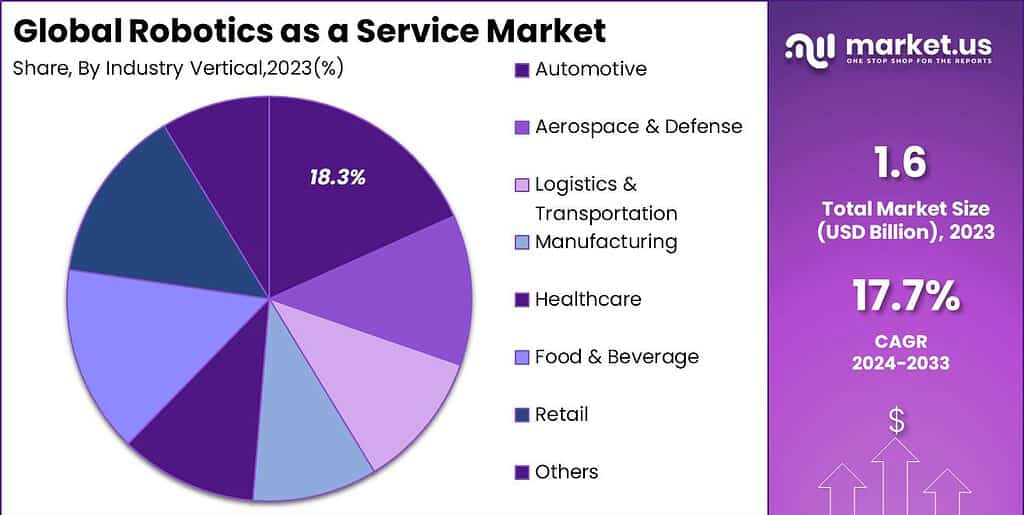
- Within the end-user industries, the Automotive segment captured an impressive 18.3% market share, reflecting the sector’s growing reliance on robotics to streamline production and assembly processes.
- Geographically, North America stood out as the largest market, holding more than 38% of the global share. The region’s technological advancements and early adoption of robotics solutions have contributed to its leadership position.
Impact of AI on Robotics as a Service
The integration of Artificial Intelligence (AI) into Robotics as a Service (RaaS) is transforming the capabilities and applications of robots in various industries, leading to significant enhancements in service delivery and operational efficiency.
- Enhanced Capabilities and Autonomy: AI technologies like natural language processing, computer vision, and machine learning empower service robots to perform a variety of tasks autonomously. This includes customer service, patient care, and logistics operations, where robots can interact, interpret, and respond to human needs more efficiently. The application of AI in robots allows them to handle complex tasks that require adaptability and real-time decision-making, enhancing customer experiences and reducing operational costs.
- Smart Manufacturing and Industry 4.0: In the industrial sector, AI-enhanced robots facilitate the emergence of smart factories by enabling seamless communication and integration with other machines and sensors on the production line. This integration supports advanced functionalities like predictive maintenance and real-time quality control, significantly improving manufacturing processes’ efficiency and reducing downtime.
- Adoption and Flexibility: AI’s role in robotics is also crucial in addressing the flexibility needs of businesses, allowing for rapid deployment and scaling of robotic solutions as per changing business requirements. AI-driven robots can adapt to new tasks quickly, which is particularly valuable in environments with variable demand such as e-commerce and healthcare.
- Operational Efficiency: By automating routine and complex tasks, AI-powered robots increase operational efficiency, allowing human workers to focus on more strategic and creative tasks. This not only boosts productivity but also helps in maintaining high standards of quality and performance.
- Market Growth and Innovation: The impact of AI on the RaaS market is evident in the rapid growth and technological innovation it stimulates. Businesses are increasingly receptive to adopting AI-powered robotic solutions due to their ability to significantly lower entry barriers and operational costs while offering sophisticated capabilities that were previously unattainable.
North America RaaS Market Size
In 2023, North America held a dominant position in the global Robotics as a Service (RaaS) market, capturing over 38% of the market share, equivalent to approximately USD 0.6 billion in revenue. This leadership is attributed to the region’s strong emphasis on adopting advanced technologies, supported by a robust infrastructure and favorable business environment.
Companies in the United States and Canada, in particular, are at the forefront of integrating robotics solutions to enhance productivity and reduce operational costs across industries like manufacturing, logistics, healthcare, and retail. North America’s dominance is further fueled by the presence of key market players, extensive research and development activities, and a high rate of technology adoption.
Leading firms in the region are investing in cutting-edge RaaS solutions to cater to industries facing labor shortages and increasing operational demands. Moreover, the region benefits from government initiatives and funding aimed at promoting automation and innovation, which have played a pivotal role in driving market growth.
The region’s economic stability and early adoption of robotics in sectors like e-commerce and automotive manufacturing have created a ripple effect, encouraging businesses to transition to service-based robotic models. For instance, companies in the logistics sector are increasingly deploying robotics to optimize supply chains and manage the surge in online retail. This strategic shift toward robotics as a service helps businesses minimize capital expenditures while ensuring scalability.
Application Analysis
In 2023, the Handling segment held a dominant market position in the Robotics as a Service (RaaS) landscape, capturing more than 37.1% share of the market. This substantial market share is primarily due to the escalating demand from the booming e-commerce industry, which requires efficient material handling solutions such as order picking, sorting, packaging, and palletizing.
Autonomous mobile robots (AMRs) and robotic arms are extensively utilized for these tasks, helping businesses navigate through dynamic warehouse environments and optimize fulfillment processes. The flexibility of RaaS models plays a crucial role in this segment’s popularity, enabling businesses to scale their handling operations in response to fluctuating order volumes and seasonal demands.
This adaptability is vital for maintaining efficiency in logistics and distribution centers, where the speed and accuracy of handling processes can significantly impact overall productivity and customer satisfaction. Moreover, the handling segment benefits from the integration of advanced sensors and mapping technologies in robots.
These innovations enhance the robots’ ability to navigate warehouses, collect and deliver items, and optimize the layout for efficient storage and retrieval. In industries like manufacturing and logistics, where handling heavy and bulky items is common, these robots offer high payload capacities and assist in labor-intensive tasks such as loading and unloading trucks, moving large components, and managing pallet operations.
The robust growth of this segment is underpinned by the transition of traditional warehouses towards automated systems that improve efficiency and reduce operational costs. This trend is expected to continue, driven by the growing adoption of automation technologies that streamline operations and enhance competitiveness in fast-paced market environments
Industry Vertical Analysis
In 2023, the automotive segment in the Robotics as a Service (RaaS) market held a dominant position, capturing a significant market share of more than 18.3%. This strong market presence can be largely attributed to the pivotal role that robotics plays in enhancing manufacturing efficiency and quality in the automotive industry.
Automotive robotics has become integral to the sector due to its ability to streamline production lines and mitigate the risk of human error, which is particularly valuable in environments that demand high precision and consistency. The adoption of robotics in the automotive sector helps in improving safety standards by automating potentially hazardous tasks and enhances production capabilities by ensuring high-quality assembly operations. This has led to a reduction in production costs and an increase in throughput, bolstering the segment’s growth.
The continuous advancements in technology and integration of systems equipped with artificial intelligence and machine learning further drive the demand for automotive robotics. These technologies enhance the flexibility and efficiency of robots, allowing for more complex and varied tasks in automotive manufacturing processes. Moreover, the push towards electric vehicles and the diversification of vehicle models have necessitated more adaptable and sophisticated robotic solutions.
Strategic partnerships between robotics manufacturers and automotive firms are also pivotal, enhancing innovation and adaptation of robots in automotive production lines. For example, significant investments in robotic systems for material handling, assembly, and painting operations in the automotive industry are indicative of the sector’s reliance on these technologies to maintain competitiveness and meet evolving market demands.
Key Market Segments
By Application
- Handling
- Assembling and Disassembling
- Dispensing
- Processing
- Welding and Soldering
- Others
By Industry Vertical
- Logistics & Transportation
- Aerospace & Defense
- Automotive
- Manufacturing
- Healthcare
- Food & Beverage
- Retail
- Others
Key Regions and Countries
- North America
- US
- Canada
- Europe
- Germany
- UK
- Spain
- Austria
- Rest of Europe
- Asia-Pacific
- China
- Japan
- South Korea
- India
- Australia
- Thailand
- Rest of Asia-Pacific
- Latin America
- Brazil
- Middle East & Africa
- South Africa
- Saudi Arabia
- United Arab Emirates
Drivers
Increasing need for automation in a cost-effective manner
The increasing need for automation in a cost-effective manner is a major driver for the Robotics as a Service market. Businesses are under pressure to improve productivity and efficiency while minimizing operational expenses and making RaaS an attractive solution.
With the help of its subscription-based model, RaaS tends to eliminate the need for significant upfront investments in robotic systems. Companies can scale their automation needs as required thus paying only for what they use. This flexibility is particularly beneficial for small and medium enterprises looking to remain competitive without straining their budgets.
Additionally, RaaS enables access to advanced robotics technology without the burden of maintenance and upgrades. This approach allows the businesses to focus on core operations while achieving the automation goals affordably.
Restraint
Resistance from businesses to adapt to new technologies
Resistance to adopt new technologies remains a key restraint in the RaaS market. Many businesses, particularly small and medium enterprises, hesitate to transition from traditional methods due to uncertainty about costs, compatibility, and overall return on investment. This cautious approach slows the adoption of RaaS.
Furthermore, a lack of awareness and technical expertise also contributes to this resistance. Business leaders may avoid disruptions to existing operations or struggle to integrate robotics solutions effectively without skilled personnel. Such challenges tend to create barriers to implementation.
Additionally, concerns about overreliance on technology and data security risks heighten the reluctance. Businesses are concerned about potential system failures or breaches, which can lead to significant operational or financial losses, further delaying the adoption.
Opportunities
Integration of Machine Learning and Artificial Intelligence
The integration of machine learning (ML) and artificial intelligence (AI) presents a significant opportunity for the Robotics as a Service (RaaS) market. These technologies enhance robotics systems by enabling advanced features such as predictive maintenance, real-time decision-making, and adaptive learning, making them more efficient.
AI and ML allow robots to handle complex tasks that are learned from data, and make improvements over time. This adaptability increases their appeal across industries like healthcare, logistics, and manufacturing, where precision and efficiency are critical. Businesses can leverage these advancements to reduce errors and optimize operations.
As AI and ML continue to evolve, the RaaS market can capitalize on developing innovative solutions tailored to industry-specific needs. This technological synergy drives growth and creates new avenues for adoption worldwide.
Challenges
Over-reliance leads to operational disruptions during failures.
Reliance on robotics in the RaaS market can lead to significant operational disruption during system failures. When businesses heavily depend on robots for critical tasks, even a minor malfunction can halt operations, causing delays and financial losses.
Such disruptions can be particularly challenging for industries with tight production schedules, like automotive or logistics, where downtime directly impacts the revenue. Without proper contingency plans, or skilled personnel to manage failures, businesses may face prolonged recovery times.
This over dependency on robotic systems highlights a key restraint for the RaaS market. to mitigate these risks, companies must invest in backup solutions, regular maintenance, and robust support systems, which can increase costs and complexity, potentially deterring smaller firms from adopting RaaS.
Growth Factors
- Technological Integration: The integration of advanced technologies such as artificial intelligence (AI) and machine learning is a significant driver. AI enhances the capabilities of robots, enabling them to learn from their environment and improve efficiency over time. This is particularly evident in applications like predictive maintenance, which helps in reducing downtime by anticipating maintenance needs.
- Economic Imperatives and Flexibility: Economic pressures and the need for operational flexibility are propelling businesses toward RaaS. The subscription-based model of RaaS allows businesses to access robotic solutions without heavy upfront investments, spreading costs over time and adjusting usage based on demand.
- Business Model Innovation: The shift from purchasing expensive robotic systems to using them as a service is a critical factor. This transition enables companies of all sizes to leverage robotic technologies, making it a cost-effective solution that avoids obsolescence and adapts to changing business needs.
Emerging Trends
- Collaborative Robots (Cobots): Cobots continue to rise in prominence, working alongside human employees to enhance safety and efficiency. This trend is increasingly adopted in sectors like manufacturing, where it augments productivity and helps maintain operational safety.
- Customization and Modular Solutions: As businesses vary greatly in their needs, the ability to customize and adapt robotic solutions for different tasks is becoming crucial. The rise of modular robotics systems that can be tailored to specific operational needs is an emerging trend that supports this adaptability.
- Sustainability: There’s a growing emphasis on developing eco-friendly robots that utilize less energy and can be recycled at their life’s end. This trend aligns with the global push towards sustainability and reduces the environmental impact of robotic solutions.
Business Benefits
- Cost Efficiency: RaaS offers a significant reduction in capital expenditure, providing businesses with access to the latest robotic technologies without the associated high costs of ownership. This aspect is particularly beneficial for small to medium enterprises (SMEs) that might not have the resources to invest heavily in automation technologies.
- Scalability: The flexible nature of RaaS allows businesses to scale their operations up or down with ease. This flexibility is ideal for industries with seasonal fluctuations or varying project demands, ensuring they pay only for what they need when they need it.
- Enhanced Productivity and Competitiveness: By automating routine and complex tasks, businesses can significantly enhance productivity. This automation drives faster production times, reduces errors, and maintains high-quality output, which in turn boosts overall competitiveness in the market.
Key Players Analysis
One of the well-known key player in the market is ABB Ltd, offering a range of robotic solutions for industries like automotive, logistics, and manufacturing. Their focus on innovation and AI-powered automation has made them a leader in providing flexible and scalable robotics services.
Another prominent player operating in the market is Fanuc Corporation that provides industrial robots and automation solutions with an emphasis on high performance and reliability. Their advanced robotics systems cater to industries such as automotive, electronics, and consumer goods, contributing to their strong market position.
Top Key Players in the Market
- ABB Ltd.
- KUKA AG
- Ademco Global
- Fanuc Corporation
- iRobot Corporation
- Omron Corporation
- Yaskawa Electric Corporation
- Locus Robotics
- Aethon
- Berkshire Grey Inc.
- inVia Robotics
- Other Key Players
Recent Developments
- In November 2024, Universal Robots, the Danish collaborative robot (cobot) company, has announced it will open a brand-new service and repair center exclusively for its India customers.
- In July 2024, LG announced the launch of its Robot as a Service (RaaS) subscription service this month, featuring its CLOi ServeBot. This service robot can serve food in restaurants and assist with deliveries in hospitals and hotels.









