


Report Overview
The Global LoRa and LoRaWAN IoT Market size is expected to be worth around USD 124.4 Billion By 2033, from USD 7.4 Billion in 2023, growing at a CAGR of 32.60% during the forecast period from 2024 to 2033. Geographically, North America dominated the LoRa and LoRaWAN IoT market in 2023, capturing more than 37.8% of the market share, which translated to USD 2.8 billion in revenue.
LoRa (Long Range) and LoRaWAN (Long Range Wide Area Network) are key technologies in the Internet of Things (IoT) ecosystem, designed to enable low-power, long-range wireless communication for connected devices. LoRa refers to the physical layer or modulation used for data transmission, while LoRaWAN is the communication protocol and network architecture built on top of LoRa.
The LoRa and LoRaWAN IoT market has seen significant growth and is expected to continue expanding as more industries adopt these technologies for their IoT solutions. The global market is driven by the increasing demand for low-power, long-range connectivity to support a wide range of IoT applications. LoRaWAN’s ability to support a large number of devices while minimizing power consumption makes it an attractive choice for such applications.
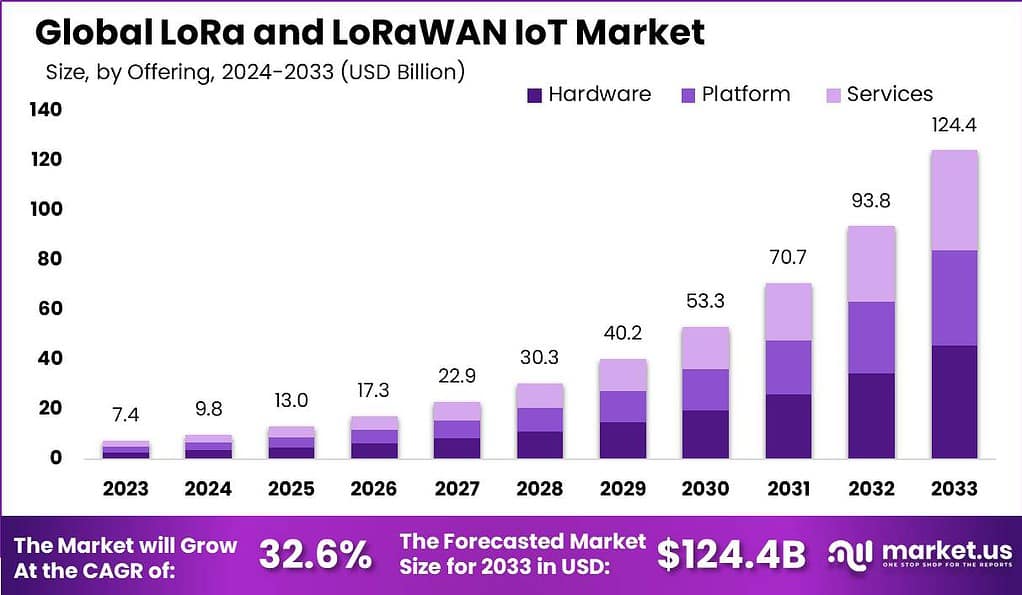
The market demand is driven by sectors like agriculture, logistics, smart cities, and industrial automation. In agriculture, for instance, IoT devices powered by LoRaWAN help monitor crops, soil conditions, and weather patterns over long distances with minimal energy consumption. In logistics, it is used for tracking goods and managing fleets. The appeal of LoRaWAN lies in its ability to cover a large area while keeping energy usage low, making it ideal for remote and rural locations.
Recent advancements in LoRaWAN technology include improvements in network capacity, direct device-to-device communication, and enhanced security features, which have broadened its applications. These developments ensure that LoRaWAN remains at the forefront of LPWAN technologies, catering to an evolving market with increasing needs for connected devices and data security.
The popularity of LoRaWAN is also fueled by its open-source nature and low deployment costs compared to other wireless communication technologies. As more companies and municipalities implement smart solutions, the demand for LoRa-based networks continues to grow. LoRaWAN provides secure, scalable, and cost-effective connectivity, which is essential for the efficient functioning of large-scale IoT networks.
The market is seeing significant expansion, especially in regions like North America, Europe, and parts of Asia Pacific, where investments in smart infrastructure and IoT applications are increasing. The continued expansion of IoT technologies across different industries is expected to drive the market forward. The market is expanding in both developed and emerging economies, where IoT adoption is rising across industries.
Key Takeaways
- The Global LoRa and LoRaWAN IoT Market is projected to reach USD 124.4 Billion by 2033, up from USD 7.4 Billion in 2023, with a CAGR of 32.60% during the forecast period from 2024 to 2033.
- In 2023, the Hardware segment dominated the LoRa and LoRaWAN IoT market, accounting for over 36.7% of the total market share.
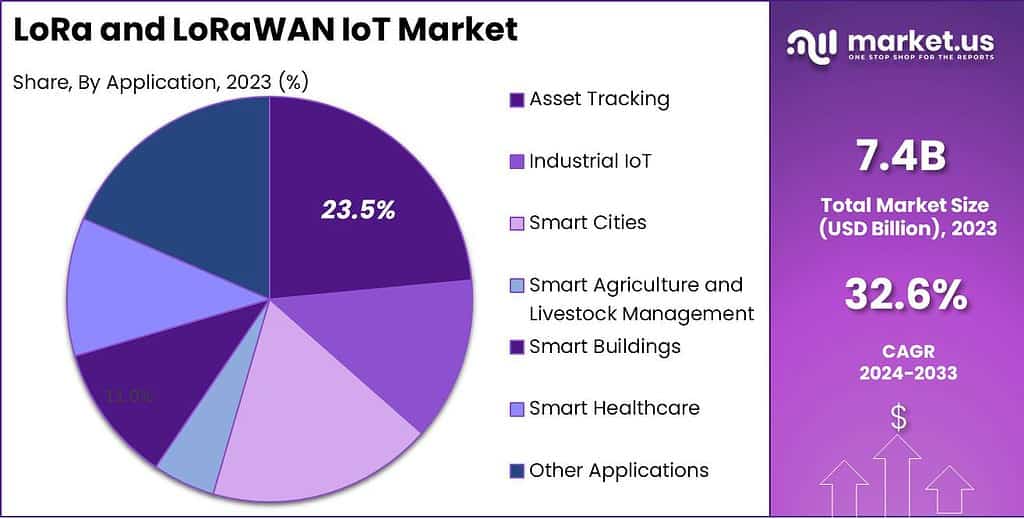
- The Asset Tracking segment also held a significant position in the market in 2023, capturing more than 23.5% of the total share.
- The Manufacturing sector led the LoRa and LoRaWAN IoT market in 2023, holding more than an 18.6% share, driven by the growing adoption of IoT-enabled smart manufacturing solutions that enhance operational efficiency, reduce downtime, and improve asset management.
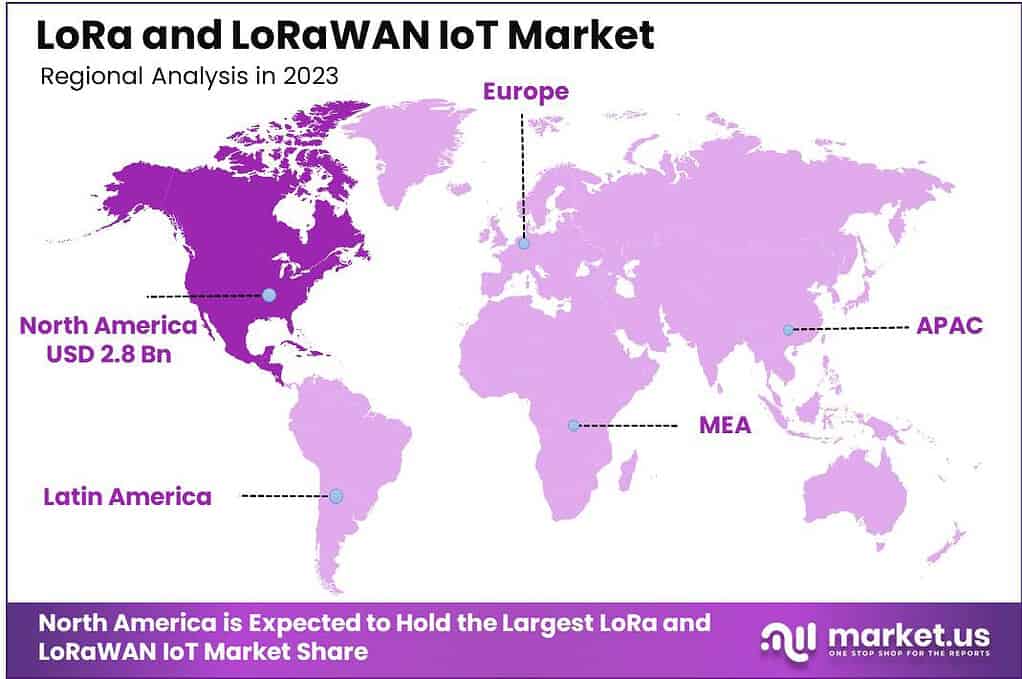
- North America held the largest market share in the LoRa and LoRaWAN IoT space in 2023, with a dominant share of over 37.8%, translating to USD 2.8 billion in revenue.
Offering Analysis
In 2023, the Hardware segment held a dominant market position in the LoRa and LoRaWAN IoT market, capturing more than 36.7% of the total share. The primary factor driving this growth is the increasing demand for low-power, long-range communication solutions that are critical for Internet of Things (IoT) applications.
LoRa-based hardware, which includes devices such as sensors, gateways, and end nodes, is central to the functionality of LoRaWAN networks. The continued expansion of smart cities, agriculture, industrial automation, and environmental monitoring is boosting the adoption of these hardware devices.
The dominance of the hardware segment is also driven by advancements in hardware technology, including the miniaturization of components and the development of more efficient energy management solutions. With an increasing need for sensors and devices that can operate for extended periods without requiring frequent maintenance, LoRa-based hardware offers an ideal solution for industries that need long-range, battery-powered, and low-cost devices.
Application Analysis
In 2023, the Asset Tracking segment held a dominant market position in the LoRa and LoRaWAN IoT market, capturing more than 23.5% of the total share. This growth can be attributed to the increasing need for real-time visibility and management of valuable assets across a wide range of industries.
LoRaWAN-based asset tracking solutions provide a reliable, cost-effective way to monitor the location, condition, and movement of assets, whether in warehouses, transportation networks, or across large outdoor areas.
The rise in global trade, along with the complexity of modern supply chains, has further driven the demand for asset tracking solutions. LoRaWAN’s long-range capabilities and low-power requirements make it an ideal solution for tracking goods in transit or in remote locations where cellular or GPS-based solutions may not be as effective.
Furthermore, the Asset Tracking segment benefits from the growing trend of digital transformation and automation in industries that rely heavily on managing physical assets. With IoT platforms providing real-time data analytics and insights, companies can optimize their supply chain operations, improve inventory management, and reduce costs.
End User Analysis
In 2023, the Manufacturing segment held a dominant market position in the global LoRa and LoRaWAN IoT market, capturing more than an 18.6% share. This sector’s leadership can be attributed to the growing adoption of IoT-enabled smart manufacturing solutions that enhance operational efficiency, reduce downtime, and improve asset management.
The Manufacturing sector is particularly poised for growth due to its strong emphasis on automation and Industry 4.0 initiatives. IoT applications within manufacturing facilities allow for predictive maintenance, which reduces costs and improves equipment lifespan.
LoRa technology, with its long-range and low-power capabilities, is perfectly suited to monitor machines and production lines across large facilities, ensuring smooth workflow and greater productivity. This has enabled manufacturers to reduce energy consumption and avoid costly downtimes, giving them a competitive edge in a fast-paced industry.
Another factor contributing to the Manufacturing sector’s dominance is the increasing demand for real-time data in supply chain management. By deploying LoRa-based IoT solutions, manufacturers are able to track the movement of goods, monitor inventory levels, and optimize supply chain logistics.
Key Market Segments
By Offering
- Hardware
- Platform And Services
By Application
- Asset Tracking
- Industrial IoT
- Smart Cities
- Smart Agriculture And Livestock Management
- Smart Buildings
- Smart Healthcare And Other Applications
By End User
- Retail
- Manufacturing
- Transportation & Logistics
- Agriculture
- Healthcare
- Energy & Utilities
- Government & Public Safety
- Enterprise
- Residential
- Travel & Hospitality
Driver
Low Power Consumption and Long Range
One of the key drivers behind the growing adoption of LoRa and LoRaWAN IoT Market is their ability to deliver long-range communication with very low power consumption. This is especially crucial for IoT devices that need to operate over extended periods of time without frequent battery replacements.
LoRaWAN enables devices to communicate over distances of up to 15 kilometers in rural areas, and 2-5 kilometers in urban environments, while consuming minimal power. This makes it ideal for applications like smart agriculture, environmental monitoring, and asset tracking, where devices are often deployed in remote or hard-to-reach areas. The combination of long-range communication and low power usage significantly reduces operational costs, as devices can function for years on a single battery.
Restraint
Limited Data Throughput
LoRaWAN is often limited by its relatively low data throughput compared to other wireless communication technologies like LTE or Wi-Fi. LoRaWAN is designed for small packets of data, which is perfect for applications like sensors or trackers that only need to transmit short bursts of information. However, when it comes to applications requiring real-time data streaming or high-bandwidth capabilities, LoRaWAN may not be suitable.
In densely populated IoT deployments, like smart cities or large industrial operations, the limited throughput could result in network congestion and slower response times. As a result, businesses and developers must carefully evaluate the specific requirements of their IoT applications before choosing LoRaWAN as the communication protocol.
Opportunity
Expansion in Smart Cities and Agriculture
One of the most promising opportunities for LoRa and LoRaWAN lies in their integration into smart city and smart agriculture applications. In smart cities, LoRaWAN’s long-range and low-power features make it ideal for monitoring public infrastructure, traffic management, and environmental conditions.
For instance, LoRaWAN-based sensors can be deployed to monitor air quality, detect waste levels in bins, or track the performance of streetlights. These applications not only improve the efficiency of city management but also help reduce operational costs and enhance the quality of life for residents.
With the growing demand for sustainable farming and resource-efficient city management, LoRa and LoRaWAN offer the scalability and cost-effectiveness needed to address these needs. This positions LoRa technology as a key enabler in both urban and rural settings.
Challenge
Network Interference and Security Concerns
One of the major hurdles is network interference. As LoRa operates in unlicensed frequency bands, it is susceptible to interference from other devices and networks that use the same spectrum. In densely populated areas or environments with many IoT devices, interference can lead to data transmission failures or reduced network performance.
Furthermore, security remains a significant challenge for LoRaWAN networks. Although the technology includes encryption and security features, the overall security of a LoRaWAN network depends on the strength of the implementation. If not properly configured, networks can be vulnerable to cyberattacks, such as spoofing or jamming.
Emerging Trends
One of the key emerging trends is the integration of LoRaWAN with 5G networks. This combination offers the potential to enhance IoT deployments, combining the long-range capabilities of LoRa with the high-speed, high-capacity benefits of 5G. This is expected to drive innovation in industries such as agriculture, smart cities, and logistics.
Another significant trend is the growing focus on data security. As more devices connect through LoRaWAN, protecting data from cyber threats is crucial. With evolving encryption standards and secure communication protocols, LoRaWAN is strengthening its ability to ensure safe and reliable data transmission.
Moreover, LoRaWAN is also becoming a crucial enabler of sustainability. As industries and cities look for ways to reduce their environmental footprint, the low energy consumption of LoRaWAN-based devices is offering an attractive solution.
Business Benefits
LoRaWAN offers numerous business benefits, particularly for companies looking to harness the power of IoT without incurring the high costs of traditional wireless communication methods.
The low-power nature of LoRaWAN also translates into reduced operational costs. Devices connected through LoRaWAN typically have battery lifespans measured in years, reducing the need for frequent maintenance or recharging.
Another significant benefit is the flexibility LoRaWAN offers in terms of network deployment. Businesses can either choose to set up their own private networks or take advantage of public networks, depending on their needs. This flexibility allows companies to scale their IoT operations without being locked into a specific infrastructure.
Furthermore, LoRaWAN is playing a vital role in enabling businesses to optimize their operations. With real-time data collected from IoT devices, companies can monitor equipment performance, track assets, and analyze environmental conditions to improve decision-making and resource management.
Regional Analysis
In 2023, North America held a dominant market position in the LoRa and LoRaWAN IoT market, capturing more than a 37.8% share, translating to USD 2.8 billion in revenue. The region’s leadership is primarily attributed to the high adoption rate of Internet of Things (IoT) technologies, robust infrastructure, and favorable government initiatives aimed at promoting smart city development and industrial automation.
Countries like the United States and Canada have witnessed rapid growth in IoT applications, especially in sectors such as agriculture, logistics, smart cities, and asset tracking, driving demand for LoRa and LoRaWAN technologies. The presence of major technology players and service providers, coupled with increasing investments in IoT-enabled solutions, further strengthens North America’s market dominance.
Aditionally, North America has seen a growing number of partnerships and collaborations between IoT hardware manufacturers, network providers, and system integrators, which accelerates the adoption of LoRaWAN in commercial applications.
Another factor contributing to North America’s dominance is its advanced technology landscape, with a high penetration of digital infrastructure and increasing investments in next-generation IoT solutions. The region’s businesses, particularly in the utilities and agriculture sectors, have adopted LoRa and LoRaWAN for their ability to provide long-range communication with low power consumption and cost-efficiency.
While Europe and the Asia-Pacific region are also expected to experience significant growth, North America’s established leadership in both technological development and market demand places it at the forefront of the LoRa and LoRaWAN IoT ecosystem.
Key Regions and Countries
- North America
- US
- Canada
- Europe
- Germany
- France
- The UK
- Spain
- Italy
- Rest of Europe
- Asia Pacific
- China
- Japan
- South Korea
- India
- Australia
- Singapore
- Rest of Asia Pacific
- Latin America
- Brazil
- Mexico
- Rest of Latin America
- Middle East & Africa
- South Africa
- Saudi Arabia
- UAE
- Rest of MEA
Key Player Analysis
In the rapidly growing LoRa and LoRaWAN IoT market, several key players are shaping the landscape through their innovations and strategic initiatives.
Cisco has established itself as a leader in the IoT space with a strong focus on creating end-to-end solutions for LoRaWAN networks. The company’s expertise in networking technology enables businesses to integrate LoRaWAN solutions into their existing IT infrastructure.
NEC Corporation has made significant strides in the IoT market by offering advanced LoRaWAN-based solutions that cater to both public and private sector needs. NEC’s integrated solutions for smart cities and industrial IoT applications leverage LoRaWAN technology to provide real-time data collection and analysis, helping organizations make decisions.
Tata Communications is another major player making a strong impact in the LoRa and LoRaWAN market, primarily through its global network infrastructure and expertise in IoT connectivity. Tata Communications provides managed LoRaWAN connectivity services that enable businesses to deploy IoT solutions with minimal complexity and cost.
Top Key Players in the Market
- Cisco
- NEC Corporation
- Tata Communications
- Semtech
- Orange SA
- Advantech
- Comcast
- AWS
- Bosch
- Laird Connectivity
- Senet
- MultiTek
Recent Developments
- In June 2024, Omdia’s research reveals that NB-IoT and LoRa dominate the Low Power Wide Area Network (LPWAN) IoT landscape, accounting for 87% of connections in 2023. This trend is expected to persist, with the two technologies projected to maintain 86% of LPWAN connections by 2030.
- In June 2024, EchoStar Mobile Limited, a subsidiary of EchoStar, has teamed up with Actility to support Swisscom, Switzerland’s leading ICT company, in expanding its LoRaWAN IoT network across Europe.
- In sepetember 2024, Semtech Corporation, a leader in high-performance semiconductors and IoT systems, has unveiled its new one-channel LoRaWAN hub reference design and evaluation kit. This solution is specifically tailored for smaller-scale network deployments, making it an ideal choice for applications small to medium-sized businesses (SMBs/SMEs).









