


Report Overview
The Global IT Outsourcing Market size is expected to be worth around USD 1,094.9 Billion By 2033, from USD 471.1 Billion in 2023, growing at a CAGR of 8.80% during the forecast period from 2024 to 2033. In 2023, North America dominated the IT outsourcing market, accounting for over 35.4% of the share and generating approximately USD 166.8 billion in revenue.
IT outsourcing refers to the practice of hiring third-party service providers to manage and handle information technology (IT) services and functions that are typically managed in-house. These services can range from software development, infrastructure management, cloud computing, cybersecurity, IT consulting, and business process outsourcing (BPO), among others.
The IT outsourcing market is a dynamic segment within the broader IT industry, driven by businesses’ growing need to reduce operational costs and increase efficiency. Companies outsource IT functions to gain access to skilled professionals and advanced technologies, enabling them to stay competitive in a rapidly evolving digital landscape. This market offers various outsourcing models like offshore, nearshore, and onshore outsourcing, each providing different benefits depending on the geographical and strategic needs of the outsourcing company.

Several key drivers propel the growth of the IT outsourcing market. Cost reduction is often the primary motivator, as outsourcing allows businesses to convert fixed IT costs into variable costs, freeing up capital for other uses. Additionally, the ability to access a global talent pool equipped with specialized skills that might not be available locally plays a crucial role. Outsourcing also offers scalability, allowing companies to adjust resources based on current needs without the long-term commitments associated with hiring permanent staff.
The demand in the IT outsourcing market is largely influenced by the need for businesses to rapidly adapt to technological advancements and competitive pressures. The increasing reliance on cloud computing, data analytics, and artificial intelligence has made IT outsourcing a strategic necessity rather than a mere cost-cutting option. Moreover, the push towards digital transformation across various industries has made IT outsourcing vital for businesses seeking agility and innovation.
For instance, In June 2024, Oracle Corporation made a bold move by investing over $1 million to set up a new cloud region in Madrid, Spain. This strategic initiative is designed to support local businesses in sectors like finance, healthcare, and retail, enabling them to modernize their operations with cutting-edge cloud technologies.
With the rapid pace of technological change, opportunities for IT outsourcing are expanding into new frontiers. Emerging markets, particularly in regions like Southeast Asia, Eastern Europe, and Latin America, are seeing an uptick in outsourcing demand as they offer cost-effective solutions with high-quality deliverables. The growing threat of cybersecurity risks creates an opportunity for outsourcing partners to offer specialized services that protect businesses from evolving digital threats.
Technological advancements play a pivotal role in shaping the IT outsourcing landscape. Innovations in cloud computing, machine learning, and predictive analytics are transforming the way outsourcing services are delivered. These technologies enable outsourcing providers to offer more efficient, secure, and tailored IT solutions that meet the evolving demands of businesses. As a result, staying abreast of technological trends is essential for both providers and clients in the IT outsourcing ecosystem.
Key Takeaways
- The Global IT Outsourcing Market is projected to reach USD 1,094.9 billion by 2033, up from USD 471.1 billion in 2023, growing at a CAGR of 8.80% during the forecast period from 2024 to 2033.
- In 2023, the Application Outsourcing Services segment held a dominant market share, accounting for more than 25.5% of the global IT outsourcing market.
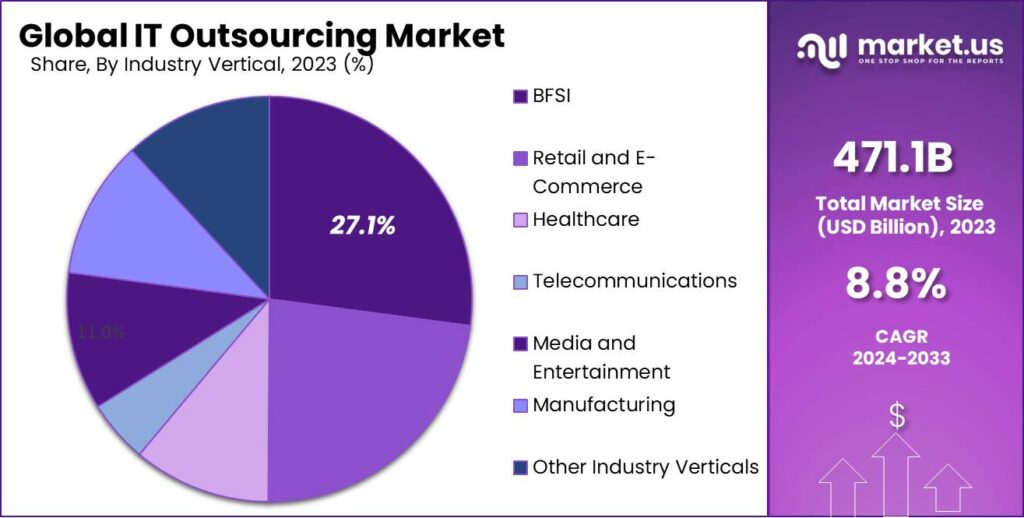
- The BFSI (Banking, Financial Services, and Insurance) segment also dominated the market in 2023, capturing over 27.1% of the global IT outsourcing market, driven by the need for secure, scalable, and reliable IT solutions in this sector.
- North America held the largest market share in 2023, with more than 35.4%, generating approximately USD 166.8 billion in revenue.
Outsourcing Trends in the U.S. and Global Market
Based on data from radixweb, 66% of businesses in the U.S. outsource at least one department, highlighting the strong preference for outsourcing as a strategic business approach. Every year, 300,000 jobs are outsourced in the U.S. alone, showcasing the scale of this practice.
For small businesses, outsourcing plays a crucial role, with 24% outsourcing their requirements to improve efficiency and focus on core competencies. Furthermore, 70% of companies report that outsourcing is cost-effective, significantly reducing the expense of hiring and managing in-house staff.
If reducing costs is one of your goals for 2024, global IT outsourcing can be a strategic move. The U.S. market alone generates $62 billion in international income, contributing significantly to the $92.5 billion global outsourcing industry.
The IT sector leads the way, with 37% of IT operations outsourced and 13.6% of IT budgets allocated to outsourcing. This trend reflects the high demand for specialized skills and cost efficiency within this industry.
Globally, 78% of companies that outsource have a favorable perception of their outsourcing partners. The pandemic has further shifted attitudes, with 45% of businesses planning to increase outsourcing to tap into skill sets that are not readily available in-house.
Between 2021 and 2025, the outsourcing industry is projected to grow at a 4% compound annual growth rate (CAGR). By 2032, business process outsourcing is expected to reach an impressive valuation of $620.1 billion, driven by evolving technology and increasing collaboration.
IT Outsourcing Statistics
- According to connectbit, 81% of companies now rely on external service providers to handle their cybersecurity needs. This highlights how businesses are prioritizing expert partnerships to combat rising digital threats.
- A significant 57% of organizations outsource to cut costs and address talent shortages. For many, it’s a smart move to focus internal teams on core business while filling gaps with specialists.
- Efficiency matters too. 27% of businesses outsource to improve operational performance, with IT services leading the charge in driving this transformation.
- When choosing an outsourcing provider, 22% of executives consider cultural compatibility as a key factor. A good cultural fit ensures smoother collaboration and long-term success.
- In the finance sector, 30.29% of IT budgets go toward outsourcing. This reflects the industry’s push for digital transformation and scalable solutions.
- Transparency is king. 54% of companies say clear communication and openness are crucial for building trust with their outsourcing partners.
- Offshore outsourcing is thriving, with 45.13% of companies opting for it. Balancing cost-effectiveness with service quality remains a top priority.
- The hybrid work revolution has driven 96% of organizations to embrace public cloud outsourcing, with Azure and AWS leading as preferred platforms.
- In 2023, global outsourcing spending reached an estimated $731 billion, underscoring the industry’s massive growth and importance.
- Among G2000 companies, 92% now use IT outsourcing, making it a standard practice for managing complex tech needs.
- For the Philippines, 9% of the country’s GDP comes from business process outsourcing, demonstrating its vital role in the economy.
- Smaller businesses are also on board. 37% of small businesses outsource at least one process, proving that outsourcing is not just for big players.
- In China, the services outsourcing industry continues to boom, with over one million new employees joining the field each year.
AI Impact on IT Outsourcing Industry
The integration of Artificial Intelligence (AI) into IT outsourcing is shaping the industry significantly, poised to transform various operational and strategic facets in 2024 and beyond. Businesses are increasingly recognizing the benefits of AI, including enhanced decision-making capabilities, cost reductions, and improved service quality.
Here’s how AI is expected to influence IT outsourcing based on current trends and expert analysis:
- Enhanced Productivity and Cost Efficiency: AI technologies enable automation of routine tasks which previously required human intervention, leading to increased productivity and significant cost savings. For instance, AI-powered automation tools are revolutionizing IT operations by streamlining processes and reducing the need for extensive manual labor.
- Improved Decision-Making and Insights: The deployment of AI in IT outsourcing not only enhances operational efficiency but also provides businesses with data-driven insights. These insights facilitate better decision-making, allowing companies to tailor their strategies more effectively to meet their objectives and customer needs.
- Security Enhancements: AI is also playing a crucial role in cybersecurity within the IT outsourcing industry. AI-driven security solutions can proactively detect and respond to threats faster than traditional methods, significantly reducing the risk of data breaches and enhancing overall security.
- Transformation of Service Delivery and Customer Interaction: AI technologies, such as chatbots and automated response systems, are transforming customer service operations within IT outsourcing by providing 24/7 support and personalized customer interactions. This not only improves customer satisfaction but also reduces the workload on human customer service agents.
- Contractual and Negotiation Advantages: AI is influencing the contractual aspects of IT outsourcing by providing more dynamic and flexible terms. This includes the ability to adapt service levels and terms in real-time based on performance data and changing needs.
- Shift Toward Cloud-Native Outsourcing: The adoption of cloud technologies in conjunction with AI is enhancing the scalability and agility of IT outsourcing services. This shift towards cloud-native solutions enables organizations to better manage and scale their IT resources according to fluctuating business demands.
Service Type Analysis
In 2023, the Application Outsourcing Services segment held a dominant market position, capturing more than a 25.5% share of the global IT outsourcing market. This segment’s leadership can be attributed to the increasing reliance of businesses on customized software applications to enhance operational efficiency and meet specific customer needs.
As companies continue to digitize their processes, the demand for bespoke software development, application maintenance, and upgrades has surged. Application outsourcing allows organizations to focus on their core functions while leveraging third-party expertise to handle the complexities of application management, including development and testing.
Furthermore, the growing need for businesses to quickly adapt to market changes and technological innovations has propelled the demand for application outsourcing services. With the rapid pace of technological advancements, such as the rise of AI-driven applications, businesses are increasingly turning to specialized providers to stay competitive.
Another key factor contributing to the dominance of the Application Outsourcing Services segment is the significant cost-saving potential it offers. By outsourcing software development and maintenance, businesses can reduce their capital expenditures and operational costs, particularly in terms of hiring, training, and retaining skilled developers.
Industry Vertical Analysis
In 2023, the BFSI (Banking, Financial Services, and Insurance) segment held a dominant market position, capturing more than a 27.1% share of the global IT outsourcing market. This dominance can be attributed to the critical need for robust, secure, and scalable IT solutions within the BFSI sector.
Financial institutions increasingly rely on outsourcing to manage complex technology, ensure regulatory compliance, and strengthen cybersecurity. The sector’s growing reliance on data analytics, AI-driven services, and customer service automation has further driven the demand for specialized IT outsourcing.
One of the key drivers behind BFSI’s leadership in the outsourcing market is the significant cost-saving potential it offers. By outsourcing functions such as software development, infrastructure management, and data processing, financial organizations can achieve operational efficiency without compromising on service quality.
Additionally, the increasing focus on cybersecurity and fraud prevention in the BFSI sector has heightened the need for specialized IT services. As the frequency of cyberattacks grows, financial institutions are turning to outsourcing providers with advanced cybersecurity expertise to safeguard sensitive financial data and maintain customer trust.
Key Market Segments
By Service Type
- Application Outsourcing Services
- Cybersecurity Outsourcing Services
- Infrastructure Outsourcing Services
- Cloud Outsourcing
- Other Service Types
By Industry Vertical
- BFSI
- Retail and E-Commerce
- Healthcare
- Telecommunications
- Media and Entertainment
- Manufacturing
- Other Industry Verticals
Driver
Cost Efficiency in IT Outsourcing
One of the primary drivers of IT outsourcing is cost efficiency. Companies around the world are increasingly opting to outsource their IT services to lower operational costs. By partnering with offshore or nearshore outsourcing providers, businesses can benefit from significant savings on labor costs, infrastructure, and technology.
In countries with lower living expenses, such as India, the Philippines, and Eastern Europe, skilled IT professionals offer competitive rates without compromising on quality. Moreover, outsourcing allows organizations to scale their operations without the financial burden of hiring and training new staff or maintaining expensive in-house infrastructure. These cost savings, coupled with the ability to access specialized expertise, make outsourcing a highly attractive option for companies looking to maximize their budgets.
Restraint
Data Security Concerns
While IT outsourcing offers substantial benefits, one of its significant restraints is data security. The more a company outsources its IT functions, the more it exposes sensitive data and business-critical information to external parties. With cybersecurity threats becoming more sophisticated, businesses face the risk of data breaches, intellectual property theft, and unauthorized access.
When outsourcing to third-party providers, especially in different geographical regions, businesses must ensure compliance with local and international data protection laws, such as GDPR in Europe or CCPA in California. Any lapse in security practices can lead to severe reputational damage, legal consequences, and financial losses.
Opportunity
Access to Advanced Technology and Expertise
IT outsourcing provides businesses with a valuable opportunity to tap into advanced technologies and specialized expertise without the need for large capital investment. With rapid technological advancements, such as artificial intelligence (AI), cloud computing, and automation, many companies may struggle to keep up due to high costs and a lack of in-house expertise.
Outsourcing allows businesses to collaborate with external providers who have the necessary skills and infrastructure to implement and manage these advanced solutions. This can be particularly beneficial for small to medium-sized enterprises (SMEs) that do not have the resources to develop cutting-edge technology in-house. By outsourcing, businesses can gain access to state-of-the-art tools, software, and IT services that improve operational efficiency, enhance decision-making, and support innovation.
Challenge
Managing Vendor Relationships
A significant challenge in IT outsourcing is managing relationships with external vendors. Effective collaboration with outsourcing partners requires clear communication, trust, and alignment of business goals. Many companies struggle with setting the right expectations and ensuring that outsourced teams understand their culture, business processes, and objectives.
Misalignment can result in delays, poor service quality, and unfulfilled project deliverables. Moreover, managing a distributed team across multiple time zones can further complicate communication and coordination. Companies must also address the risk of vendor dependency, where reliance on third-party providers for critical IT functions can make it difficult to switch vendors or bring services back in-house.
Emerging Trends
One significant trend is the rise of cloud computing. Companies are moving their infrastructure to the cloud, allowing them to outsource their IT operations more efficiently. Cloud services offer scalability, flexibility, and cost savings, making them attractive for businesses looking to reduce overhead costs while accessing cutting-edge technologies.
Another notable trend is automation and artificial intelligence (AI). Companies are increasingly adopting AI and robotic process automation (RPA) to improve operational efficiency, reduce human error, and free up employees for more strategic tasks. Outsourcing partners are integrating AI into services, providing smarter solutions for industries like finance, healthcare, and manufacturing.
Additionally, there is a growing focus on nearshoring, where businesses are opting to outsource to nearby countries rather than offshore destinations. This provides advantages such as shorter communication times, cultural alignment, and reduced language barriers, all of which contribute to more efficient collaborations.
Business Benefits
IT outsourcing offers businesses a wide range of benefits, the most prominent being cost reduction. By outsourcing IT services, companies can cut down on labor costs, infrastructure expenses, and overhead associated with in-house departments. Outsourcing also allows businesses to focus their resources on core functions while entrusting specialized tasks to external experts.
Another key benefit is access to expertise. Outsourcing allows businesses to tap into a global talent pool, gaining access to highly skilled professionals who have specialized knowledge in areas like software development, cybersecurity, and data analytics.
Improved risk management is another advantage of outsourcing IT services. By partnering with specialized providers, businesses can better manage risks such as data breaches, system failures, and regulatory compliance. Outsourcing partners often have robust security measures in place, which helps businesses avoid the high costs associated with IT disruptions and data loss.
Regional Analysis
In 2023, North America held a dominant market position in the IT outsourcing market, capturing more than a 35.4% share, generating a revenue of approximately USD 166.8 billion. The region’s leadership in the global IT outsourcing landscape can be attributed to several factors, with the robust demand for advanced technology solutions being at the forefront.
As North America continues to lead in technological innovation, businesses in this region increasingly seek specialized IT outsourcing services to maintain their competitive edge. High-tech industries, including finance, healthcare, and manufacturing, are major contributors to the demand for outsourced IT services, as they rely heavily on IT infrastructure, cybersecurity, cloud services, and application development.
The mature digital ecosystem and skilled labor force in North America are driving the demand for IT outsourcing services. As companies focus on digital transformation with AI, machine learning, and cloud solutions, outsourcing helps them manage technological complexities while controlling costs.
Another significant factor supporting North America’s dominance in the IT outsourcing market is its highly developed infrastructure, which supports a seamless transition to cloud computing and other outsourced IT solutions. The shift toward hybrid and remote work models during the pandemic has also accelerated the need for scalable IT solutions, with outsourcing providing the necessary flexibility and expertise.
Additionally, North America’s strong economic position and large IT budgets give businesses the ability to invest in comprehensive outsourcing agreements that ensure long-term IT stability and innovation. The region’s openness to adopting cutting-edge technologies, combined with a culture of outsourcing and cost-efficiency, solidifies its position as the largest and most influential market in the global IT outsourcing sector.

Key Regions and Countries
- North America
- US
- Canada
- Europe
- Germany
- France
- The UK
- Spain
- Italy
- Rest of Europe
- Asia Pacific
- China
- Japan
- South Korea
- India
- Australia
- Singapore
- Rest of Asia Pacific
- Latin America
- Brazil
- Mexico
- Rest of Latin America
- Middle East & Africa
- South Africa
- Saudi Arabia
- UAE
- Rest of MEA
Key Player Analysis
The IT outsourcing market is driven by several key players that provide a wide range of technology solutions and services to businesses across various industries.
Tata Consultancy Services (TCS), a part of the Tata Group, TCS is a leading player in the global IT outsourcing market, offering services such as cloud computing, cybersecurity, software development, and consulting. With a strong presence in over 40 countries, TCS is known for delivering high-quality, tailored solutions to sectors like BFSI, retail, and healthcare.
Accenture is a global professional services company that excels in IT outsourcing, consulting, and technology services. The company has been at the forefront of the IT outsourcing market due to its extensive capabilities in cloud services, AI and machine learning, and business process outsourcing.
Infosys is another major player in the IT outsourcing market, known for its expertise in IT services, consulting, and software engineering. With a strong presence in North America, Europe, and Asia-Pacific, Infosys offers end-to-end outsourcing solutions, including application management, cloud infrastructure, and IT consulting.
Top Opportunities Awaiting for Players
As the global demand for IT services grows, there are significant opportunities for players in this market to leverage emerging trends and address shifting client needs.
- Cloud Computing and Infrastructure Services: Cloud adoption continues to rise, with businesses migrating to cloud platforms for greater scalability, flexibility, and cost-efficiency. For IT outsourcing firms, this presents a substantial opportunity to provide cloud management services, including infrastructure setup, migration, security, and ongoing maintenance.
- Cybersecurity Solutions: As cyber threats become more sophisticated, organizations are increasingly prioritizing cybersecurity. IT outsourcing firms can tap into the growing demand for advanced security services, from risk assessments and threat detection to full security infrastructure management. Offering end-to-end cybersecurity solutions and helping businesses stay compliant with global data protection regulations is a key growth area.
- Automation and AI-Driven Services: Outsourcing firms can develop solutions that automate repetitive tasks, improve efficiency, and provide insights through AI and machine learning. Additionally, businesses are increasingly seeking AI-based customer support solutions like chatbots, which present an ongoing opportunity for IT outsourcing firms to scale their offerings.
- Managed Services: Many companies are shifting from traditional IT infrastructure management to managed services, looking for end-to-end support and proactive IT management. Outsourcing providers that offer comprehensive managed services—from network monitoring and data backup to disaster recovery, will find increasing demand from businesses.
- Remote Work Technology Solutions: The rise of remote and hybrid work models creates demand for IT outsourcing firms that can provide reliable, secure, and scalable solutions to support a dispersed workforce. Opportunities include providing virtual collaboration tools, secure remote access systems, and IT support services for remote employees.
Top Key Players in the Market
- Tata Consultancy Services Limited
- Accenture plc
- Infosys Limited
- IBM Corporation
- NTT DATA Corporation
- Fujitsu Limited
- Cognizant Technology Solutions Corporation
- Wipro Limited
- DXC Technology
- Tech Mahindra Limited
- Other Key Players
Recent Developments
- In February 2024, Accenture PLC has taken a significant step forward by acquiring Insight Sourcing, a leader in strategic sourcing and procurement services. This deal brings 220 skilled sourcing consultants into Accenture’s team and integrates over 40 advanced procurement tools.
- In June 2023, Infosys strengthened its presence in IT outsourcing by acquiring the Indian IT operations of Danske Bank. This deal, part of a $454 million, five-year contract, focuses on driving Danske Bank’s digital transformation efforts.
- In March 2023, to drive transformation, enhance customer experience, and achieve sustainability goals, DXC Technology has extended its partnership with Siam Cement Group (SCG) for another five years.
- In July 2023, NTT DATA has introduced a new outsourcing service for security management, aimed at preventing cyberattacks and minimizing damage in the event of an incident.
- In October 2024, Vodafone Idea is set to finalize its IT outsourcing contracts, a strategic move designed to broaden its vendor network and lessen its reliance on IBM.









