


Report Overview
In 2022, the Gum Hydrocolloid Market was valued at USD 10.5 billion and is expected to reach USD 17.7 Billion in 2032. Between 2023 and 2032, this market is estimated to register a CAGR of 5.5%.
Gum hydrocolloids are natural or synthetic polymers that can form gels or thickened solutions when they come into contact with water. This characteristic has led to widespread utilization across food, pharmaceuticals, cosmetics, and personal care industries. These hydrocolloids serve as multifunctional agents in the food sector, offering stabilization, thickening, emulsification, and gelling benefits.
They elevate the quality of baked goods, dairy products, and sauces, extending shelf life through moisture retention. The pharmaceutical field capitalizes on gum hydrocolloids to devise controlled-release drug delivery systems, ensuring gradual and sustained therapeutic outcomes.
Due to their water-absorbing properties, they even find applications in medical products such as wound dressings. Moreover, these versatile hydrocolloids also play a role in cosmetic formulations, enhancing stability and texture.
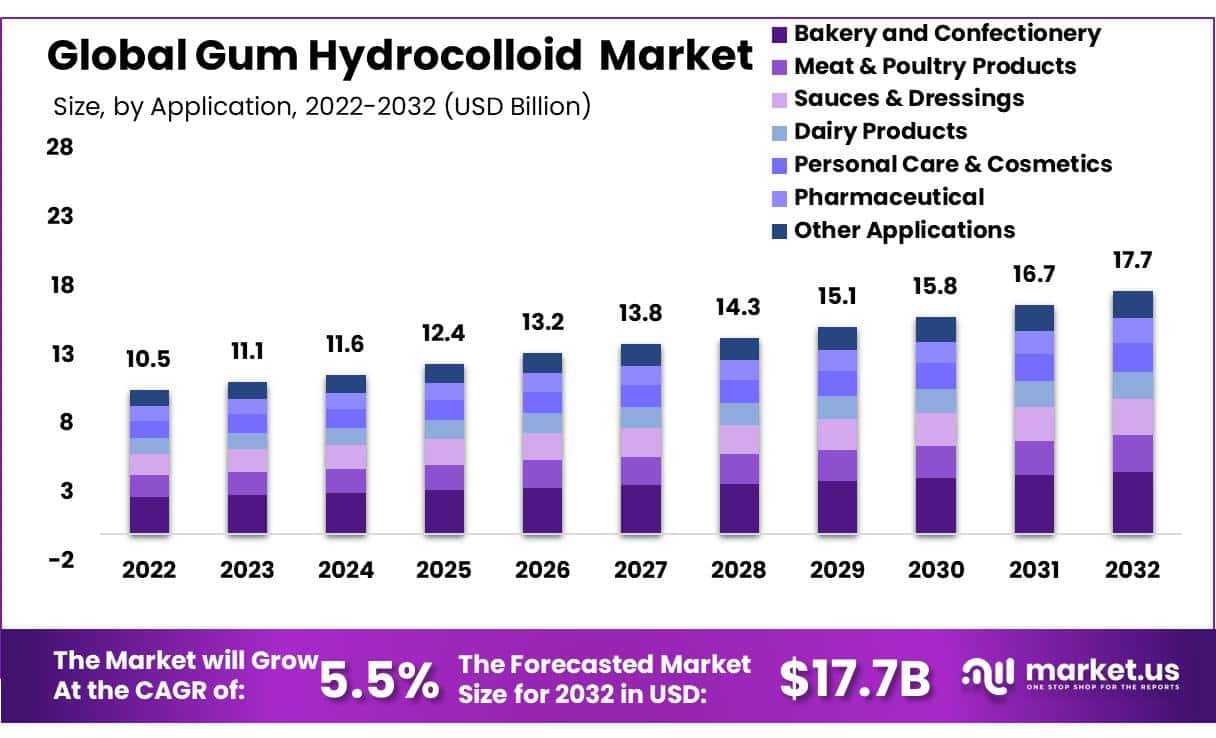
Actual Numbers Might Vary in the Final Report.
Key Takeaways
- Market Growth: The global gum hydrocolloid market is experiencing sustained expansion with an expected Compound Annual Growth Rate of 5.5% from 2023-2032.
- Overview: Gum hydrocolloids are essential ingredients in multiple industries due to their thickening, stabilizing, and gelling capabilities. Gum hydrocolloids play an integral part in food, pharmaceuticals, personal care, and other sectors by offering functional benefits while simultaneously improving product quality.
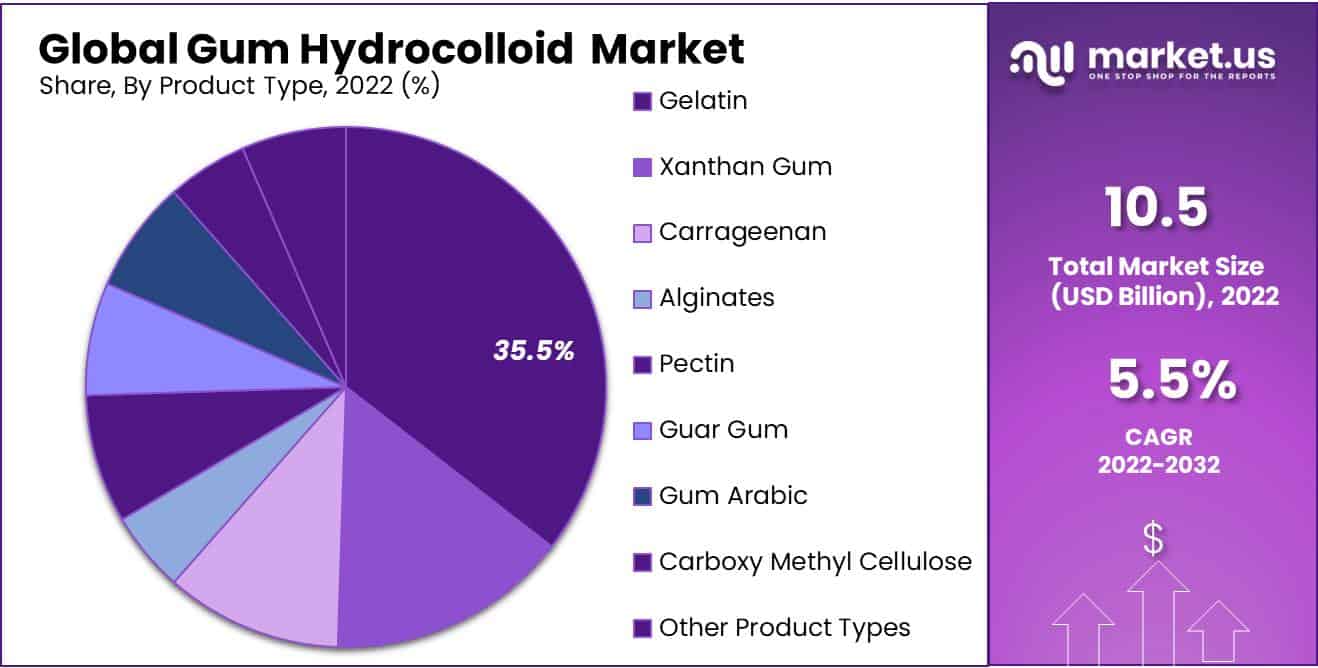
- By Product Type Analysis: According to product types, the gum hydrocolloid market can be divided into gelatin, xanthan gum, carrageenan, alginates, pectin guar gum arabic carboxymethylcellulose as well as other variants. The gelatin segment held the majority of the market share at 35.53% in 2022.
- By Source Analysis: Animal-derived gum hydrocolloid products have unique functional advantages that drive their market expansion; plant-derived options have recently begun making headway.
- Functionality: Stabilizing functionality remains a top choice among gum hydrocolloids worldwide due to its extensive role in maintaining product stability and quality.
- Key Drivers of Gum Hydrocolloid Market: Key drivers of the gum hydrocolloid market include increased consumer interest in convenience foods, rising health awareness among the general population, and expansion in the food industry around the globe. Gum hydrocolloids contribute to product innovation and quality improvement thus driving market expansion.
- Restraints: Market players face numerous challenges related to price fluctuations of raw materials as well as regulations covering their use in various applications; adhering to such laws poses a potential barrier to market expansion.
- Opportunities: The gum hydrocolloid market lies in creating innovative hydrocolloid blends to meet specific industry requirements while expanding applications within the pharmaceutical and personal care products sectors.
- Trends: Current Trends in Gum Hydrocolloid Market: Current trends in the gum hydrocolloid market include an emphasis on natural and clean label products, sustainable raw material sourcing practices, and advances in hydrocolloid production technology.
- Regional Analysis: North America held a 35.6% revenue share in 2022 due to its advanced food processing industry, robust research and development activities, and rising consumer awareness about additives and ingredients used in food.
- Key Players: Gum Hydrocolloid Market: Established Companies and Innovative Startups The gum hydrocolloid market features both established companies as well as innovative startups, with key players investing heavily in R&D, forging strategic alliances, and employing sustainable practices in order to remain competitive while meeting ever-evolving market needs. Establishing trust among their consumers as well as assuring product efficacy are the cornerstones of success within such an ever-evolving environment.
Driving Factors
Increasing Demand for Gum Hydrocolloids in Food, Pharma, and Personal Care Industries Driving the Growth of Global Gum Hydrocolloid Market
The global gum hydrocolloid market is growing due to various factors. One of the key factors is an increasing demand from the food and beverage industry, leading to an increased need for gum hydrocolloids sourced from plants and seaweeds.
These hydrocolloids are vital for enhancing the texture and stability of various foods. Consumer awareness about health and wellness has driven manufacturers to create healthier products with less fat and better texture.
Gum hydrocolloids are vital in achieving these aims, enhancing the feel and quality of low-fat and reduced-sugar items. Additionally, gum hydrocolloids have found a place in the growth of the pharmaceutical and personal care sectors. Their unique properties, such as controlled release and stability, make them valuable for pharmaceutical formulations, wound dressings, and personal care products, propelling their use beyond the food industry.
Restraining Factors
Raw Material Availability and Regulatory Compliances Posing Challenges to the Market Growth
The gum hydrocolloid market faces several challenges that can affect its growth. One major concern is the limited availability of raw materials such as guar gum, locust bean gum, and xanthan gum. The production and availability of these raw materials can be affected by factors such as climate conditions, crop diseases, and geopolitical tensions, leading to supply chain disruptions.
Additionally, the prices of these raw materials can be highly volatile. These hydrocolloids are widely used in various food and pharmaceutical products, making compliance with regulations essential. Non-compliance can result in product recalls, legal actions, and damage to brand reputation. Moreover, limited consumer awareness about the benefits and applications of gum hydrocolloids can hinder their adoption in the market.
Market Scope
By Product Type Analysis
The Gelatin Segment Held The Largest Market Share in 2022
Based on product type, the market for gum hydrocolloid is segmented into gelatin, xanthan gum, carrageenan, alginates, pectin, guar gum, gum arabic, carboxymethylcellulose, and other product types. Among these, the gelatin segment held the largest market share of 35.5% in 2022.
Gelatin is crucial in producing various pharmaceutical products and is commonly used in wound dressings, blood volume substitutes, and homeostatic sponges. It also finds its application in the food industry due to its gelling, thickening, and stabilizing properties.
This versatility has led to widespread use in the pharmaceutical and food sectors. Xanthan gum is extensively used as a thickening and stabilizing agent in the food and beverage industry. It is valuable in products such as sauces, dressings, and dairy alternatives. Similarly, Pectin, naturally found in fruits, is a gelling agent for jams, jellies, and confectioneries in the food industry. The gum hydrocolloid market offers a variety of product types, each catering to different industries and contributing to its growth and application in various sectors.
By Source Analysis
Distinct Functional Advantages Propel the Animal-Based Segment, While the Plant-Based Segment Gains Popularity in the Global Gum Hydrocolloid Market
By source, the market for gum hydrocolloids is divided into plant-based, microbial-based, animal-based, and synthetic. The animal-based segment held a significant share of the global gum hydrocolloid market in 2022. Animal-based hydrocolloids possess distinct functional properties that other sources do not easily replicate. For instance, gelatin derived from animal collagen provides exceptional gelling, emulsifying, and stabilizing properties in a wide range of food products.
These unique functionalities contribute to the texture, mouthfeel, and overall quality of food items. In 2022, the plant-based segment accounted for the second-largest market share. Plant-based gum hydrocolloids are derived from botanical sources, making them more appealing to consumers who prefer natural and sustainable ingredients. As consumer awareness of health and environmental concerns grows, rising demand for products that align with these values increases.
By Functionality
The Stabilizing Functionality Is The Most Dominant Segment For Gum Hydrocolloids Globally Due To Its Extensive Application In Maintaining Product Stability And Quality
Based on functionality, the market for gum hydrocolloids is further segmented into thickening, stabilizing, gelling, emulsifying, and other functionalities. Among these, the stabilizing functionality segment was dominant globally in 2022. Stabilizers are crucial additives used in a wide range of industries, including food, pharmaceuticals, and cosmetics, to maintain the stability and consistency of products by preventing separation or unwanted reactions.
This functionality finds extensive application in products such as sauces, dressings, dairy products, and beverages, where maintaining a uniform texture and preventing phase separation is essential for consumer appeal and product quality. The thickening function segment accounted for the second-largest revenue share in 2022. Thickening agents increase the viscosity and texture of products, giving them a desirable mouthfeel and appearance.
This functionality is commonly utilized in soups, gravies, desserts, and personal care items such as shampoos and lotions. Thickening helps achieve the desired texture and consistency that consumers expect from these products. While other functionalities, such as gelling and emulsifying, also play significant roles in various applications, the ubiquity and versatility of thickening properties make it the predominant choice in global demand and usage.
By Application
The Bakery and Confectionery Segment holds a Significant Revenue Share in the Gum Hydrocolloids Market due To Properties such as Elevating The Texture, Stability, And Shelf Life Of Baked Goods And Confectionery Products.
Based on the application, the market for gum hydrocolloids is further divided into bakery and confectionery, meat & poultry products, sauces & dressings, dairy products, personal care & cosmetics, pharmaceuticals, and other applications.
Among these, the bakery and confectionery segment dominated the market in 2022 with a revenue share of 25.7% due to the versatile properties of gum hydrocolloids in enhancing texture, stability, and shelf life in baked goods and confectionery products.
Gum hydrocolloids, such as xanthan gum, guar gum, and locust bean gum, are commonly used to improve dough consistency, moisture retention, and overall product quality. Following bakery and confectionery, the dairy products segment is the second most used application for gum hydrocolloids.
These hydrocolloids find applications in dairy products such as yogurts, ice creams, and cream-based products to enhance their texture, viscosity, and stability. Using gum hydrocolloids in dairy helps prevent liquid separation from a gel and ensures a smooth mouthfeel in these products.
Key Market Segments
Based on Product Type
- Gelatin
- Xanthan Gum
- Carrageenan
- Alginates
- Pectin
- Guar Gum
- Gum Arabic
- Carboxy Methyl Cellulose
- Other Product Types
Based on Source
- Plant-Based
- Microbial-Based
- Animal-Based
- Synthetic
Based on Functionality
- Thickening
- Stabilizing
- Gelling
- Emulsifying
- Other Functionalities
Based on Application
- Bakery and Confectionery
- Meat & Poultry Products
- Sauces & Dressings
- Dairy Products
- Personal Care & Cosmetics
- Pharmaceutical
- Other Applications
Growth Opportunities
Rising Demand Demand from Food, Pharmaceutical, and Personal Care Industries PresentsLucrative Avenues for Expansion in the Gum Hydrocolloids Market
The rising demand for gum hydrocolloids across various industries, evolving consumer preferences, and technological advancements have created a favorable environment for expansion and innovation. One of the key opportunities for growth lies within the food and beverage sector. Gum hydrocolloids find extensive uses as thicking, stabilizing, and gelling agents in various products, ranging from dairy to confectionery, sauces, and dressings.
Consumer preference for natural and functional food components drives greater demand for plant-sourced gum hydrocolloids such as guar gum, locust bean gum, and xanthan gum.
The pharmaceutical and personal care industries are also tapping into the advantages offered by gum hydrocolloids. Their gelling, emulsification, and thickening capacities add to formulations, including creams, lotions, and oral medications. As these industries expand, a corresponding rise in the demand for gum hydrocolloids is anticipated.
The APAC region emerges as a focal point for significant growth in the gum hydrocolloid market. Rapid urbanization, changing dietary habits, and a growing middle-class population in countries such as China and India are driving the demand for processed foods, which, in turn, fuels the need for gum hydrocolloids.
Latest Trends
Rising Consumer Awareness and Government Support for Sustainability
Consumers are increasingly looking for products with natural and clean-label ingredients. This trend has influenced the Gum Hydrocolloid Market, with manufacturers incorporating more plant-based and sustainably sourced hydrocolloids in their formulations. This aligns with the growing demand for products that are perceived as healthier and more environmentally friendly.
Gum hydrocolloids’ ability to enhance texture, stability, and mouthfeel has led to increased use in functional foods and dietary supplements. Hydrocolloids are also being explored for their potential health benefits, like digestive health and weight management. Gum hydrocolloids improve the texture and mouthfeel of products, contributing to a better sensory experience.
Hydrocolloids are integral to creating desirable product characteristics, from creamy textures in dairy alternatives to improved juiciness in meat substitutes. The rise of plant-based and vegan diets has prompted manufacturers to seek alternatives to animal-derived ingredients. Gum hydrocolloids, often plant-based in origin, are increasingly used in creating vegan and vegetarian products. They help mimic the textures and functionalities of traditional animal-derived ingredients.
Regional Analysis
North America is Dominant Region in the Global Gum Hydrocolloid Market
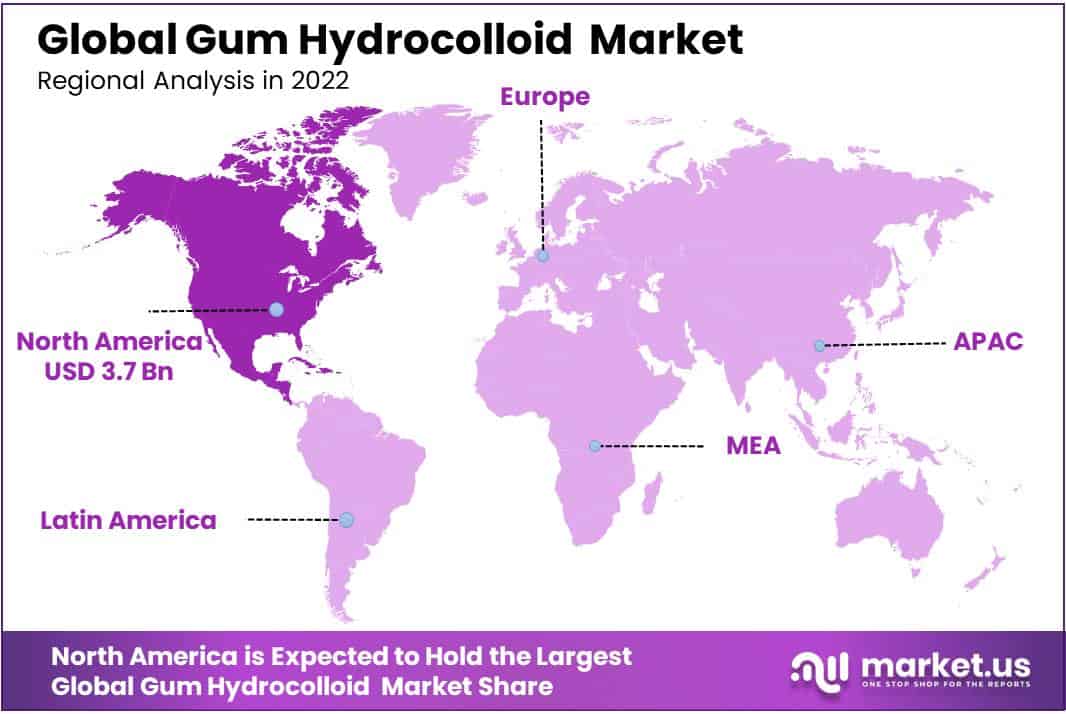
In 2022, North America held a revenue share of 35.6% of the global market due to its developed food processing industry, extensive research and development activities, and high consumer awareness regarding food additives and ingredients.
The region’s advanced processing techniques and growing demand for convenience foods contributed to the prominence of hydrocolloids in the market. In 2022 the APAC region had the second-largest revenue share in the hydrocolloids market.
The region’s large population and changing dietary habits led to increased consumption of processed and convenience foods. The rise of the middle class and urbanization also contributed to the demand for premium and innovative food products, where hydrocolloids play a crucial role in achieving desired texture and stability.
Key Regions and Countries
- North America
- The US
- Canada
- Europe
- Germany
- France
- The UK
- Spain
- Italy
- Russia & CIS
- Rest of Europe
- APAC
- China
- Japan
- South Korea
- India
- ASEAN
- Rest of APAC
- Latin America
- Brazil
- Mexico
- Rest of Latin America
- Middle East & Africa
- GCC
- South Africa
- Rest of MEA
Key Players Analysis
A range of influential players shapes the global hydrocolloids market. These include CP Kelco ApS, Danisco A/S, Cargill, Incorporated, Ingredion Incorporated, Tate & Lyle PLC, Kerry Group, Ashland Inc., FMC Corporation, Royal DSM, Rousselot, and Alland & Robert. Their contributions span innovation, quality solutions, agricultural expertise, and a commitment to advancement. Alongside these major participants, various other players contribute meaningfully to the market’s development.
Market Key Players
- CP Kelco ApS
- Danisco A/S
- Cargill, Incorporated
- Ingredion Incorporated
- Tate & Lyle PLC
- Kerry Group
- Ashland Inc.
- FMC Corporation
- Royal DSM
- Rousselot
- Alland & Robert
- Other Key Players
Recent Developments
- In Jan 2023, French ingredients company Alland & Robert launched a timely ingredient using acacia gum. Syndeo Gelling provides an innovative and multifunctional solution that brings stabilizing, gelling, thickening, binding and texturing properties and mouthfeel improvement to plant-based formulations.
- In March 202, Nexira acquired Unipektin Ingredients AG, a Swiss company that offers hydrocolloids and other ingredients. The acquisition adds to Nexira’s presence in the market segments of plant-based alternatives, dairy alternatives, and meat substitutes, according to Nexira. Terms of the transaction were not disclosed.









